


TL;DR
Stop-limit orders combine stop and limit order triggers. Stop-limit orders allow traders to set a minimum amount of profit they are willing to take or a maximum amount they can accept if they run out/lose a trade. After setting a stop-limit order and the trigger price is reached, the limit order will be placed automatically even if you exit or go offline. You place stop-limit orders strategically by considering resistance and support levels and asset volatility.
In a stop-limit order, the stop price is the trigger price for the exchange to place a limit order. The limit price is the price that will be used to place an order. You can adjust the limit price which is usually set higher than the stop price for a buy order and lower for a sell order. This difference accommodates changes in market price between when the stop price is triggered and the limit order is placed.
Introduction
If you want to start actively trading instead of HODLing, you will likely use more than market orders. Stop-limit orders provide more control and customization. The concept can be quite confusing for beginners, so let's discuss the main differences between limit, stop-loss, and stop-limit orders first.

Limit order vs. stop-loss order vs. stop-limit order
Limit orders, stop-loss orders, and stop-limit orders are some of the most common types of orders. Limit orders allow you to set a desired price range for trading, stop-loss orders set the stop price that triggers a market order, and stop-limit orders combine aspects of both. Let's dive into it further:
Limit order
When setting a limit order, you choose the maximum buy price or minimum sell price. The exchange will try to fulfill the limit order automatically when the market price reaches or is better than your limit price. This order is useful when you have a target entry or exit price and don't mind waiting until the market meets your requirements.
Typically, traders place sell limit orders above the current market price and buy limit orders below the current market price. If you place a limit order at the current market price, it will likely be executed within a few seconds (unless it is a market with low liquidity).
For example, if the market price of Bitcoin is $32,000 (BUSD), you can place a buy limit order for $31,000 to buy BTC as soon as the price reaches $31,000 or lower. You can also place a sell limit order at $33,000. This means that the exchange will sell your BTC if the price reaches $33,000 or higher.
Stop-limit order
As mentioned, stop-limit orders combine stop and limit order triggers. Stop orders add a trigger price for the exchange to place a limit order. Let's see how it works.
How do stop-limit orders work?
The best way to understand stop-limit orders is to break them down into parts. The stop price functions as a trigger for placing a limit order. When it reaches the stop price, the market will create a limit order with a special price (limit price).
Although stop and limit prices can be the same, this is not mandatory. In fact, it would be safer if you set the stop price (trigger price) slightly higher than the limit price for sell orders. For buy orders, you can set the stop price slightly lower than the limit price. This increases the chances of a limit order being filled once it is triggered.
Examples of buy and sell stop-limit orders
Stop-limit buy
Imagine BNB is at $300 (BUSD) and you want to buy when the price starts to enter a bullish trend. However, you don't want to pay too much for that BNB if the price starts to rise quickly. So you need to limit the price you are willing to pay.
For example, technical analysis tells that an uptrend could begin if the market breaks above $310. You decide to use a stop-limit buy order to open a position in the event of a breakout. You set the stop price at $310 and the limit price at $315. As soon as BNB reaches $310, a limit order to buy BNB at $315 will be placed. Your order may be filled at $315 or lower. Note that $315 is your limit price, so if the market rises too quickly above it, your order may not be completely filled.
Selling stop-limit
Imagine you bought BNB at $285 (BUSD) and it is now at $300. To prevent losses, you decide to use a stop-limit order to sell BNB if the price falls back to the entry price. You set a stop-limit sell order with a stop price of $289 and a limit price of $285 (the price when buying BNB). If the price reaches $289, a limit order to sell BNB at $285 will be placed. Your order may be filled at $285 or higher.
How to place a stop-limit order on Binance?
Let's say you just bought five BTC at $31,820.50 (BUSD) because you believe that the price will start rising soon.
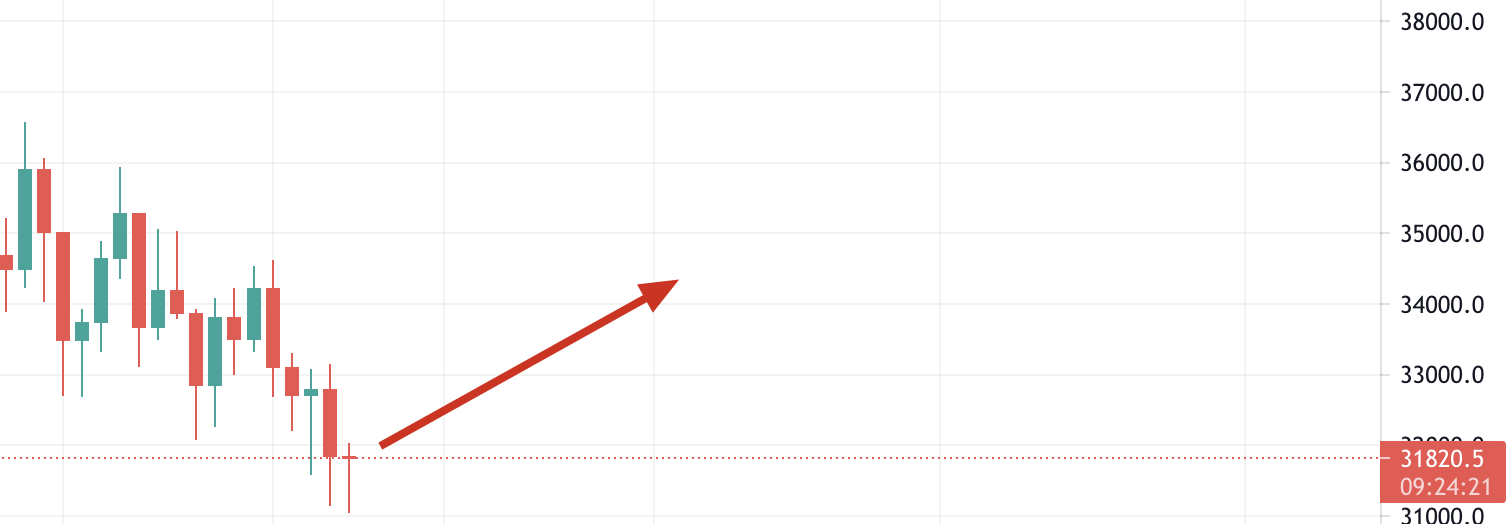
In this situation, you should set a stop-limit sell order to eliminate losses if your assumptions are wrong and the price starts to fall. To do this, log in to your Binance account and go to the BTC/BUSD market. Then, click the [Stop-limit] tab then set the stop and limit prices along with the amount of BTC to be sold.
If you believe that $31,820 is a reliable support level, you can set a stop-limit order slightly below this price (in case the price falls). In this example, we will place a stop-limit order for 5 BTC with a stop price of $31,790 and a limit price of $31,700. Let's explore it step by step.
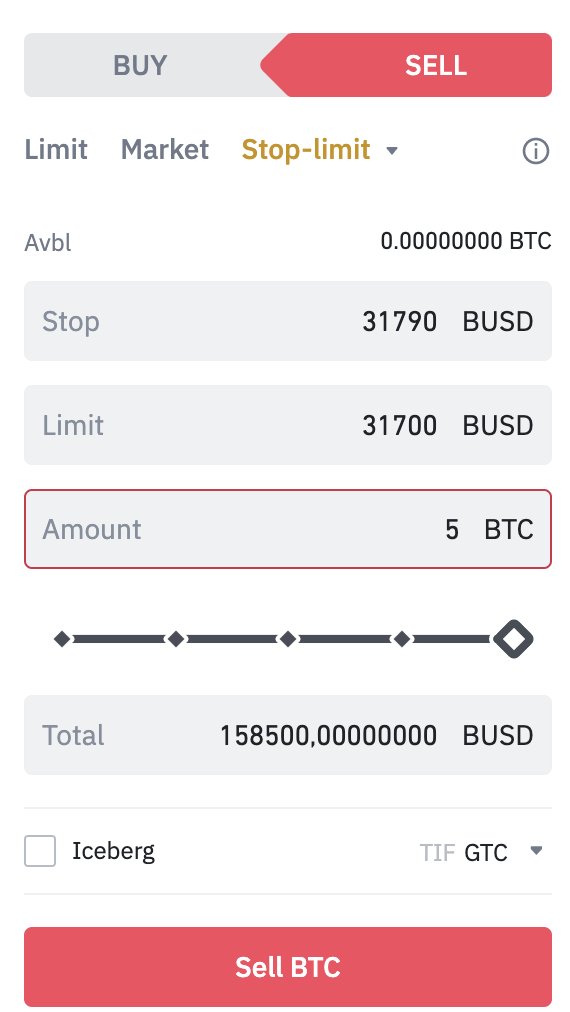
When clicking [Sell BTC], a confirmation window will appear. Make sure that everything is correct, then press [Place Order] to confirm. After placing a stop-limit order, you will see a confirmation message. You can also scroll down to view and manage open orders.

Note that stop-limit orders will only be executed if and when the stop price is reached. This means that the limit order will only be filled if the market price reaches the limit price or better. If the limit order is triggered (by the stop price) but the market price does not reach or is better than the set price, then the limit order will remain open.
Sometimes, you may be in a situation where the price falls too quickly and the stop-limit order is passed without being filled. In this case, you may need to switch to a market order to exit the trade quickly.
Advantages of using stop-limit orders
Stop-limit orders allow you to adjust and plan your trades. We can't always check prices, especially in the 24/7 crypto market. Another advantage is that stop-limit orders allow you to set an appropriate amount for the profit you want to take. Without a limit, your order will be filled at the market price regardless of size. Some traders prefer to keep rather than sell under any circumstances.
Disadvantages of using stop-limit orders
Stop-limit orders have the same disadvantages as limit orders, primarily because there is no guarantee that the order will be executed. Limit orders will only start to be filled when they reach the specified price or better. However, that price may never be reached. Although you can create a gap between the limit and stop prices, the gap may sometimes not be enough. Highly volatile assets can exceed the spread you set in the order.
Liquidity can also be an issue if there are not enough takers to fill your orders. If you're worried about orders only being partially filled, consider using fill or kill. This option specifies that your order will only be executed if it is fully fulfilled. However, note that the more conditions you add, the more difficult the order will be to execute.
Strategy for placing stop-limit orders
After learning about stop-limit orders, what is the best way to use them? Here are some basic trading strategies to increase the effectiveness of stop-limit orders and avoid some of their drawbacks.
1. Study the volatility of the selected asset to place a stop-limit order. We have suggested setting a small spread between stop orders and limit orders to increase the chances of the limit order being filled. However, if the asset being traded is volatile, you may need to set the spread slightly larger.
2. Think about the liquidity of the traded asset. Stop-limit orders are especially useful when trading assets with large bid-ask spreads or low liquidity (to avoid undesirable pricing caused by slippage).
3. Use technical analysis to determine price levels. Setting the stop price at a support or resistance level is a good idea. One way to determine these levels is through technical analysis. For example, you can use a buy stop-limit order with a stop price slightly below a critical resistance level to take advantage of the breakout. Or, a stop-limit sell order slightly below the support level to ensure you exit before the market falls any further.
If you are unsure about the definition of support and resistance levels, read the Basics of Support and Resistance Explained.

Closing
Stop-limit orders are a powerful tool that can provide more trading capabilities than market orders. There is also the added benefit of not needing to trade actively for an order to be completed. By combining multiple stop-limit orders, you can easily manage your crypto holdings when prices fall or rise.