

Chapter
Cryptocurrency 101
How does blockchain work?
How to invest in cryptocurrency?
Questions about cryptocurrencies
Bab 1 - Cryptocurrency 101
List of contents
What are cryptocurrencies?
What makes cryptocurrency unique?
Why is it called cryptocurrency?
What is public-key cryptography?
Who invented cryptocurrency?
What is the difference between cryptocurrencies and tokens?
What is a crypto wallet?
What are cryptocurrencies?
Cryptocurrency (or “crypto”) is digital money that allows anyone to send value in the digital world.
Maybe you're wondering how this system is different from Paypal or other digital banking apps on your phone. Of course, they all provide seemingly the same services and benefits – sending money to a friend, buying from your favorite website – however, they are very different.
What makes cryptocurrency unique?
Cryptocurrencies are unique for several reasons. However, the most important thing is to look at its function, offering services as an electronic money system that is not owned by one party.
A good cryptocurrency is decentralized. No central bank or group of users can change the rules without reaching consensus. Network participants (nodes) run software that connects them with other participants so they can share information among themselves.
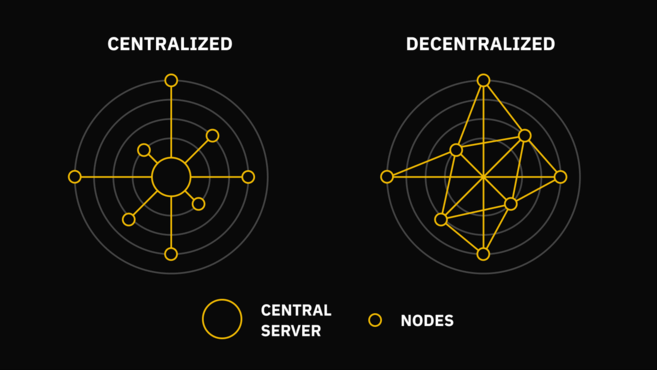
Centralized vs. centralized networks decentralized.
On the left is a system like that used by banks. Users must communicate through a central server. On the right, there is no hierarchy: nodes are interconnected and convey information between them.
The decentralization of cryptocurrency networks means they cannot be shut down or censored. In contrast, to take down a centralized network, you only need to damage the main server. If a bank deletes its database and has no backup, it will be very difficult to determine a user's balance.
In cryptocurrencies, nodes store a copy of the database. Each acts as its own server. If one node is offline, its peers will still be able to get information from other nodes.
Cryptocurrencies function 24 hours a day, 365 days a year. Can transfer value anywhere in the world without interference from intermediaries. This is why we often call it permissionless: anyone with an Internet connection can send funds.
Why is it called cryptocurrency?
The term "cryptocurrency" comes from the words cryptography or cryptography, and currency or currency. This is because cryptocurrencies use many cryptographic techniques to secure transactions between users.
What is public-key cryptography?
Public-key cryptography underlies cryptocurrency networks. This is what users rely on to send and receive funds.
In a public-key cryptography scheme, you have a public key and a private key. A private key is basically a collection of a large number of numbers that is impossible for anyone to guess.
For Bitcoin, guessing the private key is the same as correctly guessing the outcome of 256 coin tosses. With today's computers, you can't even crack someone's private key until the end of the world.
However, as the name suggests, you need to keep your private key secret. From this key, you can generate a public key. Public keys can be safely given to anyone. It is absolutely impossible to reverse engineer the public key to obtain your private key.
You can also create a digital signature by signing data with your private key. This is analogous to signing a document in the real world. The main difference is that anyone can know for sure whether the signature is valid by comparing it to a matching public key. This way, users don't have to reveal their private keys, but can still prove ownership.
In cryptocurrencies, you can only spend funds if you have the corresponding private key. When making a transaction, you announce to the network that you want to move currency. Announcements in the form of messages (transactions), which are signed and added to the cryptocurrency database (blockchain). As mentioned previously, you need a private key to create a digital signature. And because anyone can view the database, anyone can prove whether your transactions are valid by checking the signature.
Who invented cryptocurrency?
Over the years, there have been several attempts to present digital money schemes, but the first cryptocurrency was Bitcoin, which was released in 2009. It was created by a person or group of people using the pseudonym Satoshi Nakamoto. To this day, his true identity remains unknown.
Bitcoin gave birth to a large number of subsequent cryptocurrencies – some aiming to compete, and others to integrate features not available in Bitcoin. Today, many blockchains not only serve to send and receive funds, but also to run decentralized applications using smart contracts. Ethereum is perhaps the most popular example of this type of blockchain.
What is the difference between cryptocurrencies and tokens?
At first glance, cryptocurrencies and tokens appear identical. Both are traded on exchanges and can be sent to and from blockchain addresses.
Cryptocurrencies function exclusively as money, either as a medium of exchange, a store of value, or both. Each unit is fungible, meaning that one coin is worth the same as another.
Bitcoin and other early cryptocurrencies were designed as currencies, but later blockchains sought to continue to innovate. Ethereum, for example, not only provides functionality as a currency, but also allows developers to run code (smart contracts) on a distributed network, and create tokens for various decentralized applications.
Tokens can be used like cryptocurrencies, but are more flexible. You can mint millions of identical tokens, or just a few with unique properties. These tokens can serve as anything, from digital receipts representing a stake in a company to loyalty points.
In protocols with smart contracts, the base currency (used to pay for transactions or applications) is separate from the token. In Ethereum, for example, the native currency is ether (ETH), and this currency must be used to create and transfer tokens within the Ethereum network. These tokens are implemented according to standards such as ERC-20 or ERC-721.
What is a crypto wallet?
Basically, a cryptocurrency wallet is a means of storing your private keys. It can be a specially made device (hardware wallet), an application on your PC or smartphone, or even just a piece of paper.
Wallets are the interface that most users rely on to interact with cryptocurrency networks. Various wallets will offer different types of functionality – obviously, paper wallets cannot sign transactions or display current prices in fiat currency.
In terms of convenience, wallet software (such as Trust Wallet) is considered superior in everyday payments. From a security perspective, hardware wallets are almost unmatched in their ability to protect private keys from all kinds of threats. Cryptocurrency users tend to store funds in both types of wallets.
Chapter 2 - How does blockchain work?
List of contents
What is blockchain?
How are blocks added to the blockchain?
How does crypto mining work?
Can scalability be applied to cryptocurrencies?
Who makes decisions in cryptocurrency software?
What is blockchain?
Blockchain is a special type of database where data can only be added (cannot be deleted or changed). Transactions are periodically added to the blockchain in what we call blocks (consisting of transaction information and other important metadata).
We call the structure a chain because the metadata in each block includes a piece of information that links it to the previous block. More specifically, the data contains the hash of the previous block, which you can think of like a unique digital fingerprint.
The probability of two pieces of data giving you the same output from a hash function is very low. Therefore, if someone tries to modify an old block, its hash will be different, which means that the hash of the next block will also be different, and so on. Thus, obviously, if a block is changed, then all the blocks that come after it will also change.

Each hash in one block is included in the next block. Forming a block chain (chain of blocks), or blockchain.
The blockchain is downloaded completely by network participants. Remember when we discussed that anyone can validate transactions and signatures with public-key cryptography? When a node receives a block, it performs a number of checks. If any are invalid, the block is rejected.
When a node receives a valid block, it makes its own copy and then passes the block to other nodes. Everyone does the same thing until the block spreads throughout the network. This process is also carried out for unconfirmed transactions – that is, transactions that have been broadcast, but have not yet been entered into the blockchain.
See also: What is Blockchain Technology? An Essential Guide.
How are blocks added to the blockchain?
The integrity of the blockchain is damaged if incorrect financial information is recorded. At the same time, there is no administrator or leader in a distributed system managing the ledger – so how do we ensure that participants act honestly?
Satoshi proposed a Proof of Work system, which would allow anyone to suggest blocks to be added to the blockchain. To submit a block, users must sacrifice computing power to guess the challenges set by the protocol.
Proof of Work is the proven and most tested scheme for achieving consensus among users, but by no means the only one. Other alternatives such as Proof of Stake are also being explored, although their form of implementation is not yet known (additionally, hybrid consensus mechanisms have been around for some time).
See also: What is a Blockchain Consensus Algorithm?
How does crypto mining work?

The process described above is known as mining. If miners find a solution, the blocks they build will extend the chain. As a result, they will receive rewards in the native currency of the blockchain in question.
Cryptographic miners must complete their work by hashing data repeatedly to produce numbers that are below a certain value. Hashing with a one-way function means that even if the output is available, it is almost impossible to guess the input. However if the input is available, it is very easy to verify the output. Thus, each participant can verify that miners have generated the ‘correct’ blocks, and reject invalid ones. In this case, the miner will not receive the reward, instead having wasted resources by trying to forge blocks with invalid ones.
It is an interesting game theory that the party who tries to cheat will pay a high price, while the party who acts honestly will make a profit. No malicious party has unlimited resources to attack a powerful network. Therefore, we can ensure that those with the resources will gain a return on investment if they participate properly.
See also: What Is Cryptocurrency Mining?
Can scalability be applied to cryptocurrencies?
As you probably know, distributed networks are somewhat less efficient. Unfortunately, cryptocurrencies can only be secure and censorship-resistant if all nodes synchronize a copy of the blockchain. The lower the requirements for joining, the easier it is for people to join.
You can see why a blockchain that only adds small blocks every ten minutes is preferable to a blockchain that adds large blocks every five minutes. The second option would require the node to run high-powered computers to stay in sync, and shut down lower-powered computers. This will result in greater centralization, as there are fewer peers in the network.
However, with smaller blocks, we cannot achieve as many transactions per second (TPS). Also means that, during peak hours, transactions will take a while to be added to the blockchain. Obviously inconvenient if you want to make fast payments, but this is the price to pay to achieve decentralization.
We call this problem the scalability dilemma. A system that has good scalability is a system that is easy to adapt to increase throughput with minimal losses. Blockchains do not have good scalability – as explained earlier, increasing throughput with larger blocks would undermine the entire mission of a distributed network.
To improve TPS without harming network decentralization, off-chain scalability appears to be a viable approach. It includes a variety of solutions – centralized and decentralized – that allow transactions to be carried out without being entered into the blockchain.
Learn more about some examples of off-chain scalability: Blockchain Scalability: Sidechains and Payment Channels.
Who makes decisions in cryptocurrency software?
Cryptocurrency networks are opt-in. Nobody forces you to run software you don't want. In a good protocol, the code will be completely open-sourced so that users can ensure the fairness and security of the system.
In general, cryptocurrencies allow anyone to participate in development. New features or code edits are vetted by the developer community before being approved and published. From there, users can review the code themselves and choose whether or not to run it.
Some updates will be backward-compatible, meaning the updated nodes will still communicate with the old ones. While others are not backward-compatible – old nodes will be “thrown out” of the network unless updated. See Hard Fork and Soft Fork for a more detailed explanation.
Chapter 3 - How to invest in cryptocurrencies?
List of contents
Which cryptocurrency should you buy?
What do you need to learn before investing in cryptocurrency?
Where to buy cryptocurrency
Centralized exchange (CEX)
Decentralized exchange (DEX)
P2P Exchange
How to buy cryptocurrency
How to buy cryptocurrency on Binance
How to buy cryptocurrency on Binance DEX
How to buy cryptocurrency on Binance P2P
Which cryptocurrency should you buy?
Only you can make this choice – you have to do your own research, Do Your Own Research (DYOR), and also decide based on your own analysis. There are so many tools available that can help you make better decisions. For example, Binance Research provides excellent insights & offers analysis of the market, as well as comprehensive reports on individual projects.
If you want to be able to judge which cryptocurrency to buy, it is very important that you first understand how Bitcoin works. The good news is, this is why we wrote the guide What is Bitcoin? for you!
What do you need to learn before investing in cryptocurrency?
Where should we start? There are so many ways to analyze financial markets, and generally, most professional investors will use a variety of very different strategies. However, at a high level, there are two main schools of thought for evaluating investments: fundamental analysis (FA) and technical analysis (TA).
Fundamental analysis is a method for assessing assets primarily based on economic and financial factors. Analysts who use this method observe macro and micro economic factors, industry conditions, or the underlying business of the asset (if any). In the case of cryptocurrencies, this method also looks at public blockchain data, which is sometimes referred to as on-chain metrics.
This is done by observing the number of transactions, addresses, top holders, network hash rate, and many other information. This analysis aims to make an asset valuation and compare it with the current valuation. Ultimately, this approach aims to determine whether an asset is currently undervalued or overvalued.
With all that we've discussed, it's important to remember that cryptocurrencies are a new and still developing asset class. Fundamental analysis is not perfect, there are still many weaknesses in determining valuation. Simply put, there is no standard framework for determining the valuation of cryptocurrencies, most existing models simply cannot be trusted. The success or failure of a cryptocurrency project depends on many different factors, which cannot be explained by current frameworks.
Technical analysts take a different approach. Unlike fundamental analysts, technical analysts do not try to determine the intrinsic value of an asset. Instead, evaluate trading and investment opportunities based on historical trading activity. This is done by focusing on price movements, chart patterns, indicators, and various other graphic tools to evaluate the strength or weakness of the market. In essence, technical analysts believe that the past price movements of an asset can be used to predict future price movements.
Because technical analysis can be applied to any market with historical data, this approach is widely used by cryptocurrency traders.
So which one should you learn? Well, why not both? Most market analysis tools work best when combined with other tools. Whichever you choose, it is important to understand financial risk and risk management, and never invest more than you can afford to lose.
Where to buy cryptocurrency
There are various ways to buy cryptocurrency. However, the first thing you need to do is convert your fiat currency into cryptocurrency. Then, you can choose to HODL it, trade it for other crypto assets, or lend it to earn interest. Let's take a look at the different types of cryptocurrency exchanges.
Centralized exchange (CEX)
You may find the concept of centralized exchanges a bit confusing because cryptocurrencies are often said to be decentralized. In short, a centralized exchange is an online platform that facilitates trading by connecting buyers and sellers.
The way it works is that users deposit fiat money or cryptocurrency into an exchange and trade within its internal system. If you are familiar with how cryptocurrency wallets work, you will know that, in this case, your crypto assets are held by the exchange. But it should be easy enough to withdraw your funds from the exchange and store them in your own wallet, if you wish.
Some people may prefer to keep funds on an exchange, either because they trade regularly or for convenience. However, if an exchange is hacked, user funds may be at risk.
Decentralized exchange (DEX)
Decentralized exchanges are a bit different. When you use DEX, there is no custodian involved. In fact, a more accurate term to refer to this type of exchange is non-custodial exchange.
This is what happens when you trade on DEX. Instead of depositing funds into an exchange's wallet, you trade directly from your own wallet. When a trade is executed, funds are transferred directly on the blockchain using the magic of smart contracts.
Since there is no entity acting as a custodian, some consider it a safer option when compared to CEX. Another positive is that most DEXs do not require you to provide any personal information other than your blockchain wallet address. However, at the same time, storing your own funds requires a certain amount of technical expertise, and security is entirely your own responsibility.
P2P Exchange
Peer-to-peer (P2P) exchanges are also places that connect buyers and sellers, but they are slightly different from CEXs and DEXs. In this case, the exchange itself is nothing more than a link between buyers and sellers, and buyers - sellers can complete transactions in any way they agree. So, deposit and settlement methods can be decided by the buyer and seller in each transaction.
How to buy cryptocurrency
How to buy cryptocurrency on Binance
Log in to Binance, or register if you don't have an account yet.
Please go to the Buy and Sell Cryptocurrency page.
Select the crypto asset you want to buy, and the currency you want to pay with.
Select a payment method.
If prompted, enter your card details, and complete identity verification.
Just that! Crypto assets will be credited to your Binance account.
How to buy cryptocurrency on Binance DEX
Using DEX is a bit more complicated than the other options available.
Here's what you need before you start:
Wallet that can connect to Binance DEX (we recommend Trust Wallet).
A certain amount of BNB to pay transaction fees.
If everything is ready, follow all the detailed instructions in our Binance DEX guide:
Binance DEX: Interface Guide
Binance DEX: create a wallet
Binance DEX: Access your wallet
How to buy cryptocurrency on Binance P2P
Log in to Binance, or register if you don't have an account yet.
Please go to the Binance P2P page.
Choose whether you will buy or sell.
Filter by currency, payment method or other trading terms.
Choose from the list the one that suits your needs, or create your own offer.
Chapter 4 - Questions about cryptocurrencies
List of contents
Are cryptocurrencies legal?
Is crypto dead?
Are cryptocurrencies safe?
Are cryptocurrencies anonymous?
Are cryptocurrencies worth anything?
Are all digital currencies the same as cryptocurrencies?
What is the market capitalization of cryptocurrencies?
Why do I have to pay transaction fees?
I lost my keys. Can I get my funds back?
What is the future of cryptocurrencies?
Are cryptocurrencies legal?
Very few countries expressly prohibit the buying, selling, and holding of cryptocurrencies. In most parts of the world, Bitcoin and other virtual currencies are perfectly legal. But before starting to deal in crypto assets, you should check whether the regulations in your country allow it.
It is important to remember that each country has a different approach to regulating cryptocurrency activities. Make sure you don't break any rules around taxation and other compliance.
Is crypto dead?

The media has declared cryptocurrencies dead hundreds of times in the last decade. However, crypto is still present just as it appeared in 2009. This does not mean that crypto does not have volatility – in fact prices fluctuate wildly. For those just trying to make a profit, a bear market can be very discouraging.
However, it is very wrong if anyone says that cryptocurrencies are "dead". Crypto continues to attract new users, its technology and infrastructure continue to grow more sophisticated.
The core innovations of Bitcoin and Ethereum will no doubt play an important role in shaping our current monetary system to be more suitable for today's times. Immutability, censorship resistance, trustlessness, or near-instantaneous transactions using public monetary systems can completely change the mechanisms of economic activity on the Internet.
Are cryptocurrencies safe?
There are several levels of risk in cryptocurrencies. If you forget your password to access your bank account, you can reset it through customer support. However, if you forget or lose the private key that gives you access to your crypto, there's no one to help you. Using a reputable exchange could be an option – it requires trust, but you don't risk losing your private key.
Public-key cryptography has never been tampered with. With good security measures, your other online accounts being hacked is more likely than having your funds stolen. The best things for you to do include being alert to common scams (social engineering, phishing, etc.), keeping your private keys offline at all times, and keeping a backup of them in a safe place.
Are cryptocurrencies anonymous?
Indeed, your name is not connected to your cryptocurrency address – the address looks like a random string of numbers and letters on the blockchain. However, be careful about assuming that this makes you anonymous. Instead, you have a pseudonym – you still have some kind of identity connected to it, it's just not the one you use in real life.
There are certain methods that make it possible to associate an IP address with your activity. Things like dust attacks and other analysis techniques can be used to reveal identities. Remember that a blockchain is essentially a huge public database. If you're concerned about privacy, you should try to make it difficult for others to link transactions to your name. Cryptocurrencies like Bitcoin are not private by default, but methods like coin mixing and CoinJoins can make analysis heuristics unreliable.
Small amounts of cryptocurrency (known as privacy coins) can obscure the source, destination, and amount of funds in transactions, using methods such as Confidential Transactions. This type of crypto asset has stronger privacy by default but is not completely resistant to identity disclosure.
Are cryptocurrencies worth anything?
In the financial system, values are shared beliefs. Just like anything of value, the value is not inherent in the cryptocurrency itself – it is given to it by people. In other words, something has value if people believe it does. This statement is true, regardless of whether the object is a precious metal, a piece of paper, or a few bits in a database.
Some people consider cryptocurrencies and Bitcoin, something akin to scarce digital commodities. Due to its predictable issuance rate and monetary policy, some have argued that Bitcoin could act as a store of value in the future, similar to gold. Since Bitcoin has only been around for more than a decade, in this case, it is not yet known whether Bitcoin will stand the test of time.
Are all digital currencies the same as cryptocurrencies?
No. You may have heard that many nation-states and central banks are working on creating their own versions of digital currencies. However, it is just that – digital currency. In fact, this digital money is often collectively referred to as central bank digital currencies (CBDC). It is essentially a digital version of fiat money, and does not have most of the benefits of cryptocurrencies. Issued and declared as legal tender by a central government and usually do not use a distributed ledger, such as a blockchain, to store transaction records.
You may have also heard of Facebook Libra, another type of digital currency. On the positive side, it is planned to be built on an open-source blockchain system. However, it will not be permissionless like Bitcoin or Ethereum, meaning that participants will need more than just an internet connection to use it. Moreover, the project and its activities will be carried out and managed by an association consisting of several selected members.
So, despite CBDCs and other forms of digital money using blockchain or cryptography, they are very different from cryptocurrencies like Bitcoin.
What is the market capitalization of cryptocurrencies?
When you look at cryptocurrency prices, you only see part of the picture. An equally important metric is how many units of a cryptocurrency exist, i.e. supply.
More specifically, to value a cryptocurrency network, you need to know how many units there are currently. Referred to as circulating inventory. Different cryptocurrencies adopt different issuance schedules, so it is important to understand how issuance works on each network.
Market capitalization (or market cap) is the price of one unit multiplied by the amount of inventory in circulation.
Market Capitalization = Circulating supply*PriceAs you can imagine, the market capitalization of a cryptocurrency network is a more accurate representation of value than the price of a single unit. A coin network with a lower price but a higher circulating supply may have a higher total value (market capitalization) than a coin network with a higher price but a lower circulating supply. And the opposite can also apply in certain cases.
However, it is worth noting that market capitalization does not represent how much money is coming into a particular market. For example, it is a common misconception among newcomers: that Bitcoin market capitalization represents the total amount of money invested in Bitcoin. That doesn't make sense because market capitalization depends on price and supply.
Why do I have to pay transaction fees?
If you send one bitcoin to another address, you will notice that the address receives less than you sent. That's because you pay a small fee to reward miners for committing your transactions to the blockchain.
Many cryptocurrencies use similar mechanisms to incentivize users to secure the network. In a Proof of Work system, transaction fees are usually combined with newly minted coins (block subsidy) to form the block reward.
You can adjust the fees depending on the urgency of the transaction. A rational miner will always try to generate as much revenue as possible, so will prioritize transactions with higher fees. You can view current pending transactions to get an idea of the average costs, and adjust them accordingly.
I lost my keys. Can I get my funds back?
If your keys are truly lost, you will likely never get your funds back. A huge benefit of cryptocurrencies is the elimination of custodians and intermediaries in managing financial transactions. However, the downside is that the responsibility is now completely in your hands. So you have to be very careful not to lose the private key, because that is what represents your fund ownership.
What is the future of cryptocurrencies?
What the future of cryptocurrencies looks like depends entirely on who you ask. Some people believe that Bitcoin will replace gold in the digital era and change the existing financial system. Others argue that cryptocurrencies will always be a secondary system, existing as a limited market. There are also some people who believe that Ethereum will become a distributed computer, serving as the backbone of the new Internet.
Skeptics predict the industry will eventually collapse, while supporters believe in the existing cryptocurrency system. There are a lot of things that could happen – it's too early to say for sure what will happen even a year from now. But we cannot deny that there is huge growth potential.