


Introduction
Market trends are one of the most fundamental aspects of financial markets. Market trends can be defined as the direction of an asset or the market as a whole. Therefore, market trends are constantly monitored by technical analysts and fundamental analysts.
Trading in a bull market tends to be relatively easy. Some of the easiest trading and investment strategies are available amidst this trend. Even inexperienced traders can succeed in profitable bull market conditions. Regardless, you still need to understand how market cycles work.
What should you know about bull markets? How can traders take advantage of it? We will discuss everything in this article.
What is a bull market?
A bull market (or bull run) is a financial market condition when prices increase. The term bull market is often used in the context of the stock market. However, the term can be used in any financial market, including Forex, bonds, commodities, real estate and cryptocurrencies. Additionally, a bull market can also refer to specific assets such as Bitcoin, Ethereum, or BNB. In fact, the term can refer to specific sectors, such as utility tokens, privacy coins, or biotech stocks.
You may have heard Wall Street conversations using the terms “bullish” and “bearish.” When a trader says he feels bullish, it means he expects prices to rise. When he feels bearish, he expects prices to fall.
Being bullish often means that they also go long on that market, although this is not always the case. Being bullish does not necessarily mean that a long trading opportunity exists right now. Bullish here means the hope that prices will rise.
Please also note that a bull market does not mean that the market does not fall or fluctuate. This is why considering bull markets on a longer time frame makes more sense. In this sense, a bull market will contain periods of decline or consolidation without breaking the main market trend. Take a look at the Bitcoin diagram below. While there have been periods of decline and some “brutal” market crashes, there has been a primarily uptrend from the start.
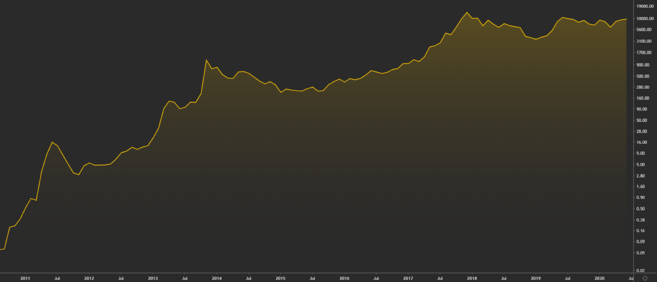
Bitcoin price chart (2010-2020).
Based on this understanding, a bull market depends on the time period discussed. Generally, when using the term bull market, the time period discussed is months or years. As with other market analysis techniques, longer time frame trends will have greater validity than shorter time frame trends.
Thus, there may be a prolonged period of decline in a long time frame bull market. These counter-trend price movements are known in particular for their high volatility.
Example of a bull market
Some of the most famous examples of bull markets come from the stock market. Times where stock prices and market indexes (such as the Nasdaq 100) continue to rise.
In the context of the global economy, prices fluctuate between bull markets and bear markets. This economic cycle can last for several years, even decades. Some people argue that the bull market that started after the 2008 Financial Crisis and lasted until the coronavirus pandemic was “the longest bull market in history.” This may or may not be true. As we said, a bull market on a long time frame depends on the point of view.
That said, let's take a look at the long-term performance of the Dow Jones Industrial Average (DJIA). It can be seen that the DJIA has basically been in a century-long bull market. Of course, there are periods of decline that can last for several years, such as in 1929 or 2008. However, the trend is still upward overall.

DJIA performance since 1915.
Some argue that a similar trend is seen in Bitcoin. However, it is impossible to know if and when Bitcoin will experience a multi-year bear market. Please also note that most other cryptocurrencies (altcoins) will likely never experience similar price increases. So, be careful about your investment choices.
Bull markets vs. bull markets bear market – what's the difference?
These two concepts are opposites, so the difference is not that difficult to guess. Prices continue to rise in a bull market, while prices continue to fall in a bear market.
This also results in differences regarding the best way to trade assets. In a bull market, traders and investors will generally choose long positions. In a bear market, they will choose to go short or save their money.
In some cases, choosing cash (or stablecoins) may also mean shorting the market, as prices are expected to fall. The main difference is that choosing cash means preserving capital, while shorting means profiting from falling market prices. However, if you sell an asset with the hope of buying it again at a lower price, you are essentially in a short position, despite not profiting directly from the decline.
One other thing to consider is cost. Choosing a stablecoin tends to be cost-free, as there are usually no custody fees. However, most short positions will require a funding fee or interest rate to keep the position open. This is why quarterly futures may be ideal for long-term short positions because there are no funding costs associated with them.
➟ Want to start your crypto adventure? Buy Bitcoin on Binance!
How traders take advantage of bull markets
The main concept behind bull market trading is relatively simple. When prices are rising, a generally sensible strategy is to go long and “buy the dip”. This is why buy and hold strategies and periodic investment strategies are generally appropriate for long-term bull markets.
There is a wise sentence that says: "The trend is your friend, until it's not". This means that trading in the direction of the market trend makes sense. On the other hand, no trend will last forever and the same strategy may not always produce good results in other parts of the market cycle. The only thing that is certain is that the market can and will change. As we saw with the arrival of COVID-19, bull markets that last several years can vanish in just a few weeks.
Of course, most investors will be bullish in a bull market. This makes sense, because prices are rising. As a result, the overall sentiment will also be bullish. However, some investors will be bearish even in a bull market. They can even be successful with short-term bearish trades, such as shorting, if their trading strategy is suitable.
Some traders will try short positions at the most recent high in a bull market. However, this is an advanced strategy and is generally more suitable for professional traders. As a less experienced trader, it usually makes more sense to trade with the trend. Many investors get trapped when trying to open a short position against the market. After all, stepping in front of a raging bull is a very dangerous act.
Closing
We have discussed an explanation of the bull market and how traders can trade in bull market conditions. Usually, the easiest trading strategy in any market trend is to follow the direction of the overall trend.
Bull markets can provide great trading opportunities even for beginners or first-time investors. However, you must always manage risks well and continue learning to avoid mistakes wherever possible.
Still have questions about market trends, bull markets, or trading? Visit our Q&A platform, Ask Academy, where the Binance community answers your questions.