


TL;DR
Binance Smart Chain (BSC) is a hard fork of the Go Ethereum (Geth) protocol and as such has many similarities to the Ethereum blockchain. However, the BSC developers have made significant changes in several key areas. The biggest change is the BSC consensus mechanism, which allows for cheaper and faster transactions.
Introduction
At first glance, Binance Smart Chain (BSC) and Ethereum appear very similar. DApps and tokens installed on BSC are compatible with the Ethereum Virtual Machine (EVM). You may have noticed that your public wallet address is the same on both blockchains. In fact, there are cross-chain projects operating on both networks. However, there are several striking differences between the two chains. If you are considering which option is suitable to use, the best step is to know and understand the differences.
Blockchain traffic and DApp ecosystem
As of June 2021, Ethereum hosts more than 2,800 DApps on the blockchain compared to around 810 on BSC. This is a significant difference, but it indicates a strong and growing ecosystem considering BSC's young age.
Active addresses are also an important on-chain metric to consider. Despite being a newer blockchain, BSC recorded 2,105,367 addresses on June 7, 2021. This figure is more than twice Ethereum's record high of 799,580 addresses on May 9, 2021.
So, what is the cause of this sudden massive growth of BSC? This is mostly due to faster confirmation times and lower fees. BSC's growth may also have to do with the increasing trend around NFTs and their compatibility with popular crypto wallets, such as Trust Wallet and MetaMask.
If we look at daily transactions, there is an even bigger difference between the two. On BSC, users can move their funds and interact with smart contracts faster and more economically. You can see BSC's peak daily transactions of 12 million and its current status of just over four million in the image below.
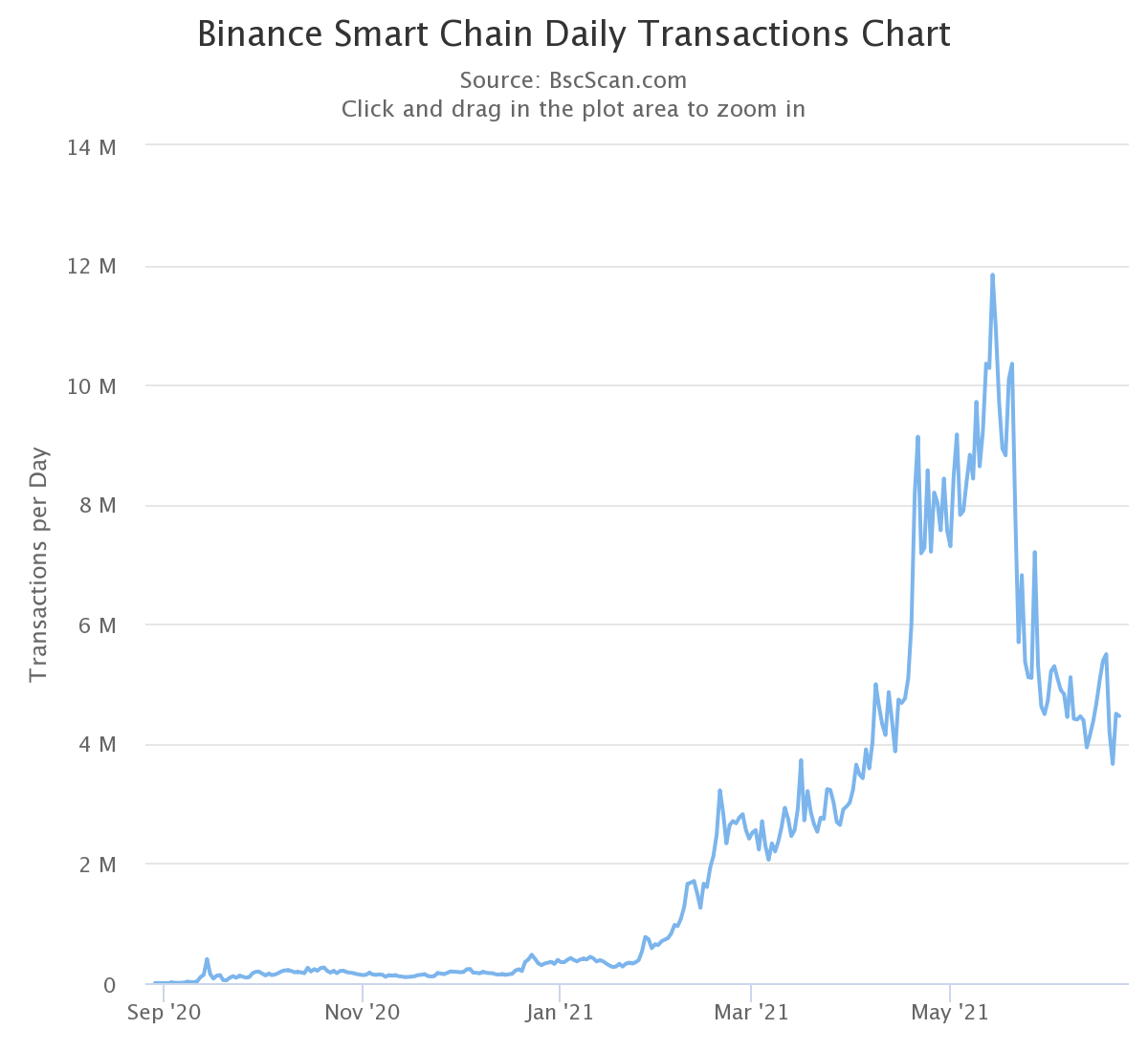
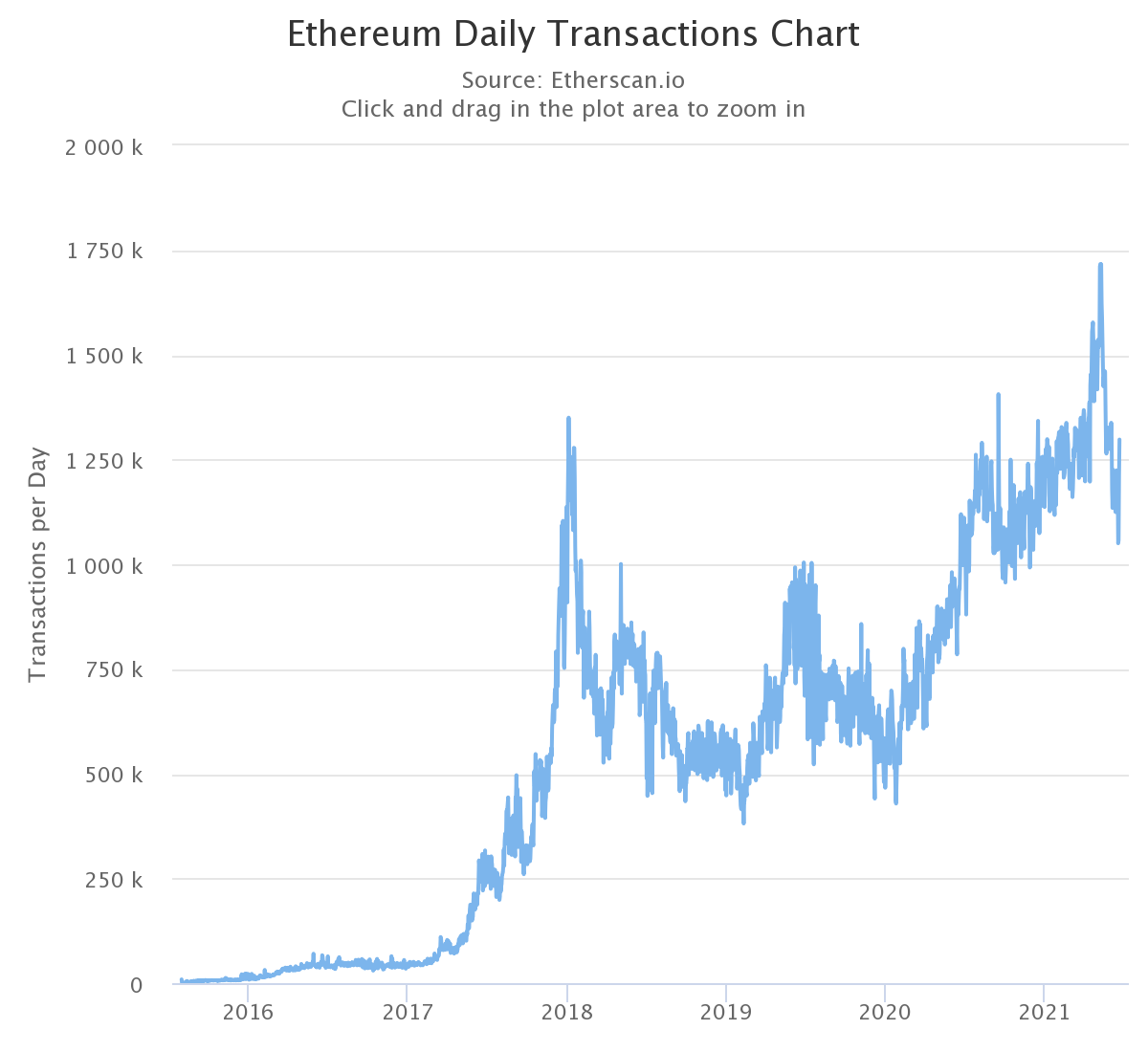
On the other hand, Ethereum has never exceeded 1.75 daily transactions. For users who need to move funds periodically, BSC appears to be the more popular choice. Daily transactions need to be considered in the context of active addresses as well. At the time of writing this article, BSC has a higher number of users who also transact more on average.
The most frequently used DeFI DApp on Ethereum and BSC
When it comes to decentralized finance, there is a large number of DApp crossovers between BSC and Ethereum due to blockchain compatibility. Developers can move applications from Ethereum to BSC easily and new BSC projects often reuse open source code from Ethereum under different names. Let's take a look at the top five DApps on Ethereum voted by users on DAppRadar.
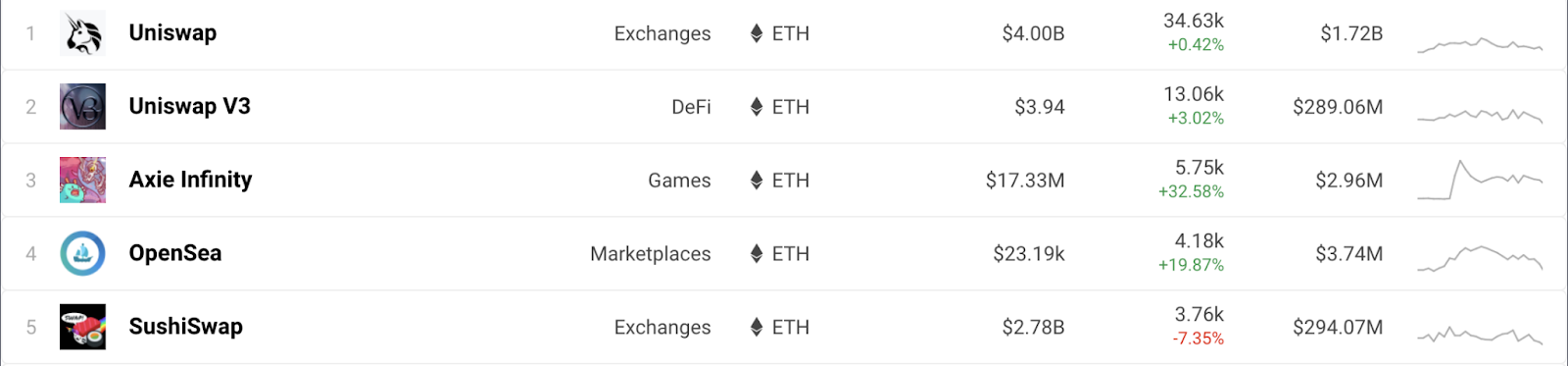
Here, you can see the combination of two DeFi Automated Market Makers (Uniswap and SushiSwap), a crypto game (Axie Infinity), and a peer-to-peer marketplace (OpenSea). If you look at the top five from BSC, there will be a lot of similarities.

PancakeSwap was created as a hard fork of Uniswap. Autofarm and Pancake Bunny are yield farms – a category not seen in Ethereum's top five. Biswap and Apeswap are both Automated Market Makers. Because fees are so cheap on BSC and transactions are so much faster, yield farming tends to be more efficient on Binance Smart Chain. These factors make it a popular choice for BSC users.
When it comes to crypto games, Ethereum is truly the most popular gaming platform. While there are projects on BSC that are very similar to CryptoKitties and Axie Infinity, they haven't been able to reach as large an audience as classic games on Ethereum.
Transfer between networks
If you have ever deposited BEP-20 or ERC-20 into a wallet, you may have noticed that Ethereum and BSC wallet addresses are identical. So, for example, if you choose the wrong network when withdrawing tokens from an exchange, you can withdraw them from another blockchain easily.
If you accidentally withdraw ERC-20 tokens to BSC, you can still find them at the appropriate BSC address. You also go through the same process if you accidentally send tokens from BSC to Ethereum. In either case, your funds are fortunately not lost permanently. For a more detailed guide, read How to Recover Crypto Transferred to the Wrong Network on Binance.
Transaction fees
BSC and Ethereum both use a gas model for transaction fees that measures the complexity of a transaction. BSC users set gas prices according to network demand and miners will prioritize transactions with higher gas prices. However, Ethereum's London hard fork brings some new modifications that will likely remove the need for high fees.
The Ethereum update resulted in a new pricing mechanism with a base fee per block. The base fee changes depending on transaction demand, so users no longer have to decide the gas fees themselves.
In the past, Ethereum gas fees were much higher than BSC. The highest average ever was in May 2021, which was $68.72. This trend is starting to change, but Ethereum is still more expensive for now.
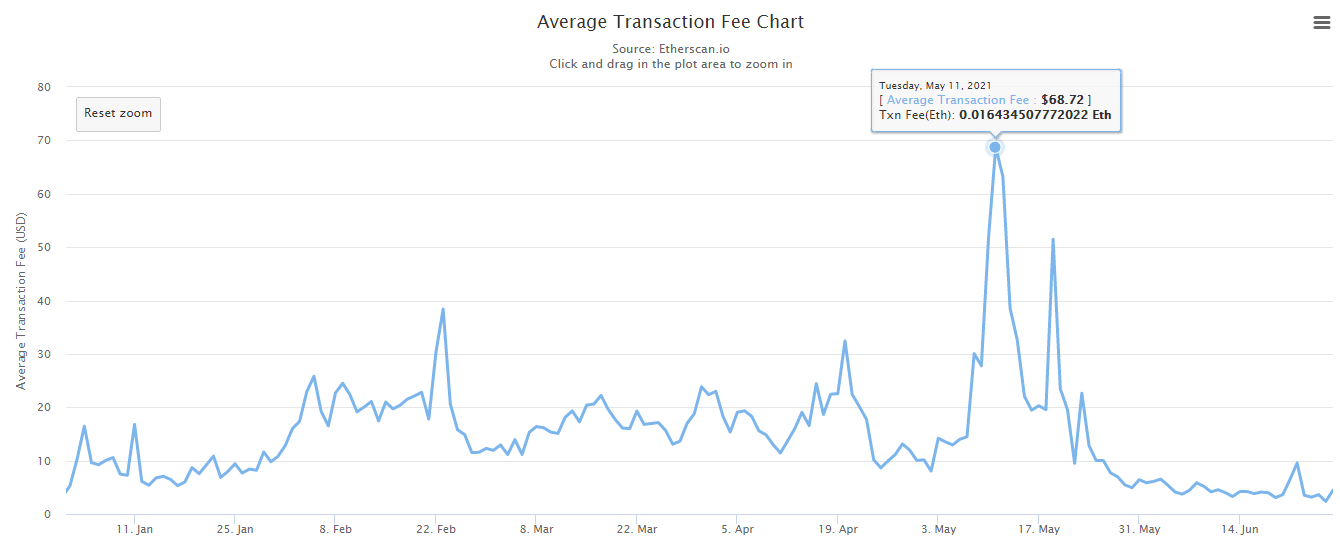
Let's take a look at the average fees for Ethereum from Etherescan to get a better understanding. The top three numbers show the current gas price on Ethereum. For BSC and Ethereum, one gwei is equivalent to 0.000000001 BNB or ETH respectively. If you pay a lower price, your transaction will take longer.
For ERC-20 token transfers to another wallet, the average price at the time of writing this article is $2.46. This amount increases to $7.58 when using a Uniswap liquidity pool involving multiple transactions.

Below, we can see a transaction on BSC with a fee of just $0.03, equivalent to an ERC-20 transfer in an Ethereum gas tracker. BSC has calculated it by multiplying the gas used by the transaction (21,000) by the gas fee (5 gwei).

Transaction time
Measuring the average transaction time on a blockchain can be quite difficult. While technically a transaction is complete once the miner validates the block containing it, other aspects can impact the waiting time:
If the set fee is not high enough, miners can delay your transaction or even not include it in a block at all.
More complex interactions with blockchain require multiple transactions. For example, by adding liquidity to a liquidity pool.
Most services will only consider a transaction valid after a certain number of blocks have been confirmed. This additional confirmation reduces the risk of merchants and service providers experiencing refunded payments if the block is rejected by the network.
If we look at the gas statistics for Ethereum in the image above, we can see that transaction times range from 30 seconds to 16 minutes. These figures take into account successful transactions, but do not include additional confirmation requirements.
For example, if you deposit ETH (ERC-20) into a Binance account, you need to wait up to 12 network confirmations. With blocks coming into mining approximately every 13 seconds, this transaction took an additional 156 seconds when depositing ETH into a spot wallet as can be seen from the diagram below.

On BSC, the average block time is 3 seconds. When compared with Ethereum's duration of 13 seconds, there is a speed increase of around 4.3 times.

Mechanism consensus
While Ethereum's Proof of Work (PoW) consensus mechanism is similar to the one Bitcoin uses, there are major differences with BSC's Proof of Staked Authority (PoSA). However, this difference will not last long. With Ethereum 2.0, this network will use a Proof of Stake (PoS) mechanism.
PoSA BSC combines aspects of Proof of Authority (PoA) and Delegated Proof of Stake (DPoS). 21 validators take turns generating blocks and, in return, receive BNB transaction fees as a reward. To become a validator, users must run a node and stake at least 10,000 BNB to become a selected candidate.
Other users called delegators stake BNB behind the selected candidates. Then, the top 21 selected candidates based on the amount submitted will take turns processing the blocks. This entire process is repeated every 24 hours. Delegators also receive a share of the rewards generated by validators.
Ethereum PoW is a very different system. Instead of the community choosing validators, there is a race to solve the computational puzzle. Anyone can participate, but they must purchase or rent special mining equipment. The more computational power you have, the more likely you are to solve the puzzle first and validate the block. Successful miners will receive transaction fees and ETH rewards.
While PoW is an effective way of establishing consensus and ensuring network security, developers have explored the use of other mechanisms. Their goal is to find more efficient and environmentally friendly alternatives without sacrificing safety.
For this reason, the Ethereum network will eventually switch to Proof of Stake. Validators will stake ETH for the opportunity to generate blocks. Other validators will “validate” the block and check that it is correct. If someone generates a block containing fake transactions, he or she will risk losing all staked coins. Then, validators receive rewards for successful blocks and for validation. By depositing and staking large amounts of ETH directly, malicious validators risk losing funds.

Closing
It's clear that there are many similarities between Binance Smart Chain and Ethereum. This plays a role in making it easier for Ethereum users to migrate and start experimenting with BSC. However, despite the similarities, BSC adopted interesting changes to try and improve performance and efficiency. The Proof of Staked Authority (PoSA) consensus mechanism allows users to enjoy increasingly cheaper and faster blockchain transactions.