


TL;DR
Smart contract security audits provide a detailed analysis of a project's smart contracts. This is important to protect the funds invested through it. Because all transactions on the blockchain are final, funds cannot be recovered if stolen. Typically, an auditor will examine the smart contract code, create a report, and then provide it to the project for follow-up. Then a final report is released that details any remaining errors and work that has been done to address performance or security related issues.
Introduction
Smart contract security audits are very common in the Decentralized Finance (DeFi) ecosystem. If you have invested in a blockchain project, your decision may be based in part on the results of a smart contract code review.
While most people understand the importance of auditing for cryptocurrencies, not many people delve into the field of code. Let's take a look at the methods, tools, and results typically found in smart contract security audits so you can make more informed decisions.

What is a smart contract audit?
Smart contract security audits examine and comment on a project's smart contract code. Typically, these contracts are written in the Solidity programming language and provided via GitHub. Security audits are especially valuable for DeFi projects that intend to handle millions of dollars worth of blockchain transactions or large numbers of players. Audits typically follow a four-step process:
1. The smart contract is provided to the audit team for initial analysis.
2. The audit team presents their findings to the project for follow-up.
3. The project team makes changes based on the problems found.
4. The audit team releases a final report taking into account any new changes or remaining errors.
For most crypto users, smart contract audits are important when investing in new DeFi projects. This has become the standard for projects that want to be taken seriously. Certain audit providers are also considered leaders in the industry, making their audits more valuable in the eyes of investors.
Why do we need a smart contract audit?
With the large value of transactions passing through or locked in smart contracts, these funds become attractive targets for malicious attacks from hackers. A small coding error can result in large amounts of money being stolen. For example, the DAO hack on the Ethereum blockchain robbed around 60 million dollars worth of ETH and even led to a hard fork of the Ethereum network.
Because blockchain transactions are irreversible, ensuring that project code is secure is important. The highly secure characteristics of blockchain technology make it difficult to retrieve funds and resolve issues, so preventing vulnerabilities at all costs is preferable.
How does smart contract auditing work?
The smart contract audit process is fairly standard among audit providers. Although each auditor's approach may vary slightly, the general process is as follows:
1. Determine the scope of the audit. Smart contract and project specifications are determined by the project (its intended purpose) and its overall architecture. Specifications help audit teams understand project goals when creating and deploying code.
2. Provide an initial quote based on the amount of work performed.
3. Run the test. The exact characteristics will change depending on the audit team, analysis tools, and methods. Typically, manual and automated testing are both performed.
4. Create an initial draft of the report with the errors found and provide it to the project team for feedback and follow-up in the form of improvements.
5. Issue a final report considering the actions taken by the team to address the issues discussed.
Metode audit smart contract
Gas efficiency
Smart contract audits don't just focus on blockchain security. This audit also looks at efficiency and optimization. Some contracts perform a complex series of transactions to complete their intended function. With gas fees on networks like Ethereum being relatively high, efficient contracts can save a lot on transaction fees.
Optimizing performance is also an indicator of developer skill. Inefficient steps magnify failure and should be avoided. When gas fees are high, smart contracts may fail to execute, especially when low gas limits are used.
Contract vulnerabilities
Most audit work involves checking contracts for security vulnerabilities. While some problems are easy to spot, most of them involve advanced techniques and strategies for draining funds. For example, market manipulation can be used with weak smart contracts to carry out flash loan attacks. To discover these issues, auditors begin the process of vulnerability testing and simulating malicious attacks on smart contracts. Common vulnerabilities include:
1. Re-entry issue: The smart contract makes an external call to another external contract before any effects are completed. Then, the external contract can call the initial smart contract repeatedly and interact with it in ways it should not be able to, because the initial contract balance has not been updated.
2. Overflow dan underflow integer: Smart contract melakukan operasi aritmetika, tetapi hasilnya melampaui kapasitas penyimpanan (biasanya 18 angka desimal). Hal ini dapat menyebabkan penghitungan jumlah yang salah.
3. Frontline opportunities: Poorly structured code can cause early warnings of market buying or selling. As a result, this may allow others to use that information and trade with it for their own benefit.
Platform security flaws
Most audits include looking at the network hosting the contract and even the APIs used to interact with the DApp. A project may be vulnerable to DDoS attacks or suffer a breach in its website UI. This means that users will actually connect their wallets to malicious blockchain applications.
What is an audit report?
The audit report is provided at the end of the audit process. For the sake of transparency, projects are expected to share their findings with the community. Most reports categorize issues based on severity, such as critical, major, minor, etc. The report will also include the status of the issue, as the project is given time to resolve it before the release of the final report.
Selain dari ringkasan eksekutif, laporan standar akan berisi saran, contoh kode yang mubazir, dan uraian lengkap mengenai lokasi kesalahan pengodean. Proyek diberikan waktu untuk menindaklanjuti temuan laporan sebelum versi final dirilis.
Where can I get a smart contract audit?
A number of smart contract audit services have become well-known for their services. Two of these have become quite popular and getting an audit of them will require an initial quote and submission of information.
CertiK
CertiK is an industry leader when it comes to smart contract auditing. Hundreds of projects have audited smart contracts with them. PancakeSwap, BSC's largest Automated Market Maker (AMM), is one example. Below is part of CertiK's audit of PancakeSwap.
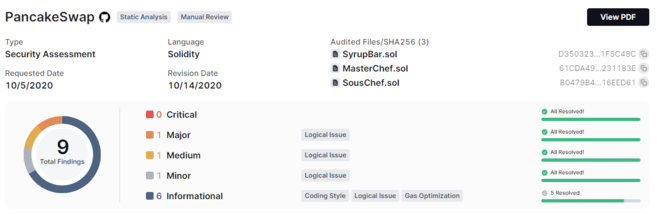
Additionally, most projects supported by Binance Labs have had their contracts audited by CertiK. CertiK released an audited project leaderboard that allows you to compare each one along with a security score. Please note that, in addition to Ethereum, CertiK also covers the BSC and Polygon projects.

ConsenSys Diligence
ConsenSys, run by Joseph Lubin, co-founder of Ethereum, is the biggest name in the cryptocurrency industry when it comes to blockchain development. With ConsenSys Diligence, the company offers audits of Ethereum smart contracts. They also provide an automated service that checks Ethereum Virtual Machine (EVM) contracts for commonly found issues.
How much does a smart contract audit cost?
The exact cost of an audit depends on the number of smart contracts to be examined. Typically, an audit will cost thousands of dollars. A large enough project can cost more than $10,000. The audit company that performs the audit for you and its reputation will also influence the amount paid.

Closing
Fortunately, for investors and users, smart contract auditing has become the gold standard. However, if all projects do, it will no longer easily be an indicator of value. This is why reading your own audit is so important. Even if you don't have technical knowledge, it can be useful to see comments and the severity of potential issues.
When you encounter an audit, now it will at least be easier for you to understand its contents. Always ensure that every investment decision looks at the whole picture and considers all information.