

Ringkasan
APY and APR - You've likely seen these two similar terms when checking out decentralized finance (DeFi) products.
APY, or annual percentage yield, includes quarterly, monthly, weekly, or daily compound interest, while APR, or annual percentage rate, does not. This simple difference makes a significant difference to the calculation of returns over a certain period of time. Therefore, you must understand how these two metrics are calculated and their impact on the returns you can earn from your digital funds.
APR vs. APY
APR and APY are both basic concepts related to personal finance. Let's start with a simpler term, namely annual percentage rate (APR). APR is the interest rate that lenders earn on their money, and that loan takers pay, over a one-year period.
For example, if you put $10,000 into a bank savings account with a 20% APR, you'll earn $2,000 in interest after one year. Your interest calculation is the principal amount ($10,000) times the APR (20%). So, after one year, you will have a total of $12,000. After two years, your capital will be $14,000. After three years, you will have $16,000 and so on.
Before discussing annual percentage yield (APY), let's understand compound interest. Simply put, compound interest is the process of earning interest from previous interest. In the example above, if a financial institution pays interest to your account every month, your balance will look different in each month of all twelve months of the year.
Instead of getting $12,000 at the end of the 12th month, you will receive a certain amount of interest each month. The interest is added to the principal amount of your deposit, so the base amount for earning interest increases each month. You'll have more money earning interest each month. This effect is called compounding.
For example, say you put $10,000 into a bank account with a 20% APR and compounded monthly interest. You will earn $12,429 at the end of one year. There is an additional interest yield of $429 just by adding the compound interest effect. How much interest would you earn with an APR of 20%, but with interest compounded daily? The answer is $12,452.
The power of compound interest will be greater over a longer period of time. After three years, you would have $19,309 with the same 20% APR product and daily compound interest. That means the interest yield is $3,309 more than the same 20% APR product without compound interest.
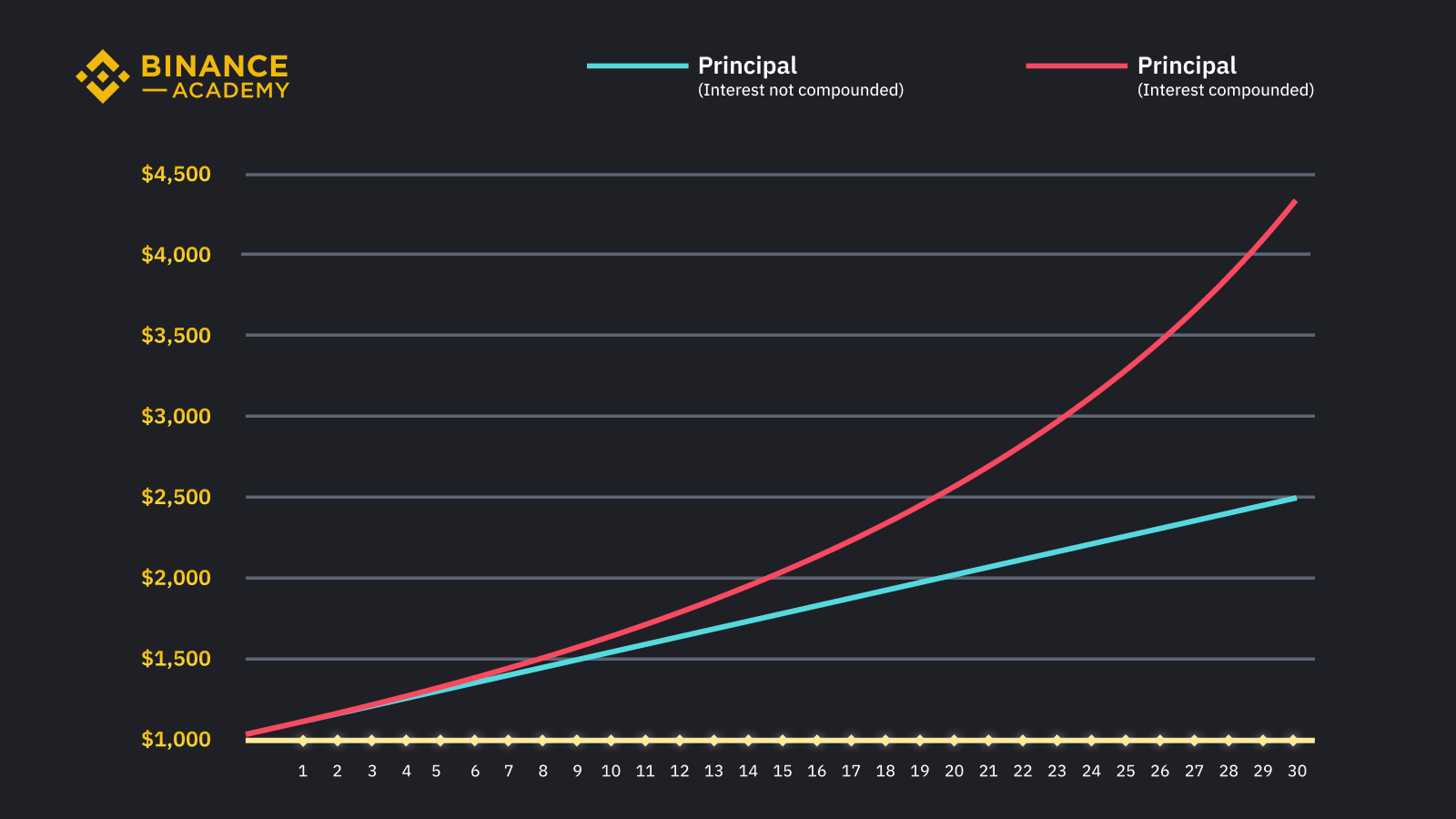
Just by including compound interest, you will make a larger amount. Also note that interest varies based on the frequency of compound interest. You earn more when the frequency of compound interest is higher. Daily compound interest will provide greater interest than monthly compound interest.
How to calculate the amount that can be earned from financial products with compound interest? This is where we use annual percentage yield (APY). You can use a formula to convert APR to APY depending on the frequency of compound interest. APR of 20% with monthly compound interest equals an APY of 21.94%. With daily compound interest, the APY equals 22.13%. This APY figure represents the annual interest return earned after including compound interest.
In short, APR (annual percentage rate) is a simpler, more static metric: The quote is always a fixed annual rate. However, APY (annual percentage yield) includes interest earned on interest, also known as compound interest. APY changes according to the frequency of compound interest.
How to compare different interest rates?
From the example above, it can be seen that more interest can be earned when the interest is doubled. Various products present the rate of return as APR or APY. Understanding the difference between the two is important. Be careful when comparing products, just like when comparing apples to oranges (two clearly different products).
Products with higher APYs may not necessarily earn more interest than products with lower APRs. You can convert APR and APY easily using online tools if you know the frequency of compound interest.
The same goes for DeFi and other types of crypto products. When looking at products that may state crypto APY and APR usage, such as crypto savings and staking, be sure to convert them first so you get accurate numbers.
Additionally, when comparing two DeFi products by APY, make sure that they both compound interest over the same period. If both have the same APR, but one product compounds monthly and the other daily, then the product with daily compound interest can earn more crypto interest.
An important point to note is the meaning of APY in relation to the crypto product you are looking for. Some product warranties use the term “APY” to refer to rewards that can be earned in cryptocurrency over a selected time period, rather than actual or predicted returns/yields in fiat currency. This important distinction is worth understanding, as crypto asset prices can be volatile and the value of your investment (in fiat) can fall as well as rise. If the price of a crypto asset drops drastically, the value of your investment (in fiat) could still be lower than the initial fiat amount invested, even though you continue to earn APY in the crypto asset. Therefore, you should carefully review the relevant product terms and conditions and conduct your own research to understand the investment risks and the meaning of APY in that context.
Closing
The difference between APR and APY may seem confusing at first, but they are easy to distinguish by remembering that annual percentage yield (APY) is a more complex metric that includes compound interest. Because of the effect of earning interest on other interest, APY is always a higher number if interest is compounded more frequently than once a year. The point is, always check the calculations used for your interest.
Penafian dan Peringatan Risiko: Konten ini disajikan kepada Anda dengan dasar “sebagaimana adanya” untuk informasi umum dan tujuan pendidikan saja tanpa pernyataan atau jaminan dalam bentuk apa pun. Konten ini tidak boleh dianggap sebagai nasihat keuangan ataupun dimaksudkan untuk menyarankan pembelian produk atau jasa tertentu. Silakan baca penafian lengkap kami di sini untuk detail lebih lanjut. Harga aset digital menjadi volatil. Nilai investasi Anda bisa turun atau naik, dan Anda mungkin tidak mendapatkan kembali jumlah yang sudah diinvestasikan. Anda bertanggung jawab penuh atas keputusan investasi Anda dan Binance tidak bertanggung jawab atas kerugian yang mungkin Anda alami. Bukan nasihat keuangan. Untuk informasi selengkapnya, baca Ketentuan Penggunaan dan Peringatan Risiko kami.