

In brief
Wrapped Ether (WETH) is a token tied to Ether (ETH). WETH is used in several platforms and DApps that support ERC-20 tokens. Although ETH is used to pay network transaction fees, it does not have the same functionality as ERC-20 tokens.
You can easily convert ETH to WETH through a process called wrapping. You can also convert WETH back to ETH at any time. Both wrapping and unwrapping follow a 1:1 ratio, meaning there are no additional costs other than transaction fees.
You can wrap your ETH manually by interacting with the WETH smart contract, which will store the ETH and return you the exact amount of WETH.
Ethereum's DeFi ecosystem is huge, and using WETH offers many opportunities for staking and investing. There are many versions of WETH, but some are more popular than others. You can even find ETH wrapped on other blockchains for use in their ecosystems. Popular applications with WETH include NFT trading, providing liquidity to liquidity pools, and crypto lending.
Introduce
If you use Ethereum, most of the tokens you trade and invest in likely use the ERC-20 token standard. This technical standard has become a popular choice for decentralized applications, wallets, and projects because it offers practicality for most users. However, this practice has presented a problem for Ethereum's native coin, Ether.
Ether does not follow the same rules as ERC-20 tokens, but there is demand for its use in ERC-20 DApps. Wrapped Ether is the solution to this problem and you may have seen it before. Let's see why it has become a useful tool for investors and token holders across many projects and DApps.

Wrapped Ether (WETH) là gì?
WETH is an ERC-20 token on Ethereum that is pegged to the price of Ether (ETH). While Ethereum's native token, ETH, can be used to pay gas fees, WETH cannot. However, WETH has a wider range of uses than ETH and is very popular in the Decentralized Finance (DeFi) ecosystem. MetaMask, TrustWallet and quite a few wallets in the Ethereum network support WETH. Let's explore some of its use cases.
Why do we need to wrap ETH tokens?
It seems confusing why we need a token like WETH. Don't we already have ETH on the Ethereum blockchain? The first thing to understand is that not every token on Ethereum is technically the same. The network allows developers to create new rules and standards for cryptocurrencies.
An example is the ERC-721 format that gives us Non-Fungible Tokens (NFTs). These work very differently from Ether or ERC-20 tokens. Developers have a lot of room for customization when creating digital assets. So, although ETH can be used to pay gas fees on Ethereum, ETH cannot be used in every DApp.
Most DeFi DApps today accept ERC-20 tokens for investment and staking. If we want to add ETH to the liquidity pool or use it as collateral, the fact that ETH has an additional ERC-20 format will make this much easier. This provides cross-blockchain compatibility and saves time developing new smart contracts.
How to wrap Ether (ETH)?
The process of generating WETH is simple - you deposit your ETH into a smart contract, then in return the contract gives you WETH. This means that all WETH created is completely backed up by ETH reserves. At this point, your ETH is locked in the smart contract and you can exchange WETH at any time to get your ETH back. Once your ETH is returned, the contract will burn the WETH that was provided.
To wrap Ether, you can interact directly with the WETH smart contract, which will take the ETH and credit WETH to your wallet at a 1:1 ratio (you still have to pay transaction fees). The reverse conversion requires another smart contract interaction, and the process is similar.
However, swapping another token for WETH is much easier if you do it on a cryptocurrency exchange. Let's see how you can swap your ETH to WETH using the Uniswap decentralized exchange or directly through your Metamask wallet.
Wrap ETH on Uniswap
1. Open Uniswap and connect your wallet. Make sure Ethereum is selected as your network.

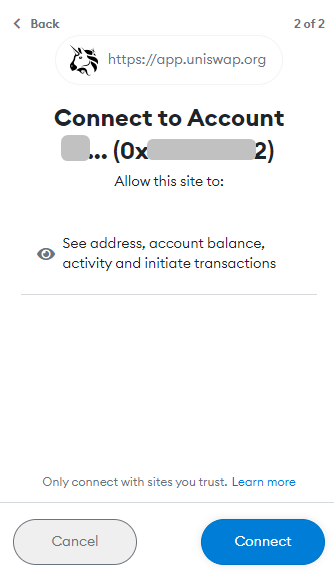
2. Select ETH in the top field and WETH in the bottom field. If you click [Select a token], you will see WETH at the top of the list.

3. Enter the amount of ETH you want to convert to WETH and click the [Swap] button.
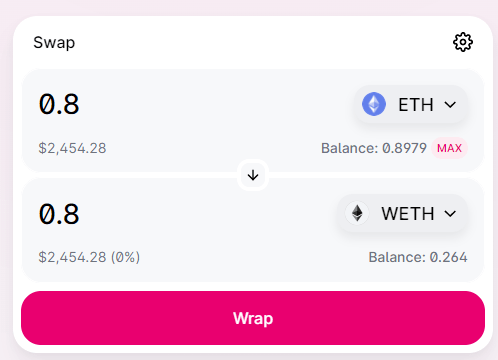
4. Now you will need to confirm the transaction in your crypto wallet. Don't forget that you'll also need to pay gas fees, so make sure you have some extra ETH in your wallet. Check if the details are correct and click [Confirm].

5. Now you just need to wait for the transaction to be confirmed on the blockchain. Waiting time will depend on current network traffic. If you are in a hurry, you can speed up the transaction (i.e. pay a higher fee) so that the transaction is confirmed faster.
Wrap ETH on MetaMask
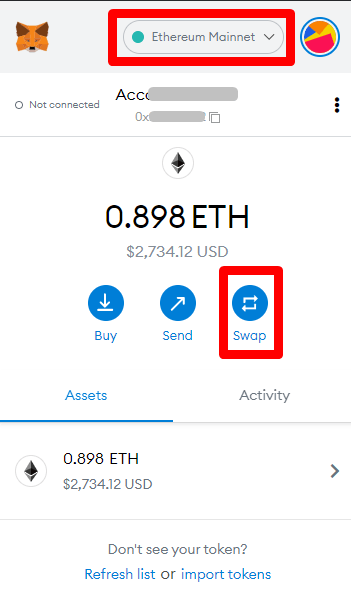
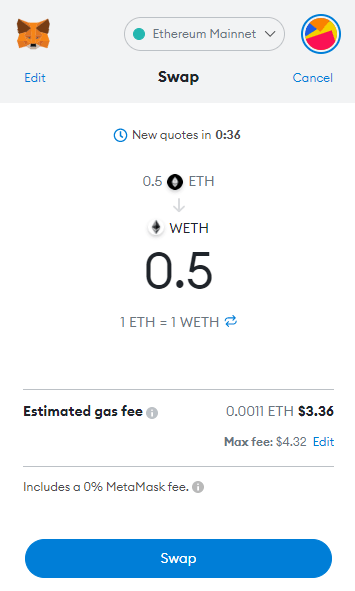
1. Open your MetaMask wallet and make sure your network is [Ethereum Mainnet]. Next, click [Swap].
2. In the [Swap to] field, search for WETH.
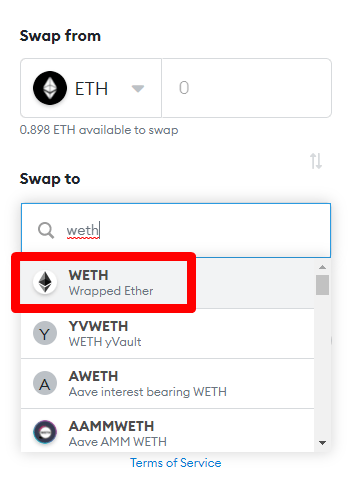
3. Enter the amount of ETH you want to swap and click [Review Swap].

4. You will now see a quote showing the conversion rate (should be 1:1). Click [Swap] to complete your transaction.
How to unwrap Ether (WETH)?
As mentioned before, you can manually unwrap Ether by interacting with a smart contract. However, swapping WETH for ETH is simpler and safer. To do this, follow the Uniswap or MetaMask instructions above, but make sure you are changing from WETH to ETH. You can also use Binance to convert your WETH.
1. Visit the Binance & OTC Exchange Portal. Select WETH in the [From] field and ETH in the [To] field, then click [Preview Conversion].

2. You will now see the transaction details. Check them before accepting the swap. Note, Binance does not allow you to swap ETH for WETH using this method.
Can you wrap ETH on other blockchains?
Other wrapped versions of ETH exist on major blockchains, which increases ETH's interoperability. For example, using wrapped ETH on BNB Smart Chain (BSC) allows you to trade or use WETH in the BSC DeFi ecosystem. To do this, you will need to withdraw ETH from Binance or another exchange to your BSC wallet. Make sure your exchange supports ETH to WETH conversions before making a withdrawal.
Alternatively, you can use a bridging service. These are third-party DApps that use cryptocurrency and store it on the native blockchain, then mint wrapped tokens at a 1:1 ratio on the destination blockchain.
Bridging tokens generally work well, but be aware that moving tokens across blockchains can be risky. There have been cases where the smart contracts of some bridges have been compromised. If you want to bridge Bitcoin, Wrapped Ethereum, or another token, carefully research the platform you use before using their bridging services.
How does wrapped ETH remain the same price as ETH?
The key to maintaining WETH's peg to ETH is its 1:1 convertibility. If WETH price is cheaper, people will buy it and convert it to ETH to make profit. This will increase the demand for WETH and, therefore, increase the price of WETH. If WETH is more expensive, people will buy ETH and convert it to WETH to sell, increasing the supply of WETH and lowering its price. These supply and demand principles ensure that exchange rates remain relatively stable.
Which DeFi applications can WETH be used on?
There are many DeFi DApps on Ethereum that accept ERC-20 tokens. Another option is to add WETH to the liquidity pool available on a Decentralized Exchange (DEX) like Uniswap. By providing liquidity, you can receive fees from swap users when they use the liquidity pool. However, temporary losses are a possible risk and may result in a reduction in the amount of your deposited tokens. Using a pool with a large amount of liquidity will minimize this risk.
You can also start lending your WETH on a platform like Aave. Other users can borrow your tokens, but they must first provide collateral covering their loan. In return, you will receive interest until you decide to clear your deposit.

summary
Ethereum has one of the oldest and most developed DApp ecosystems today. This makes WETH an essential part, as many ETH holders want to use their ETH in DeFi projects. If you want to try WETH, Binance Academy recommends purchasing it with ETH or other tokens, as this method is simpler and more convenient than interacting with smart contracts.