



In brief
In cryptocurrency trading, leverage refers to the use of borrowed capital to make a trade. Leveraged trading can amplify your buying or selling power, allowing you to trade with larger amounts of money. So, even if your initial capital is small, you can use it as collateral to make leveraged trades with higher capital. While leveraged trading can multiply your potential profits, it also carries high risks - especially in the volatile cryptocurrency market. Be careful when using leverage when trading cryptocurrencies. It can lead to significant losses if the market moves against your position.
Introduce
Leverage trading can be a bit confusing, especially for beginners. But before experimenting with leverage, it's important to understand what it is and how it works. This article will help you learn about leveraged trading in the cryptocurrency markets, but it is still useful even when you trade in traditional markets.

What is leverage in cryptocurrency trading?
Leverage refers to the use of borrowed capital to trade cryptocurrencies or other financial assets. It amplifies your buying or selling power so you can trade with more capital than you have in your wallet. Depending on the cryptocurrency exchange you use, you can borrow up to 100 times your account balance.
The amount of leverage is described in ratios, such as 1:5 (5x), 1:10 (10x) or 1:20 (20x). It shows how many times your initial capital is multiplied. For example, imagine that you have $100 in your exchange account, but you want to open a position worth $1,000 in bitcoin (BTC). With 10x leverage, your $100 will have the same purchasing power as $1,000.
There are many types of transactions when using leverage. Common types of leveraged trading include margin trading, leveraged tokens, and futures contracts.
How does leveraged trading work?
Before you can borrow funds and start trading with leverage, you need to deposit money into your trading account. The initial capital you provide is called collateral. The amount of collateral depends on the leverage you use and the total value of the position you want to open (called margin).
Let's say you want to invest $1,000 in Ethereum (ETH) with 10x leverage. The required margin will be 1/10 of $1,000, which means you need to have $100 in your account as collateral for the borrowed money. If you use 20x leverage, your margin requirement will be even lower (1/20 of $1,000 = $50). But remember that the higher the leverage, the higher the risk of liquidation.
In addition to the initial deposit, you also need to maintain a margin threshold for your trades. When the market moves against your position and the margin is below the maintenance threshold, you will need to add more funds to your account to avoid liquidation. This threshold is also known as the margin maintenance margin.
Leverage can be applied to both long and short positions. Opening a long position means you expect the price of an asset to increase. On the contrary, opening a short position means you believe that the price of the asset will decrease. While this may sound like regular spot trading, using leverage allows you to buy or sell assets based solely on the collateral and not the assets you hold. So, even if you don't have assets, you can still borrow cryptocurrencies and sell them (open a short position) if you think the market will go down.
Example of a short position using leverage
Imagine, you want to open a BTC long position worth $10,000 with 10x leverage. This means you will use $1,000 as collateral. If the price of BTC increases by 20%, you will make a net profit of $2,000 (minus fees), much higher than the $200 you would make if you traded your $1,000 capital if Do not use leverage.
However, if the price of BTC drops by 20%, your position will drop to $2,000. Since your initial capital (collateral) is only $1,000, a 20% reduction will result in liquidation (your balance goes to zero). In fact, you can get liquidated even if the market only drops 10%. The exact liquidation value will depend on the exchange you are using.
To avoid liquidation, you need to add more money to your wallet to increase your collateral. In most cases, the exchange will send you a margin request before the liquidation occurs (e.g. an email asking you to deposit more funds).
Example of a leveraged short position
Now, imagine that you want to open a short position of 10,000 USD BTC with 10x leverage. In this case, you will borrow BTC from someone else and sell it at the current market price. Your collateral is $1,000, but since you are trading on 10x leverage, you can sell $10,000 worth of BTC.
Let's say the current BTC price is 40,000 USD, you borrowed 0.25 BTC and sold it. If the price of BTC drops 20% (to $32,000), you can buy back 0.25 BTC for just $8,000. This will give you a net profit of $2,000 (minus fees).
However, if BTC increases by 20% to $48,000, you will need an additional $2,000 to buy back 0.25 BTC. Your position will be liquidated because your account balance is only $1,000. Again, to avoid liquidation, you need to add more funds to your wallet to increase your collateral before reaching the liquidation price.
Why do traders use leverage to trade cryptocurrencies?
As mentioned, traders use leverage to increase their position size and potential profits. But as the examples above show, leveraged trading can also lead to the possibility of larger losses.
Another reason traders use leverage is to enhance the liquidity of their capital. For example, instead of holding a 2x leveraged position on a single exchange, they can use 4x leverage to maintain the same position size with lower collateral. This will allow them to use the rest of their funds elsewhere (e.g. trading other assets, staking, providing liquidity to decentralized exchanges (DEX), investing in NFTs, etc.).
How to manage risk with leveraged trading?
Trading with high leverage may require less capital but it increases the chances of liquidation. If your leverage is too high, even a 1% price movement can lead to large losses. The higher your leverage, the smaller your tolerance for volatility. Using lower leverage gives you more margin to trade. This is why Binance and other cryptocurrency exchanges have limited the maximum leverage for new users.
Risk management strategies such as stop loss and take profit orders help minimize losses in leveraged trading. You can use a stop loss order to automatically close your position at a specific price, which is useful when the market goes against your predictions. Stop-loss orders can protect you from significant losses. Take profit orders are the opposite; they close automatically when your profit reaches a certain value. This allows you to secure your income before market conditions change.
At this point, you must clearly understand that leveraged trading is a double-edged sword that can multiply both your profits and losses exponentially. It can carry extremely high risks, especially in the volatile cryptocurrency market. At Binance, we encourage you to trade responsibly by understanding your actions. We provide tools like anti-addiction notifications and pause functions to help you stay in control of your trades. You must always be extremely cautious and don't forget DYOR to understand how to use leverage properly and plan so that your trading strategy is effective.
How to Margin Trade on Binance?
You can use leverage to trade on cryptocurrency exchanges like Binance. We will show you how to start Trading on Margin, but the concept of leverage can be found in other types of trading as well. Before you start, you need a Margin account. Follow the article How to Activate Margin Account on Binance to open a margin account if you haven't opened one yet.
1. Go to [Trade] - [Margin] from the top navigation bar.
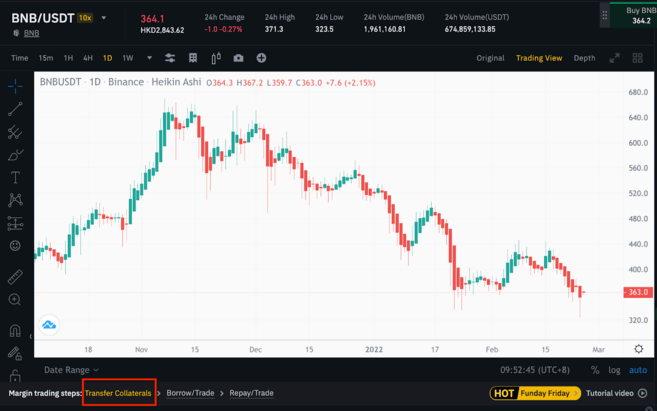
2. Click [BTC/USDT] to search for the currency pair you want to trade. We will use the BNB/USDT pair as an example.
3. You will also need to transfer funds to your Margin Wallet. Click [Transfer Collaterals] below the candlestick chart.
4. Select the wallet to transfer funds to, the destination deposit account, and the currency to transfer. Enter the amount and click [Confirm]. In this example, we are transferring 100 USDT into the cross margin account.

5. Now go to the box on the right. Select [Cross 3x] or [Isolated 10x]. Margin in Cross Margin mode is shared between your Margin accounts, while margin in Isolated Margin mode is independent for each trading pair. You can read more about the difference between both of these forms in the article FAQ: Difference between Isolated Margin and Cross Margin.
6. Select [Buy] or [Sell] and select the order type, such as a market order. Click on [Borrow] and you will notice that the 100 USDT we transferred to the Cross Margin account is now multiplied by 3 times to 300 USDT.

7. You can buy BNB with leverage by entering the amount of USDT in [Total] or the amount of BNB to buy in [Amount]. You can also drag the bar below to select the percentage of available balance to use. You will then see the amount you are borrowing for this transaction. Click [Margin Buy BNB] to open a position.
Note, you won't be able to use all of your available balance because you need to pay a transaction fee. The system will automatically retain the transaction fee amount depending on your VIP level.


summary
Leverage allows you to easily get high profits from a modest initial investment. However, leverage combined with market volatility can make liquidations happen quickly, especially if you are using 100x leverage to trade. Always exercise caution and evaluate risks before making leveraged trades. Never trade funds you cannot afford to lose, especially when using leverage.