

TL;DR
You may have come across these two similar-sounding terms, APY and APR, when considering decentralized finance (DeFi) products.
APY, or annual percentage yield, includes interest compounded quarterly, monthly, weekly, or daily, while APR, or annual percentage yield, does not include interest compounded. This simple difference can make a significant difference when calculating profits over a period of time. Therefore, it is important to understand how these two metrics are calculated and what it means for the profits you can earn from your digital funds.
APR vs. APY
APR and APY are both basic metrics for personal finance purposes. Let's start with the simpler term, annual percentage rate (APR). APR is the interest rate that lenders earn on their money — and borrowers pay to use that money — over a period of one year.
For example: If you deposit $10,000 in a bank savings account with a 20% APR, you will receive $2,000 in interest after one year. Your interest is calculated by multiplying the principal amount ($10,000) by the APR (20%). So, after a year you will have a total of 12,000 USD. After two years, your capital will amount to 14,000 USD. After three years, you will have $16,000, and so on.
Before getting into annual percentage yield (APY), let's first understand what compound interest is. Simply put, compound interest is earning interest on previous interest. In the example above, if the financial institution paid interest on your account monthly, for twelve months of a year, each month your balance would be different.
Instead of receiving $12,000 at the end of the 12th month, you will receive some interest each month. That interest is added to the principal amount of your deposit and your total interest amount increases each month. Every month, you will have more money to earn interest. This effect is called compound interest.
Let's say you deposit $10,000 into a bank account with a 20% APR, with interest compounded monthly. Ignoring the details of complicated math, you will receive 12,429 USD at the end of one year. That means you have an additional $429 in interest earned simply by adding the effect of compound interest. How much interest would you earn with exactly 20% APR but the interest is compounded daily? You will then have 12,452 USD.
The longer the period, the more impressive the power of compound interest. After three years, you would receive $19,309 for the same product with a 20% APR compounded daily. That means the interest earned will be $3,309 more than the same product with a 20% APR but without compound interest.
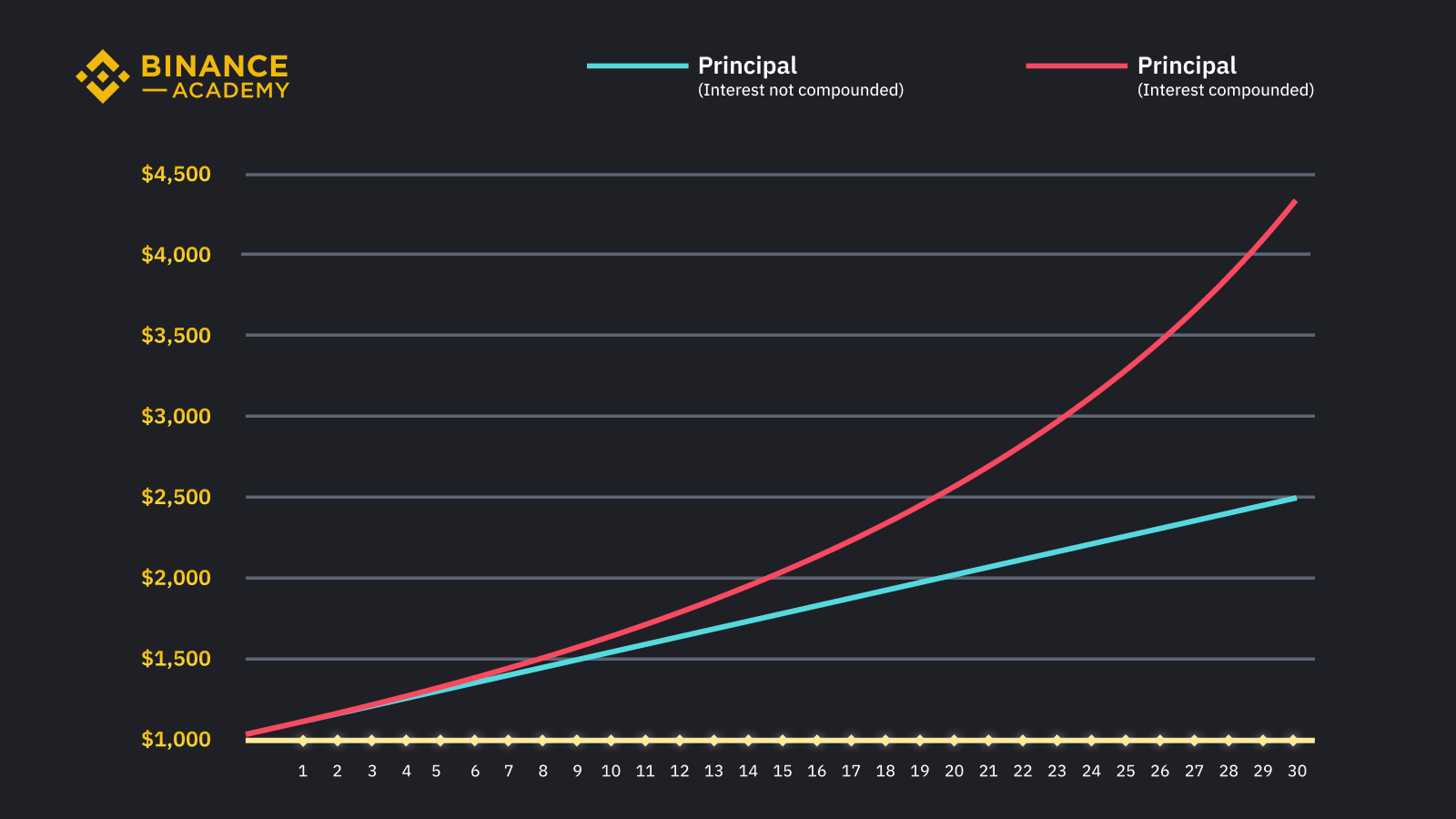
Just by combining compound interest, you will earn more money from the capital you have. Also note that interest will vary depending on the frequency of interest calculation. The more frequently interest is calculated, the more you earn. Daily compounding will give you more interest than monthly compounding.
How do you calculate how much you can earn when a financial product has compound interest? Now we need the annual percentage profit (APY). You can use a formula to convert APR to APY depending on the frequency of interest calculation. A 20% APR with monthly compounding equates to a 21.94% APY. APR of 20% with daily compounding equates to an APY of 22.13%. These APYs represent the annual interest return you earn after compounding interest.
In short, APR (annual percentage rate) is a simpler and more static metric: It is always quoted as a flat annual rate. But APY (annual percentage yield) incorporates interest earned based on interest, or compound interest. APY changes according to the frequency of interest calculation. One way to remember the difference is to remember that "yield" has seven letters (three more than "rate") and also has a more complex concept (and a larger return).
How to compare different interest rates?
From the example above, you can see that more profit can be earned when interest is compounded. Different products may display interest rates as APR or APY. Because of this difference, we need to use the same terminology for comparison. Be mindful when you compare products as you may be comparing apples to oranges.
Products with higher APYs won't necessarily yield more returns than those with lower APRs. You can easily convert APR and APY using online tools if you know how often interest is calculated.
The same goes for DeFi and other types of crypto products. When looking at promoteable products using cryptocurrency APY and APR, such as Savings and Staking, be sure to convert the APY and APR so you can compare apples to apples.
Furthermore, when comparing two DeFi products with APY, make sure they have the same interest calculation period. If they have the same APR, but one product charges monthly and one product charges daily, the product that charges daily may give you more crypto interest.
Another important point to note is what APY means in relation to the specific cryptocurrency product you are considering. Some product collaterals use the term “APY” to refer to the reward one can earn in cryptocurrency within the selected timeframe, not the actual or projected profit/yield. bet in any fiat currency. This is an important distinction to note because crypto asset prices can fluctuate and the value of your investment (in fiat currency) can go down as well as up. If crypto asset prices plummet, the value of your investment (in fiat) may remain less than the original fiat amount you invested, even if you continue to earn APY in Crypto assets. It is therefore important that you carefully review the relevant product terms and conditions and do your own research to fully understand the investment risks involved and what APY means in a particular context. there.
summary
APR and APY may seem confusing at first, but it's easy to differentiate them by remembering that annual percentage yield (APY) is a more complex index that includes compounding. Because of the effect of earning interest on interest, the APY is always greater when interest is calculated more frequently than once a year. The bottom line is to always check the rate you are looking at when calculating how much profit you will earn.
Disclaimer and Risk Warning: This content is presented to you on an “as is” basis, for general information and educational purposes only, and no representation or warranty is made to you hereunder. any form. This should not be construed as financial advice, nor is it intended as a recommendation to purchase any specific product or service. Please read our full disclaimer here for more details. Digital asset prices may fluctuate. The value of your investment may go down as well as up and you may not get back the amount you invested. You are solely responsible for your investment decisions and Binance is not responsible for any losses you may incur. This is not financial advice. For more information, see our Terms of Use and Risk Warning.