

Directory:
1. Large token unlocking data for this week;
2. Overview of the crypto market, a quick read on the weekly rise and fall of popular coins/sector capital flow;
3. Current situation of spot ETF capital inflow and outflow;
4. BTC clearing map data;
5. Key macro events and financial data forecasts and analysis for this week.
1. Large token unlocking data for this week;
During the period from March 31 to April 6 this week, 28 tokens will undergo a one-time unlocking. Sorted by unlocking value as follows:
Among them, #OP , #SOL , W, CHELL, and ENA have unlocking values exceeding $20 million:
OP will unlock over 32.2122 million tokens on March 31, with an unlocking value of approximately $27.77 million, accounting for 0.75% of the circulation;
SOL will unlock over 2.7248 million tokens on April 1, with an unlocking value of $363 million, accounting for 0.54% of the circulation;
W will unlock over 1.367 billion tokens on April 3, with an unlocking value of $130 million, accounting for 13.68% of the circulation;
CHELL will unlock over 2.6715 million tokens on April 3, with an unlocking value of $21.53 million, accounting for 0.27% of the circulation;
ENA will unlock over 134 million tokens on April 5, with an unlocking value of $54.49 million, accounting for 0.9% of the circulation.
It is worth noting that SOL ranks first with a unlocking value of $363 million, and has increased by 4.23% in the past 7 days.
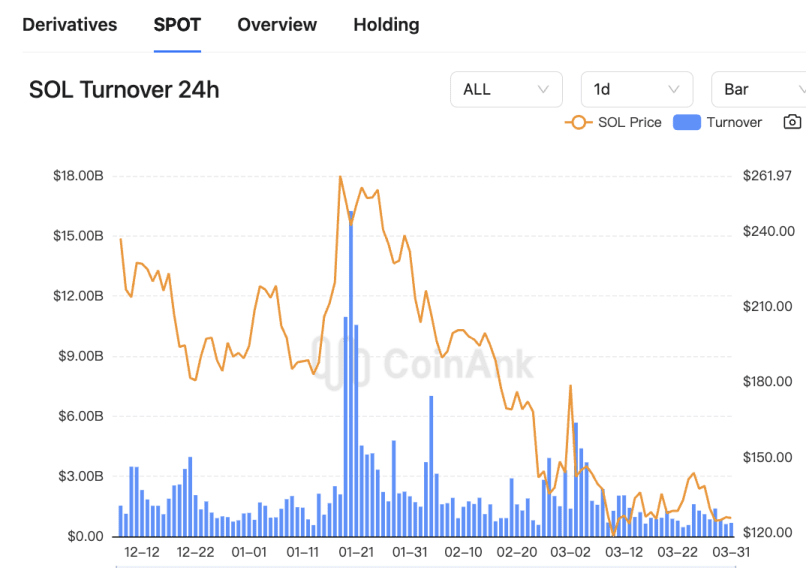
The unlocking situation of these projects may have varying degrees of impact on the relevant markets. The above is in UTC+8 time, this week pay attention to the adverse effects caused by the unlocking of these tokens, avoid spot trading, and seek short-selling opportunities in contracts. The data comes from CoinAnk.
We believe that the unlocking pressure of SOL is controllable, but market sentiment fluctuations must be noted. Although the unlocking amount of SOL is as high as $363 million, it only accounts for 0.54% of the circulation, having relatively limited actual impact on the market. Combining historical experience, institutional investors purchased SOL at an average price of $64 during the FTX bankruptcy auction, and the current price shows substantial floating profits, but the motivation for selling may weaken due to long-term strategic layouts. In addition, the recent price trend of SOL is strong (up 4.23% in the past 7 days), reflecting the market's confidence in its ecological development, and the staking mechanism and on-chain activity also provide support for the price.
W and CHELL have high unlocking ratios, posing significant short-term risks: the unlocking volume of W accounts for 13.68% of the circulation, far exceeding SOL and ENA (0.9%), and its surge in circulation may trigger short-term selling pressure. Similar events caused drastic fluctuations in W prices in July 2024, necessitating caution against liquidity dilution risks. Although CHELL has a lower unlocking amount, its circulation ratio (0.27%) is still higher than SOL, and if there is a lack of demand support, there may be considerable price correction pressure.
The actual impact of token unlocking on the market depends on holder behavior. Historical data shows that institutional investors tend to hold tokens with high growth potential (such as SOL) for the long term, while projects dominated by retail investors (such as W) have higher short-term volatility risks. In the current market recovery context, investors need to pay attention to changes in trading volume after unlocking, judging risks in conjunction with the project's fundamentals. SOL, due to its ecological advantages, may be able to absorb selling pressure, but tokens with high circulation ratios need to be treated with caution.
2. Overview of the crypto market, a quick read on the weekly rise and fall of popular coins/sector capital flow
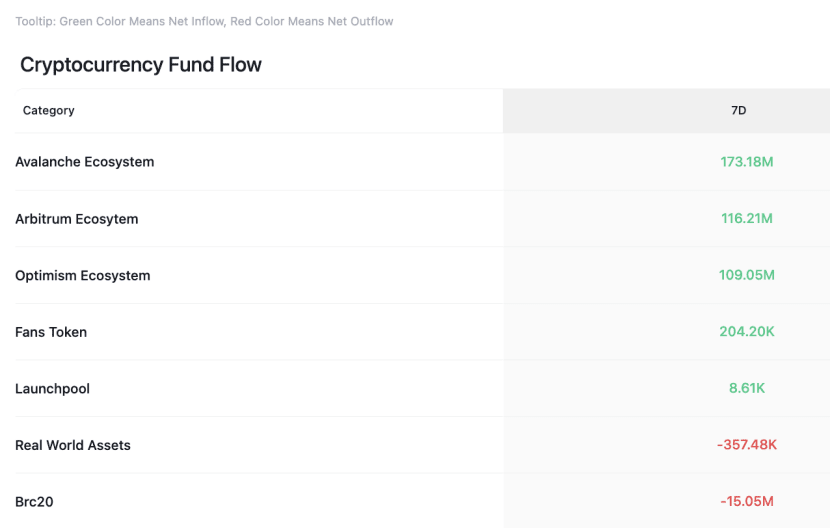
CoinAnk data shows that in the past 7 days, the crypto market, categorized by conceptual sectors, saw net inflows in five sectors: Avalanche ecosystem, Arbitrum ecosystem, Optimism ecosystem, fan tokens, and Launchpool. Additionally, many coins have exhibited rotational increases over the past week. The top 500 by market capitalization include #MLN , #ZEC , FORM, REQ, CORE, and XAUT, among others, showing relatively strong increases, and trading opportunities for strong coins should continue to be prioritized.
3. Current situation of spot ETF capital inflow and outflow.
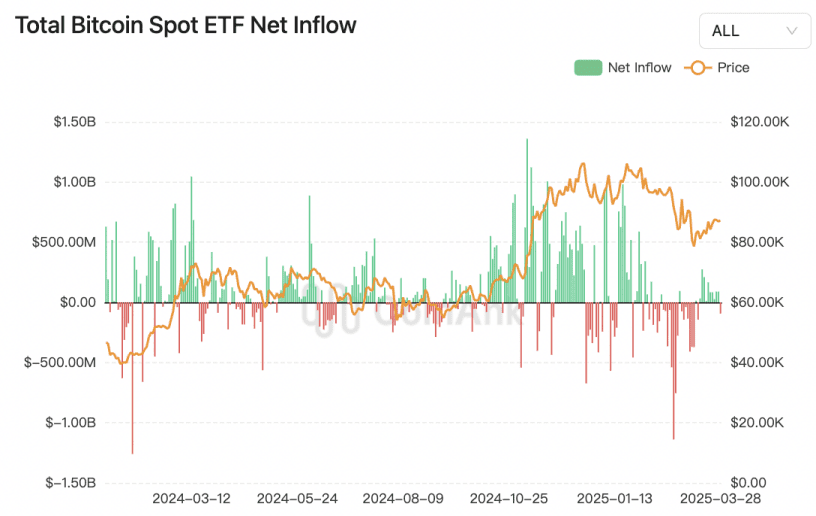
CoinAnk data shows that in the past week, the U.S. spot Bitcoin ETF had a net inflow of $196.4 million; the U.S. spot Ethereum ETF had a cumulative net outflow of $8.7 million.
With Nasdaq submitting the 19b-4 application for Grayscale's Avalanche ETF, the altcoin ETFs currently submitted to the U.S. Securities and Exchange Commission cover 11 types, including XRP, SOL, #DOGE , ADA, AVAX, SUI, HBAR, DOT, LTC, APT, and AXL. It is reported that VanEck has also filed for the Avalanche ETF, and AVAX is currently about the 15th largest digital asset by market capitalization.
We believe that the capital flow and product expansion trends of U.S. crypto ETFs reflect institutional investors' risk repricing logic across different digital asset classes. The net inflow of $196.4 million into the Bitcoin spot ETF in a week, contrasted with the $8.7 million net outflow from the Ethereum ETF, reflects differences in regulatory attitudes—SEC's consensus on BTC as "non-security" enhances institutional confidence, while the ongoing review of ETH's staking mechanism suppresses capital accumulation.
The wave of altcoin ETF expansion reveals a deeper trend: 11 token ETF applications cover assets such as XRP, SOL, AVAX, essentially reflecting traditional finance's passive adaptation to the diversification of narratives in the crypto market. Taking AVAX as an example, the dual giants Grayscale and VanEck are competing for ETFs, closely related to its modular subnet architecture attracting institutional-level applications (such as JPMorgan's Onyx settlement experiment), but its ranking of 15th by market capitalization suggests that liquidity thresholds remain a key constraint. The current application list presents three characteristics: public chain infrastructure (DOT, APT), payment-type tokens (XRP, LTC), and meme assets (DOGE), reflecting institutions attempting to capture beta returns in segmented tracks within regulatory frameworks.
On the potential impact side, if altcoin ETFs are approved, it may trigger a liquidity siphoning effect, but two major risks must be noted: first, the SEC may exacerbate market volatility through a "batch release" strategy, such as approving only part of the ETFs, triggering capital migration; second, the imbalance between the market capitalization of underlying assets and the scale of ETFs may amplify price manipulation risks. In the short term, the capital inflow from Bitcoin ETFs may signal the market entering a new stage of "core asset support - altcoin narrative rotation," but the regulatory arbitrage space in the institutionalization process is narrowing.
4. BTC clearing map data.
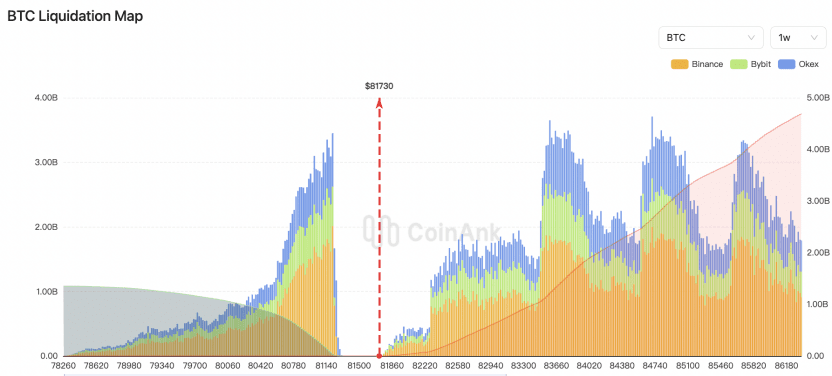
CoinAnk clearing map data shows that if BTC breaks through $88,660, the cumulative short liquidation strength on mainstream CEX will reach $8.134 billion. Conversely, if Bitcoin falls below $78,260, the cumulative long liquidation strength on mainstream CEX will reach $1.355 billion.
We believe that Bitcoin has formed an asymmetric clearing threshold in the range of $78,260 to $88,660, with strategic layout differences between long and short forces at key price levels. Market resilience is significantly differentiated: if it breaks through $88,660, it will trigger $8.13 billion in short liquidations, which is 6 times the intensity of long liquidations, indicating that shorts are densely defended near historical highs; while the amount of long liquidations below $78,260 is only $1.35 billion, reflecting the relatively restrained leverage of longs, possibly due to institutional capital providing support.
Structural motivations include triple logic: first, the CME Bitcoin futures open interest gap is currently at $85,200, resonating technically with the liquidation peak; second, short positions are concentrated above $89,000, with some hedge funds attempting to bet on a weakening ETF capital flow (net outflow of $830 million last week) suppressing breakthrough momentum; third, on-chain data shows that whales have increased their holdings by 28,000 BTC in the $78,000-$80,000 range, forming a liquidity moat.
On the potential transmission path, breaking through $88,660 may trigger a short squeeze, pushing the price to test the psychological level of $95,000. However, caution must be exercised regarding the sharp rise in derivative funding rates (currently at 0.03%) that may lead to profit-taking. If it falls below $78,260, strong liquidation of longs or miner sell-offs (averaging 900 coins per day) may create a combined force, but 94% of ETF holders have a cost basis below $75,000, which may limit downward space. The current market is in a liquidity rebalancing phase of a continuation bull market, and directional choices need to be validated by macro liquidity and on-chain chip distribution.
5. Key macro events and financial data forecasts for this week.
The important macro data to be announced this week is as follows:
Monday 21:45, U.S. March Chicago PMI
Tuesday 21:45, U.S. March S&P Global Manufacturing PMI final value
Wednesday 20:15, U.S. March ADP employment numbers
Thursday 01:00, European Central Bank President Lagarde delivers a speech
Thursday 19:30, the European Central Bank will release the minutes of the March monetary policy meeting.
Thursday 19:30, U.S. March Challenger job cuts
Friday 00:00, Federal Reserve Vice Chairman Jefferson delivers a speech
Friday 20:30, U.S. March unemployment rate, U.S. March seasonally adjusted non-farm employment, U.S. March average hourly wage year-on-year/month-on-month
Friday 23:25, Federal Reserve Chairman Powell delivers a speech.
The intensive release of macroeconomic data from the U.S. and Europe, along with speeches from central bank officials this week, will have a significant impact on the crypto market. Core points of focus include:
1. Federal Reserve policy expectations dominate market sentiment. Federal Reserve Chairman Powell's speech on Friday and the statements from several officials will be the focus. If he emphasizes inflation stickiness or delays interest rate cuts (such as mentioned hawkish tendencies), it may exacerbate risk asset sell-offs, putting pressure on cryptocurrencies such as Bitcoin. Conversely, if he hints at a need for policy shifts due to economic slowdown, it may boost market liquidity expectations, driving a rebound in crypto assets. Additionally, the ADP employment data serves as a precursor to non-farm data; if it shows an overheating labor market, it may strengthen expectations for maintaining high interest rates, suppressing buying in the crypto market.
2. Non-farm data and PMI form cross-validation. The non-farm employment, unemployment rate, and wage growth data on Friday are particularly crucial. If employment growth exceeds expectations (such as a forecast of +200,000) and wages rise month-on-month, it may confirm economic resilience, weakening the necessity for rate cuts, leading to a synchronized pullback in the crypto market and U.S. stocks. Conversely, if the data is weak (such as indicated signs of a slowdown in employment), it will enhance expectations for easing, with risk appetite rebounding, potentially driving crypto assets up. At the same time, if the manufacturing PMI falls below the boom-bust line (as analyzed, indicating contraction risks), it may trigger recession concerns, indirectly benefiting Bitcoin as "digital gold."
3. The spillover effect of the European Central Bank's actions. If Lagarde's speech and the meeting minutes release signals an early rate cut in the Eurozone, it may push up the dollar index through euro depreciation, creating pressure on cryptocurrencies priced in dollars. Conversely, if Europe maintains a tightening stance, a relatively weaker dollar could help attract capital into the crypto market.
Overall impact path: The crypto market may exhibit high volatility this week, especially in short-term trading before and after data releases. Mid-term trends will still depend on the Federal Reserve's policy path and the likelihood of a "soft landing" in the macroeconomy. If the data combination shows "strong employment + high inflation," Bitcoin may test key support levels; while a combination of "weak employment + low PMI" could catalyze market bets on liquidity easing, pushing crypto assets through resistance. Historical experience shows that subtle changes in Powell's wording often trigger sharp price fluctuations, necessitating caution against sudden market movements following speeches.