

Recently, the topic of crypto market regulation has attracted widespread attention. First, Kraken was fined $30 million for providing cryptocurrency staking services in the United States, and exchange staking has become the focus of everyone's discussion. While people are paying attention to whether the SEC will take action against Coinbase Exchange, the SEC has begun to focus on the stablecoin - BUSD.
According to media reports, the stablecoin issuer Paxos may face a lawsuit from the SEC due to issues related to BUSD. The SEC believes that BUSD is an unregistered security and may take compulsory measures against Paxos. If the lawsuit is confirmed, it will have a significant negative impact on the current crypto ecosystem.
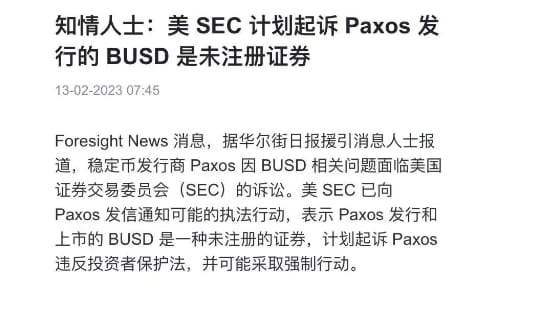
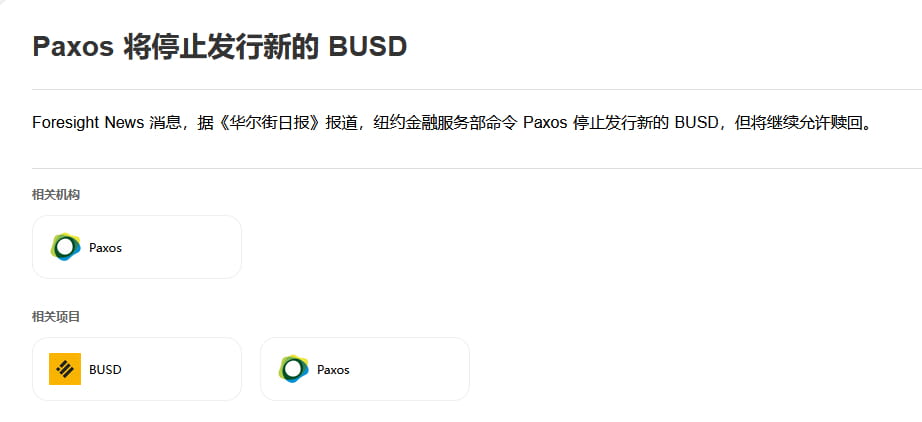
Immediately afterwards, on the afternoon of February 13th, Beijing time, the New York Department of Financial Services ordered Paxos to stop issuing new BUSD tokens and continue to manage the redemption of BUSD. That is to say, the scale of BUSD has been limited and only the exit of existing stocks is allowed. This is obviously bad news for BUSD. At the same time, the stablecoin market may usher in a major reshuffle. Crypto players holding centralized stablecoins in a bear market may face many uncertain risks.
The risks of centralized stablecoins
There are many ways to issue stablecoins. The most common ones are issuance by centralized institutions and over-collateralization issuance by decentralized smart contracts. Other forms such as algorithmic stablecoins will not be discussed in depth here due to their small market size.
The most common centralized issuances are stablecoins such as USDT, USDC, and BUSD. They have a registered institution as the issuer and provide a 1:1 exchange service between these stablecoins and the fiat currency USD.
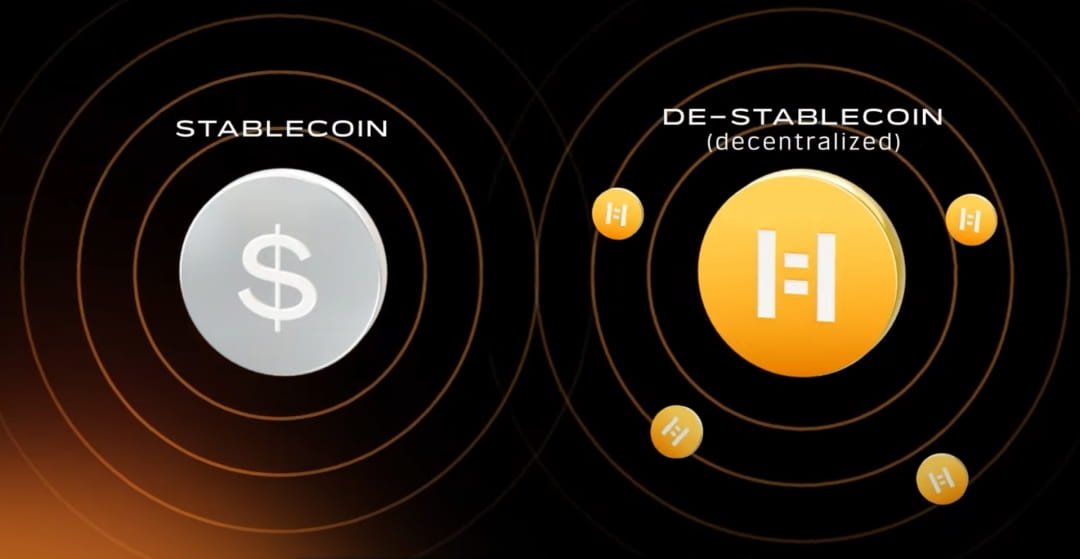
The decentralized issuance method is that everyone pledges cryptocurrencies through smart contracts, and the smart contracts automatically issue stablecoins in the corresponding proportion and provide them to the pledgers. DAI on the Ethereum chain and HAY on the BNB Chain are both decentralized issuance methods.
The biggest risk of centralized issuance is opacity, which is very obvious in USDT. Although USDT claims to be issued at a 1:1 ratio, negative news about the audit of USDT by its issuer Tether is often reported. For example, Tether's replacement of an unknown auditing company caused widespread panic in the market. In 2021, Tether, the issuer of USDT, received a fine of $45.2 million from the U.S. Commodity Futures Trading Commission (CFTC), mainly because USDT's 1:1 support by the U.S. dollar was false propaganda, which also questioned the credibility of USDT, and FUD news came out from time to time. The core of this situation is that the issuance of centralized stablecoins itself involves huge amounts of U.S. dollar assets. At the same time, it is easy to forge, supervision is not sound, and it is particularly challenging to human nature, so this will bring uncontrollable risks.

Although USDT is still operating normally, the market's doubts about Tether's USDT audit have not disappeared. USDT is generally considered to be a mine buried in the crypto market, and no one knows when it will explode. Even so, because USDT is widely adopted and accepted, and there is currently no product on the market that can replace USDT, people have to continue using it. The situation that BUSD is facing now makes people worry about the prospects of USDT.
Advantages of decentralized stablecoin HAY
The decentralized stablecoin HAY is generated by over-staking crypto assets in smart contracts. For example, when we stake $2 of ETH or BNB, we get $1 worth of DAI or HAY stablecoins, and when we return $1 of DAI or HAY, we can get back the ETH or BNB we staked.

HAY solves the stablecoin peg problem
The issuance of decentralized stablecoins is carried out through smart contracts, using an over-collateralized approach, with sufficient assets to support the value of #HAY. Therefore, we don’t need to worry about the anchoring problem between decentralized stablecoins and fiat currencies. The decentralized stablecoin HAY can perfectly solve the liquidity problem on BNB Chain.
HAY can replace the gap left by BUSD withdrawal
#BNB Chain has a rich DApp ecosystem, ranging from DeFi to asset pledge, to GameFi, NFT, P2E, and Metaverse. The essence of BUSD's regulation is a gentle exit, and the market demand for decentralized stablecoins will not decrease as a result. The BNB ecosystem may even be negatively affected by the exit of BUSD. The value anchoring of on-chain assets and on-chain liquidity both require stablecoins as a medium. HAY, as a decentralized stablecoin, can replace the function of BUSD, fill the market gap caused by the exit of BUSD, and continue to promote the prosperity of the ecosystem on BNB Chain.
HAY is natively issued on BNB Chain
The decentralized stablecoin native to the public chain is very critical. Currently, part of the stablecoins on the BNB Chain come from other chains, such as USDT, USDC, DAI, etc., which are all from Ethereum and other chains. The other part is the native stablecoins on the BNB Chain, such as BUSD and HAY.
Cross-chain stablecoins can cross over or cross over. Once stablecoins on other chains, such as USDC, USDT, etc., cross back to the original chain (redeem and exchange for US dollars), this will affect the ecological development of BNB Chain. The native decentralized stablecoin can increase the stability of BNB Chain's DeFi ecology, thereby promoting the ecological development of BNB Chain. This is also one of the key advantages of HAY.
Analysis of the Problems of Stablecoins
Stablecoins generally encounter three problems, namely regulatory issues, currency anchoring issues, and security issues. In this regard, we use HAY and USDT to analyze decentralized stablecoins and centralized stablecoins one by one.
1. Regulatory issues
HAY is issued through smart contracts, which are deployed on the blockchain. Anyone can issue it with over-collateralization. There is currently no regulatory body, and the regulatory body cannot supervise smart contracts, just like Bitcoin cannot be banned.
USDT needs to deal with regulation and needs to obtain a license or regulatory approval before it can be used. For example, the SEC believes that BUSD is an unregistered security, which is a possible risk. Paxos's suspension of issuing new BUSD brings uncertain regulation to the development of BUSD. This kind of regulation often comes without warning and has a significant impact on the market.
2. Value Anchoring Issue
HAY anchors stablecoins through over-collateralization of smart contracts. The pledged assets and circulating assets can be checked on the chain. At the same time, there are clear rules such as liquidation mechanism and price stabilization mechanism, which can achieve the value anchoring of stablecoins and legal currencies.
USDT is obtained through a 1:1 exchange with the US dollar. The issuer needs to hire a third-party auditing agency to regularly audit the supporting US dollar assets, which incurs considerable audit fees. If the issuer misappropriates funds, the centralized stablecoin may depreciate or even return to zero.
3. Security issues
The security of HAY mainly relies on the security provided by smart contracts. The security of smart contracts is mainly audited by code auditing agencies. At the same time, some contract codes are open source, and the normal operation of the decentralized stablecoin project is maintained through on-chain governance. No one can freeze your HAY, and the BNB staked in the smart contract cannot be frozen by anyone.
When USDT is involved in theft or other illegal activities, Tether can freeze the corresponding coins, making it impossible to transfer them on the chain. The security of the underlying assets is mainly related to which institution the issuer keeps the US dollars. Currently, many banks refuse to provide Tether with US dollar deposit services. Once these US dollar assets or government bonds are frozen, they may return to zero.
From these aspects, decentralized HAY has more advantages than centralized USDT or BUSD, and is more in line with the decentralized spirit of blockchain.
Amid turmoil, HAY has opportunities for development
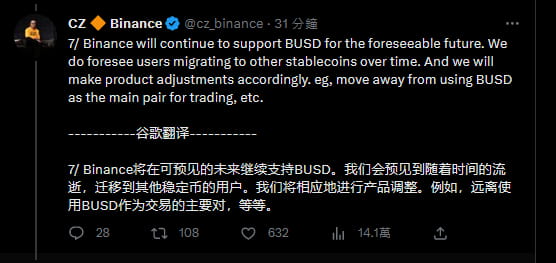
After BUSD was suspended, CZ also announced on Twitter that the product would be adjusted and BUSD might no longer be used as the main trading currency. There is no doubt that this is an important development opportunity for BNB Chain's native decentralized stablecoin HAY.
First, HAY is decentralized, there is no regulatory problem, and the code security has been audited by multiple third-party institutions, and it has already reached a certain scale on BNB Chain. Secondly, HAY has established cooperative relationships with multiple DeFi applications in the BNB Chain ecosystem. In addition to staking on the Helio official website, HAY can also be used on DeFi applications such as Boosted vaults, Magpie, Wombat, and THENA.
According to Helio Protocol's plan, the application scenarios of HAY on BNB Chain will continue to be expanded in the future. It can be seen that although centralized stablecoins face regulatory issues, HAY will also develop rapidly as a result and continue to maintain the stability and prosperity of the decentralized application ecosystem on BNB Chain.