


Original title: (AI×Crypto Future Intersection: In-depth Analysis of Five Major AI Layer1 Projects)
Original author: Louis, Biteye
With the rapid development of AI technology, traditional blockchain architectures can no longer meet the high-performance computing and complex data processing needs of AI applications, prompting the rise of Layer 1 blockchain platforms optimized for AI, which exhibit diverse characteristics in terms of technical architecture, application scenarios, and business models. This study delves into the five leading AI Layer1 projects: Bittensor, Vana, Kite AI, Nillion, and Sahara, and provides detailed participation guides for investors.
One, Bittensor: Decentralized AI network infrastructure
As an early explorer in the blockchain AI field, Bittensor is committed to building an open decentralized artificial intelligence cooperation network. Its goal is to break down the centralized barriers in traditional AI research and development, allowing more participants to contribute and benefit together. Unlike traditional centralized AI systems (such as OpenAI and others), Bittensor has created an open peer-to-peer ecosystem where participants can receive corresponding rewards based on their contributions to the network.
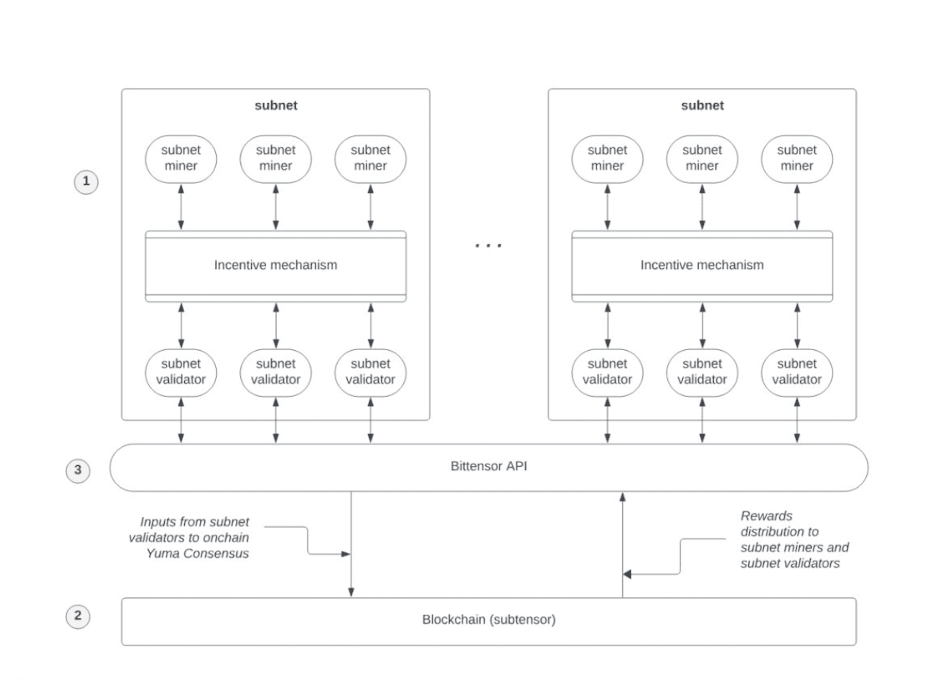
Bittensor's technical architecture adopts a dual-layer structural design:
· Root network (mainnet): Responsible for coordinating the entire system, verifying and managing the issuance of TAO tokens, serving as the hub for resource allocation across the entire network.
· Subnet ecosystem: Each subnet acts like an independent AI laboratory, developing specialized solutions for specific AI application scenarios and proving their value in market competition.
This design allows Bittensor to balance the overall network's stability with the expertise of various fields, providing a flexible infrastructure for the development of decentralized AI.
Ecosystem development progress
The number of subnets has expanded from the initial 32 to over 64, covering various AI application scenarios such as text generation, trading signals, and data annotation.
The active user base has reached 140,000, achieving a doubling growth compared to the previous year.
The total market valuation of subnets exceeds $100 million, with daily trading volume maintained at around $45 million.
Institutional participation has significantly increased, with renowned fund Grayscale incorporating TAO into its decentralized AI fund, adjusting the weight to 29.55%.
These data indicate that Bittensor is gaining recognition from an increasing number of market participants, and its ecosystem is entering a positive development track.
Bittensor's recently completed dTAO (Dynamic TAO) system upgrade is a significant innovation in its economic model. The core of this upgrade is to optimize the allocation mechanism for the TAO token, shifting from a resource allocation method reliant on validators’ subjective judgments to a more market-oriented allocation mechanism, allowing resources to flow more precisely to truly competitive subnets.
Bittensor's original economic model has exposed several key issues in practice:
· Lack of objectivity in evaluation mechanisms: As the number of subnets increases, validators find it difficult to comprehensively and objectively assess the actual value of each subnet, leading to decreasing allocation efficiency.
· Power structure imbalance: Many validators are also subnet operators, and this role overlap easily leads to conflicts of interest, with validators possibly favoring the subnets they participate in or even engaging in private trading.
· Participation barriers: Ordinary TAO holders find it difficult to directly influence network resource allocation decisions, with power overly concentrated in a few validators.
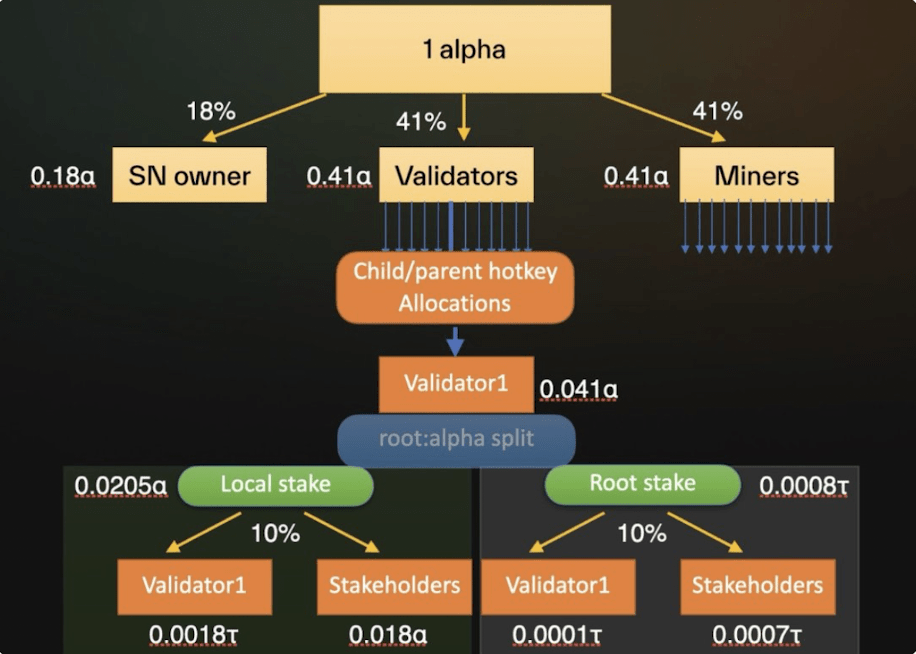
To address these issues, the dTAO upgrade introduces a dynamic resource allocation system based on market mechanisms. This system transforms each subnet into an independent economic unit, driven by users' actual needs.
Its core innovation is the subnet token (Alpha token) mechanism:
· Operational principle: Users can obtain Alpha tokens issued by various subnets by staking TAO, representing their support for specific subnets.
· Resource allocation logic: The market price of Alpha tokens becomes a signal for measuring the demand strength of subnets. Initially, the alpha token price is the same, with only 1 TAO and 1 alpha token in each pool. As liquidity is added for both tokens in the subnet, the price of the alpha token will also change accordingly, and the emission of TAO will be proportionally allocated based on the subnet token prices, with higher-priced subnets receiving more TAO allocation, thus achieving automatic optimization of resource allocation.
This mechanism significantly improves the efficiency and fairness of resource allocation, stabilizing the value of TAO tokens and providing more avenues for ordinary users to participate in network governance.
Investor participation strategy
For retail investors interested in participating in the Bittensor ecosystem, there are several main avenues:
· Liquidity provision: Obtain Alpha tokens for various subnets by staking TAO and participate in subnet ecosystem construction. This method is relatively robust, allowing for resource allocation based on different subnet perspectives to diversify risks.
· Secondary market investment: Directly purchase Alpha tokens of interesting subnets from the trading market. However, it should be noted that Alpha tokens are currently in the initial emission phase, with high inflation rates and selling pressure, and investors should carefully choose subnets with long-term development value.
· Technical contribution: For investors with technical backgrounds, they can choose to become network validators or subnet miners, earning rewards by verifying the quality of AI models on the network or running AI models for specific subnets.
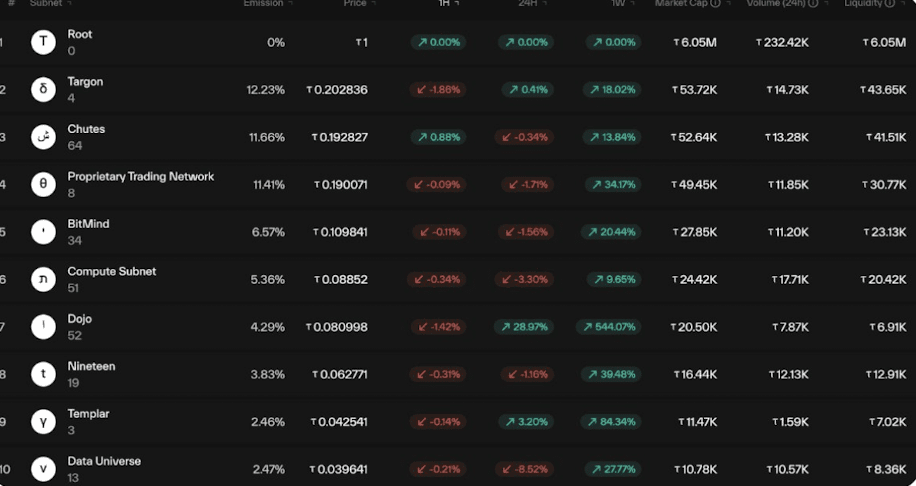
Currently, the most active subnets include:
· Subnet 4 Targon: Focused on AI inference services for text generation, characterized by fast response times and low costs.
· Subnet 64 Chutes: Provides API interfaces for various LLMs, allowing developers to build and deploy AI applications on the Bittensor network.
· Subnet 8 PTN: Focused on the financial sector, incentivizing miners to generate accurate trading signals through reward mechanisms, covering various financial markets such as forex and cryptocurrencies.
· Subnet 52 Dojo: Focused on data annotation, encouraging users to earn tokens through data labeling. YZi Labs announced it invested in its parent company Tensorplex.
Two, Vana: Data sovereignty and value reconstruction platform.
The Vana project focuses on solving a core issue in today's digital economy: ownership and value distribution of personal data. In the current internet ecosystem, users' data is mostly monopolized and controlled by large tech companies, while the users who actually create this data rarely benefit from it. Vana's innovation lies in establishing an ecosystem where users truly own and control their data while being able to obtain economic returns from it.
As an EVM-compatible Layer 1 blockchain network, Vana's technical architecture consists of five core components:
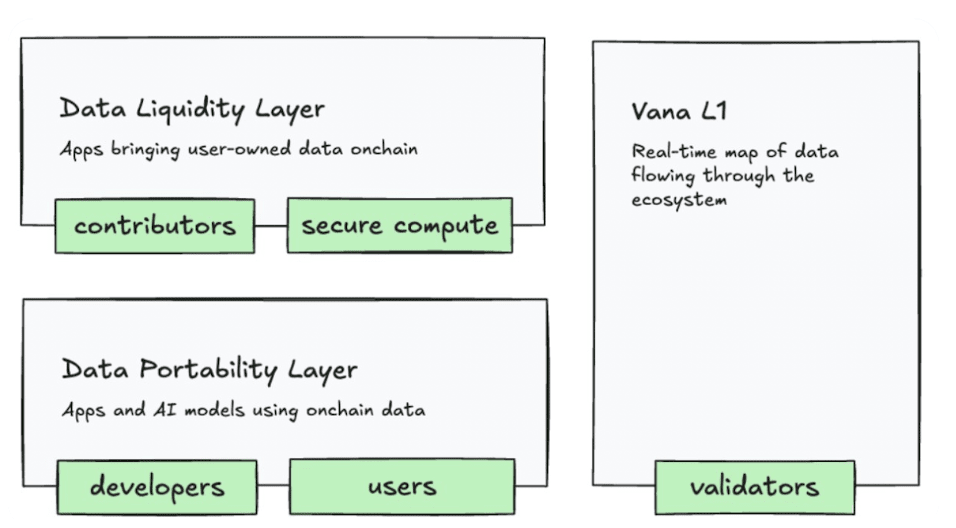
1. Data Liquidity Layer: This is the core of the Vana network, achieving incentives, aggregation, and verification of data assets through data liquidity pools (DLP). Each DLP is a smart contract specifically designed to aggregate specific types of data assets, such as social media data and browsing history.
2. Data portability layer: Ensures that user data can be conveniently transferred between different applications and AI models, enhancing the flexibility of data usage.
3. Universal Connectome: Tracks real-time data flow across the ecosystem, forming a data ecosystem map that ensures system transparency.
4. Unmanaged data storage: An important innovation of Vana is its unique data management approach. Users' raw data is not put on-chain but rather stored at locations chosen by users, such as cloud servers or personal devices, ensuring complete control over their data.
5. Application ecosystem: Based on data, Vana has built an open application ecosystem, where developers can use the data accumulated in DLPs to build various innovative applications, including AI applications, while data contributors can earn dividend rewards from these applications.
This design enables Vana to create a fairer data value distribution mechanism while protecting user data privacy, providing an important data foundation for the development of decentralized AI.
Latest developments
Vana's financing and partnership expansion continue to advance:
In February 2025, YZi Labs announced a strategic investment in Vana, with Binance founder CZ joining as an advisor.
In terms of ecosystem construction, Vana has built multiple data projects covering various fields, from social media data to financial forecasting data, including: Finquarium (financial forecasting data), GPT Data DAO (ChatGPT chat data), Reddit Data DAO (Reddit user data), Volara (Twitter data), Flirtual (dating data), etc.
Recently, Vana organized a hackathon during Eth Denver, offering a prize pool of up to $50,000 to incentivize developers to build DataDAOs and AI applications based on Vana data, further expanding its ecosystem.
These developments indicate that Vana is actively building a complete ecosystem around data ownership and value realization, with its development momentum worth noting.
Participation path analysis.
For investors interested in participating in the Vana ecosystem, the main participation methods include:
· Data contribution: Upload your social media data, browsing data, etc. to the corresponding data liquidity pool (DLP) to earn corresponding token rewards. For example, contributing data in the Reddit Data DAO can earn RDAT tokens. This is the most basic and lowest-threshold way to participate.
· Staking participation: Stake Vana tokens through DataHub into promising DLPs to share the Vana block rewards obtained by DLPs. It is important to note that only the top 16 DLPs can receive rewards, so choosing quality DLPs is crucial.
· Ecosystem co-construction: For participants with certain expertise, there is an opportunity to create new data liquidity pools. As the creator of a new DLP, they need to design specific data contribution goals, verification methods, and reward parameters, and implement a contribution proof function that can accurately assess the data value.
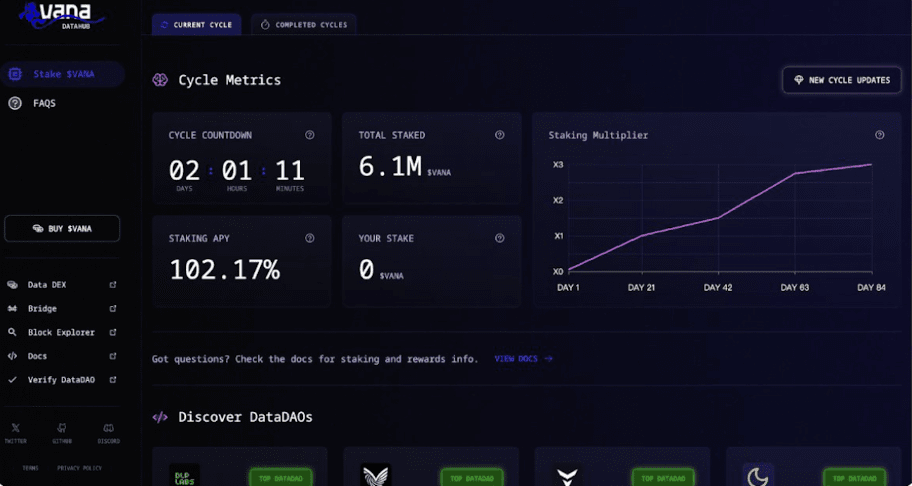
Vana represents an important innovation at the intersection of blockchain technology, data economy, and artificial intelligence. By establishing a decentralized data platform, Vana aims to redefine data ownership and value distribution mechanisms, providing fair returns to data creators while offering high-quality training resources for AI development.
Three, Kite AI: Technical breakthroughs of AI native public chain
Kite AI is a native Layer 1 blockchain project focused on the AI field, built on the Avalanche framework. It aims to address various challenges faced by traditional blockchains in handling AI assets, particularly how to achieve clear rights and incentives for AI data, models, and agent contributions.
Kite AI has proposed four core technological innovations:
1. PoAI consensus mechanism: Proof of Attributed Intelligence is a consensus mechanism pioneered by Kite AI, accurately tracking the value contributions of data, models, and AI agents through an on-chain verifiable contribution record system. The project has designed a dynamic reward pool mechanism that distributes profits according to contribution proportions, effectively addressing issues such as 'data black box' and 'model plagiarism' in traditional AI economies.
2. Composable AI Subnets: Kite AI adopts a modular architecture, supporting developers to build industry-specific AI collaborative ecosystems on demand. For example, in the healthcare subnet, patient data can be encrypted and selectively authorized to pharmaceutical companies for AI model development, with profits distributed among data subjects, model developers, and subnet maintainers, creating a win-win ecosystem.
3. AI native execution layer: Kite AI is building an on-chain AI native execution layer specifically for handling AI computation tasks such as inference, embedding, and fine-tuning/training. Users can authorize smart contract wallets to execute inference calls and interact with models through this layer. This execution layer not only supports blockchain transactions and state changes but also integrates confidential computing environments (such as Trusted Execution Environments, TEE) to ensure data security and privacy protection during the computation process.
4. Decentralized data engine: Kite AI ensures that data creators receive fair compensation in the AI workflow. The platform has built-in compliance modules that meet regulations such as GDPR/CCPA, satisfying global data privacy requirements and reducing compliance costs for developers.
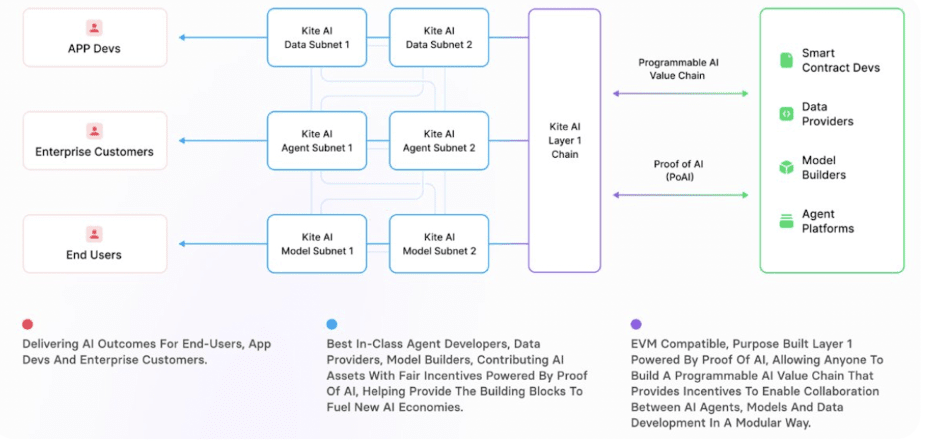
These technological innovations enable Kite AI to create a fairer and more transparent value distribution environment for AI developers and data providers, promoting the decentralized development of AI technology.
Development status.
Kite AI launched its incentive testnet on February 6, 2025, which is the first AI-native Layer 1 sovereign blockchain testnet.
The testnet has shown impressive performance since its launch:
In less than 70 hours after the testnet launch, the number of connected wallets exceeded 100,000, and as of now, a total of 1.95 million wallets have joined the incentive testnet V1, with over 1 million wallets interacting with AI agents, totaling over 115 million calls.
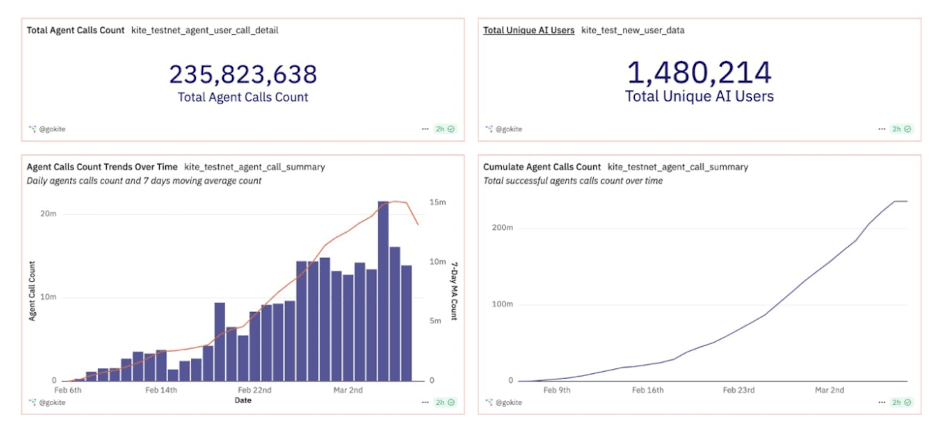
The project has a strong background, developed by an experienced Silicon Valley team, with co-founders having deep technical leadership experience in the AI field, having worked at top tech companies such as Uber, Salesforce, Databricks, etc. Core team members come from industry-leading companies like Google, BlackRock, Uber, and the NEAR Foundation, with academic backgrounds from top institutions like MIT and Harvard.
In terms of capital support, the project has received investments from top institutions such as General Catalyst, Hashed, Hashkey, and Samsung Next, and has established technical collaborations with Eigenlayer, Sui, Avalanche, and AWS.
As a selection committee member of Avalanche's InfraBUILDL(AI) program, Kite AI plays an active role in promoting the development of the Avalanche AI ecosystem, this collaboration aims to make Avalanche a leading blockchain for AI applications.
As the global data economy is expected to exceed $70 billion by 2025, Kite AI is poised to become an important infrastructure for data rights confirmation and monetization, and its development potential is worth looking forward to.
Participation opportunity analysis.
Early participation in the Kite ecosystem has several main avenues:
· Testnet participation: Kite AI's testnet is now open, providing generous incentives for early participants. Investors can start participating through the official website (gokite.ai) or the testnet portal (testnet.gokite.ai) to experience network functionalities and have the opportunity to earn testnet rewards.
· Application development: Investors with development capabilities can attempt to deploy AI-driven DApps on Kite AI, exploring innovative scenarios such as on-chain model training and data markets. The platform provides developers with rich tools and support, lowering the barriers to entry.
· Subnet deployment: Kite AI has prepared a token airdrop plan for teams that are among the first to deploy AI subnets, encouraging developers to create specialized AI subnets. For investors with specific industry expertise, this is a great opportunity to leverage their expertise for additional returns.
· Early contributor points: Users who actively participate in the construction of the Kite AI ecosystem will receive point rewards and priority support for ecosystem resources. These points may be converted into specific tokens or other rights in the future.
Four, Nillion: Frontier exploration of privacy computing.
Nillion is redefining the way sensitive data is processed through its unique 'blind computation' technology, opening new avenues for future digital privacy protection.
Nillion is a decentralized public network based on an innovative cryptographic primitive called Nil Message Compute (NMC), allowing network nodes to operate in a non-traditional blockchain manner. The project was founded in November 2021, led by forward-thinking innovators like Alex Page and Andrew Masanto, aiming to create a system that can safely handle high-value data without exposing sensitive details.
Nillion's core advantage lies in its 'blind computation' capability— a process that allows data to remain encrypted throughout its lifecycle of storage, transmission, and processing. Its technical architecture integrates various cutting-edge privacy protection technologies:
· Multi-Party Computation (MPC): Allows multiple nodes to collaboratively compute a function without disclosing their private inputs, achieving joint computation without data sharing.
· Fully Homomorphic Encryption (FHE): Allows direct operations on encrypted data, ensuring that data remains encrypted from start to finish, providing privacy protection throughout the process.
· Zero-Knowledge Proof (ZKP): Provides a method to verify computations without disclosing any underlying data, enhancing the system's credibility.
· Nada language: A domain-specific language designed for creating secure MPC programs, simplifying the development process of privacy protection applications and lowering the learning curve for developers.
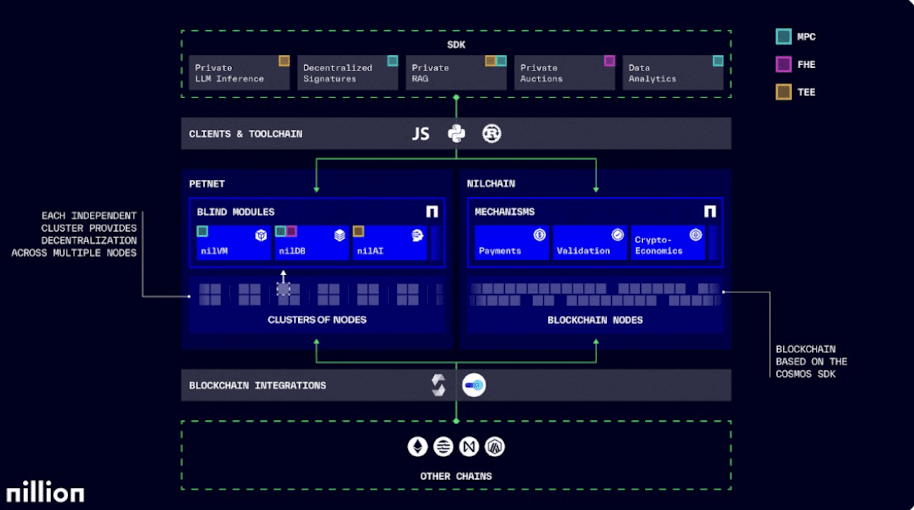
Nillion's network architecture consists of three main layers: processing layer (responsible for secure computing), coordination layer (NilChain, managing communication between nodes), and connection layer (serving as a gateway to connect external systems). This multi-layer architecture enables Nillion to provide powerful computing capabilities while protecting data privacy, meeting the needs of various privacy-sensitive scenarios.
Latest development progress
According to the latest information, the development of the Nillion network is steadily advancing:
The Nillion mainnet is planned to go live in March 2025 (this month). The total supply of Nillion tokens is 1 billion, expected to be distributed at the time of mainnet launch.
In terms of financing, Nillion completed a $25 million funding round led by Hack VC on October 30, 2024, with investors including well-known institutions such as HashKey Capital, Animoca Brands, and angel investors from projects like Arbitrum, Worldcoin, and Sei. This round of financing brings Nillion's total funding to $45 million, providing ample financial support for the project's long-term development.
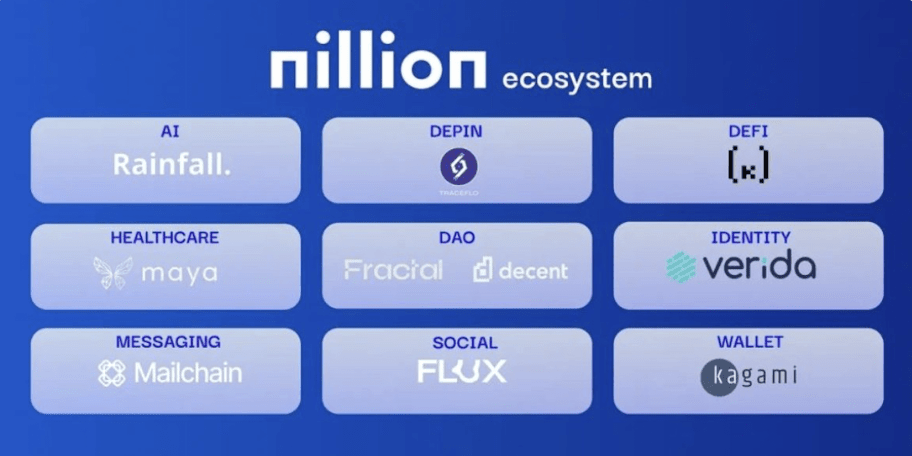
In terms of ecosystem expansion, Nillion has established integration relationships with several mainstream public chains, including NEAR Protocol, Aptos, Arbitrum, Mantle, and Sei. Through collaboration with NEAR Protocol, Nillion aims to enhance privacy tools, enabling developers to innovate more effectively in the DeFi space.
In the AI ecosystem, Nillion has established partnerships with several AI-related projects, including Ritual, Crush AI, Skillful AI, Virtuals Protocol, etc. For example, Virtuals Protocol is currently the largest multimodal AI agent protocol, which, through collaboration with Nillion, utilizes its secure computing infrastructure to support the private training and inference of AI models, achieving a perfect combination of AI and privacy.
For a more detailed introduction to the Nillion ecosystem project, please refer to our previous article: https://x.com/BiteyeCN/status/1881297074228252702
Ecosystem participation strategy
As the Nillion mainnet approaches launch, retail investors have various ways to participate in its ecosystem:
· Token economic participation: Although the eligibility check for Nillion's airdrop closed on February 3, 2025, there will be more opportunities to participate in Nillion's token economic system with the launch of the mainnet. According to official information, Nillion airdrops will reward community members and early builders with up to 75 million NIL tokens.
· Developer ecosystem participation: Nillion provides developers with rich tools and resources to support the creation of privacy-protecting applications:
· Node Deployment Kit (NDK): Simplifies the process of joining the network and managing nodes, lowering technical barriers.
· Nada language: Designed specifically for creating secure MPC programs, making it easier for developers to build privacy-protecting applications.
· Application fields: Developers can create applications based on Nillion in multiple fields, including:
· Artificial Intelligence: Processing data and inference without exposing sensitive information.
· Personalized agents: AI agents for storing, computing, and processing private data.
· Privacy model inference: AI models that securely handle private data.
· Privacy knowledge base and search: Encrypt storage of data while providing search functionality.
· Network node operation: As a decentralized network, Nillion offers participants the opportunity to operate nodes. By running nodes, users can contribute computing resources and receive corresponding rewards while helping to maintain the network's security and decentralization.
Five, Sahara AI: A platform for building a new economy of AI assets.
Project development.
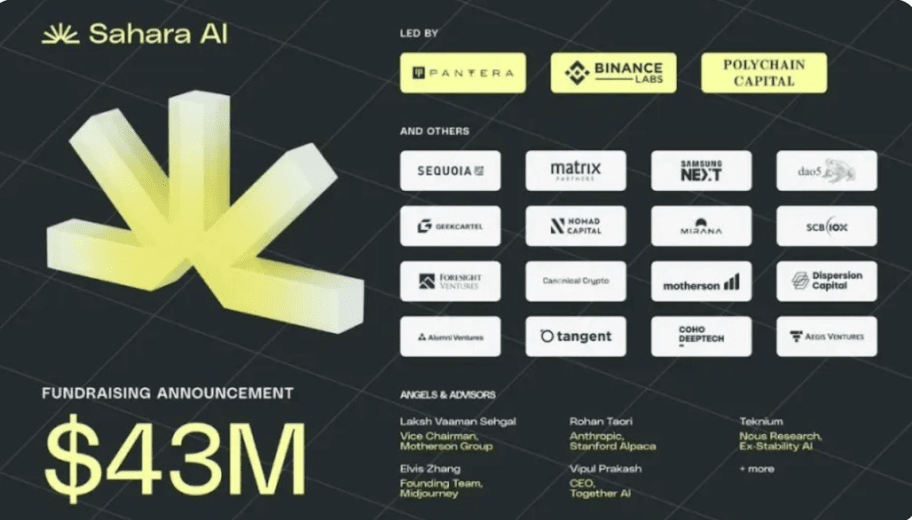
Sahara AI's core philosophy is to build a 'human AI collaboration network,' enabling ordinary users, developers, and enterprises to participate in the creation, deployment, and monetization of AI assets. Through this collaborative model, Sahara AI hopes to lower the entry barriers for AI, allowing every participant to share in the industry's growth dividends. The project has successfully secured a total of $43 million in funding led by Binance Labs, Polychain Capital, and Pantera Capital.
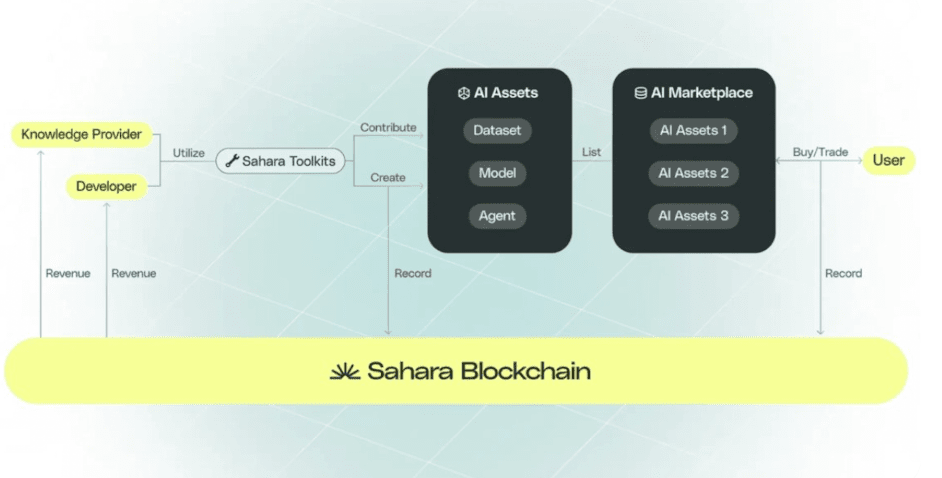
The technical architecture of the platform consists of three key components:
1. Sahara Blockchain: Provides the foundation for secure, transparent transactions and efficient AI lifecycle management within the ecosystem.
2. AI infrastructure: Distributed collaborative training and service capabilities supporting advanced algorithms and computing frameworks.
3. Sahara AI Marketplace: A decentralized trading center for AI assets.
These components together form a complete ecosystem, supporting the entire process from data collection and annotation to model training, deployment, and monetization.
Latest development progress
The Sahara AI project is in a rapid development stage, with its testnet having gone through several important phases:
In December 2024, Sahara AI launched the beta version of the first phase of the data service platform testnet, attracting more than 780,000 user applications, with over 10,000 candidates receiving the first batch of participation qualifications. In this phase, participants can contribute to the AI ecosystem by completing tasks for data collection, optimization, and annotation and receive rewards.
In February 2025, Sahara AI launched the second phase of the testnet, expanding the platform's contributor base and introducing additional reward opportunities. This phase further strengthened user participation in shaping the future of decentralized AI.
The latest development is that Sahara AI announced the public testnet named 'SIWA' will launch on March 10, 2025. This is considered the last major test before the Sahara AI mainnet launch and TGE, and it may also be the last opportunity for participants to earn airdrop rewards (referred to as 'points').
Sahara AI has released its roadmap for 2024-2025, which includes several key milestones:
· Q4 2024: Launched data service platform and testnet, allowing users to earn rewards through data collection and annotation.
· Q1 2025: AI Marketplace launch, providing development tools and data service expansion features, supporting model development, training, and deployment, and introducing an early access program.
· Q2 2025: Launch of the Sahara Studio toolkit, covering model training, deployment, and workflow management, further optimizing the developer experience.
· Q3 2025: Launch of the Sahara Chain mainnet, providing secure and transparent on-chain infrastructure for large-scale decentralized AI, while supporting the assetization and trading of data and models.
On March 1, 2025, Sahara AI launched an incubator program aimed at discovering and supporting the world's most promising AI x Web3 innovation projects. This program focuses on two tracks: AI infrastructure and AI applications, welcoming teams with MVP or above maturity to participate. Successfully selected projects will have the opportunity for full integration into the Sahara AI ecosystem, gaining exclusive technical support, market expansion resources, and investment opportunities.
Ecosystem participation strategy
For users interested in participating in the Sahara AI ecosystem, here are several main ways to participate:
1. Join the waiting list and testnet.
The first step to participating in the Sahara AI ecosystem is to join the official waiting list:
· Visit the official waiting list page of Sahara AI.
· Fill in the required information and submit the application form.
· Selected users will receive access to the testnet.
· Complete various tasks in the testnet to accumulate Sahara points.
Notably, the SIWA public testnet scheduled to launch on March 10, 2025, may be the last opportunity to receive airdrop rewards before the mainnet TGE, and interested users should apply promptly.
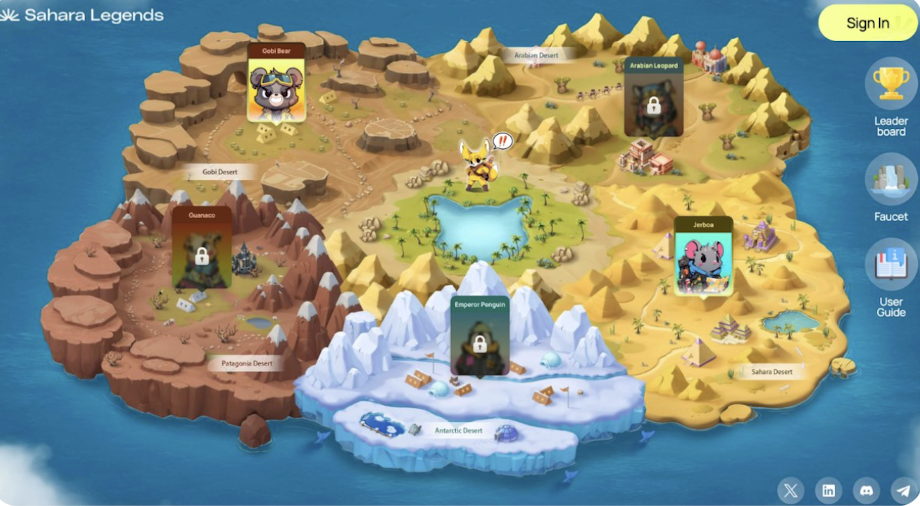
2. Participate in Legends activities.
Sahara AI also offers an event called 'Legends,' allowing users to collect fragments and mint NFTs:
· Visit the Sahara Legends event page and log in to connect your wallet.
· Explore five unique desert-themed areas and start collecting fragments.
· Invite friends to join the event to earn additional fragments.
· Use the collected fragments to mint Soulbound Desert Guardian NFTs.
· Collect mascots NFT from each desert and merge them to create exclusive Fennec Fox NFTs.
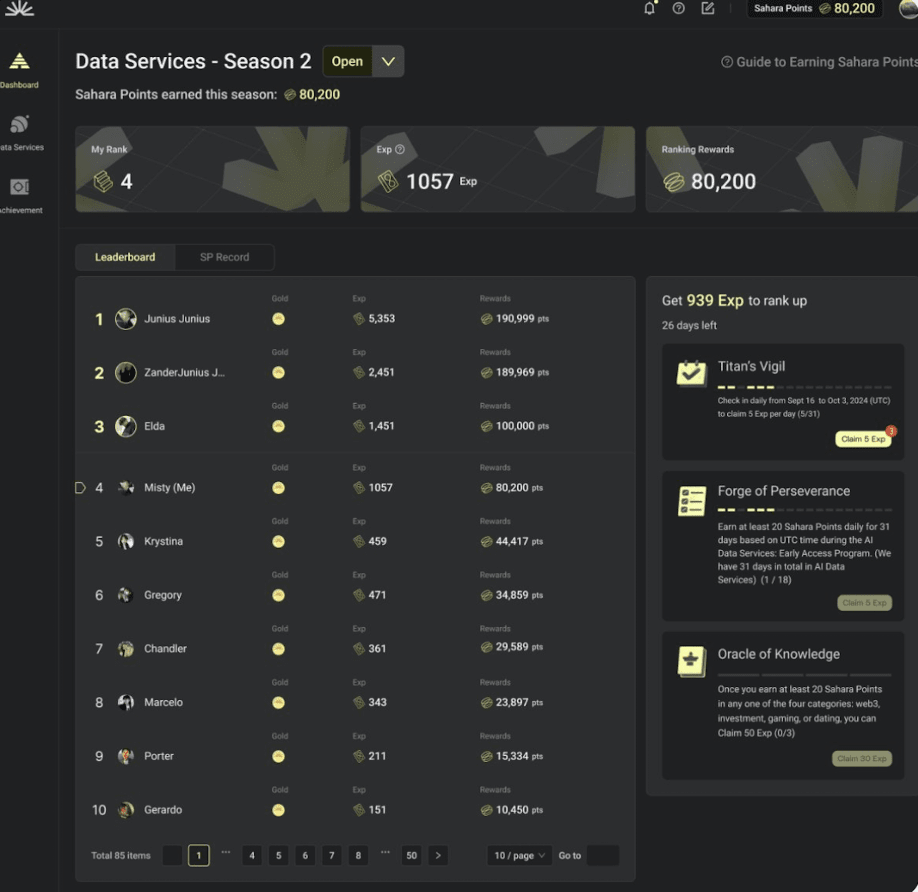
3. Contributing data service platform
Sahara AI's data service platform provides users with the opportunity to earn rewards through data contributions:
· Participants can choose high-value data tasks from various fields such as creator economy, finance, science, etc.
· After completing tasks, the platform will reward users based on their contribution, accuracy, and consistency.
· Leaderboards are set up to encourage outstanding performers.
· All rewards are distributed in points, laying the groundwork for future token distribution within the ecosystem.
Six, Summary
AI Layer 1 is at a critical stage of rapid evolution. This emerging track is reconstructing the underlying architecture of AI technology through decentralized infrastructure. From data rights confirmation to computational resource allocation, from model training to application deployment, these platforms are breaking through the limitations of traditional centralized AI systems, building a more open, transparent, and efficient technological ecosystem. In the future, this track will continue to drive technological innovation and advance the development of artificial intelligence towards a more decentralized and collaborative direction.
Original link