


Exactly three months after Binance was first rumored to be acquired, the world’s largest cryptocurrency exchange has announced its first-ever institutional investment.
On March 12, 2024, Binance announced that it had received a $2 billion investment from MGX, an Abu Dhabi-based investment institution. This is not only a milestone in Binance's development history, but also the largest institutional investment in the crypto industry to date. Against the backdrop of increasing global regulatory pressure and depressed market sentiment, this investment has clearly sent a strong signal to the outside world that Binance is still a "hot commodity" in the eyes of global capital, especially in the Middle East.
According to MGX's official website, this Abu Dhabi investment institution was established in March 2024 and is affiliated to the Abu Dhabi Artificial Intelligence Committee (AIATC), which was established in January 2024 and focuses on promoting Abu Dhabi's development in artificial intelligence and advanced technologies. The chairman of its board of directors is none other than Tahnoun bin Zayed Al Nahyan, a name that is well-known in the UAE business and political circles and even the global capital markets.
MGX mainly invests in artificial intelligence, data technology, semiconductors and advanced computing technology, and this investment in Binance marks its official entry into the field of cryptocurrency and blockchain. In other words, this is not just a transaction, but a strategic bet by Abu Dhabi Capital on the future of digital assets.
Binance’s new financier: Abu Dhabi’s No. 2, Tahnoun
Behind MGX's $2 billion is not just a new investment company, but more importantly, its actual helmsman - Tahnoun bin Zayed Al Nahyan. As a core member of the Abu Dhabi royal family, Tahnoun's identity is far more than just "rich enough to rival a country".
Tahnoun's official title is UAE National Security Advisor and Deputy Ruler of Abu Dhabi, but his influence in the UAE goes far beyond the authority of a deputy. He not only oversees the intelligence and security affairs of the UAE, but also dominates the country's economic lifeline - several sovereign wealth funds, which manage a total of $1.5 trillion in assets and are top players in the global capital market.
If Abu Dhabi is the heart of the UAE, then Tahnoun is the brain behind the beating of this heart. His business empire spans multiple fields, from artificial intelligence to finance, from sovereign wealth funds to cryptocurrency, covering almost all of the world's most cutting-edge industries.
Tahnoun's business empire: AI, finance, and cryptocurrency
Through multiple investment groups, Tahnoun has built a huge business empire spanning AI, finance, energy, mining and cryptocurrency, and is expanding globally. The following are several core companies and institutions he controls:
1. G42: The AI giant in the UAE
G42 is the largest and most important artificial intelligence company in the UAE. People who know it call it "the number one Internet company in the UAE" and "Middle East Alibaba + Tencent". Founded in 2018, its business covers multiple fields such as biotechnology, cloud computing, data analysis and network security. In recent years, G42 has conquered the global market and has reached cooperation with technology giants such as Microsoft and OpenAI. In early 2024, it was even reported that it planned to invest in OpenAI's chip manufacturing project in an attempt to build the UAE's own AI ecosystem.
There are many Chinese people in G42's management, such as G42 CEO Xiao Peng (formerly the senior executive vice president of MicroStrategy), G42's biopharmaceutical company Hayat Biotech CEO Cong Hongbin, etc. G42 also has a lot of business dealings with Chinese companies. The G42 Expansion Fund (referred to as 42X Fund) it established has an office in Shanghai and recruited Chinese Hu Ningfeng to help it recruit potential unicorns in China.
2. ADQ: The UAE’s sovereign wealth fund
Abu Dhabi Development Holding (ADQ) is one of the three major sovereign wealth funds in the UAE, investing primarily in infrastructure, energy, healthcare and advanced technology. Tahnoun took over ADQ in 2023, further consolidating control over the UAE's sovereign wealth and accelerating Abu Dhabi's expansion in the international capital markets.
3. IHC: An investment giant spanning multiple industries
International Holding Company (IHC) is one of the most influential holding companies in the UAE, with investments covering mining, real estate, financial technology, agriculture, aerospace and renewable energy. In recent years, IHC has performed well in the global capital market, with its market value rising rapidly, and has become one of the most influential investment groups in the Middle East. IHC has invested in Phoenix, the first Crypto listed company in the Middle East. Its core business is Phoenix Miner, the world's largest Bitcoin mine, which has 7% of the computing power of the global Bitcoin network.
4. First Abu Dhabi Bank (FAB): The largest bank in the UAE
Tahnoun is also the head of First Abu Dhabi Bank (FAB), which is not only the largest commercial bank in the UAE, but also plays the role of a financial hub in the Middle East and North Africa (MENA) region. In recent years, FAB has also begun to get involved in the field of digital finance and blockchain, paving the way for the UAE to further integrate into the global cryptocurrency market.
Battle for the throne: The suppressed dream of the second-in-command
Tahnoun is not only a top capital player, but also a political operator with deep ambitions. Once upon a time, he almost became the crown prince of Abu Dhabi, but ultimately failed to do so.
The tradition of the UAE royal family is usually "the younger brother succeeds the elder brother", that is, in 2022, after Tahnoun's elder brother, the current UAE President MBZ, succeeds their eldest brother to the throne, as the president's younger brothers, Tahnoun and his younger brothers have the opportunity to inherit the throne in theory. And Tahnoun is regarded as the most likely candidate to inherit the throne of crown prince due to his huge influence in finance, technology, defense and other fields.
However, the current UAE President MBZ decided to break the tradition of "the younger brother succeeds the elder brother" and directly designated his son Khalid as the crown prince to ensure that the power would not fall into the hands of his brothers. The position of crown prince became the focus of power struggle, and a series of power struggles began within the royal family.
Unwilling to give up, Tahnoun spent a long time trying to persuade MBZ to change his decision, even providing evidence that the arrangement went against the wishes of their father, the founding father of the UAE. But the reality was that he could not shake MBZ's decision.
Faced with his brother's stubbornness, Tahnoun made a shrewd deal: control of the financial empire in exchange for the compromise of the throne. As compensation, MBZ appointed him as the chairman of the Abu Dhabi Investment Authority (ADIA), allowing him to manage up to $1.5 trillion in assets.
This gave Tahnoun's economic influence even more than that of his nephew, Crown Prince Khalid. Since then, Tahnoun's power has grown, not just in finance, but also as a behind-the-scenes operator of the UAE's intelligence and security systems.
He directly controls G42, the UAE intelligence agency, and multiple cybersecurity entities, and is considered the core figure of the UAE's global espionage network. He planned and executed Project Raven, a large-scale surveillance program targeting political dissidents, which caused an uproar after being exposed by Western media. His cybersecurity layout even reaches the global scope, including secret intelligence transactions with the United States, Israel, and Iran.
Inside G42, employees even called Tahnoun "Tiger". According to a former engineer, "Tiger" once ordered the team to either build a business with an annual revenue of $100 million or create a technology that would make him famous. The G42 conglomerate has also stepped into the security country. Most of the company's technology and data centers are located in Zayed Military City, a restricted access area. All G42 employees need security clearance to be hired.
The beginning of Abu Dhabi’s crypto hegemony, Binance’s new sanctuary?
This is not the first "marriage" between Binance and Abu Dhabi.
According to people familiar with the matter, Binance has been deeply involved in the UAE market for a long time, with about 1,000 employees and offices in Abu Dhabi and Dubai. Team members have also expressed their recognition of the UAE's crypto regulatory environment. Although Binance has deliberately avoided setting up a formal headquarters, its relationship with the UAE has long been extraordinary. Today, MGX's $2 billion investment has pushed Binance directly from a "resident enterprise" to part of the UAE's capital strategy, allowing it to find a key financial and legal haven under the global regulatory storm.
The investment from MGX means that Binance is not only a resident enterprise in the UAE, but also a part of the strategic layout of UAE capital. This gives Binance a vital financial and legal haven in the global market.
The UAE has long been open to cryptocurrencies and has actively attracted global blockchain companies to settle in, becoming one of the most attractive cryptocurrency regulatory regions in the world. Both the Dubai Virtual Asset Regulatory Authority (VARA) and the Abu Dhabi Global Market (ADGM) provide clear legal frameworks for crypto companies. Compared with the regulatory barriers in the European and American markets, the UAE is undoubtedly a more ideal place to settle: more flexible than Singapore, providing a lot of financial incentives; more independent than Hong Kong, not affected by Chinese policies, attracting a large number of Web3 companies; in the previous situation of stricter regulation in Europe and the United States, many crypto companies have chosen to relocate to Dubai and Abu Dhabi.
For Binance, this is not just about capital support, but also means that its positioning in the global market is changing. As European and American regulations become stricter, the Middle East, especially the UAE, is gradually becoming a new center for the global crypto industry.
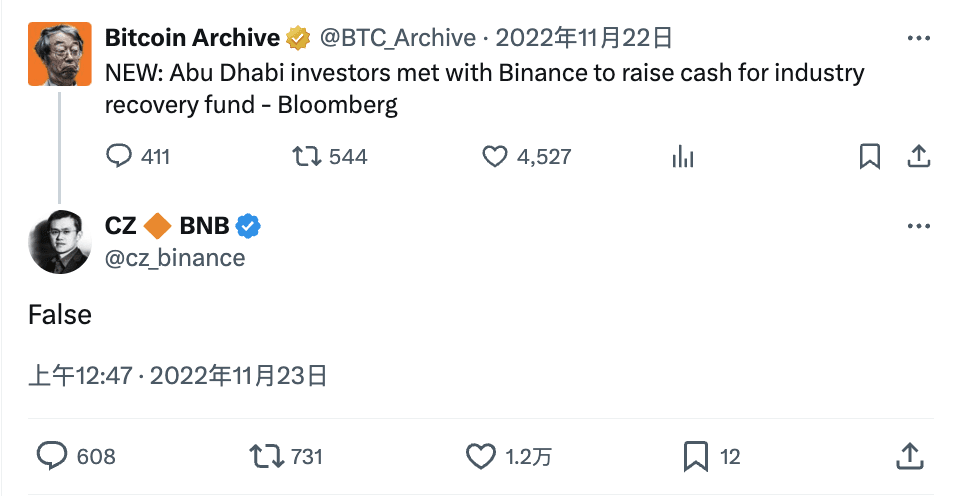
Binance's relationship with UAE capital is not sudden. As early as November 2022, Zhao Changpeng (CZ) and his executive team were exposed to secretly meet with investors in Abu Dhabi, hoping to raise funds to establish a crypto industry recovery fund to support projects that were experiencing liquidity crises at the time. According to people familiar with the matter, the object of his seeking financial support at the time was precisely Tahnoun's financial entity.

However, after the media broke the news, CZ quickly denied on social media that Binance had raised funds in Abu Dhabi, and only briefly responded that the report was "False."
A spokesperson for Binance also stated that CZ’s meeting in Abu Dhabi focused on discussing the global regulatory framework, especially how the Middle East can establish stricter cryptocurrency custody requirements globally, rather than simply raising funds.
No matter how Binance clarified, Tahnoun's capital finally came. The $2 billion investment from MGX is not only a capital transfusion, but also a formal recognition of Binance's importance in the global crypto market by Abu Dhabi Capital.
For Binance, MGX’s investment not only brought financial support, but also changed its market narrative.
In November 2023, Binance reached a $4.3 billion settlement with the U.S. Department of Justice to resolve allegations of violating anti-money laundering regulations. As part of the agreement, CZ resigned as CEO, admitted that Binance failed to effectively implement compliance measures, and ultimately served less than four months in prison.
After CZ left, his successor Richard Teng had a clear mission - to transform Binance from an "industry rebel" into a "good boy" in the traditional financial world.
After Richard Teng took office, Binance began to vigorously promote the compliance process, strengthen communication with regulators in various countries, and strive to get rid of the image of "marginalization of the crypto industry."
It is worth noting that Teng was once an official of the Abu Dhabi Financial Regulatory Authority. His background has brought Binance closer to the UAE regulators, and the investment in MGX is more like a natural capital cooperation.
For Binance, this investment means that it can break away from the global financial system dominated by the US dollar, reshape its image with the help of Middle Eastern capital and regulatory systems, and further expand into the global market.
This is Binance’s new identity and Abu Dhabi’s new ambition.
MGX's $2 billion investment in Binance is not a simple business transaction, but a far-reaching financial game. At present, the inferred equity structure is: before the sale of equity, CZ's share is rumored to be 90%, and MGX is currently most likely the second largest shareholder.
Abu Dhabi is trying to shape itself into a global crypto financial center, and Binance also hopes to use this opportunity to break free from the shackles of European and American regulations and find a new global positioning.
Under Tahnoun's control, UAE capital has established a huge influence in the fields of artificial intelligence, sovereign wealth, and financial technology, and cryptocurrency may become the next chess piece to be included. MGX is just one of Tahnoun's capital machines, and Binance is just another important chess piece in this financial chess game.
So, will Binance set up an official headquarters in the UAE? Will Abu Dhabi become the new center of the global cryptocurrency industry? How will Tahnoun's financial empire continue to expand? All this may have just begun.