


Setting aside business aspects, ROAM itself adopts a point design to record contributions, and due to the long development cycle, it has a large number of community points. Therefore, how to handle the relationship between its point design and tokens is something I have been paying attention to.
In these days, the $PI that has risen against the trend actually has unresolved point issues. They are destroyed by timing KYC.
This achieves a balance between points and tokens (because Pi has set 1 point to 1 token, with a total fixed at 100 billion, but this 100 billion does not fully belong to the community).
With the example of Pi, although Roam @weRoamxyz does not have as massive a surplus of points as Pi, the scale accumulated over the years is also in the tens of billions.
1. Total volume and distribution.
In terms of specific token distribution, there were no detailed rules previously, so this aspect was not mentioned in the previous tweets. The latest disclosed distribution is as follows.
(1) The total supply is 1 billion $ROAM.
(2) Of which 12% belongs to the team, 28% belongs to investors, and the remaining 60%, which is 600 million, is allocated to the community.
The allocation is very simple and straightforward. The portion belonging to the team has clear lock-up, and no additional ecological funds or liquidity allocations have been set up.
The 600 million involved here is not a one-time airdrop. I mentioned before that it is exchanged for tokens through [point burning], and the biggest difference from Pi is that Roam dynamically changes based on the demand for redemption.
The basic principle is that when the demand for redemption is strong, the redeemable proportion of a single point in $ROAM is less. This can reduce the resistance encountered when the token is on an upward trend, and can further reduce ongoing selling pressure during a downward trend, thus avoiding a 'death spiral'.
Because these two trends are the phases when holders are most eager to sell.
2. Asset categories and distribution.
In the economic design phase of Roam, the Pilot burning pool was launched before TGE, setting up the corresponding burning pools for [mining machines and stickers], and together with points, formed three pools with different ratios during the TGE phase.
According to the public data from the Pilot burning pool: the mining machine (NFT) pool, sticker pool, and ordinary pool produce tokens in the ratio of 5:3:2 respectively.
These are actually further divisions of the 60% community share, so the meaning is also very clear. The part weight attributable to the mining machines needs to be larger, and we can also subdivide this further.
Of the 60% belonging to the community: 30% belongs to mining machine NFTs, 18% to stickers, and 12% to ordinary points.
That is: 300 million belongs to mining machine NFTs, 180 million to stickers, and 120 million to ordinary points.
Therefore, after calculating this, I believe there is no need to overly worry about the design of the community's point distribution. Not to mention the dynamic redemption ratio based on supply and demand, the 'cost-free' part accounts for about 12%, and it won't all enter circulation at TGE.
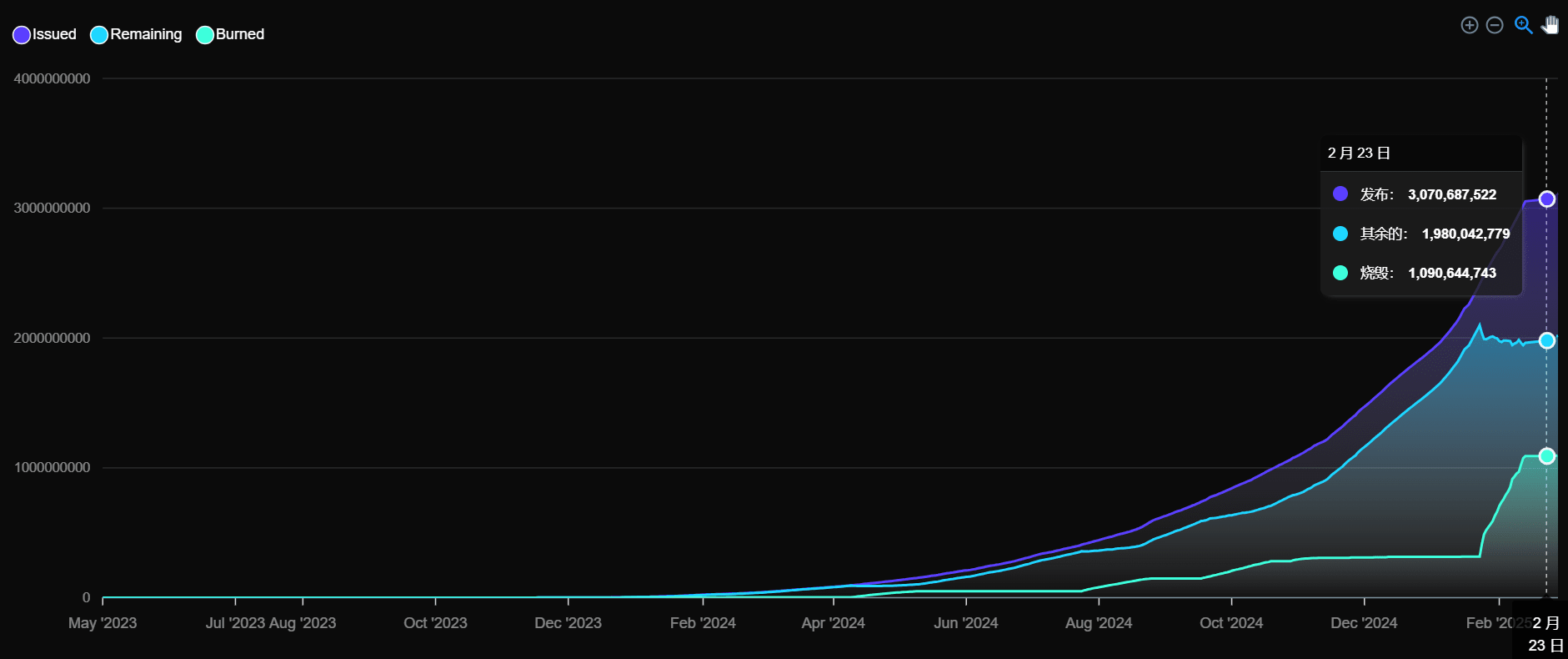
(According to the latest burning data, Roam has already destroyed one-third of the points).
3. Reverse 'dual economic design'.
Strictly speaking, Roam adopts a dual economic driving model of points + tokens after TGE, which fundamentally differs from the [dual-token model].
In addition to retaining adjustments for the subsequent release of tokens, a reverse destruction mechanism for token destruction is also designed.
That is: all applications within the Roam ecosystem, including games, social, AI, etc., need to use points, and then tokens can be used to redeem points reversely.
In this back-and-forth, it essentially consumes points while also destroying tokens.
This design sounds very much like a dual-token design, as they often have such a redemption relationship. However, since Roam uses points as the carrier, the value is unidirectional, making it less likely to experience premium.
The places where premium fluctuations occur will only be the redemption ratios that change dynamically based on the supply and demand curve, unrelated to price. Therefore, a set of 'point and token arbitrage' gameplay can be derived.
4. To be honest, Roam's economic design, especially the handling of points, is one of the most outstanding point designs I have seen in the past year or two.
Therefore, I am also very much looking forward to how it will perform in the post-listing market driven by this model.
I am more looking forward to whether it can use this design to set aside the business carrier of DePIN and run out a self-circulating economic model driven by arbitrage.