
Written in front
From Terra, which once ranked among the top three in market value, to Evmos, which was once famous, to Canto, which has been very popular recently, the Cosmos ecosystem seems to never lack "phenomenal" public chains. Since the beginning of this year, Canto's on-chain TVL has soared by nearly 200% (currently the on-chain TVL is 190 million US dollars), and the price of its native token $CANTO has increased by 6 times in less than 2 weeks.

Canto's amazing growth has also made me ponder how to find the next Alpha like Canto. And BeraChain is likely to be the Alpha I am looking for.
TLDR
After briefly reviewing Canto, I mainly compared and analyzed Canto and Berachain from three core dimensions (nurturing background/innovation mechanism/ecological heat).
By analyzing the correlation and differences between the two and combining Canto's success path, this paper objectively explains the possibility of Berachain becoming the next Canto.
Conclusion: Berachain already has the soil to nurture the next Alpha public chain in the Cosmos ecosystem.
Canto Overview
Before comparing Canto and BeraChain, let’s take a brief look at Canto:
Canto is an EVM-compatible Cosmos SDK application chain focused on Defi. Its core applications include a three-axe consisting of DEX/ lending/ stablecoins. Canto is a completely community-driven Layer 1 with no foundation, no token pre-sale, and no VC funding support.
Canto is a fork of Evmos, but it is more than just a fork. Canto's innovations are:
Innovation 1: Introduced a new governance paradigm - unified governance, providing free public infrastructure (FPI) to users;
The Canto network itself and its FPI are controlled by the $CANTO validator network. Its native DEX does not issue protocol tokens to collect fees, eliminating predatory rent-seeking behavior at the application layer.
Innovation 2: Proposals are shared through Contractual Revenue (CSR) – a cost-sharing model.
The fees generated by users interacting with smart contracts on the chain are allocated to contract developers in a certain proportion. The purpose is to provide developers with a stable income stream and encourage developers to deploy and innovate the protocol.
The launch of CSR also indirectly promotes FRI’s vision. Smart contract developers can obtain income through CSR and no longer rely on protocol fees and other rent-seeking behaviors.
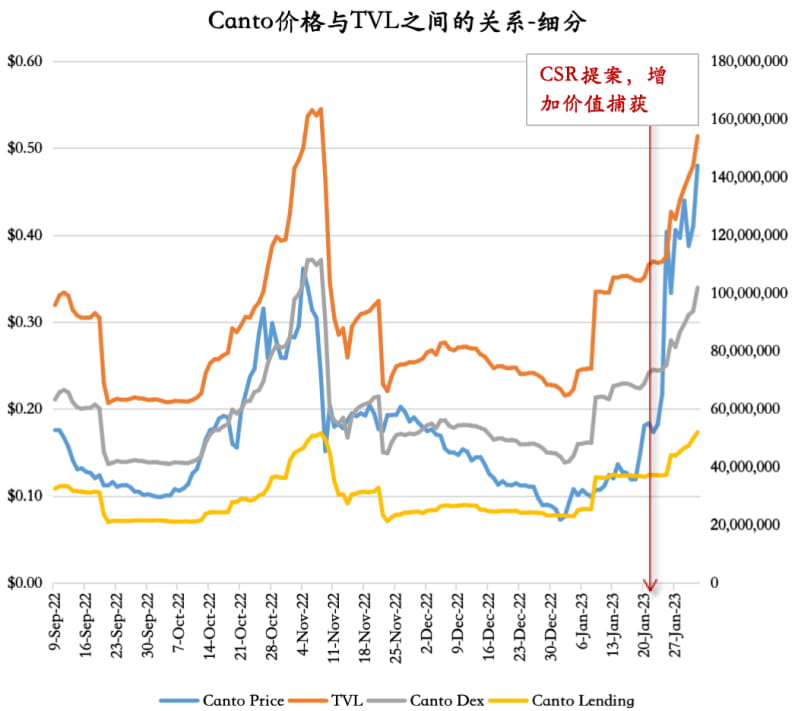
Let’s take a look at its on-chain TVL and $CANTO price (see the figure below):
Intuitively, TVL and $CANTO price trend are highly positively correlated. Currently, its TVL has exceeded 180 million US dollars, with an increase of 150% in the past month.
Its daily active addresses and daily transaction volume have recently surpassed the leading public chain of "Move" Aptos (see the figure below).

The explosiveness and sustainability shown by Canto in recent times have been eye-catching, bringing a visual feast to the Crypto market. The rise of Canto is by no means accidental, and therefore it also leaves room for the next Alpha-level public chain in the Cosmos ecosystem.
Next, I will compare some similarities between BeraChain and Canto from several important dimensions, and try to objectively explain why I think BeraChain is expected to become the next Canto.
Background
Like Canto, BeraChain is an EVM-compatible application chain in the Cosmos ecosystem that focuses on Defi. It does not have any VC financing and is completely community-driven.
Canto is promoted by the developer organization Plex, while BeraChain is proposed and incubated by the Bong Bears community. Bong Bears consists of 101 limited edition bear NFTs, and the current OS floor price is as high as 222ETH.
BeraChain and Canto have very similar backgrounds.

Innovative narrative
Any project that does not have a feasible innovative narrative and is simply a fork will not be sustainable and will be in a mess once the hype wears off.
Canto’s innovative narrative is FPR+CSR. BeraChain also has its own feasible innovations, including a new consensus mechanism - Proof of Liquidity (POL) and a Tri-token economic model.
Innovation 1: POL
POL is a variation of POS, which verifies the network and obtains block rewards by providing unilateral liquidity pledge. In addition to its native token $BERA, tokens that support pledge include blue-chip tokens such as BTC/ETH/ATOM, stablecoins such as USDC/USDT, etc.
Simply put, the difference of the POL consensus mechanism is that validators can pledge any eligible assets to protect network security.
Innovation 2: Tri-token
Berachain launched the $BEAR/ $BGT/ $HONEY three-token economic model, bringing a flywheel effect to the ecosystem through the Tri-token structure.
BEAR: as node staking rewards and gas;
HONEY: Overcollateralized stablecoin;
BGT: ERC-721 format token with voting rights and dividend rights.

Ecological heat
Different from Canto’s poor ecosystem in the initial stage before it was launched, Berachain, although still in the development stage, has attracted many projects to deploy.
Not only does it include some EVM ecological projects, but Yechong has also spawned a number of native projects. Currently, there are as many as 40+ ecological projects planned to be deployed on Berachain.
Summarize
The above article compares and analyzes Canto and Berachain through three core dimensions: breeding background, innovation narrative, and ecological heat, aiming to find out the correlation and differences between the two.
Based on the successful evolution path of Canto, we can deduce the possibility of Berachain becoming the next Alpha public chain of Cosmos. Based on the comparative analysis of the information currently mined, I think Berachain already has the soil for nurturing Alpha.
Final Thoughts
The above is my thinking on why Berachain is expected to become the next Canto. NFA. DYOR.
Follow me and witness the spark of early blockchain Alpha. ✨