




Stablecoin, playing a crucial role in the global cryptocurrency ecosystem, has seen significant growth in 2024, with transfer volumes surpassing both Visa and Mastercard combined.
The annual transaction volume of stablecoin reached $27.6 trillion last year, surpassing the volume of Visa and Mastercard by 7.7%, according to a report on January 31 from the cryptocurrency exchange CEX.io.
One of the main drivers of stablecoin transfer volume is the increasing use of bots, especially on Solana and Base, according to CEX.io's chief analyst, Illia Otychenko.
Tether's USDt (USDT), the world's largest stablecoin by market capitalization, accounted for an average of 79.7% of stablecoin trading volume, solidifying its position amid a strong rise in stablecoin reserves on centralized exchanges.
Stablecoin surpasses Visa and Mastercard despite losing market share.
Stablecoin supply increases significantly to 59% in 2024, reaching 1% of the USD money supply. Despite surpassing Visa and Mastercard in volume, stablecoin lost 13.5% market share in total market capitalization, according to CEX.io.
The decline in market share primarily occurred in the third quarter of 2024 when activity in the cryptocurrency market decreased.
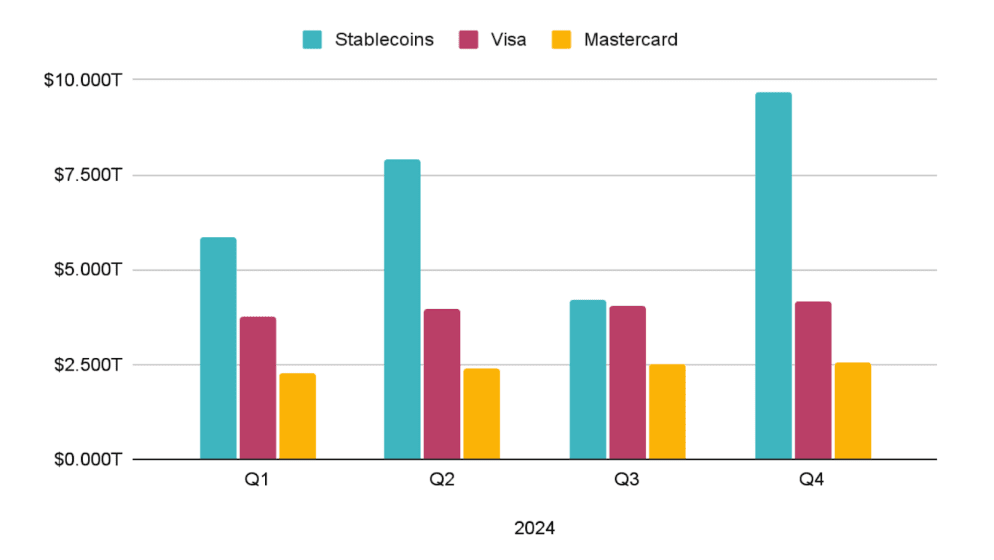
Quarterly transfer volume of stablecoin compared to Visa and Mastercard. Source: CEX.io.
Regarding overall development, Otychenko of CEX.io said:
“Stablecoin has seen an increase in both supply and volume after cryptocurrency activity surged following the elections, surpassing Visa and Mastercard by more than two and three times respectively in the fourth quarter.”
Otychenko noted that this trend shows users are increasingly using stablecoin for saving and transferring money as a cost-effective way to transfer value compared to traditional payment methods.
“However, the role of stablecoin as the lifeblood of cryptocurrency trading and DeFi interactions currently surpasses this trend,” he added.
Bot activity accounts for 70% of stablecoin transfers.
Bot trading activity accounted for a large portion of stablecoin trading volume in 2024, which CEX.io estimates could be as high as 70%. On Solana and Base, bot transactions accounted for up to 98% of the volume.
“High bot activity in the network does not necessarily mean the transfer volume is ‘worse’,” Otychenko said, adding that bots are often used to improve market efficiency through arbitrage trading or gas fees by paymasters.
Bots can be used for harmful behaviors like frontrunning, sandwich attacks, pump schemes, and wash trading, and lack of liquidity pools. However, the dominance of bots in stablecoin may also represent the maturation of some networks, he noted.
Ethereum and Tron still dominate, but other networks are gaining momentum.
Ethereum and Tron continue to dominate as the main networks for stablecoin in 2024, accounting for over 83% of the market by the end of the year.
Meanwhile, their combined market share has decreased from 90% at the beginning of the year, indicating an ongoing diversification across other networks, particularly Solana, Arbitrum, Base, and Aptos.
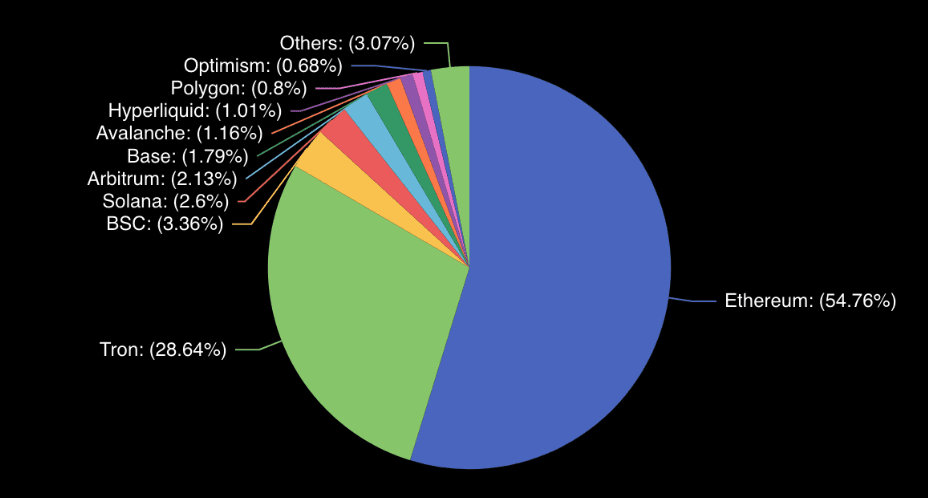
Market capitalization distribution of stablecoin by network. Source: CEX.io.
“This change is particularly pronounced for Tron, where its market share has sharply declined from 38% to 29%,” the report stated.
The market capitalization of Ethereum's stablecoin has increased by 65% in 2024, reaching an all-time high. This growth is partly driven by reduced transaction fees following the Dencun upgrade in March, along with optimism following the elections in the United States, Otychenko said.