


 Image Source: HashKey Capital
Looking back at history, we can easily find that many of the cutting-edge technology discussions in the Ethereum developer community have ultimately evolved into current everyday application products, from DEXs and lending to Rollups and DA, all of which are like this. This also contains opportunities for investment layout.
So, at this point in early 2025, what valuable information can we capture from Ethereum's roadmap, recent discussions at DevCon, and the upcoming Pectra upgrade at the beginning of next year? This article attempts to provide a summary and discussion.
Ethereum's Roadmap
The Ethereum roadmap has always been an important reference for observing future development directions, including various stages such as The Merge, The Surge, The Scourge, The Verge, The Purge, The Splurge, etc. Vitalik has also been intensively posting in October to introduce the content of each stage. Among them:
The Merge: The main completion is the execution layer and consensus layer, thus achieving the transition from PoW to PoS. However, The Merge also includes some improvements in consensus protocols, including single-slot finality and lowering the validator threshold.
The Surge: The main discussion content focuses on future scalability, improving the base layer to better serve Rollups. EIP-4844 has gone live, and future key topics include PeerDAS to reduce node pressure and cross-Rollup interaction.
The Scourge: Mainly reduces some issues related to MEV, including over-centralization of builders and MEV value being captured by large LSTs.
The Verge: Includes changing the base layer from Merkle trees to Verkle trees and Snarkification of the EVM.
The Purge: Reduces the storage and state maintenance pressure on Ethereum nodes by deleting or archiving historical data. It will also clean up some technical debt.
The Splurge: Some more advanced improvements, including underlying EVM, account abstraction, and other cryptographic applications (VDF, etc.).
We have extracted the key improvements of these phases in the table below, introducing their main effects and outlining the current progress.
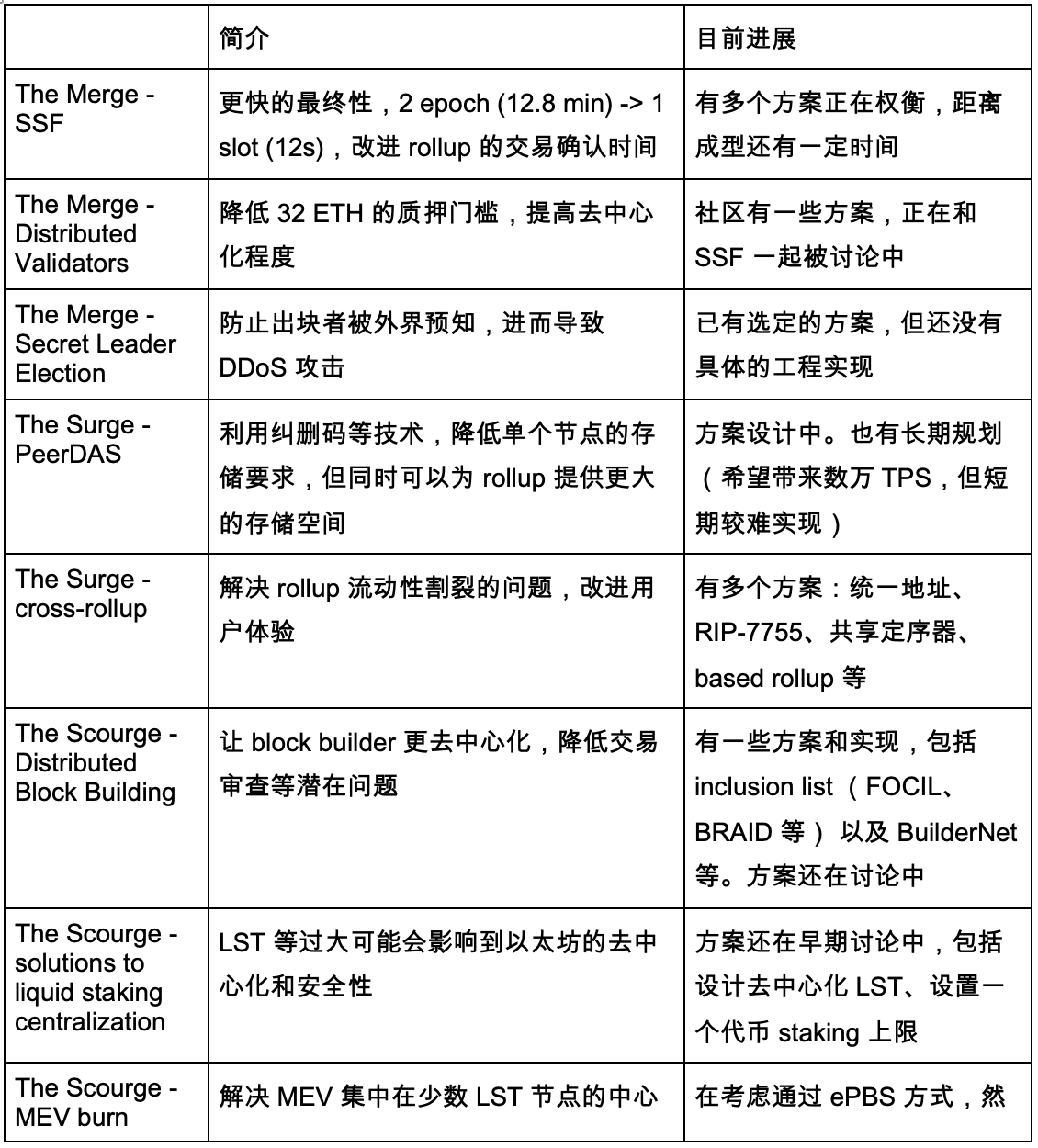 Image Source: HashKey Capital
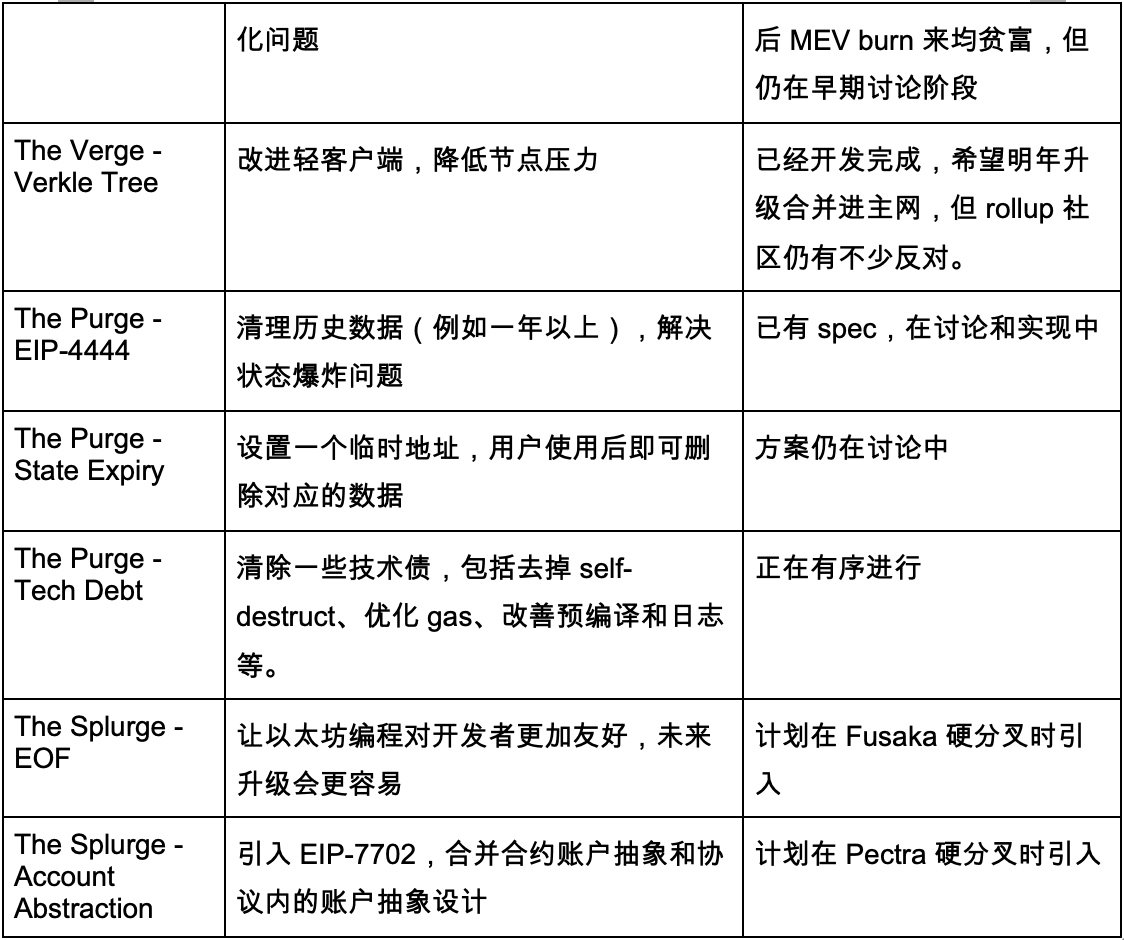 Image Source: HashKey Capital
DevCon
In addition to the roadmap, another valuable source of information is the recent Ethereum DevCon conference, which discussed current issues and potential solutions.
One of the most notable topics at DevCon may belong to Beam Chain. The community's desire for future new development directions can be seen from the slightly sarcastic yet inaccurate 'Ethereum 3.0'. Beam Chain proposes many underlying improvements, including Snarkification of the base layer and enhancements to block generation and Staking. However, the roadmap is expected to take about 5 years to complete, so it does not require much additional attention for the time being.
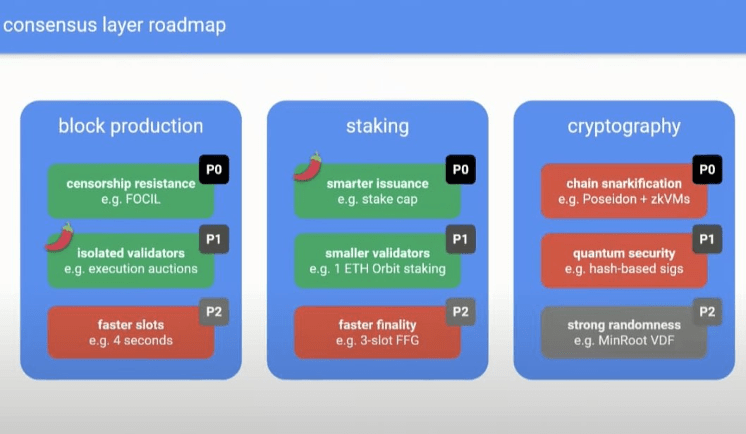 Image Source: HashKey Capital
Rollup-related topics remain a hot topic during DevCon. Among them, the most discussed issues were the liquidity fragmentation and interaction difficulties between Rollups affecting user experience, with multiple speeches and panels addressing this issue or related solutions. Additionally, the current technical maturity of Layer2 was also discussed at the conference, as currently only Optimism and Arbitrum have reached Stage 1 (permitted fraud proof), while most other Layer2 projects remain at Stage 0 (centralized upgrades, no fraud proof, etc.), needing to synchronize with Layer1 upgrades.
Additionally, discussions about chain abstraction, pre-confirmation, cryptographic applications, future upgrades, etc., were also concentrated during DevCon. We will focus on introducing the Pectra upgrade content in the next section.
Pectra Upgrade
Recently, the Ethereum Pectra upgrade, expected to be completed in Q1 2025, is worth paying attention to, which will include multiple related transformations from the underlying to the user end.
EIP-7702: AA
The most relevant to users is EIP-7702, which further develops EIP-4337 based on the design of EIP-3074, granting all EOA accounts the ability to 'temporarily' convert to smart contract accounts, which can further improve user experience (one signature for multiple transactions, 0 gas, etc.), but may also increase security risks such as signature phishing. At the same time, EIP-7702 also takes effect for all EOA accounts, so wallet and other products should also be redesigned to respond to this upgrade. However, overall, the activation of EIP-7702 will still bring new opportunities to all AA projects. More information can be found in our previous report.
EIP-7691: Increase blob count
Pectra plans to adjust the target number of blobs in each block from 3 to 6 and raise the maximum blob count from 6 to 9. Blobs provide cheaper storage for Rollups, and increasing the blob count will further lower the cost of Rollups at the expense of increased node operational costs, enhancing Ethereum's DA competitiveness. Thus, it will further benefit Rollup projects. Additionally, the adjustments to the target and maximum values will also make gas decrease more rapidly when blobs are unused and gas increase more slowly when blobs are at maximum capacity.
EIP-7251: Increase Staking cap
Pectra plans to raise the current staking cap from 32 ETH to 2048 ETH. Ethereum Staking service providers and whales no longer need to split their ETH across multiple nodes but can consolidate it into one node, reducing the number of validators in staking.
Future Opportunities
All the aforementioned technological changes or research discussions may bring about new changes and opportunities. We summarize some key opportunities as follows.
Interoperability between Rollups
Whether from the roadmap or many shares from DevCon, liquidity interoperability and interactivity between Layer2 (Rollups) are the main concerns of developers.
Currently, various proposals in the community are addressing liquidity and interoperability issues between Rollups from different levels.
Based Rollup: Currently, many Layer2s use their relatively centralized sequencers to achieve transaction ordering, which is then published to Layer1, hence failing to realize interaction quickly and timely. One solution is to implement the ordering function through Layer1 to ensure the atomicity of interactions between Layer2s that utilize this ordering function.
Shared sequencer: Apart from Based-Rollup, another implementation method is for Layer2 to share a group of sequencers to complete interactions.
Cross-chain intents: Beyond resolving issues from the sequencer level, using intents to meet cross-Rollup needs is another solution.
Currently, the aforementioned solutions are being implemented and advancing, such as Spire Labs' proposed Based Stack for implementing based Rollup, which is expected to go live in Q1 2025; Shared sequencer related projects like Astria, Espresso, and Polygon AggLayer are being launched and iterated; ERC-7683 has started being used by Unichain, Arbitrum, etc., to solve cross-chain liquidity issues; and Optimism's ERC-7802 can realize SuperchainERC20 to support a unified standard for assets within the Superchain ecosystem and facilitate liquidity transfer. These different solutions may compete in the market for a winner in 2025.
Account Abstraction
Since it involves all EOA account addresses, the activation of EIP-7702 will provide a new opportunity for AA projects. EIP-7702, combined with chain abstraction, intents, and other features, may also build more complex cross-chain or multi-chain interaction functions. However, due to the previous lukewarm market performance of ERC-4337, the Pectra upgrade may be the last opportunity for AA track to validate PMF.
Therefore, after the Pectra upgrade in Q1 next year, teams that participated early in EIP-7702 and are prepared, such as Zerodev, may gain a new wave of growth, and the specific effects will soon be revealed.
Cryptographic Applications
Whether in the Ethereum roadmap or in discussions at DevCon, cryptographic technologies and applications remain a significant topic. On the technical side, zkEVM and zkVM architectures are gradually maturing, and ZKP combined with MPC, FHE, etc., may have more potential combinations of applications. Additionally, some cutting-edge cryptographic technology discussions during DevCon, such as the indiscernible obfuscation (iO), which is hailed as the crown jewel of cryptography, may also attract more attention.
In terms of applications, cryptographic technologies will also have many opportunities on the consumer side. Validation applications, including ZK Email (especially implementations based on Aztec Noir) and zkTLS, may see more adoption. Additionally, recently, with OFAC's sanctions against Tornado Cash being deemed overreach, it might alleviate some concerns about compliance for privacy-related applications.
Special thanks to Zhixiong Pan and Yan for reviewing and advising on this article!
This article is reprinted with permission from: (Deep Tide TechFlow)
Original authors: Zeqing Guo, Jeffrey Hu
'2025 Ethereum Roadmap: DevCon, Pectra Upgrade, What Key Points Must You Know?' This article was first published in 'Crypto City'