

Author: Moledao
The Web3 course series jointly organized by Moledao and OGBC finally officially started on January 16, 2023! The first week is the week of infrastructure, covering the basics of blockchain, Ethereum, Layer2, Layer0, and storage.
Today I will take you to review Instructor Allen’s “Storage” course on January 20, 2023! The course recording has been uploaded to Moledao’s Bilibili:
Week 1: Infrastructure Week | Storage
Then let’s learn about “storing” course notes together! Instructor introduction: Instructor Allen is the former CMO of a leading mining machine company. Co-founder of Extend labs, Ambassador of Permadao, senior miner, and storage service provider. Participated in BTC ETH AR FIL and other mining businesses. He has in-depth research on mining and distributed storage tracks.

Learnings
In this class, instructor Allen explained the value, prospects and advantages of distributed storage technology. It also introduces two leading projects in distributed storage: Arweave and Filecoin. Finally, Arweave’s project ecology is listed.
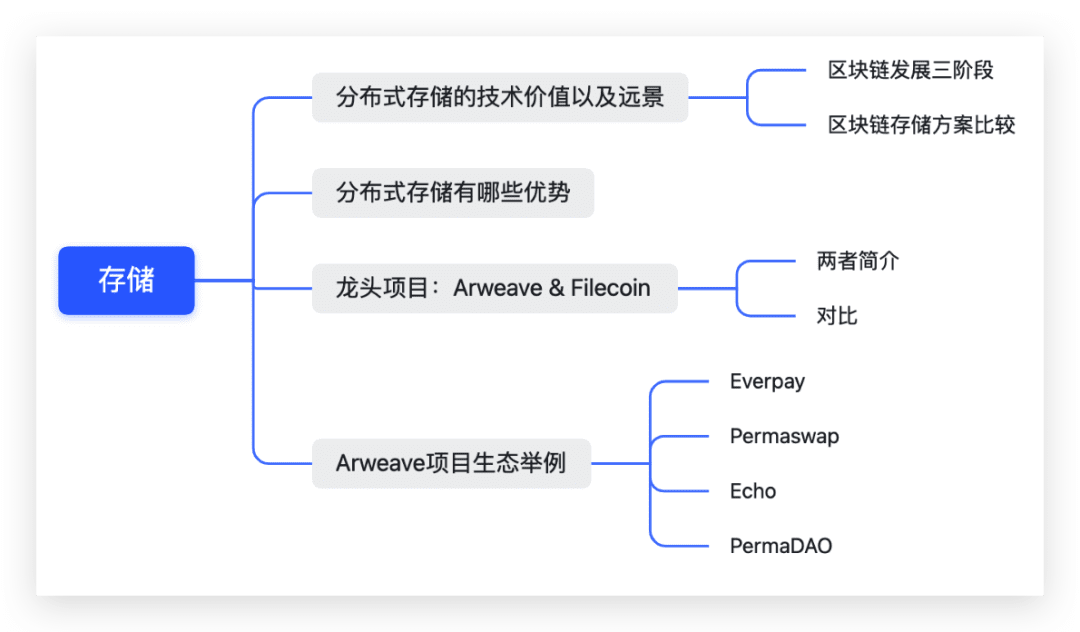
01 The technical value and prospects of distributed storage
Physical computers mainly do storage and calculation; in the Internet era, the most important thing is information storage, calculation and information distribution; in the mobile Internet era, big data and artificial intelligence have been developed; and blockchain technology is inseparable from distributed ledgers. (Bitcoin), distributed computing (Ethereum) and distributed storage (AR, fil).
1.1 Structural Differences between Web2 and Web3
Blockchain 1.0: The virtual currency represented by Bitcoin realizes monetary freedom. It is currently the best application of blockchain technology.
Blockchain 2.0: With the smart contract platform represented by Ethereum, the equity issue is solved.
Blockchain 3.0: Data freedom represented by distributed storage, ensuring data ownership and permanent storage.
1.2 The essence of cryptocurrency is a decentralized ledger
The essence of money: a unit of account
Barter: the beginning of accounting
Gold and silver and gold and silver notes. In fact, at this time, because of the good circulation of gold and silver, gold and silver notes began to exist in the form of ledgers.
central bank represented by the Federal Reserve
The essence of cryptocurrency: decentralized ledger system
The essence of cross-chain: "ledger alignment" technology between decentralized ledger systems
A new paradigm: on-chain storage reconciliation model. Because with the development of blockchain, there will be more and more data on the chain. Things like SocialFi, chain games, etc., all require a lot of storage (because all this information is valuable). Cross-chain alone is not enough.
The transition from an on-chain computational reconciliation model to an on-chain storage reconciliation model (everpay)
Blockchain is backward compatible with L0
1.3 Comparison of blockchain storage solutions
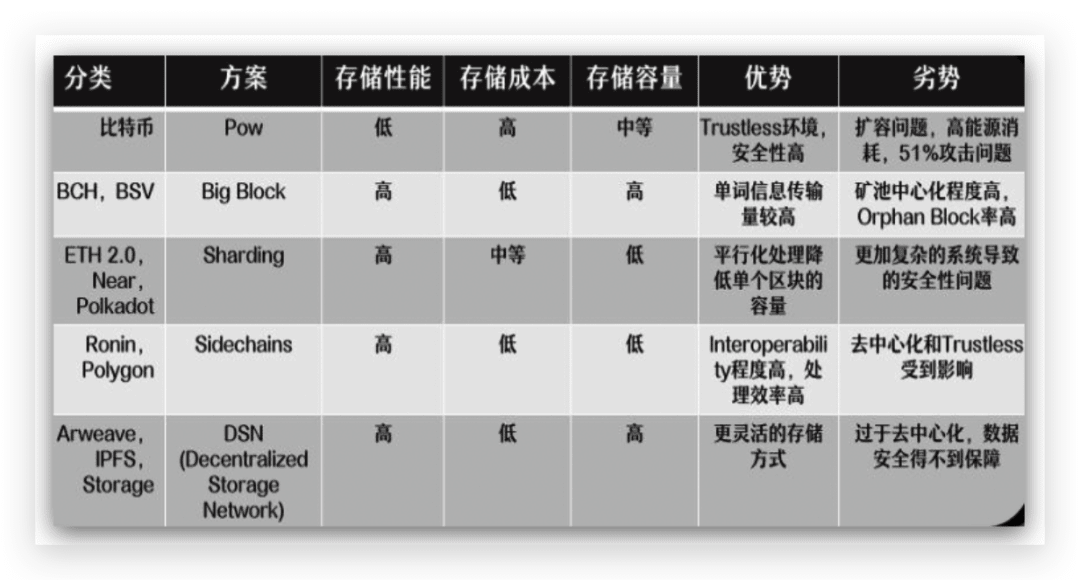 Separating non-core data from the main chain and storing it in DSN (Decentralized Storage Network) has become a mainstream solution to solve capacity expansion, improve interoperability and privacy protection.
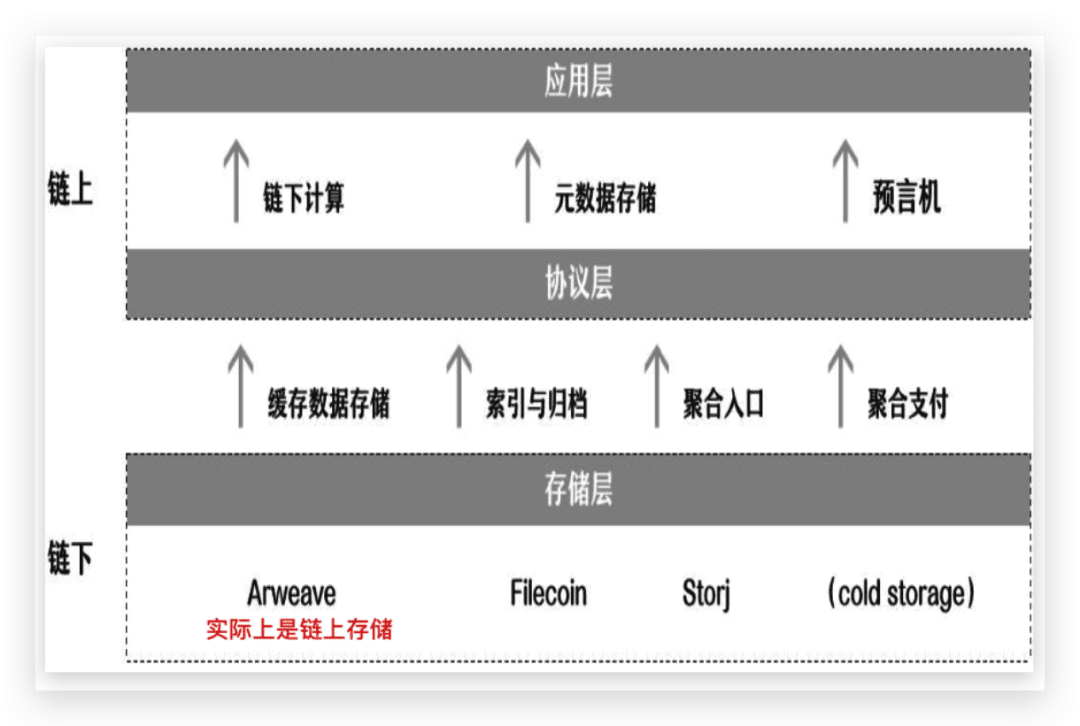 The off-chain storage layer will eventually become an important infrastructure in the Web3 ecosystem and solve any data storage problems at the protocol layer and operation layer through hot storage and cold storage.
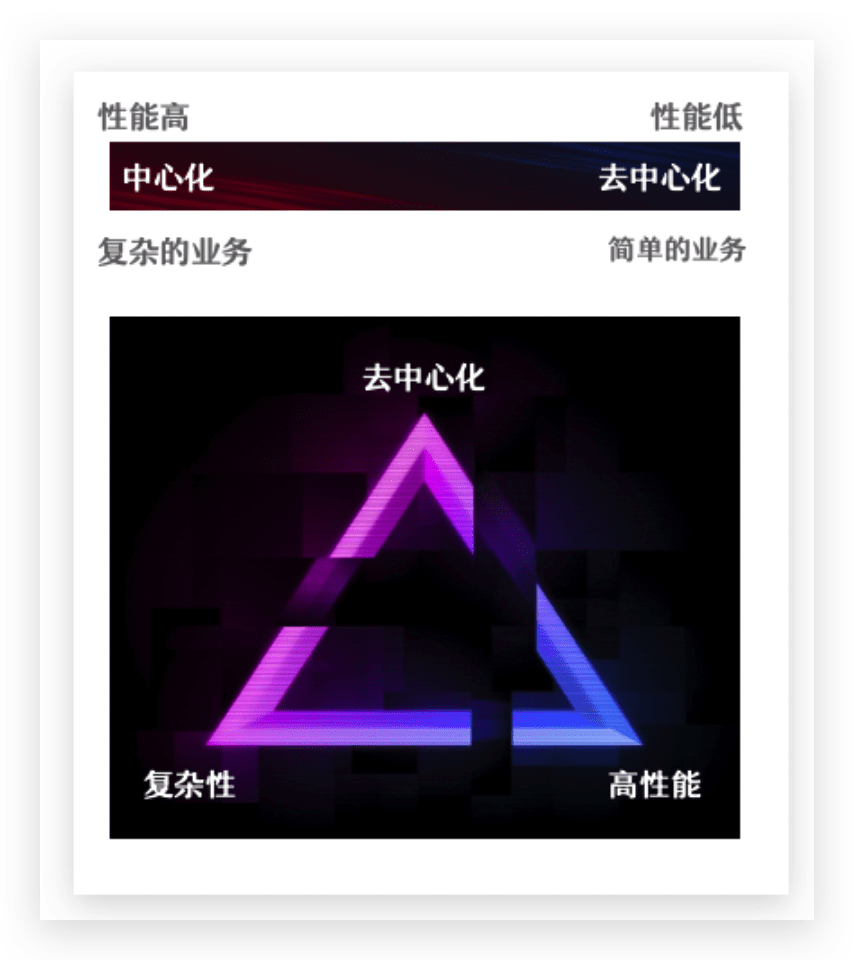 Now in the impossible triangle, the most difficult thing is to achieve both decentralization and high performance. But actually it is possible to have both. In the future, the expansion problem in the "Impossible Triangle" can be solved by completely stripping off the storage layer but maintaining interoperability, and improving data calculation and invocation through middleware, API and other services built on the cold storage layer. , push efficiency.
02 What are the advantages of distributed storage?
Advantage 1: Data can be stored permanently and cannot be tampered with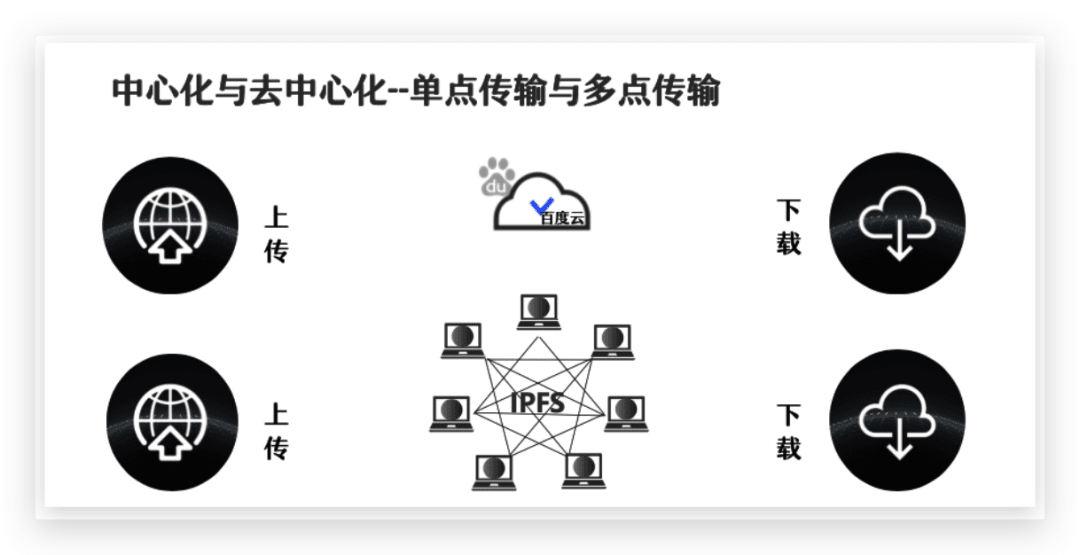
Centralized storage generally uploads and downloads as a whole. If there is a problem with the company providing the storage, the stored data may be lost.
However, decentralized storage will upload user data slices to each node, and multiple nodes will merge and download. In this way, even if there is a problem with some nodes, the data can still be well preserved.
Advantage 2: Efficiency increased by nearly 60 times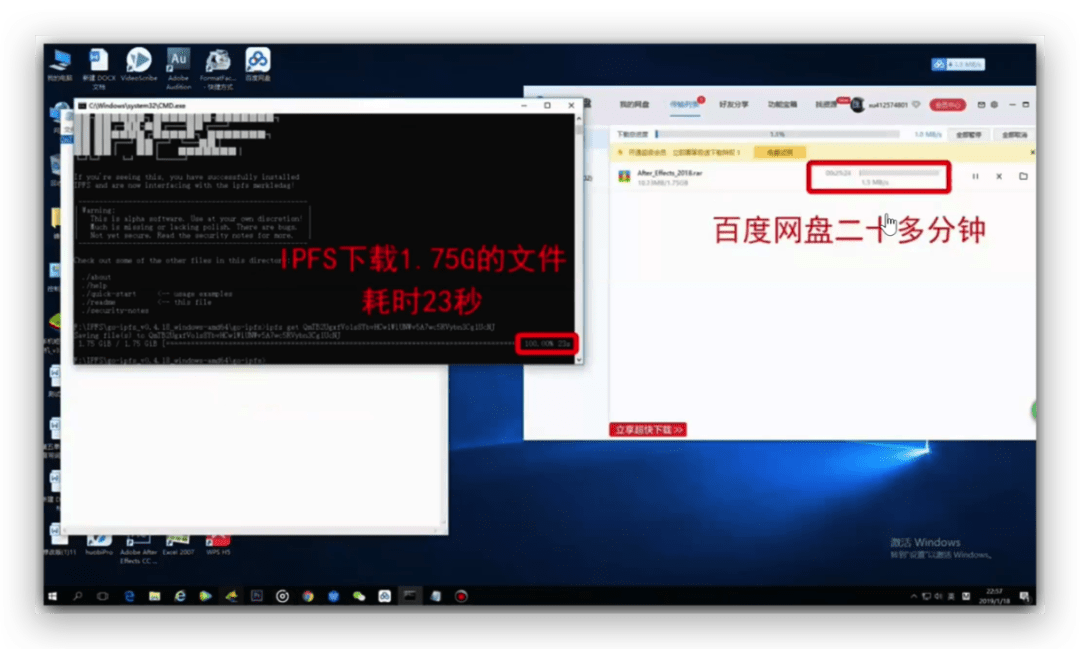
Advantage three: cost reduction
Alibaba Cloud usage cost: 0.35 yuan/GB/year. TikTok spends 4 billion on this every year. With the rise of 5G and big data, user storage preferences have changed from pictures to videos, which requires a significant increase in storage space and storage costs.
Advantage 4: Fragmented processing ensures data privacy and security
In centralized storage, private sensitive data such as various records on Ctrip and home addresses on Meituan Takeout are seriously leaked. Distributed storage saves data in slices, which can better protect user privacy.
Because of the above advantages, distributed storage has become the underlying data protocol for many world-class projects, including:
Already used by the German Aerospace Center for telemetry data storage
All confidential documents in the U.S. Apollo moon landing program were uploaded and saved using distributed storage
The world's second largest Firefox browser supports distributed storage
Library of Congress historical data permanently preserved
There are also companies like Alexandria, D.Tube, etc.
03 Leading Project: Arweave & Filecoin
3.1 Arweave|Permanent storage, decentralization 3.0 era
Arweave is a typical example. It is not exactly a blockchain structure, and the network does not require nodes to store every block. However, its SPoRA consensus mechanism requires that if a node wants to block, it must be able to access historical blocks randomly set by the network. In order to increase the probability of producing blocks, nodes will store more historical blocks and maintain permanent storage.
3.2 Filcoin|Temporary file storage, decentralized storage
A typical representative of P2P network-based storage is Filecoin. User's files are stored in the nodes of the P2P network (IPFS) rather than on the blockchain. These P2P nodes are also nodes of the Filecoin blockchain network. They rely on the replication proof PoRep to indicate the storage of a specified number of copies and the time and space proof PoST to indicate the continuous storage of data to prove that they have completed the storage task. That is to say, nodes on Filecoin need to constantly provide proof to prove that the data is properly stored.
3.3 Comparison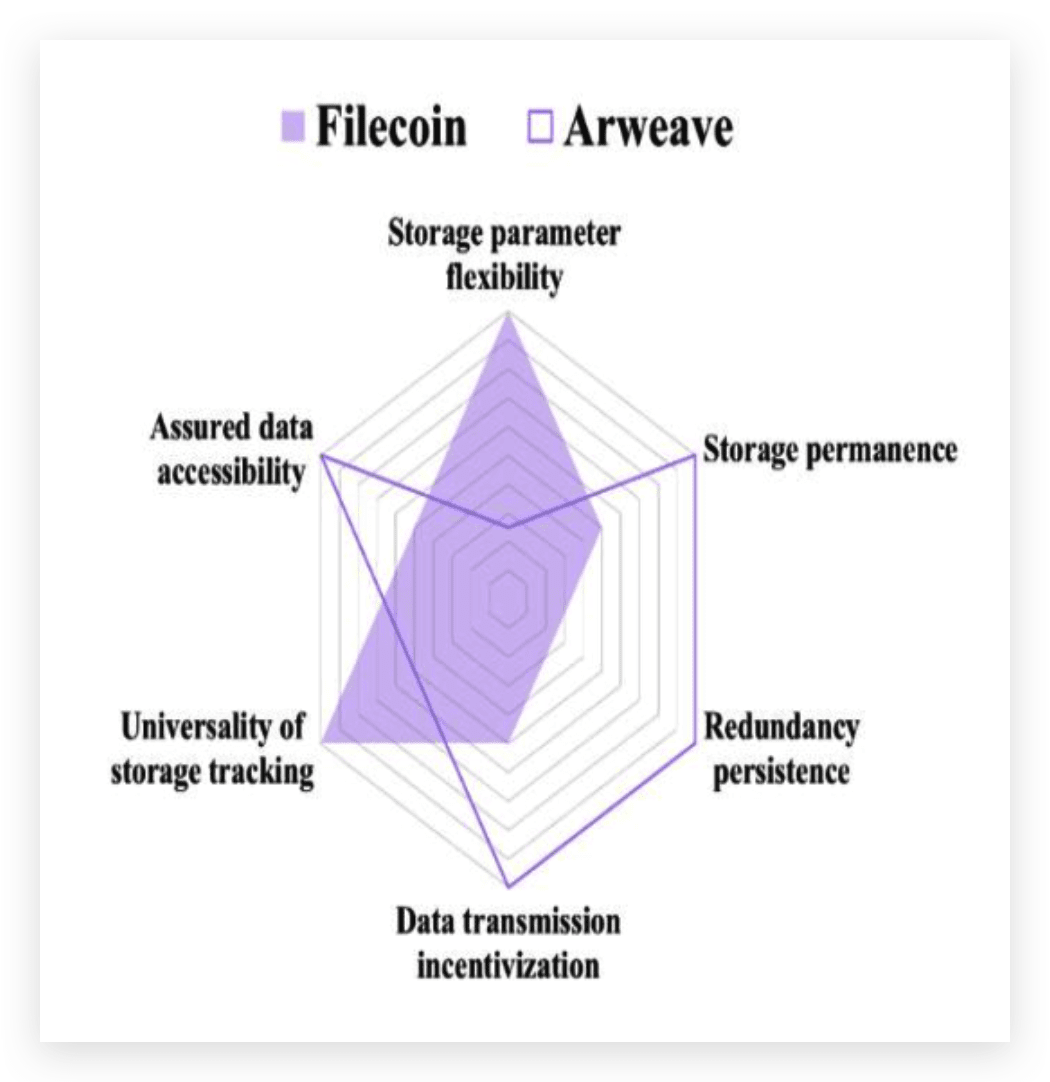
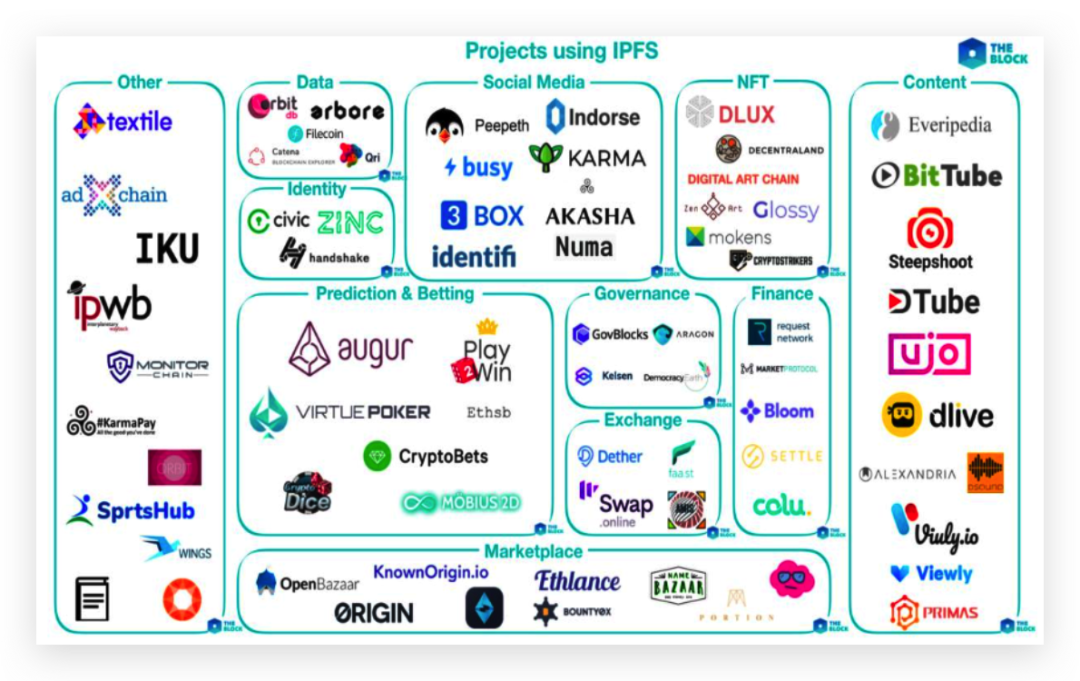
At this stage, the different technical architectures adopted by Filecoin and Arweave also bring about functional differences. According to the research report of Fundamental Labs [3], we define the functional evaluation framework as: flexibility of storage range, storage permanence, ability to avoid redundancy, incentives for data storage, universality of data storage, data Availability. To a certain extent, Arweave and Filecoin are a pair of complementary solutions: > Arweave is more focused on the permanence and stability of data storage, and is more suitable for metadata and historical data; > Filecoin can provide a more flexible storage solution ( Storage time, type), more suitable for the storage of personal and non-critical data.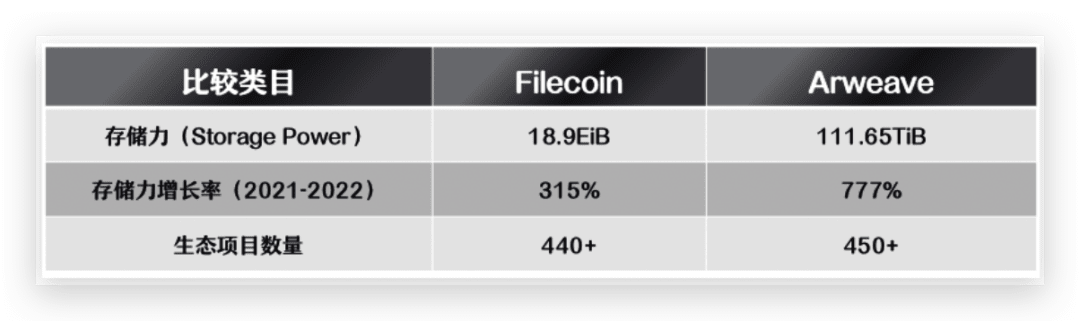 Arweave’s permanent storage can provide a more reliable solution for NFT or social applications. Filecoin has advantages in miner network and storage costs. It is worth noting that Filecoin’s previous junk data was very large, while Arweave’s data is basically real and valid data, because users need to pay first to store it. 3.4 Distributed storage part DAPP (decentralized application)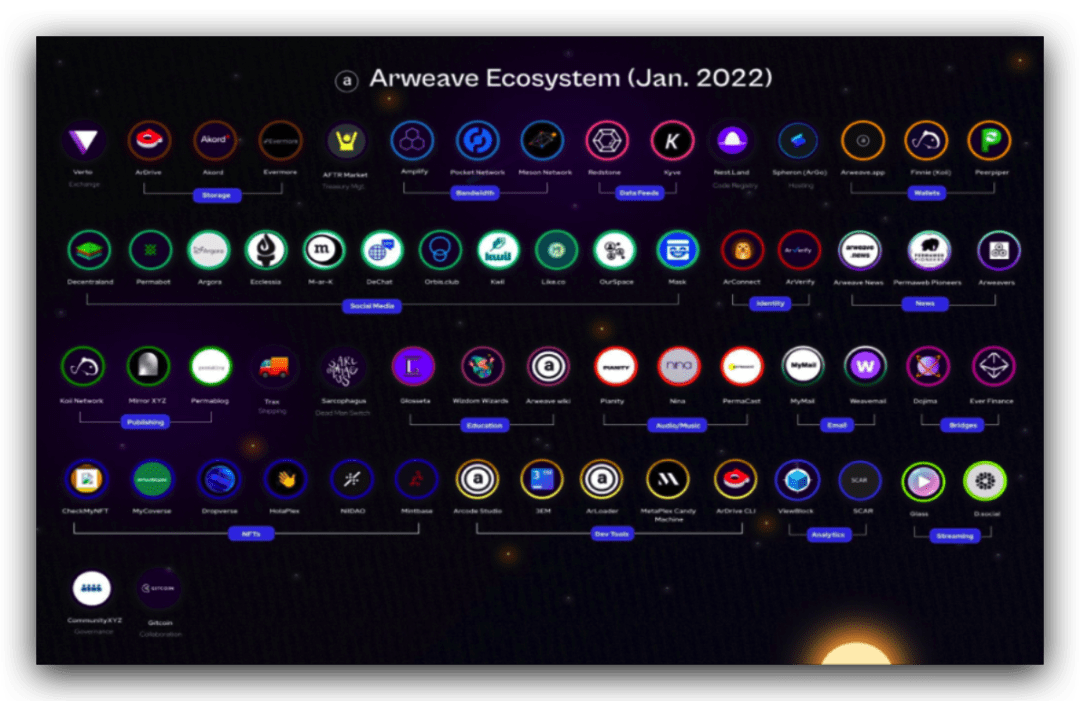
04 Arweave project ecology example
4.1 Everpay project:
Everpay project
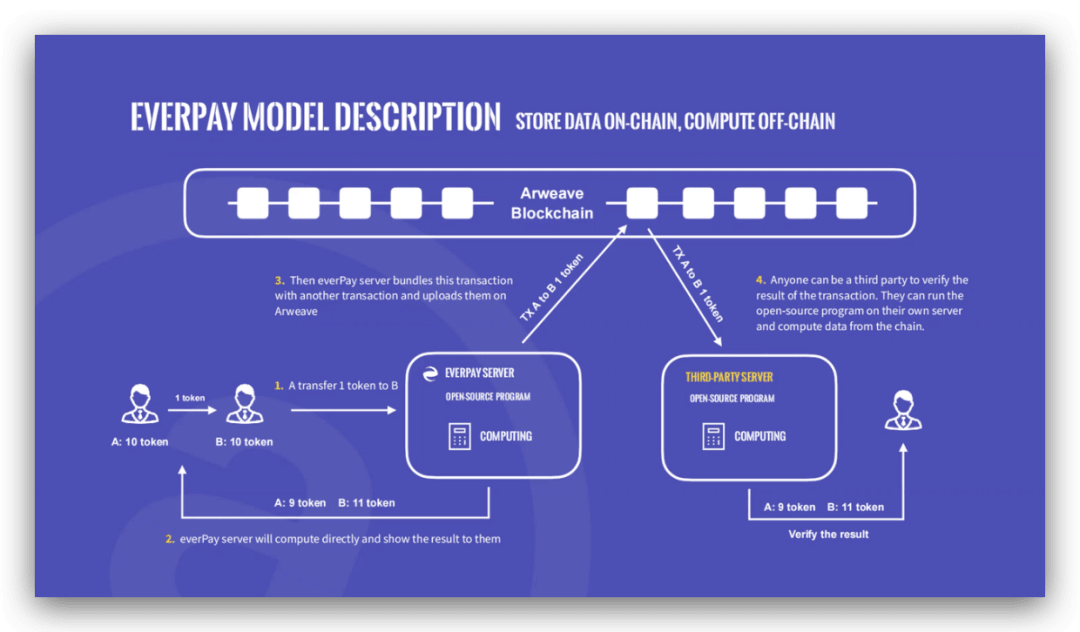 Everpay can solve the problem of low TPS in blockchain payment and can be understood as a decentralized Alipay.
Transfer process: A transfers money to B. After both A and B confirm that the transfer is correct, the transaction is recorded on the Arweave chain. The transaction process is calculated offline, and you only need to ensure that both A and B confirm that the transfer is correct. Only distributed storage is used instead of distributed computing, and tens of millions of TDS per second can be achieved. The ledger is stored on the Arweave network so it can be stored permanently and cannot be tampered with. The algorithm is open source and is also stored on the Arweave network. If you have any objections to the transaction, you can directly download the algorithm and transaction from the Arweave network for verification. Wallets, decentralized exchanges, DAOs, NFTs and dAPPs can be developed on this payment protocol.
4.2 Permaswap project
Permaswap project
 It is an exchange protocol built on Everpay. Anyone can build an exchange on this protocol, and even banks can access it.
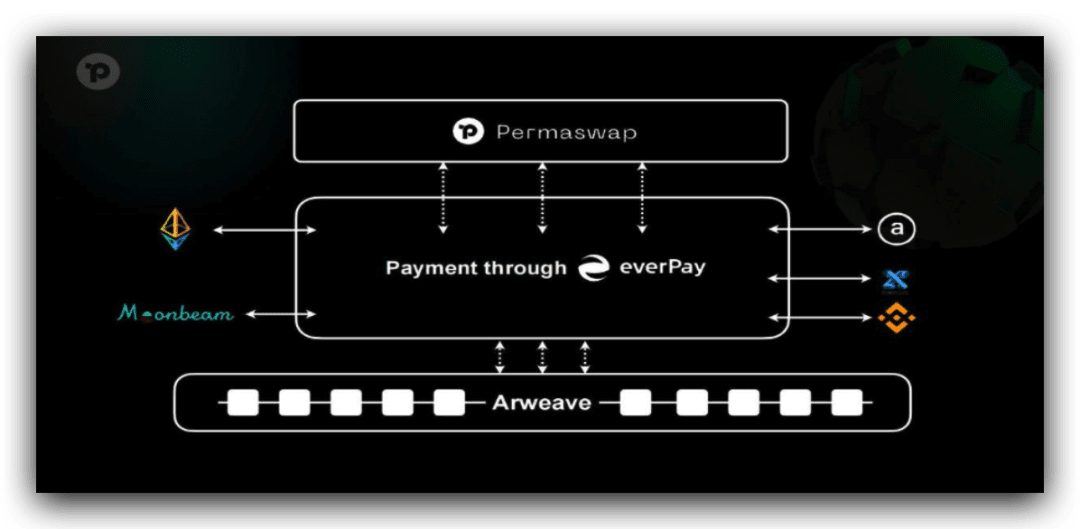 Using the Arweave network, users can keep their assets in their own wallets and at the same time, the transaction speed can reach the level of centralized exchanges. 4.3 Echo Project
Echo Project
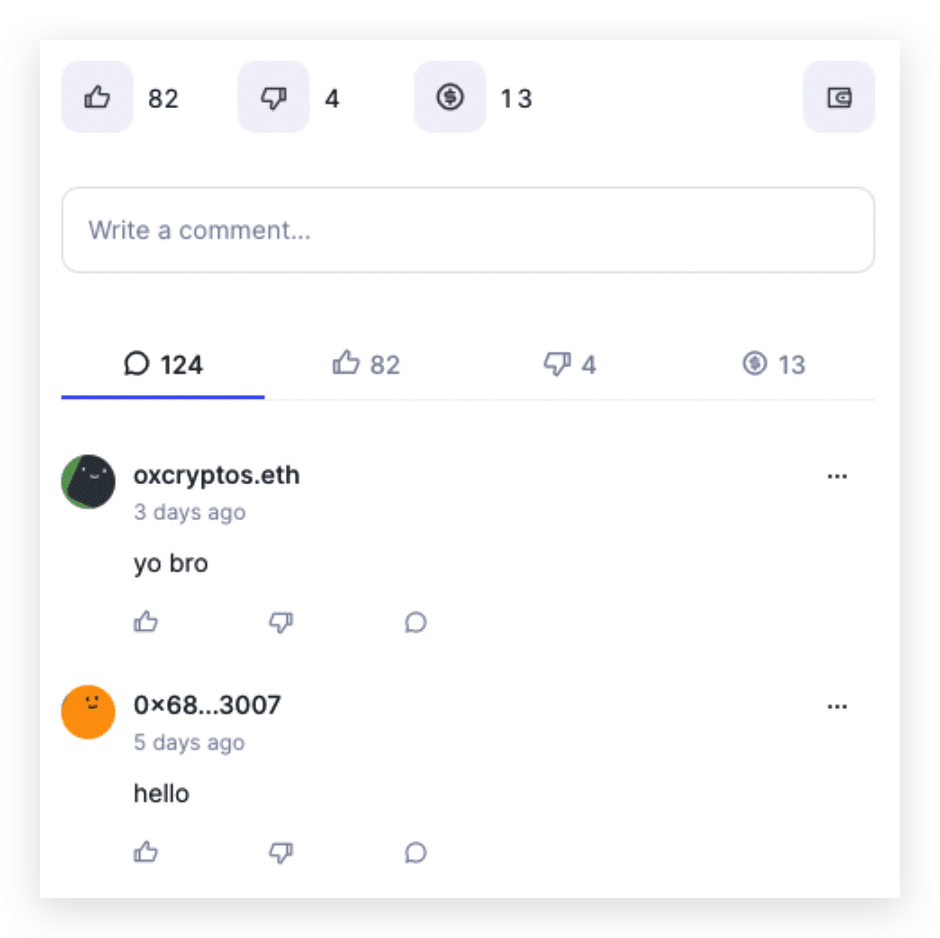 A decentralized comment plugin. If the comment is not deleted after a certain period of time, it will be permanently stored on the Arweave network without interference from any centralized organization. In the future, many GameFi, NFT or subsequent Web2 to Web3 projects can learn from this system to verify data. 4.4 PermaDAO
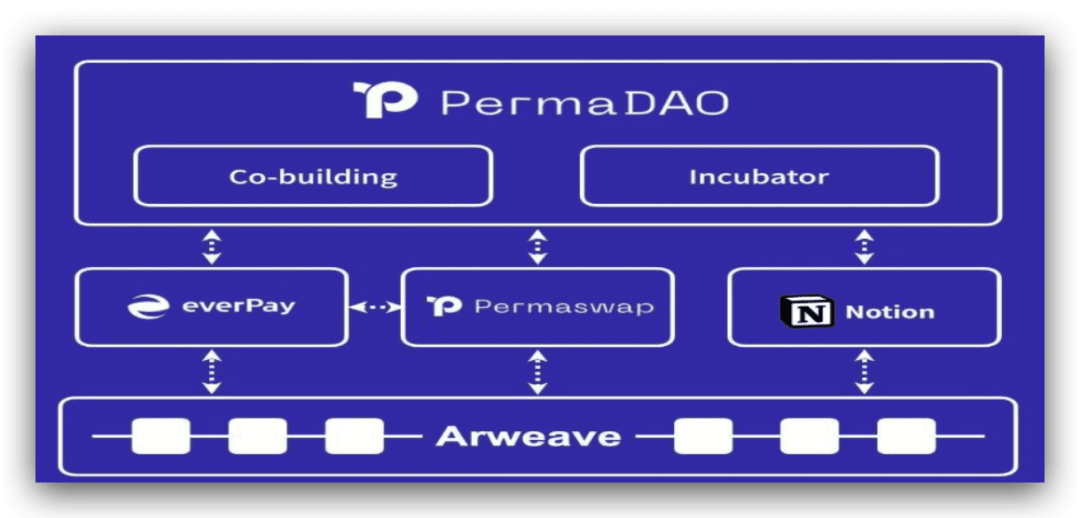 It is a co-built DAO of Arweave and Arweave project, where everyone can learn a lot of storage-related projects and knowledge.
05 Prediction of industry development direction in 2023
The real demand for on-chain storage is growing rapidly, and the storage track is ushering in substantial development;
Separating non-core data from the main chain and storing it in DSN (Decentralized Storage Network) has become a mainstream solution to expand capacity, improve interoperability and privacy protection;
L1 extended storage network can provide a new solution with higher interoperability than DSN, but it still takes time to verify the model; Arweave
Future decentralized storage scenarios will include complete interoperability, data availability, security, and user/developer-friendly off-chain computing through middleware and APIs; Arweave
The next step in the storage industry is the opportunity for data-based public chains. It will also become the bottom layer of the entire blockchain, the existence of L0.
06 Acknowledgements
Thank you to the following organizations for supporting this charity course! Sponsored by: One Global Blockchain Center (OGBC) https://www.ogbc.com/OGBC is a leading incubator for Web 3.0, working with emerging cryptocurrency startups to build the infrastructure of the future. By leveraging OGBC’s expertise, network and resources in the cryptocurrency space, companies and projects can realize their full potential and strive to develop innovative and valuable solutions for the growing number of users in the blockchain industry.
 Other partners support:











07 About Moledao
MoleDAO is a blockchain developer community for all blockchain enthusiasts to learn about the latest developments in blockchain and grow with the help of experienced blockchain pioneers and innovators to contribute to building the Web 3 ecosystem More innovative ideas. We aim to bring the blockchain concept to everyone and develop the region by building a communication community for blockchain enthusiasts, providing blockchain project support, organizing a series of global hackathons, helping match project talents, and providing project sponsorship and guidance. Blockchain ecosystem. Our vision is to become a curated one-stop blockchain ecosystem. Whether you are a blockchain enthusiast, blockchain developer, institution or investor, you can find a niche that suits you on Moledao.