


Today we continue to return, going down in order of market value. We have just finished the first phase of the RWA journey, and then we are back to the topic. Recently we know that the Bitcoin ecosystem is very popular. What sats has surged dozens of times, ordi has risen again, ordi We have said before that it is very simple to create a BRC20 on the Bitcoin chain, so this type of currency has no fundamentals and can be classified as the MEME series. The risk is higher and everyone must have the risk-taking ability. Today we will also introduce a The project of the Bitcoin ecosystem is Threshold, with the token code T. It is mainly a bridge that connects Bitcoin to Ethereum. It currently has a market value of US$230 million and ranks 150+.
Introduction
Launched in January 2022, Threshold Network is a decentralized network that enhances user privacy and security by providing a set of Threshold encryption services for web3 applications. At the same time, Threshold is the product of the first on-chain merger between two existing decentralized networks (Keep Network and NuCypher). T token is the native token on the Threshold network.
Since the Threshold network is the product of the combination of NuCypher and Keep Networks, it also has the following features:
Keep Network: The structural elements of Threshold Network are taken from Keep Network, which uses off-chain containers to encrypt, store and transmit private data. These off-chain containers are called “keeps” and can be accessed by developer smart contracts without compromising user privacy or network transparency. This technology was previously actively tested when used with tBTC, considered one of the most trusted Bitcoin (BTC) bridges in DeFi, connecting BTC to Ethereum.
NuCypher: NuCypher's privacy tools sit on top of [keep], including its management of secret or sensitive information so that processed and encrypted data cannot be leaked. The network can also grant and revoke access permissions to sensitive information, protecting it if any unusual activity is detected. Threshold Network also utilizes NuCypher's proxy re-encryption tool, which can safely and reliably delegate decryption permissions.
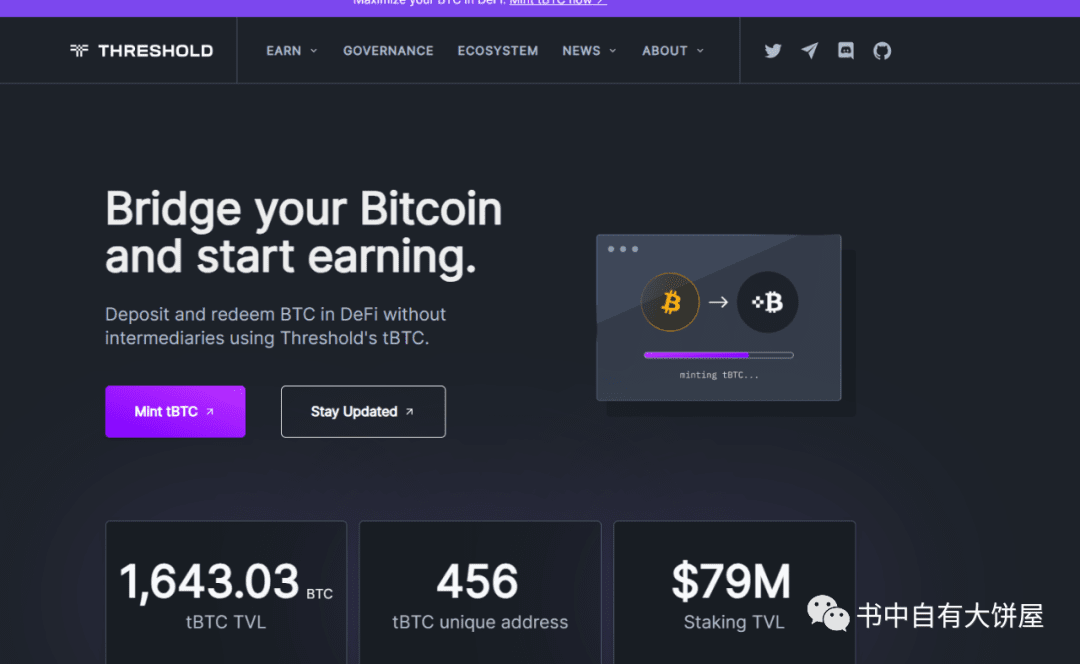
Threshold provides a set of cryptographic building blocks for privacy, access control, and x-chain bridges: Proxy Re-Encryption (PRE), Threshold Signatures (TSS), Distributed Key Generation (DKG), Random Beacons (RB). Threshold Network (T) tokens are converted from the merger of NuCypher (NU) and Keep Network (KEEP) tokens, and tokens T are issued according to the exchange ratio of 1 NU = 3.26 T, 1 KEEP = 4.78 T.
Core product TBTC v2
Unlike existing centralized solutions, tBTC V2 allows Bitcoin holders to access DeFi and web3 without relying on intermediaries. It replaces centralized intermediaries with a randomly selected set of operators running nodes on the Threshold network. Together, these operators use Threshold encryption technology to protect users’ deposited Bitcoins. User funds are controlled by a majority consensus among these operators, preventing control by one individual or group. tBTC v2 is permissionless, ensuring everyone can access it. The Threshold ecosystem combines the benefits of Threshld cryptography, privacy protection services such as PRE, and a decentralized Bitcoin to Ethereum bridge via t BTC V2. It is designed to enhance user privacy, control and accessibility in web3 environments.
tBTC v2 is the second version of a 1:1 BTC-anchored Defi product developed by Threshold Network, aiming to bring digital gold to the Ethereum network. Compared with the first version of tBTC, tBTC v2 has made many improvements to solve problems such as small signature set, ETH guarantee complexity and opportunity cost, and high coinage costs.
tBTC v2 mainly improves the following aspects:
Expanded signature set: tBTC v2 replaces the three-to-three signature set in the first version with a signature set of at least 100 independent nodes, improving the decentralization and security of the entire network.
Reduced minting costs: By integrating the network at Layer 2, minting costs for tBTC v2 users will be greatly reduced. This will enable more users to participate in minting tBTC, thereby expanding its application scenarios.
Cancellation of ETH mortgage requirement: Compared with the first version that required ETH to be mortgaged as security, tBTC v2 has canceled this requirement and instead chooses to mortgage NU or KEEP. This change lowers the threshold for user participation, allowing more people to participate in Defi projects.
Improve transaction efficiency: Due to the adoption of Layer 2 integrated network, the transaction speed of tBTC v2 will be greatly improved. This will make it more convenient and efficient for users to perform asset exchange, lending and other operations.
Enhanced security: tBTC v2 has also been greatly improved in security performance. Through the combination of multi-signature and decentralized networks, tBTC is made more robust in the face of cyber attacks.
Threshold dao
The DAO of the Threshold network is the core of maintaining decentralization. They not only provide a community for community-driven projects, but also provide a platform for T and decentralized voting, which will help run the entire network, including 3 aspects:
StakerDAO: This DAO contains the core decision-making power in the network, as it is the staker that runs the decentralized nodes that validate transactions, thus keeping the network running. Each member must own a stake in the Threshold network, and their voting rights are determined by the size of their stake.
TokenHolderDA0: Members of this DAO manage finances, token issuance, and network governance through decentralized voting and community-driven decision-making. To maintain accountability, the DAO is able to veto StakerDAO's proposals. Each member of TokenHolderDAO must hold Threshold network token T.
Keep and NuCypher Representative Council: This elected committee of members determines staker rewards to incentivize token holders to become stakers in the network. The committee also has the power to veto proposals to ensure that the network’s route remains decentralized, consistent with the ethos of the Threshold Network, and that accountability is retained.
WBTC data comparison
WBTC (Wrapped Bitcoin) is launched by BitGo in cooperation with Kyber Network, Ren and other companies. WBTC is a token on Ethereum whose value is tied to Bitcoin (BTC). BitGo is responsible for locking actual Bitcoins in a multi-signature vault and then issuing a corresponding number of WBTC tokens for circulation on Ethereum. There are currently 160,000 Bitcoins in existence, worth approximately over $5 billion.
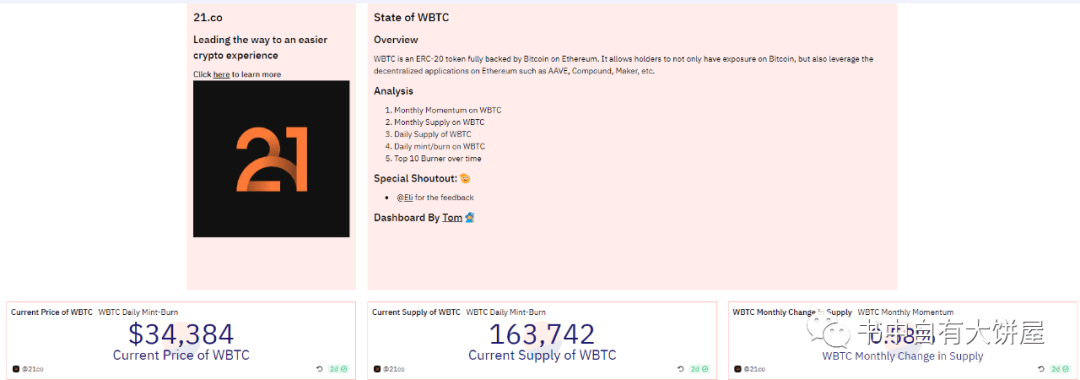
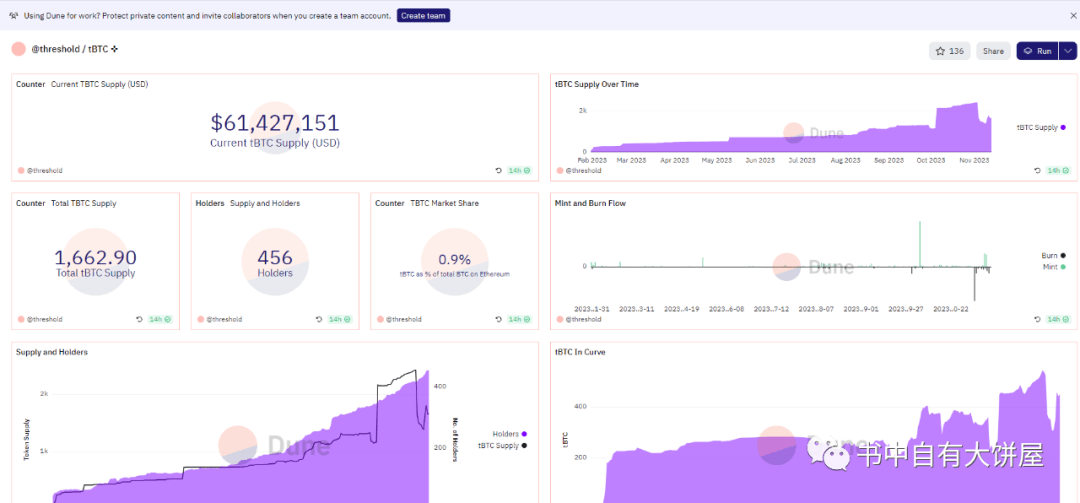
Tbtc only has more than 1,600 Bitcoins, and the current TVL value is about more than 60 million US dollars, so there is still a lot of gap compared with the boss.
Token economy
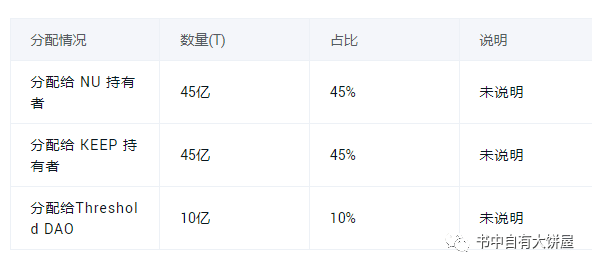
The token economic structure of T token is as follows: of the total initial token supply of 10 billion, 45% is given to NU holders, 45% is given to KEEP holders, and 10% is allocated to Threshold dao. There are currently 9,387,567,257 in circulation, which is also 90% of the circulation. The current currency price is US$0.025, and the peak was US$0.239 (2022-03-02), so it has also fallen by 90%.
Finally, let’s summarize this project. This is a project in the Bitcoin ecosystem, which cross-chains Bitcoin to Ethereum. Because there are no smart contracts and no applications on the Bitcoin chain, many people have a big pie, especially Tuen coins. , it can only be kept in the wallet blankly. With this cross-chain, the liquidity of Bitcoin can be improved. For example, it can be pledged on Ethereum, and U can be borrowed to invest again, which can generate a certain degree of leverage. There is definitely a demand for this. It can be seen from the size of the oldest WBTC that it has been growing and has reached 5.7 billion US dollars. However, there is still a big gap between Bitcoin and WBTC on the current chain of this project. The difference in magnitude is actually due to the fact that it issued coins in advance, while WBTC did not issue coins. In fact, from the comparison of TVL and market value, the market value of T project is 230 million U.S. dollars, which is a bit too high. This wave is also driven by the sudden rise of Bitcoin. Driven by it, another problem is that this protocol is actually very difficult to make money from the income alone. Its money-making logic is the same as that of Tether. That is, I take BTC to pledge, and then you give me a TBTC on the Ethereum chain. , in fact, this Tbtc is also issued by yourself, there is no cost, and if you take my real btc, it is valuable, but the current locking of TBTC is not recorded on the chain, which means you can hold my btc To do other things, and users don’t know, so this routine is the same as that of banks. Although tether company does not have a transparent review, there is indeed this risk. As for the strategy for this token, it will be explained on the planet.