


Today we continue to talk about our RWA special session, which is also the last one. Because the market value of these projects is too low, the risks are huge, and the field has basically been covered. Here we emphasize again that the RWA project introductions in recent sessions have huge risks. Don't buy it, this is just for knowledge sharing. The two projects we will talk about today are TradFI (tradition + defi) Defactor and the carbon credit PERL. Let’s take a quick look at these two projects.
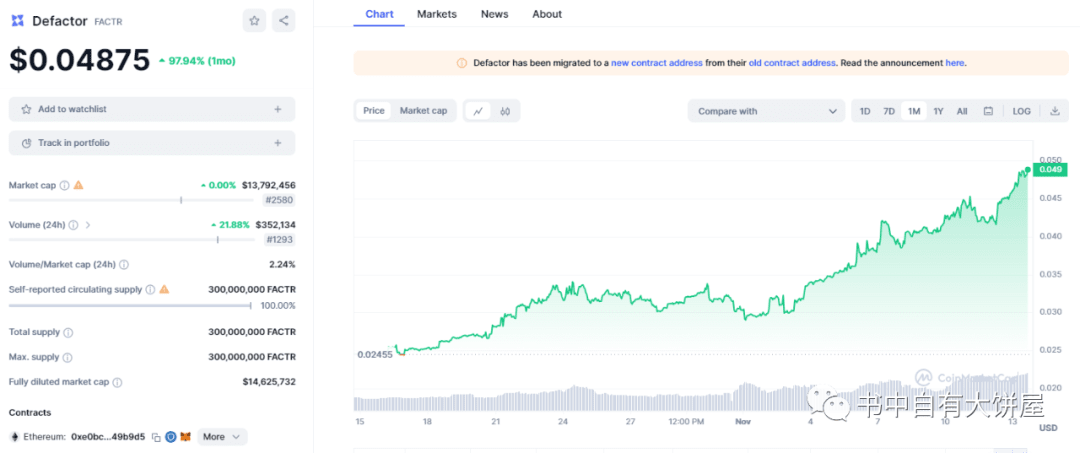
First of all, the first one is Defactor. The token name is FACTR. The increase in the past month is acceptable, from 0.0024 to 0.049, which is also doubled. However, the market value is relatively low, only more than 13 million US dollars, which can be said to be very low. . At present, there is relatively little information on this project, but the problem is not big. We only need to understand the basics of the project and expand our knowledge.
Introduction
Defactor is a platform that enables the tokenization of RWA (real world assets) and the businesses that control them with access to DeFi liquidity. Defactor uses blockchain technology to improve access to a range of asset classes, from trade finance and invoice factoring to government bonds.
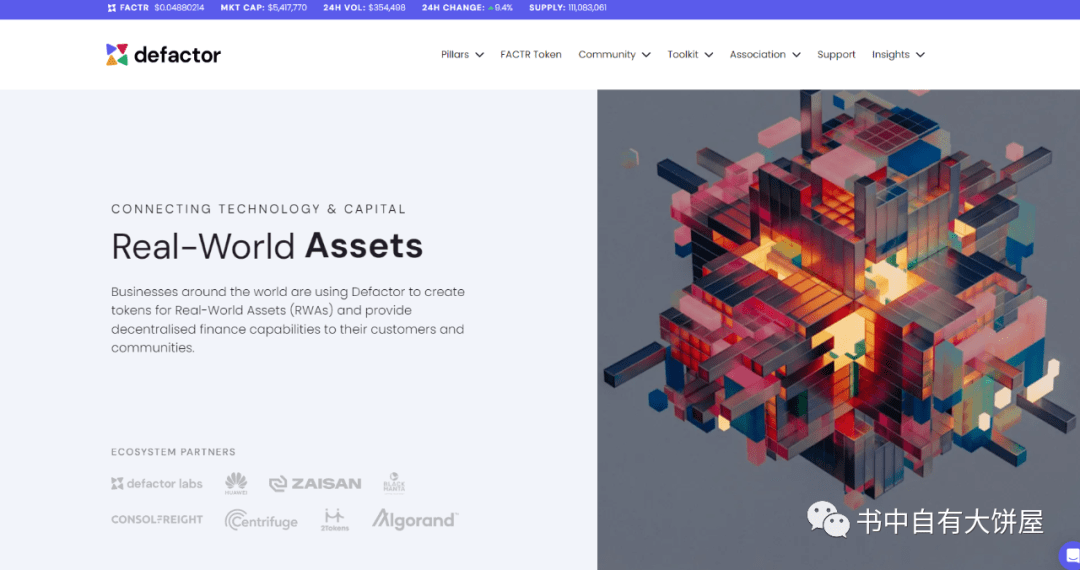
Defactor connects the asset initiator (AO) on one end and the liquidity provider (LP) on the other. It creates a DeFi investment platform through blockchain tools, and its business model charges AO and LP fees.
Specifically, the asset initiator (AO) needs to apply on Defactor and submit relevant legal documents to prove the reliability of the asset; Defactor will evaluate the asset through the risk control system and audit, and give four ratings: Prime+, Prime ,Prime-,SubPrime.
Users interested in becoming investors providing liquidity will also need to pass the platform’s KYC and AML requirements; they will then be assigned a dashboard where LPs can allocate funds to selected liquidity pools (multiple pools with different risk profiles) pool) and supports crypto payments.
Currently, Defactor only supports the tokenization of three real-world assets, namely:
Accounts receivable/factoring business (Note: Factoring, the full name is guaranteed payment agency, also known as acquisition of accounts receivable, collection and guaranteed payment); trade financing; inventory financing.
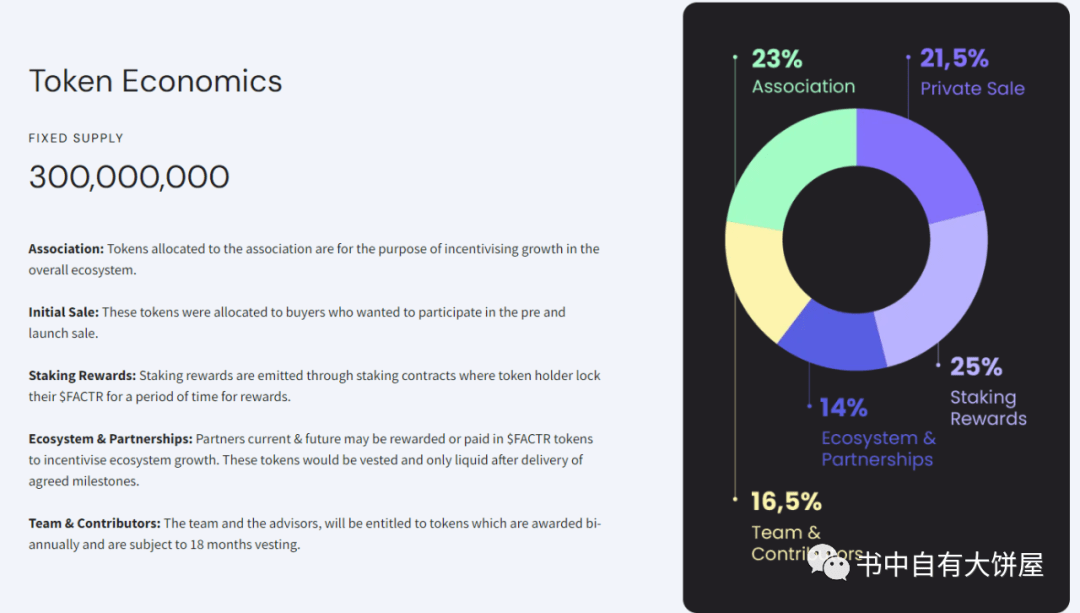
In terms of tokens, FACTR is the native token of the Defactor ecosystem. The application scenarios are as follows:
Network Access: Asset originators require FACTR tokens to access the Defactor platform and services. AO’s tokens will be locked in smart contracts throughout the financing period, thereby reducing the circulation. AOs may be required to pay a fee for each funding period. Governance: In the mid-term, FACTR will introduce a governance model to manage and optimize the network, which will allow token holders to participate in community decision-making. Staking: Token holders who stake FACTR will receive rewards. Buyback model: Defactor will allocate a portion of its revenue to repurchase FACTR tokens on a regular basis.
Token economy
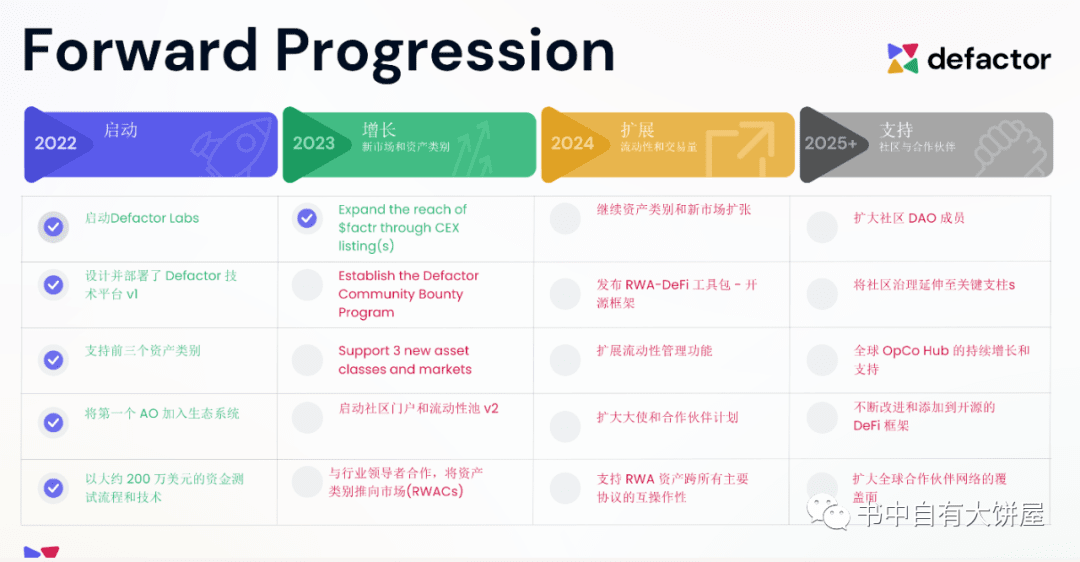
The token was issued at the end of 2021. The total number of tokens is 300,000,000. All of them are currently in circulation. The current currency price is 0.048 US dollars. At its peak, it was $0.1141 (2023-03-19). The team received 16.55+23 in token distribution. % associations, the holding ratio is still relatively high. At present, its TVL has not been found. I have not seen specific products on the official website. There is only a roadmap. It is said that it will be widely used in 24 years. Then there is also news that Huawei has given it a platform. I guess it also provides you with it. a server. And it is Huawei overseas, not Huawei domestically.
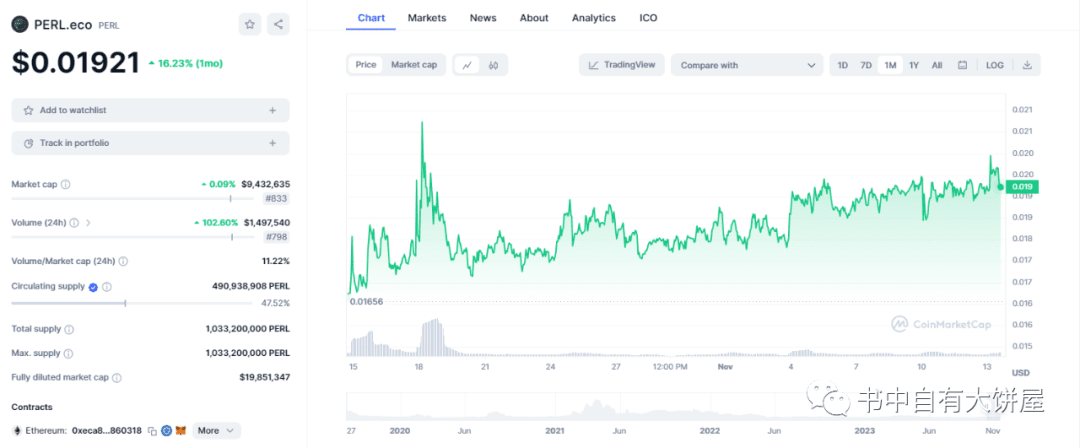
The second project is a carbon credit blockchain project called PERL.eco. The growth rate in the past month has been very average, only 20%, and its market value is only 9 million US dollars. With such a low volume, it should be casual A little bit of capital can go a long way.
Introduction
PERL.eco Future Carbon Exchange is a carbon trading project based on blockchain technology. It aims to achieve transparency and autonomous management of carbon trading through smart contracts and decentralized applications.
The core of the PERL.eco project is to establish a decentralized carbon market in which companies and emission reduction projects that emit carbon dioxide can realize carbon trading by buying and selling carbon emission quotas. The goal of the project is to encourage companies to reduce carbon emissions and promote sustainable development in this way.
Features of the PERL.eco project include:
Based on blockchain technology: The PERL.eco project uses blockchain technology to record every step of carbon trading, ensuring the transparency and non-tamperability of transactions.
Decentralized applications: The PERL.eco project develops decentralized applications that can autonomously execute and manage carbon trading, reducing human intervention and errors.
Tokenization of carbon assets: The PERL.eco project can convert carbon emission quotas into tokenized form to facilitate investors' transactions and circulation.
Cross-chain transactions: The PERL.eco project supports multiple blockchain networks and cross-chain transactions. Users can realize carbon asset conversion and transactions between different blockchain networks on one platform.
KYC and AML certification: The PERL.eco project requires investors to pass KYC and AML certification to ensure investors’ identity authenticity and compliance.
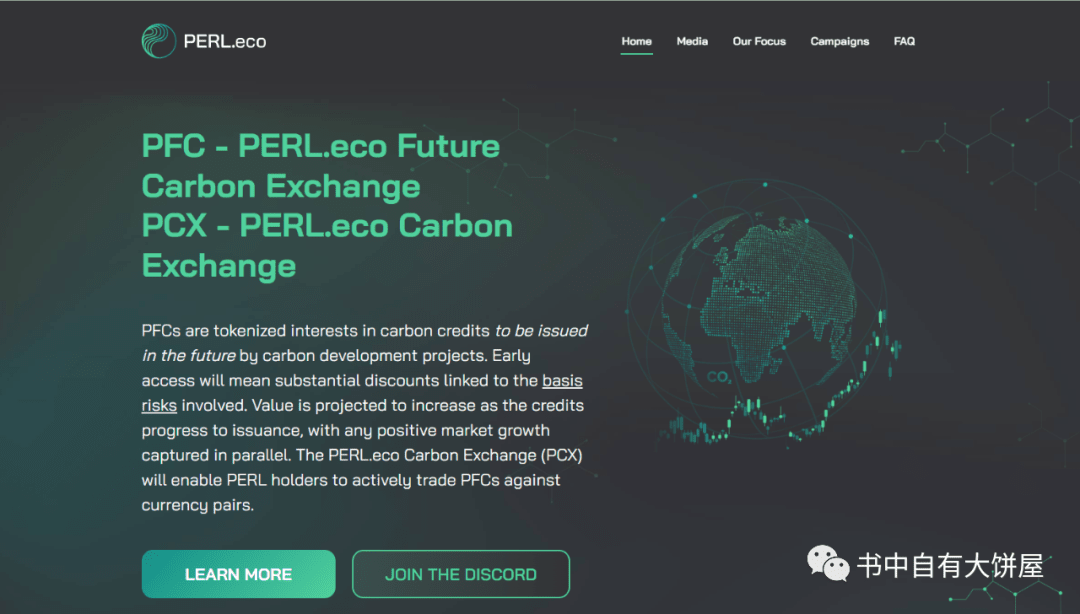
PERL allows token holders to play a key role in determining the incentive system, building a broad stakeholder base and facilitating the flow of economic value in the network. PERL holders can vote on this fee model and distribution, as well as other important decisions.
PERL. Eco focuses on the following key areas:
1. We are tokenizing carbon credits and users may be able to offset their emissions and participate in future carbon growth.
2. We are seeking to create a market that links supply and demand for biodiversity values. This will encourage the conservation of biodiversity, which is urgently needed as climate change worsens.
3. We are working with globally recognized wildlife, marine and environmental charities to develop NFT to fund the protection of critically endangered species and habitats.
4. We will allow PERL token holders to give up their farms forever and receive free rewards.
PERL.eco Carbon Offset (PCO2)
Approximately 51 billion tons of greenhouse gases are emitted into the atmosphere every year. According to NASA, the weight of 1 billion tons is equivalent to the weight of 10,000 fully loaded US aircraft carriers.
The market for carbon commodities is growing rapidly as the industry moves toward greater sustainability and emissions reduction goals. Many companies and countries have pledged to become carbon neutral by 2050. According to Katusa Research, if we meet this global carbon reduction target, this will be a $16 trillion market opportunity.
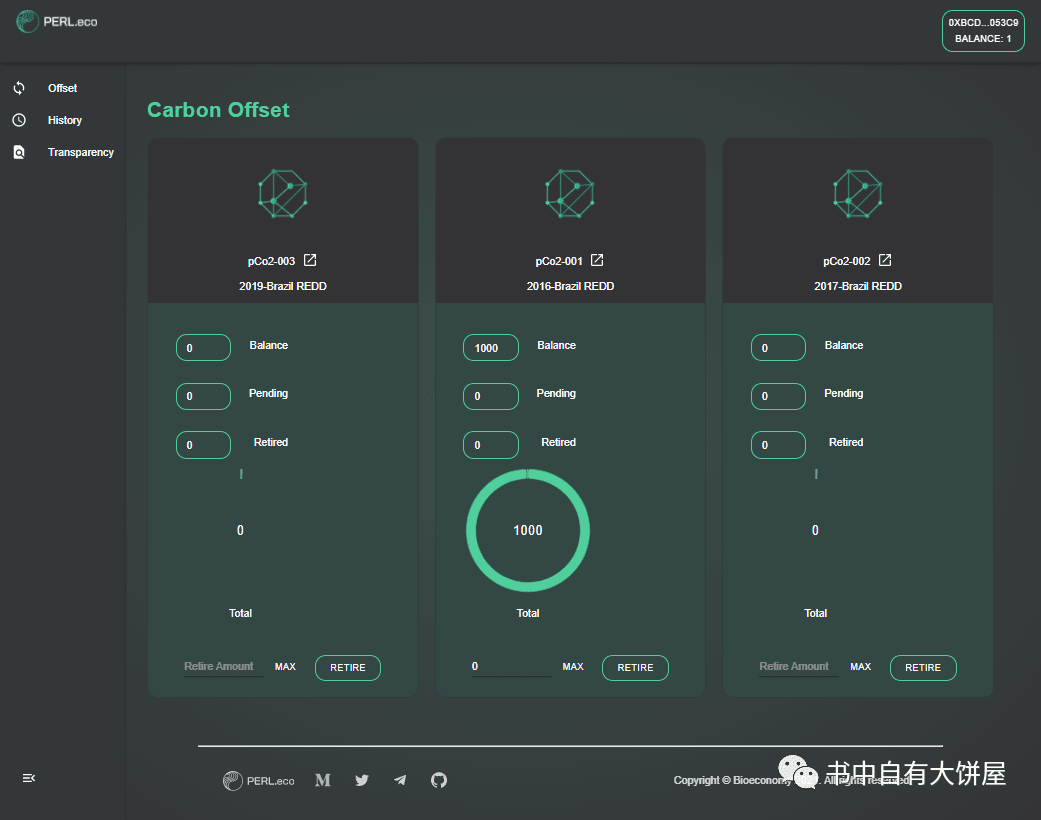
Each Pco2 represents 1kg carbon dioxide equivalent.
carbon credits
A carbon credit is a digital certificate that represents the right to emit one ton of carbon dioxide or the equivalent amount of other greenhouse gases (tCO2e). The purpose of issuing and trading carbon credits is to enable market mechanisms to drive industrial and commercial processes in a low-emitting or less carbon-intensive direction, as opposed to the approach used when there is no cost to emitting carbon dioxide and other greenhouse gases into the atmosphere. .
carbon exchange
PCX will be the world’s first fully regulated retail carbon exchange, allowing PFCs and other carbon financial instruments to be traded with PERL. PFC and other high quality carbon assets provided by PERL. Carbon emissions directly from supply-side carbon projects and partners will be retail traded on PCX.
PERL. eco is partnering with AirCarbon Group, operator of fully regulated carbon exchange ACX, to build PERL. The Ecological Carbon Exchange (PCX) is a free, independent regulated ecosystem for the trading of perfluorocarbons and other environmental financial instruments.
Token economy
The project is actually Binance's IEO that was launched in 2019. The total number of tokens is 1,033,200,000, and the current total amount is 490,938,908. 49% are currently in circulation. The current currency price is US$0.019, and the peak price was US$0.2959 (2021-04-05). In terms of distribution, the team’s currency holding ratio is 15+19 for the Ministry of Finance, which is about 34%, which is not very high.

To sum up, of these two projects, the first is traditional finance + blockchain, specializing in accounts receivable and trade finance. Then there is not a lot of information about this project, the market value is also very low, and the project is also very small. In the early stage, specific products have not yet been produced, so the risks are currently huge. The second project is carbon neutral. Our country is also vigorously developing this business. There are also many domestic blockchain companies making products in this area. Blockchain The chain is indeed very good at solving the problem of carbon credit. The industry is a big industry, but it is basically in the experimental stage at present. The same is true for this project. It was launched in 19 years and is still in a very early stage. The product There has been little progress on the project, and it is still in the drawing-out stage, including the currency price, which is gone forever. Judging from the currency price alone, this project is basically in the dark, so the projects discussed today, including the projects discussed in the previous issues, are For projects with a market value of less than 100 million U.S. dollars, the risk is huge and it is very likely to return to zero. Do not buy it at will. Through these series of special explanations, we learned that the current classification of the RWA sector is Layer 1 (polyx), which is stable. Currency (Maker, RSR), synthetic assets (SNX, UMA), real estate (labs), TradFi (FACTR), private fixed income (MPL), public fixed income (SMT), credit (CFG, GFI), carbon credit ( PERL), currently the two with the highest market capitalization are the stablecoin series, the synthetic asset series, and credit. Other areas are relatively low, so we have also concluded which RWA transfer projects are good and which are bad. Our Have you enriched your knowledge? Later, we will start an analysis of leading projects in the entire industry. Our friends at Planet Mass should be a month ahead.