

Original title: The Endgame for BNB Chain: AMA with the Core Development Team
Original author: Ignas, DeFi Research
Original translation: 0x26
Editor’s Note:
Crypto researcher Ignas has conducted AMAs on many chains such as zkSync, Near, Solana, and Avalanche, and raised many constructive questions. Although Binance's newly launched Web3 Wallet has recently become the focus of market attention, in the era of "one-click chain launch", how Binance strategically positions opBNB and how to give opBNB this L2 value is also extremely important. The following is Ignas' AMA with the BNB Chain core development team.
This will probably be my last AMA for the L1 project in the L2 era.
I’m glad that the last interview for L1 is with BNB Chain. It’s harder to contact the BNB Chain team than other L1 teams. So I’m grateful to the core developers of BNB Chain for taking the time to answer my questions.
Even if you are not too interested in BNB Chain, you have to admit that it is important. BNB Chain is always in the top three in terms of TVL, active users, and number of dApps.
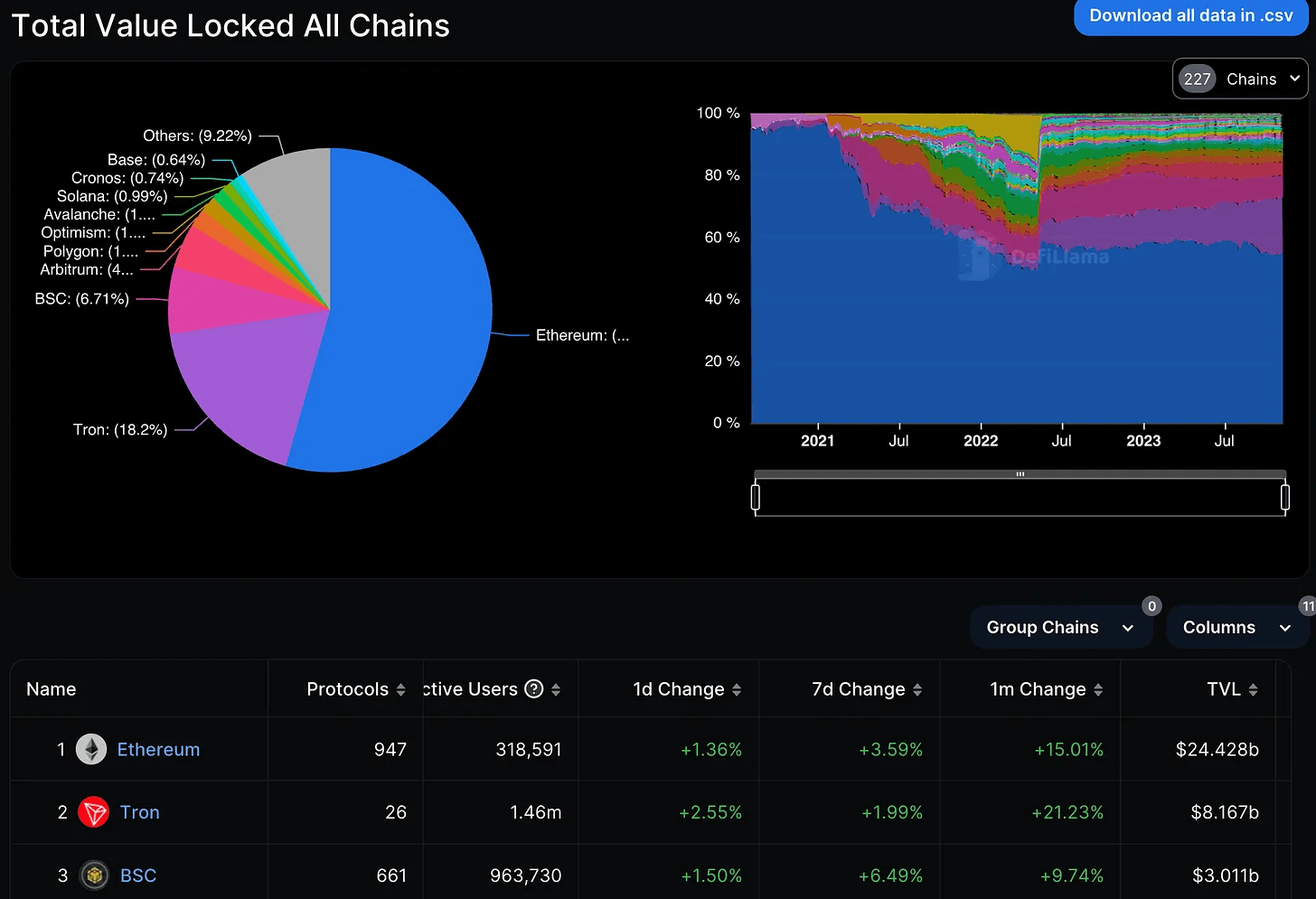
However, BNB Chain may not be the most popular chain on crypto Twitter, and I’ve even been criticized in the comments for covering the growth of the BNB Chain ecosystem.
However, numbers don’t lie. Users love using BNB Chain. Now, BNB Chain recently launched an L2 on BNB Chain, opBNB, to improve performance and reduce gas fees.
So, among the many L2 layers, what is the significance of BNB Chain and opBNB?
Question 1
In the L2 era, what is the significance of L1, especially BNB Chain's L2? Do you agree with Sanket (Polygon) and Matter labs CEO that Ethereum has won the L1 game?
BNB Chain Core Development Team
L1 and L2 solutions, such as BNB Chain and Ethereum, each have their own advantages and positioning in the Web3 world.
According to Nansen, there are less than 6 chains with more than 1 million monthly active users. Compared to Web2, there is still a long way to go to achieve mass adoption and reach 1 billion users. This is not about who wins the L1 race, but embracing the diversity and specific advantages of different solutions.
BNB Chain is based on the Ethereum technology stack, including OP Stack. We want to focus on the actual needs of users. BSC currently has more than 5,000 dapps and more than 1 million daily active users. Some high-frequency trading use cases and games are currently looking for cheaper and more scalable solutions, and opBNB provides them with a seamless solution both technically and commercially.
So, it’s not really a competition. It’s about finding the best combination of solutions to different problems. After all, we’re all in the same boat!
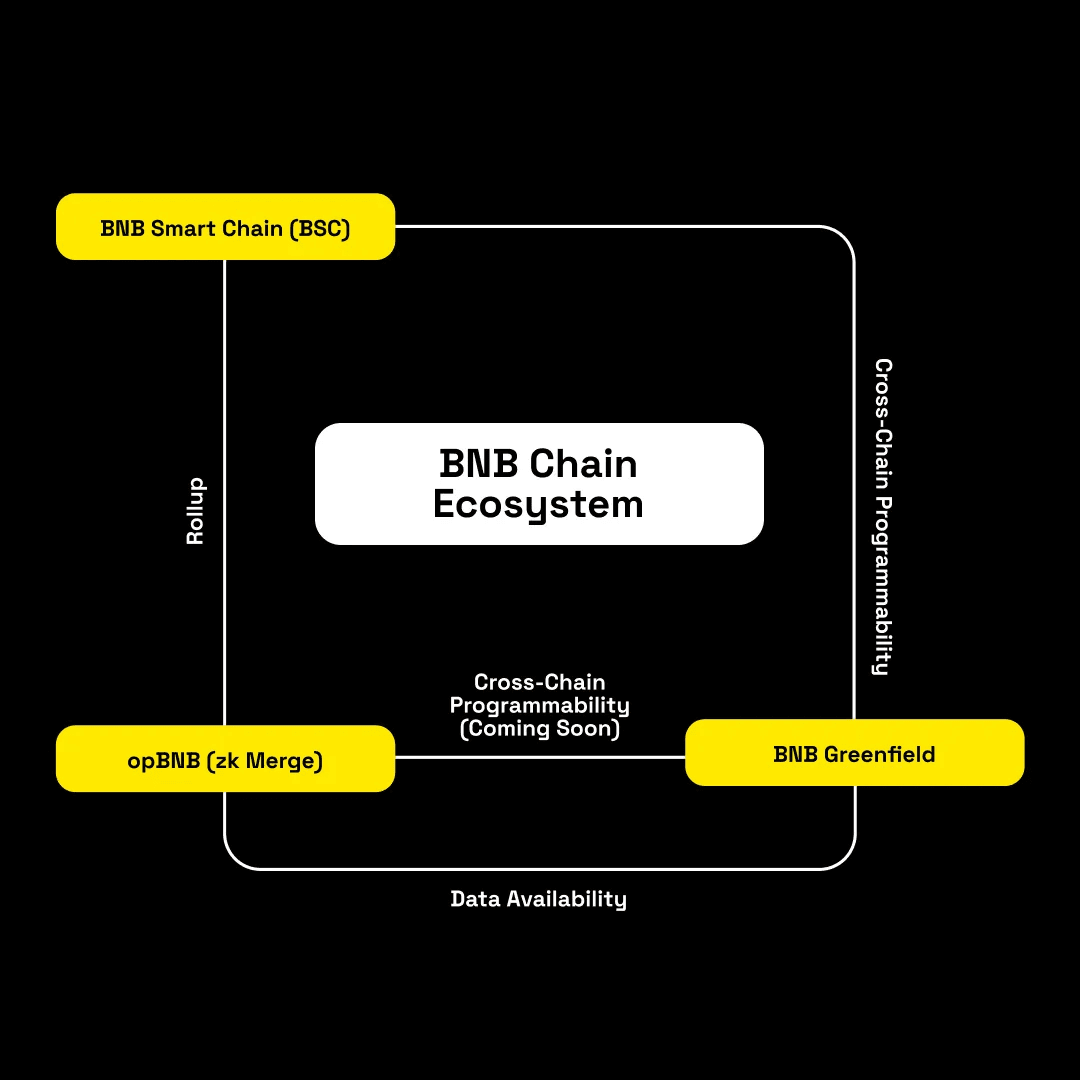
Please see the image below for a schematic diagram of the BNB Chain ecosystem:
Issue 2
Despite being in the top three for most activity metrics, BNB Chain has been criticized for being overly centralized, which was exposed when the BNB bridge was hacked.
Furthermore, with the current regulatory crackdown on cryptocurrencies, especially Binance, don’t you think this centralization is very worrying for users of Binance and BNB Chain?
What do you think of these criticisms? Do you plan to make BNB Chain more decentralized or focus on different value propositions of L1?
BNB Chain Core Development Team
BNB Chain is community-driven and not controlled by any single party. It all depends on the participation of users, developers, and validators. BNB Chain follows the same progressive decentralization approach as many other top protocols.
Currently, we have around 46 to 49 validators, of which 32 are actively participating. Validators are selected based on the BNB they stake.
We realize that decentralization is a process. We are eager to continue increasing the number of validators to become more decentralized over time, and we plan to increase the number of active validators to 40 by the end of 2023.
Issue 3
First of all, congratulations on launching opBNB, the L2 chain! Considering the already crowded market for L2 solutions, what is different about opBNB? How will you compete to attract more users and TVL?
To put it another way, wouldn’t it be more efficient to transform BNB Chain’s L1 into a true L2, similar to what Polygon is currently doing, rather than launching an independent Layer 2 on top of BNB Chain?
BNB Chain Core Development Team
Thank you so much!
As mentioned before, we created this L2 to provide a better experience for our 1 million+ daily active users and 5,000+ dApps that crave faster speeds and more savings. Some highlights of opBNB include the lowest gas fees of all L2s, a strong gas limit per block, and consistent fees regardless of traffic. In addition, we ensure that every transaction is approved by all nodes to ensure top security.
We support projects on opBNB through various programs, including bonuses, Kickstart, liquidity programs, marketing support, etc. We also focus on projects in DappBay.
Regarding the idea of modifying BNB Chain's L1 to a true L2, it is important to note that L1 is still crucial in the Web3 space. Launching opBNB can directly connect to a large BNB Chain user base and help developers better meet various use cases.
BSC has a wide and comprehensive DeFi portfolio, none of which needs to be migrated to opBNB. Even in the Ethereum ecosystem, Defi on the mainnet still dominates. BSC will be seen as a Defi hub, while opBNB is more suitable for games, SocialFi, and low-latency Defi applications such as derivatives, prediction markets, and payments.
Question 4:
What should the BNB Chain community look forward to? Are there any major updates or announcements coming up? We are eager to learn more about the major milestones on the roadmap.
BNB Chain Core Development Team
We recently launched BNB Greenfield on the mainnet. This new infrastructure component is designed to handle data and distributed ledger technology. It provides top-notch functionality in terms of data backup and recovery controls. More details are below:
Data Ownership: Data Unitization and Exchange (DataFi) is fundamentally different from other dStorage solutions (such as Filecoin or Arweave). Greenfield will focus on enabling creators, builders, and projects to build, deploy, and monetize their data and intellectual property (code, publications, novels, music, videos, etc.).
Cross-chain programmability: This is established between BSC and Greenfield, and will soon be established between opBNB and Greenfield. Existing BSC/opBNB developers can seamlessly leverage Greenfield as a storage and data processing layer. Gaming and social media dApps will soon be able to be implemented entirely on-chain.
Decentralized AI: This is another key theme. AI has greatly improved the efficiency of content creation (AIGC), and creators need a better data platform. In addition, the AI supply chain is now embracing Web3. For example, in decentralized AI dataset annotation and decentralized LLM training that protects data privacy. We will work with the BNB Chain community to build AI-related infrastructure around Greenfield.
Question 5:
What is the ultimate plan and vision for BNB Chain?
BNB Chain Core Development Team
BNB Chain aims to onboard 1 billion Web3 users to achieve true Web3 mass adoption. Key focus areas include decentralization, faster transaction speeds, multi-chain integration, and more support for developers.
Original link


