


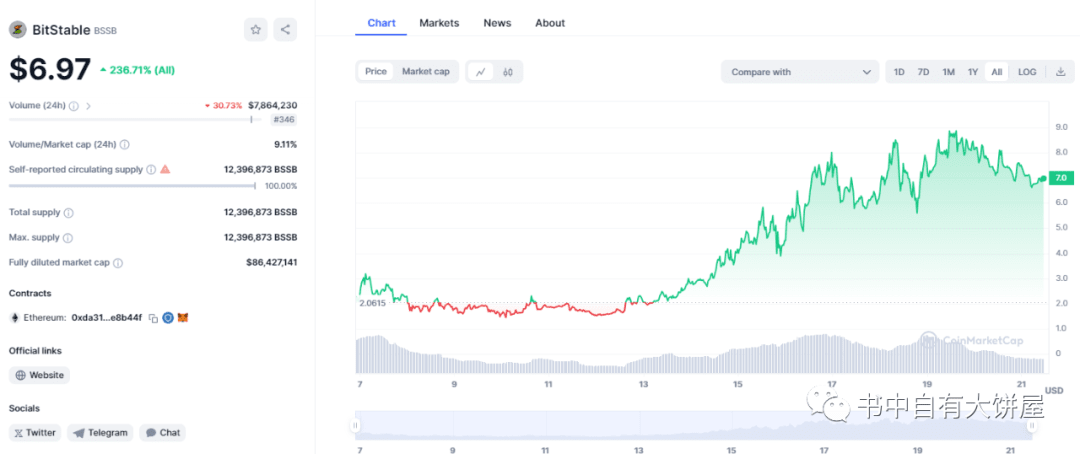
Yesterday we talked about auction, and we learned that it is actually a decentralized auction project, but it updated a version in the middle and started to make financial-related products, and then launched IDO, taking advantage of the popularity of the Bitcoin ecosystem, Two Bitcoin ecological projects were launched in succession, namely BSSB (stable currency project) and BDID (ID related) project, making it a launch platform for the Bitcoin ecosystem, and then the currency price also skyrocketed.
Introduction
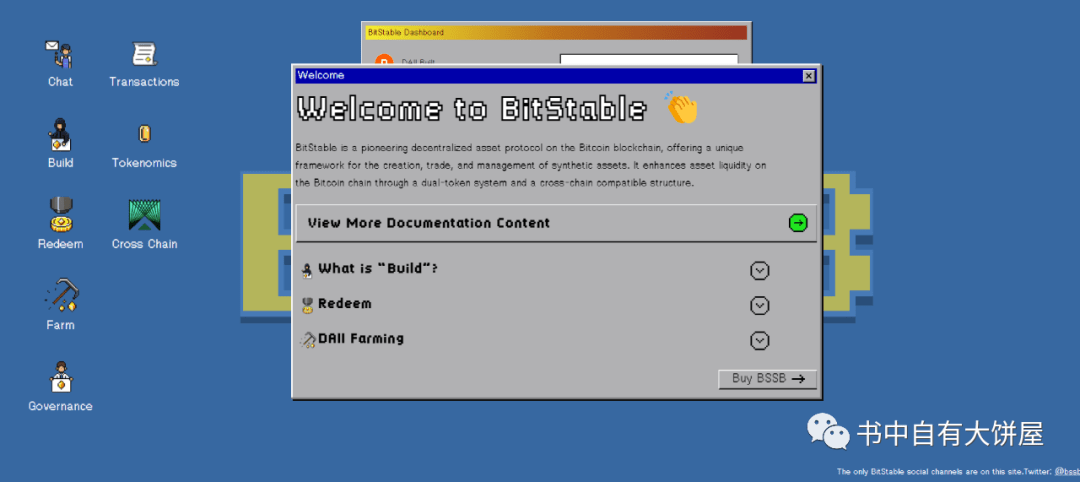
BitStable is a decentralized asset protocol based on the Bitcoin network that allows anyone, anywhere to generate $DAII stablecoins against collateralized assets in the Bitcoin ecosystem. BitStable has a dual-token system and a cross-chain compatible structure, and its tokens are $DAII and $BSSB. The total supply of $DAII is 1 billion.
$DAII is a stablecoin (BRC 20) whose value and stability come from the robustness of the Bitcoin ecosystem assets, including BRC 20, RSK, and the Lightning Network. In addition, in BitStable's conception, with its cross-chain capabilities, $DAII can also bring the Ethereum community into the Bitcoin ecosystem (through the cross-chain platform multibit).
DAII model
The DAII module in the BitStable protocol is a cornerstone feature designed for generating and managing DAII stablecoins on the Bitcoin blockchain. Given the limitations of Bitcoin in terms of smart contract functionality, the DAII module focuses on a simplified minting and burning process using ORDI assets in the initial stages.
minting and redeeming
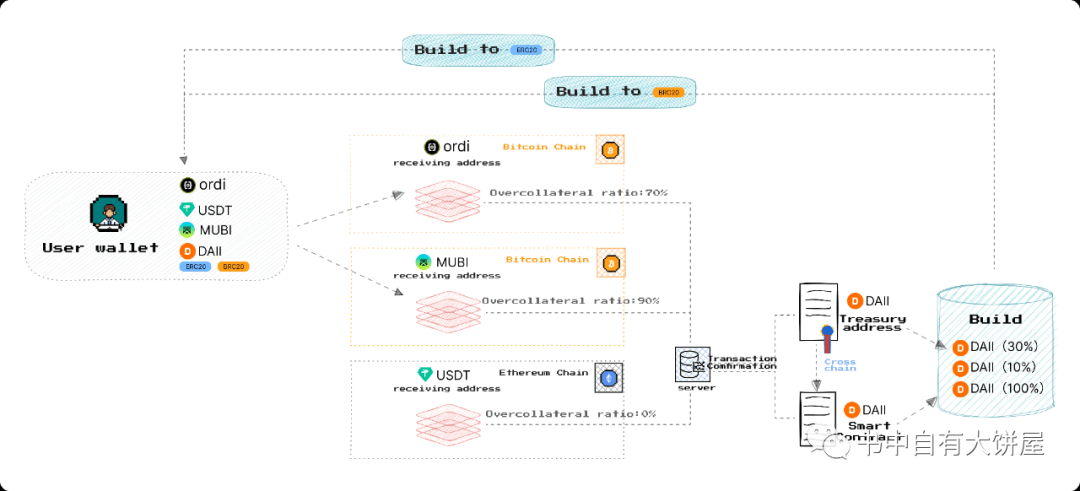
Users can use assets approved by "BSSB Governance" as collateral to mint DAII (only ORDI and MUBI were supported in the early stage). This process involves locking ORDI into the BitStable protocol on the Bitcoin blockchain.
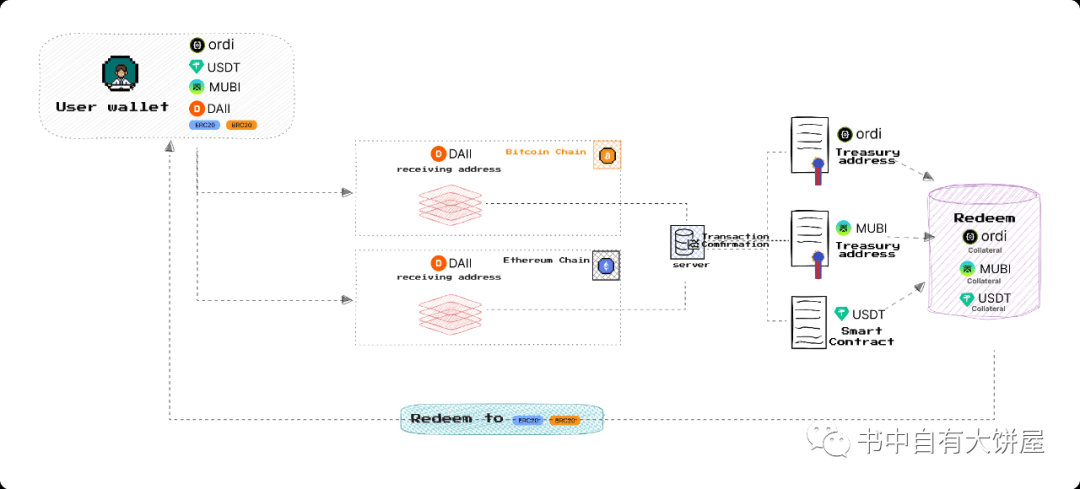
When users need to redeem the collateral or USDT on the Ethereum chain, they need to redeem SDAII on the Bitstable platform to restore SDAII to balance. Cross-chain and mining
Cross-chain and mining
Additionally, DAII minted on the Bitcoin blockchain can be bridged to Ethereum as an ERC 20 token, and this cross-chain functionality enhances DAII’s liquidity and usability within the broader crypto ecosystem. Users who obtain $DAII on the Ethereum chain can use stablecoins such as USDT or USDC for one-to-one replacement, and then cross-chain to the Bitcoin chain to participate in economic activities.
BitStable has partnered with MultiBit Bridge for cross-chain transfers between Bitcoin, EVM and other L1s.
To participate in mining and receive rewards, users need to use the MultiBit bridge to bridge their $DAII back to the Bitcoin blockchain. This process ensures that mining activities are securely anchored to the Bitcoin network. Rewards for mining activities are distributed within BSSB, aligning incentives with the governance and stability of the BitStable ecosystem.
Users can bridge their $DAII back to Ethereum as an ERC 20 token. This return process is crucial for users who wish to exchange DAII for USDT or participate in the Ethereum DeFi protocol. On Ethereum, users can exchange their DAII for USDT, completing the cycle of cross-chain interaction and providing a seamless user experience.
Overcollateralization and liquidation
BitStable stated that it will set an over-collateralization rate that is relatively safe and difficult to liquidate based on the price fluctuations of the collateral; assuming the over-collateralization rate is 50%, this means that users can only obtain $DAII of 50% of the collateral value. Although the overcollateralization rate is set, BitStable will still set the liquidation plan as a safety plan and set the health factor as a reference.
DAII Mining
$BSSB is the platform’s governance token and is used by stakeholders to maintain the system and manage $DAII. Holding BSSB can obtain platform income dividends and voting rights, and you can also have certain acceleration rights in the early stage.
Users can stake $DAII in "Farm" to obtain $BSSB. It should be noted that Farm only runs on the Bitcoin chain, so when the user's $DAII is exchanged for USDT on the EVM chain, MultiBit needs to be used to pledge $DAII (ERC 20) on the chain.
If you want to obtain higher mining income, you can also pledge $BSSB to obtain boosted equity and increase the equity weight of $DAII.
Token distribution
According to the information, the total supply of $BSSB is 21 million, and the total amount raised is US$500,000. 50% of it will be distributed through Bounce Finance, and this distribution will be divided into two rounds:
60% of the allocation will be carried out through staking Auction (obtaining the corresponding $BSSB allocation by staking AUCTION tokens);
40% of the allocation will be through the auction mechanism (1 $BSSB = 0.0000233 ETH).
The team will hold 5% of $BSSB (6 months locked and 15 months linear unlock), the airdrop will account for 3.5%, the staking rewards will account for 36.5%, and LP will account for 5% (locked indefinitely).
Compare DAI and maker
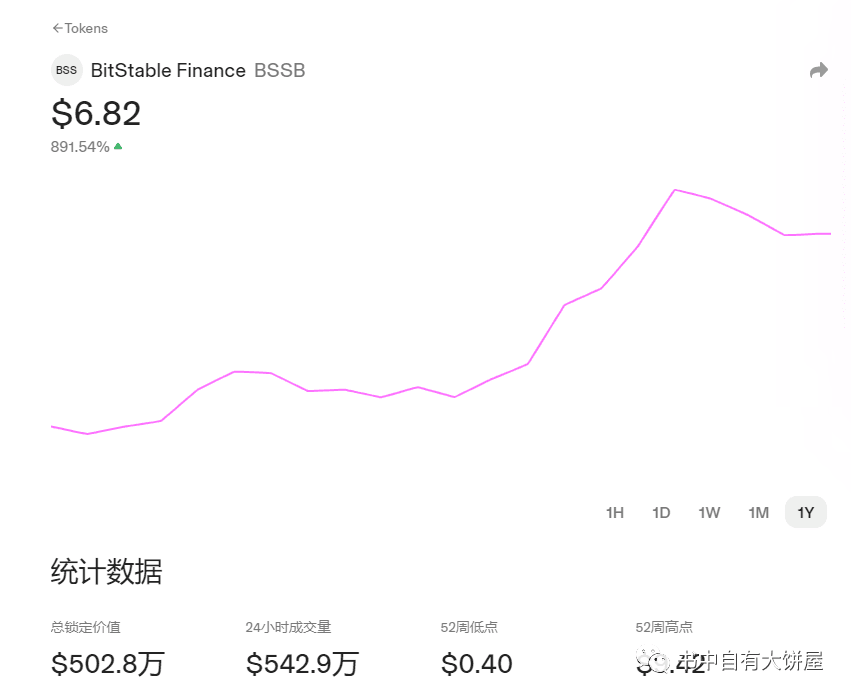
The current market value of DAI is US$5.3 billion, which corresponds to the market value of MAKER of US$1.2 billion. However, the current total supply of DAII is only 31 million, and the market value is only US$200 million. The current currency price of BSSB is US$6.8, and FDV is only about US$140 million. Compared with DAI, there is at least 10 times the space.
GODID (BDID) project two
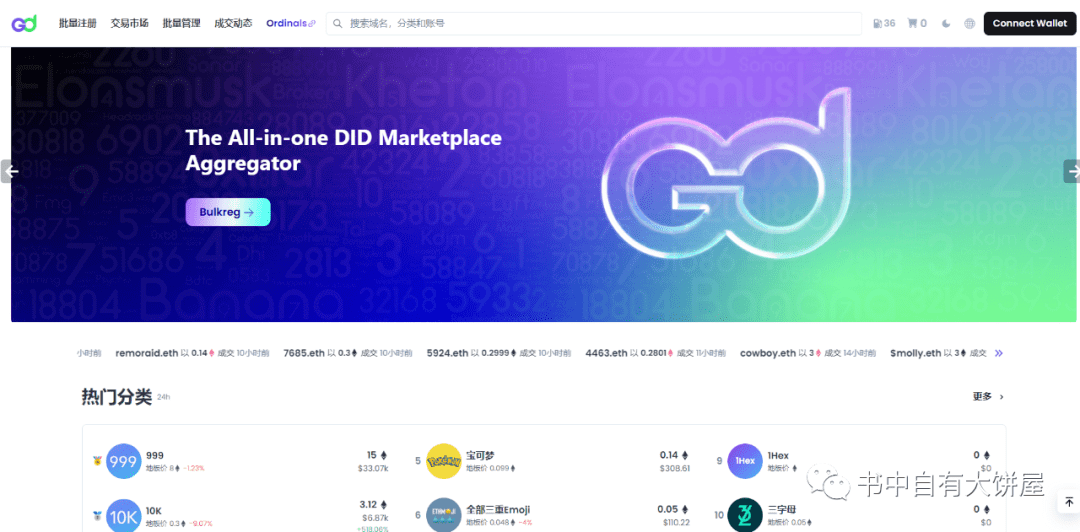
GoDID is a DID aggregation trading platform that currently mainly serves ENS, Space ID and Bitcoin Ordinals DIDs.
GoDID’s ENS module
GoDID provides the most practical ENS platform with lower rates and diverse functions. GoDID's ENS module is completely built using OpenSea's Seaport contract. GoDID's ENS module covers the entire life cycle of ENS, including search & registration, transaction and management.
In addition, GoDID also provides various practical rankings and tools for ENS users, such as bidding by category, pre-registration of popular accounts, multi-market listings, etc.
Most importantly, GoDID provides users with the most diverse classifications (144 categories in total), which facilitates user inquiries and transactions.
GoDID’s Ordinals module
In order to better serve Ordinals DID users, GoDID has specially incubated BDID, hereinafter referred to as BDID. BDID focuses on the registration, trading and management of Ordinals DIDs, and is in a unique position to support various mainstream Ordinals DIDs including .sats, .bitmap, and .btc.
BDID is committed to opening and becoming the most professional platform in the field of Ordinals DIDs. Looking to the future, the platform plans to lead the research and development of derivatives in the Ordinals DIDs ecosystem, thereby increasing the circulation and value of Ordinals DIDs. In addition, the platform is committed to bridging the gap between various DID protocols on BTC L2 and enhancing connectivity and synergy among different DIDs in the ecosystem.
Details of this launch
BDID token distribution situation
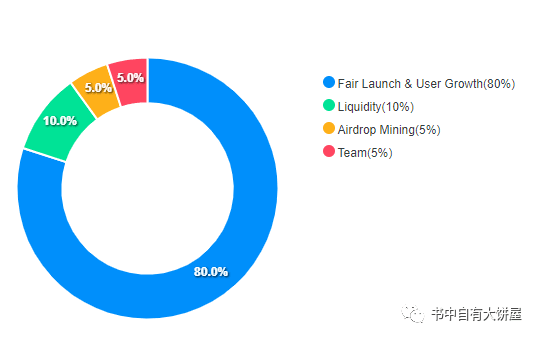
Total quantity: 500, 000, 000. The current price is US$0.031. The current market value is US$14,286,150, which is still relatively low.
Launch distribution amount: 400, 000, 000 (accounting for 80% of the total amount, respectively 20% for lottery, 40% for AUCTION pledge, and 20% for DAII pledge)
Liquidity: 50, 000, 000 (accounting for 10% of the total)
Mining airdrop: 25, 000, 000 (accounting for 5% of the total, for MUBI, BSSB, AUCTION, WBTC, lasting 50 days)
Team allocation: 25, 000, 000 (accounting for 5% of the total, locked for 6 months, linearly released for 12 months)
This Launch supports three ways to participate: use AUCTION to purchase lottery tickets for the lottery, use AUCTION to pledge and obtain the allocation in proportion, use DAII (the stable currency issued by the previous Launch project) to pledge and obtain the allocation in proportion, specific quota I won’t go into details, you can go to the transmitter and take a look.
To sum up, this project is an integrated ID-related DID market. It feels like it is made by the Chinese, because the documentation is all in Chinese, and the BDID token has nothing to do with the platform itself, and is related to the ID itself. Product sales are not popular yet, and the size is very average. Although it is still enjoying the popularity of BRC20 recently, overall this project is relatively average. Currently, only Bybit and uni are online, and there are many exchanges that are not online. However, since the launch, the currency price has been falling and its performance is not as good as BSSB.
Then let’s continue yesterday’s topic and take a look at the platform Auction. Judging from the two launchpads currently launched, users of Auction should make a lot of money. It is said that it is higher than that of An An (about 15%). Previously, An An His ACE is almost 1 million, and he earns 40,000 in 5 days, which is almost 4 points at a time. I have said before that the biggest problem with AUCTION is that the tokens are not linked to the product. Now that we can focus on this launch platform, give rewards, and allow users to hold them all the time, maybe it is a good choice? And judging from the size, the market value of the auction is not high. As for the token strategy, the two projects we talked about today will be explained in Our Planet.