


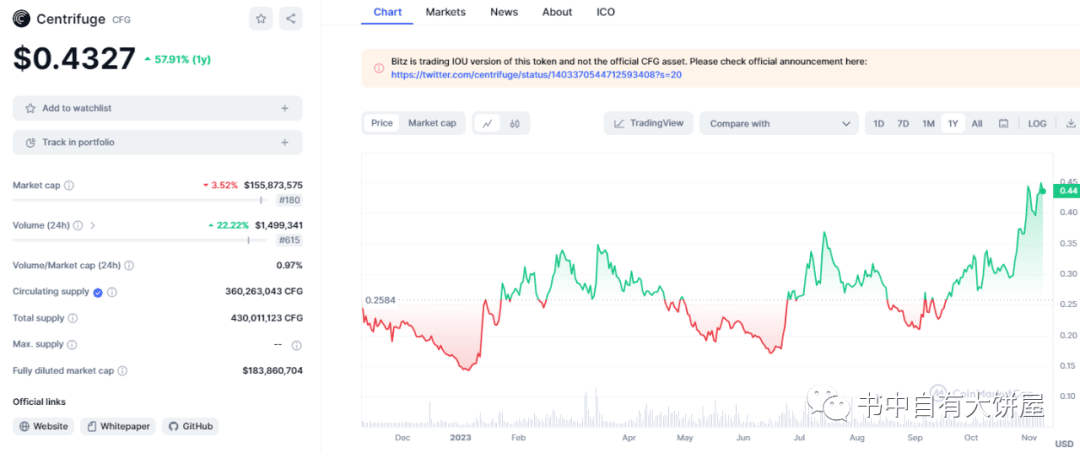
Today we will launch a series of rwa special sessions. Later programs will introduce the players on the RWA track in several consecutive episodes. In fact, we have met some SNX, MKR, etc. before. Today we are talking about CFG. Its performance in the past year has been okay. , it has risen from the lowest point of 0.15 to 0.44, which is almost a three-fold increase. The current market value has reached 150 million US dollars, ranking 180+. Today we will take a look at it.
Introduction
Centrifuge is a DeFi protocol on Polkadot that can bridge assets such as invoices, real estate, and royalties to DeFi, mortgaging physical assets in smart contracts in the form of NFTs. Borrowers can finance with their own real assets without banks or other intermediaries, and use NFT's tradability and mortgageability to achieve a diversified DeFi product experience.
Centrifuge is a supply chain financial operating system that can represent real assets (such as bills) as NFT tokens through the Centrifuge platform. After obtaining a certain value performance, it can mint ERC-20 tokens by applying Tinlake to over-collateralize various NFT assets—— CVT (Collateralized Value Token), then lock CVT to lend crypto assets, such as Dai, from various decentralized lending protocols, thus bringing physical assets into the crypto world.
The company was founded in 2017 by Lucas Vogelsang, Maex Ament and Martin Quensel. One of the founders, Maex Ament, is a mathematician and serial entrepreneur. Like most members of the team, he has been engaged in the traditional supply chain finance field for a long time and has many years of industry experience and deep professional knowledge.
One of the company’s investment advisors is MakerDAO’s Foundation Chairman and COO Steven Becker and Zeppelin Solutions’ Founder and CEO Demian Brener.
Product operation logic-off-chain part:
The main legal compliance process occurs off-chain, and the flow of funds and tokens occurs on-chain.
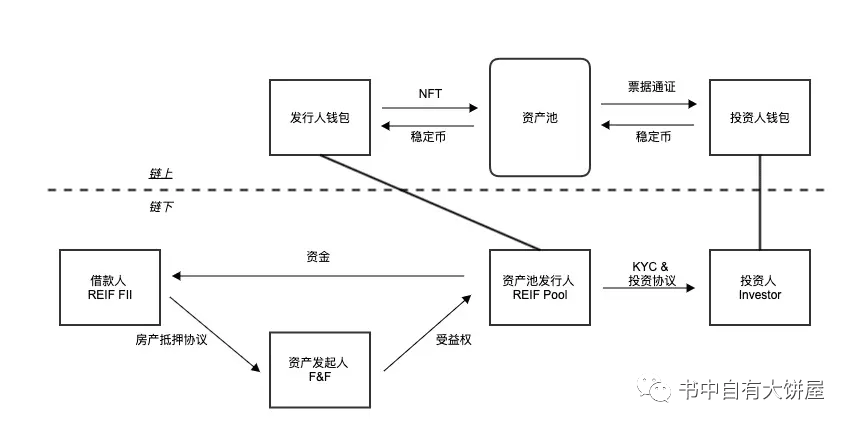
The borrower signs a property mortgage agreement with the asset originator.
The beneficial interest in this asset is then transferred to the asset pool issuer.
The issuer of the asset pool signs an agreement with the investors and confirms the compliance of the investors.
The issuer of the asset pool will hand over the funds obtained from investors (on the chain) to the borrower to complete the borrowing process. During the repayment stage, the borrower hands over the funds to the issuer of the asset pool as agreed, and the principal and interest are distributed to the investors through the chain.
The blockchain mainly establishes an open trading market between asset pool issuers and investors:
The issuer uses the MerkleTree structure to store relevant information about the asset, and mints the NFT as a representation of the off-chain collateral linked to the on-chain pool.
On-chain asset-level transparency: Investors can see at a glance which assets (NFTs) are contained in a pool, how much has been lent, how much has been paid back, which assets are overdue, and more.
The asset pool issues two types of ERC-20 note tokens, called TIN and DROP. Holding the token DROP will be a more robust investment, yielding a fixed rate of return upon settlement. Holding the token TIN is a radical investment with a fluctuating rate of return. When the borrower performs the contract, he or she will receive higher returns, but when the borrower defaults, he or she may lose the principal.
Features:
(1) Asset issuance: Centrifuge allows the issuance of multiple types of assets, including tokens, stable coins, real-world assets, etc. Users can issue assets to the blockchain through smart contracts to achieve digital and decentralized management of assets.
(2) Asset financing: Centrifuge provides blockchain-based asset financing functions, allowing users to obtain financing by mortgaging or pledging assets. Financing methods can be interest-rate-based loans, margin-based transactions, etc.
(3) Asset liquidity: Centrifuge improves asset liquidity by integrating with multiple DeFi protocols. Users can transfer and exchange assets between different protocols to achieve the best allocation of assets and maximize returns.
(4) Decentralized governance: Centrifuge adopts a decentralized governance model, with community members participating in decision-making and management. Community members can participate in the governance process through voting and proposals to ensure the transparency and fairness of the system.
Relationship with MakerDAO and Aave
Among the major DeFi protocols, MakerDAO and Aave are actively carrying out RWA business, and related business is conducted through Centrifuge.
There are multiple MakerDAO-related fund pools on Centrifuge. These fund pools are integrated with MakerDAO's Vault and funds can be withdrawn directly from the Vault. The largest are the active capital pools BlockTower Series 3 and BlockTower Series 4, where BlockTower is the sponsor. They are both private pools. The priority capital is obtained from Maker Vault, and the secondary capital is contributed by the sponsor BlockTower. The funds in these two pools are respectively to US$37.33 million and US$97.17 million. There are also two fund pools, BlockTower Series 1 and BlockTower Series 2, also sponsored by BlockTower, which will be launched soon. In addition, there are New Silver Series 2, ConsolFreight Series 4, Fortunafi Series 1, and Harbor Trade Credit Series 2 on Centrifuge, which are integrated with Maker Vault. The values in the corresponding liquidity pools are US$12.05 million and US$3.61 million respectively. , US$8.43 million, US$2.14 million. The capital pool related to MakerDAO has a total of approximately US$161 million, accounting for 80% of Centrifuge TVL.
Funding pools integrated with Maker Vault have another benefit. Each capital pool has a reserve pool. The funds in the reserve pool can be lent by the issuer or redeemed by investors, but no interest will be generated. Normally, there is no remaining funds in the reserve pool. If it is a capital pool integrated with Maker Vault, as long as the debt limit of the Vault is not reached, when the user needs to redeem, they can directly withdraw funds through Maker Vault and transfer personal debt to Maker Vault.
Aave and Centrifuge have jointly established a lending pool dedicated to RWA. Depositors can deposit USDC and receive Centrifuge mining rewards in addition to interest income. Borrowers use various DROP tokens as collateral to borrow USDC to improve fund utilization. The current total deposits in the RWA market in Aave are US$7.62 million, of which USDC deposits are US$3.41 million, and total borrowings are US$2.78 million, which is not high compared with MakerDAO.
team
The Centrifuge team comes from many world-renowned companies and organizations, including Consensys, Electro Coin Company, Parity, Goldman Sachs, Credit Suisse, SAP, Microsoft, Deloitte, United Nations, Federal Reserve, etc. Our founder is a serial entrepreneur who has been engaged in entrepreneurship in the traditional financial field and has accumulated many years of experience.
CEO Lucas Vogelsang has been working at the intersection of technology and business since graduating from college. He is CTO of Swiss e-commerce startup DeinDeal and co-founder of Centrifuge. After successfully selling DeinDeal, he helped German startup KaufDA expand internationally. He then joined Taulia as Engineering Manager. He later co-founded Centrifuge with Martin and focused on real-world asset DeFi.
CFO Martin Quensel is a serial entrepreneur in the fields of fintech, crypto, and financial supply chain automation. He began his career at SAP as a software developer and architect. Prior to Centrifuge, he was co-founder of Taulia. Martin has a keen interest in how software impacts the real world and how to make it better.
Token economy
The project was established in 2017, with a listing date of Centrifuge Chain 2020/05 and migration to Polkadot Parachain in 2022/04.
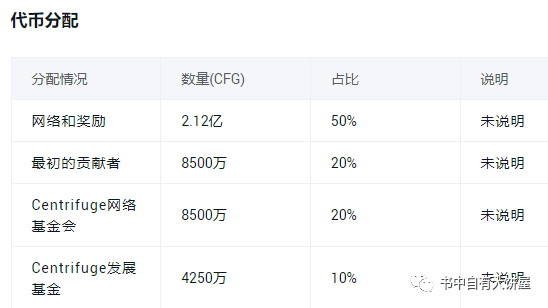
The current total number of tokens is 430,011,123, the circulation volume is 360,263,043, and the circulation rate is 83.7%. The current price ratio is around 0.42, with the highest peak of $23.9999 (2021-06-04). Judging from this, it has fallen into the value range, and the token distribution is not very clear. At least two foundations took 30% of the tokens.
Then the total assets seen on the official website are 490 million US dollars, and TVL is almost 250 million US dollars. This data is already higher than its market value. Moreover, funds have been rising recently, which shows that the market is accepting it and the product is recognized.

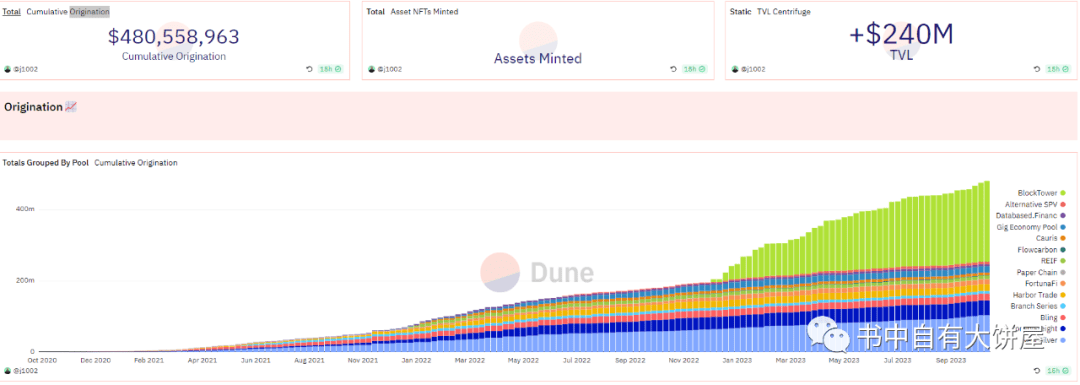
Finally, let me summarize this project. This is actually similar to a credit financial project. In fact, it does not pose a threat to mkr or aave. On the contrary, they are mutually reinforcing. This is actually very similar to the GFI we talked about before. From a data perspective alone, this project has good potential, because from various data and growth perspectives, this project is growing rapidly, and the current market value of the project is only 150 million, and the tvl on the chain has 250 million. , with total assets of 500 million, so it is still in a low valuation range, although it has tripled. However, it currently has some potential risks, such as centrifuge, where borrowers and asset originators still collude to create false (or overvalued) collateral. However, this is still a very high-quality RWA leading project for asset lending.