

Written by: Rhythm Worker, BlockBeats
Contents:
Aragon is moving away from “human rule”
The community lists the six sins of Aragon Association in the past
· The biggest debate: Where should the remaining funds go?
Aragon Association’s past governance issues
On November 3, some media reported that the DAO management platform Aragon and Aragon DAO had been dissolved. However, according to BlockBeats, Aragon actually made a major update. The Aragon Association committee responsible for managing funds raised in the network token sale was dissolved. Aragon will continue to build its product-centric mission in the future.
Aragon is moving away from “human rule”
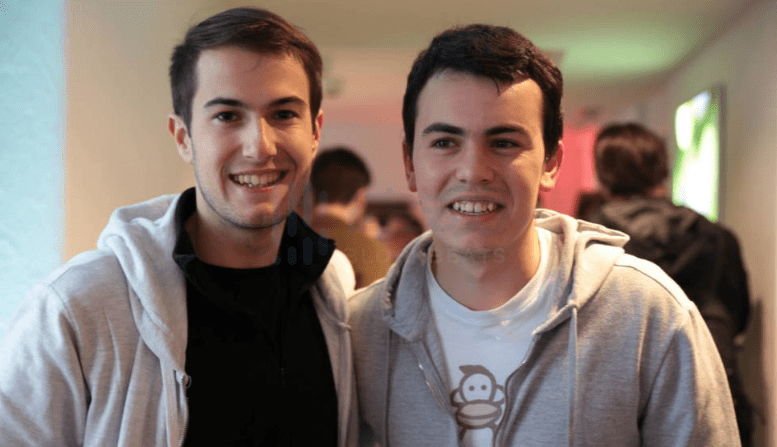
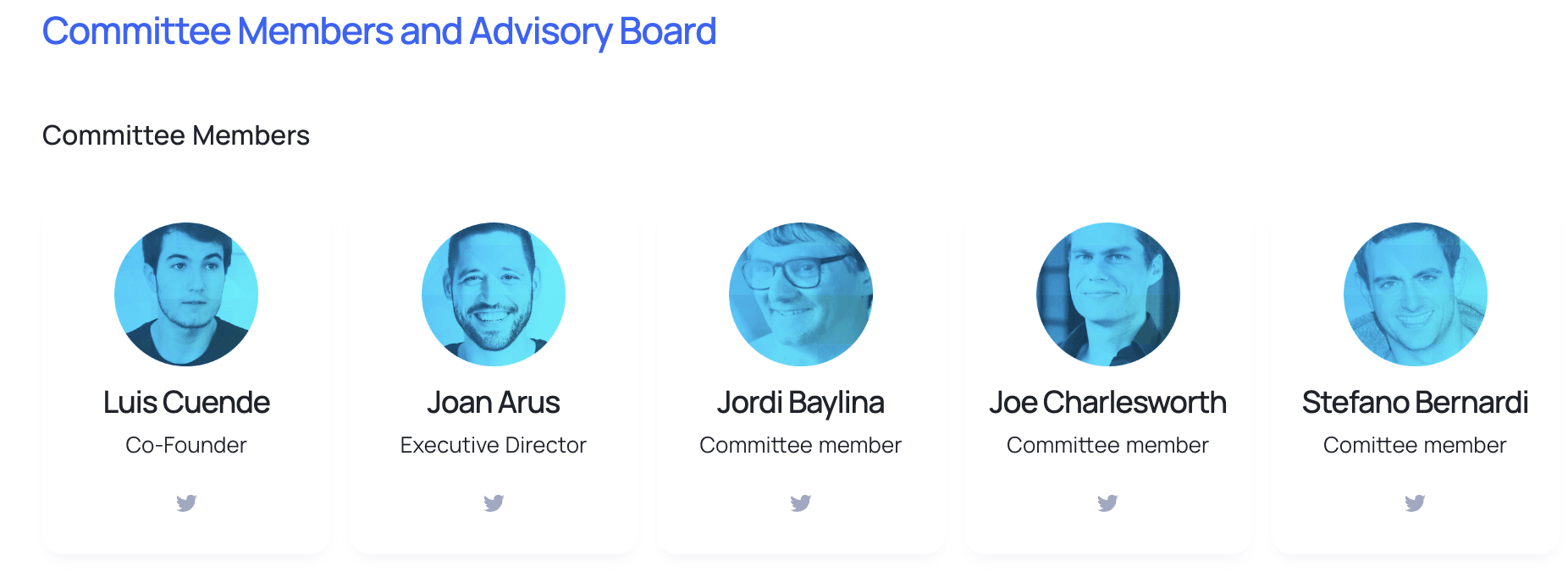
The Aragon Association Committee can be said to be the legal steward of the Aragon project, responsible for managing the funds raised in the Aragon network token sale. According to the official website, Aragon's founders Luis Cuende and Jorge Izquierdo serve as co-founders and executive directors of the Aragon Association Committee, respectively.
Aragon is a decentralized governance solution for Web3 communities and organizations, founded by Luis Cuende and Jorge Izquierdo in 2016. It aims to enable organizations, entrepreneurs, and investors to conduct business without legal ties. Aragon's open source stack supports deploying DAOs, managing communities, resolving disputes, and conducting enterprise-level voting, all without the need for middlemen, with the mission of creating better on-chain, borderless, and transparent organizations.
Aragon has made great contributions to the development of the DAO industry and can be said to be the largest DAO platform in history. For example, it developed aragonOS, a DAO framework that experiments with governance at the speed of software. Today, aragonOS supports Ethereum-based DAOs such as Lido and Curve, helping these projects manage more than $16 billion in assets. The Aragon App developed by Aragon is a user interface that allows anyone to deploy and manage DAOs without code.
Aragon explained the reason for the major update in the official announcement: "While the financial department has grown significantly, the complexity of the bureaucracy, inconsistency among stakeholders, and failed attempts to modify governance have increased tensions within the project. It turns out that neither AA nor ANT is currently suitable for managing the project. Aragon needs to start over and can do nothing but reset."
The community lists the six sins of Aragon Association in the past
Aragon community member @Samsara79416227 said that over the past year, the Aragon Association (AA) has continued to disappoint all DAO members, their communities, regulators, etc. In the past 6 months, AA has been seen doing many things that directly violate its duties.
Samsara lists the six sins of Aragon Association:
1. Ignoring the vote: It’s been 8 months since the vote to transfer the treasury to AN DAO passed, but the Aragon Association refuses to move any funds. Why are they ignoring the wishes of ANT holders?
2. Aragon Association does not provide transparency: Multiple unanswered forum posts asking about the Treasury. Aragon Association unilaterally decided to merge the Treasury without discussing timing/balances.
3. Aragon Association AA missed the timeline: Claimed they had 4 months for a solution, but every month there has been no progress. It is now October 27th and there is no sign of a solution. Why the constant delays?
4. Aragon Association’s negligence frustrates own team members - team had to create a separate Discord channel to ask questions to Aragon Association because they have no information/transparency. Even simple txns take weeks.
5. Aragon Association executive director lied: claimed his contract was not withheld, but this was a blatant lie. Why would an Aragon Association member lie about their position?
6. Aragon Association has shown bad faith, lack of care in answering questions, lies, inability to pay attention to voting, etc. This mockery of the DAO cannot continue.
The biggest debate: Where should the remaining funds go?
Aragon stated in the official announcement that the remaining funds will be used for product development. At the same time, Aragon Association is deploying 86,343 ETH to the redemption contract on the Ethereum mainnet, and ANT holders can exchange ANT for ETH at a fixed exchange rate of 0.0025376 ETH/ANT.
Regarding the decision, Aragon said that due to legal restrictions, especially the regulatory risks caused by token speculation and market manipulation, the decision could not be submitted to a public vote.
Crypto researcher DCF GOD strongly disagrees with Aragon's behavior, pointing out that the team will take 100% of the unclaimed funds for themselves. If the holder does not see this announcement and claims within 1 year, then the holder will never get the money again because the team will take it away. DCF GOD listed some possible solutions for Aragon:
A) Dead supply gets some new tokens so they can own whatever the team builds with their money;
B) All treasuries are permanently available, so when these holders discover, they can claim;
C) If the Dead supply will never be claimed (still being migrated), then it should be burned to increase everyone’s claim value;
D) All Dead supplies belong to everyone who claims again (this is what happens in the traditional way, but we have smart contracts that can be fairer to latecomers);
DCF GOD couldn't understand it, and Aragon chose Option E and donated it to the team for future product use.
Aragon Association’s Past Governance Issues
According to BlockBeats, on May 17, the Aragon Association Committee stated that "Arca and other investors launched a 51% attack on it." In response, Jeff Dorman, chief investment officer of cryptocurrency hedge fund Arca, responded in a recent blog post: "The narrative of a 51% attack is actually incorrect. We are token holders and we want to use our tokens to participate in governance. Arca's staking tokens has promoted the active participation of token holders."
In addition, in response to the Aragon Association's claim that "gangs" such as Arca have destroyed many DAOs and their communities, Arca stated that it has not attempted to dissolve Aragon, and Arca has not invested in Invictus, Rook, Rome or Temple. The Fei Labs team proposed to dissolve itself, and the Rook team initially proposed to split the "Incubator DAO". These are the best results for token holders. BlockBeats previously reported that the Aragon Association Committee announced the abolition of all voting rights of ANT holders, and Arca publicly called on Aragon to repurchase ANT.
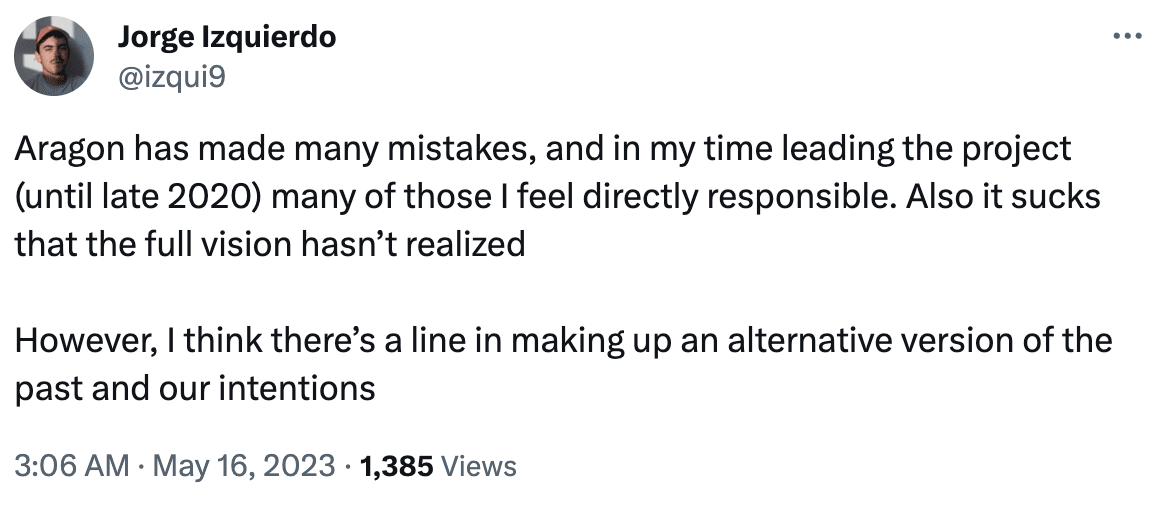
Regarding the governance issues of the Aragon Association Committee, the former executive director of the Aragon Association expressed his direct responsibility at the time: "Aragon made a lot of mistakes, and I feel directly responsible for many of them during my time leading the project (until the end of 2020). Unfortunately, the full vision has not been realized. However, I think there is a line in fabricating alternative versions of the past and our intentions."
Not only that, BlockBeats reported that on August 11, CoinDesk cited a 24-page investigation report prepared by crypto trading company Patagon Management LLC, saying that the Aragon Association considered "selling the project" to an undisclosed bidder at an unknown price in June. The report also accused Aragon of wasting its various crypto assets worth $180 million and questioned whether the organization complied with Swiss non-profit laws. Aragon said it would release a transparency report this month in response to the allegations. In May of this year, Aragon canceled plans to hand over control of its treasury to token holders due to concerns about the influence of activist investors.
Looking back to 2021, the Aragon "collective resignation" incident had the greatest impact at the time, with 13 people resigning in 5 days, which was really sad.
Although the concept of DAO is to allow the organization to be completely controlled by code, in reality many DAOs still have too much human participation and decision-making, and this excessive human participation is the fundamental reason for the trust crisis in DAO.
The idea of a DAO is to automate certain governance processes so that they can continue to run without human intervention. In Ethereum's white paper, a true DAO should be a decentralized autonomous organization that is completely independent of human coordination. Even Bitcoin has only achieved this concept to a certain extent, and is closer to the definition of a DAO, but not completely in line with it. Strictly speaking, although many organizations call themselves DAOs, they have not yet achieved true autonomy and self-governance. DAOs need to be not only decentralized, but also dehumanized.
At the same time, after so many years, DAO is still thinking about this question: should major decisions of blockchain projects be made by a few people, or should they be based on community autonomy and smart contract execution?