



As of press time, the crypto economy is at $2.69 trillion, with the digital currency market posting significant gains this week. Over the weekend, the total value locked (TVL) in decentralized finance (defi) surpassed the $100 billion mark.
Defi TVL Surpasses $100 Billion Mark
It took a while to reach this benchmark, but as of 5 p.m. EDT Sunday, defi protocols had pushed TVL to $101.42 billion. Leading the way in value was Lido, with $31.138 billion, boosted by its role in securing a sizable 9.79 million ether (ETH). Aave was next among defi protocols with $16.435 billion locked as of Sunday.
Lido operates as a liquidity staking platform, while Aave offers a unique approach by allowing users to lend, borrow, and earn interest on crypto without the need for a middleman. Rounding out the top three, Eigenlayer, which holds $13.443 billion, offers a restaking service that fits within the Ethereum ecosystem. Restaking allows users to leverage their staked assets across multiple protocols, potentially earning rewards without releasing the original funds.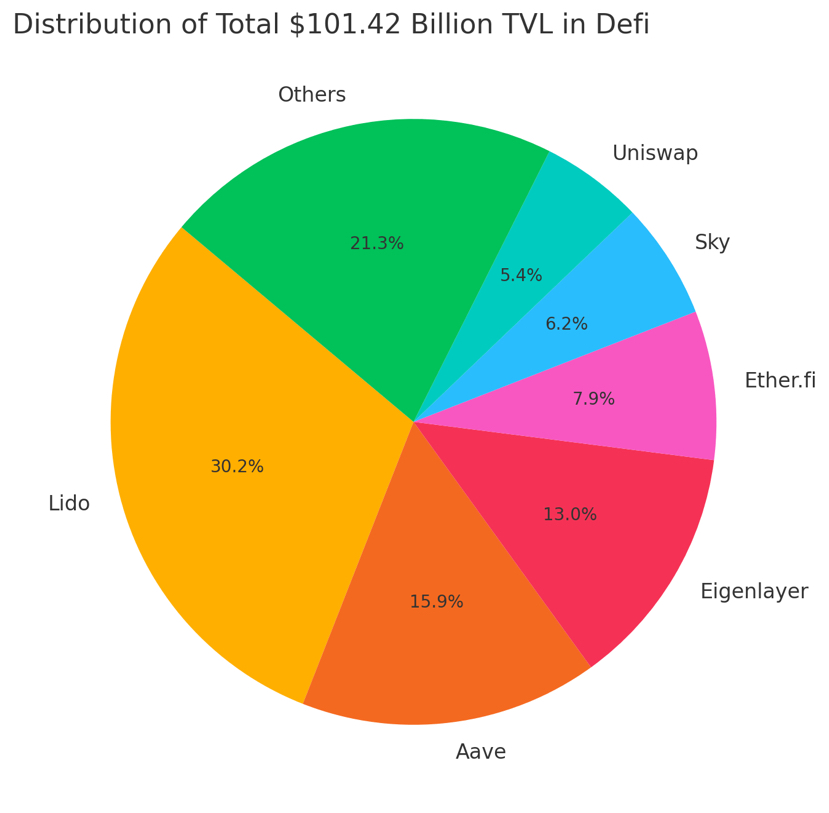
Among the prominent defi protocols by TVL size are Ether.fi, a staking protocol; Sky (formerly Makerdao), a lending protocol; and Uniswap, a decentralized exchange (dex). Ether.fi currently manages a solid $8.205 billion, while Sky holds around $6.416 billion in TVL. Uniswap’s dex, meanwhile, has $5.623 billion locked at press time. Currently, defilama.com lists a whopping 4,212 defi protocols, with the top six — Lido, Aave, Eigenlayer, Ether.fi, Sky, and Uniswap — holding a combined $81.26 billion.
In other words, these six giants account for 80.12% of the total value locked (TVL) in defi today. The remaining $20.16 billion is spread across 4,206 other platforms. But the story doesn’t end there. Binance’s liquidity staking platform, which secures 1.62 million ether, adds another $5.064 billion in TVL, or about 4.99% of the $101.42 billion locked in defi. While this concentrated value benefits major players like Lido, Aave, and Binance, it also brings with it higher risks.
A serious problem with any of these platforms — similar to the challenges other defi applications have faced over the years — could have a ripple effect, potentially shaking up the broader defi world. As the defi sector grows, its resilience will likely be tested by the concentration of assets in a few key platforms. Whether this concentration fosters innovation or invites further vulnerabilities remains to be seen in the evolving world of cryptocurrencies and blockchain technology.
Follow Wendy to stay updated with useful information from the crypto market 😉