


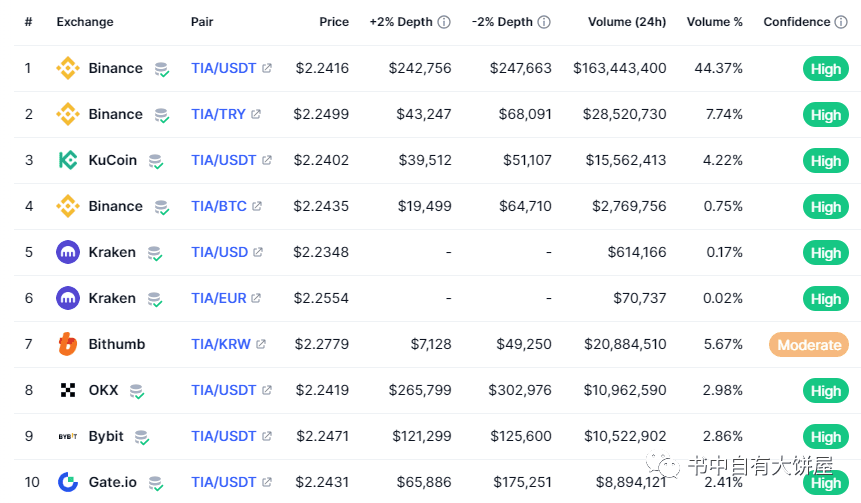
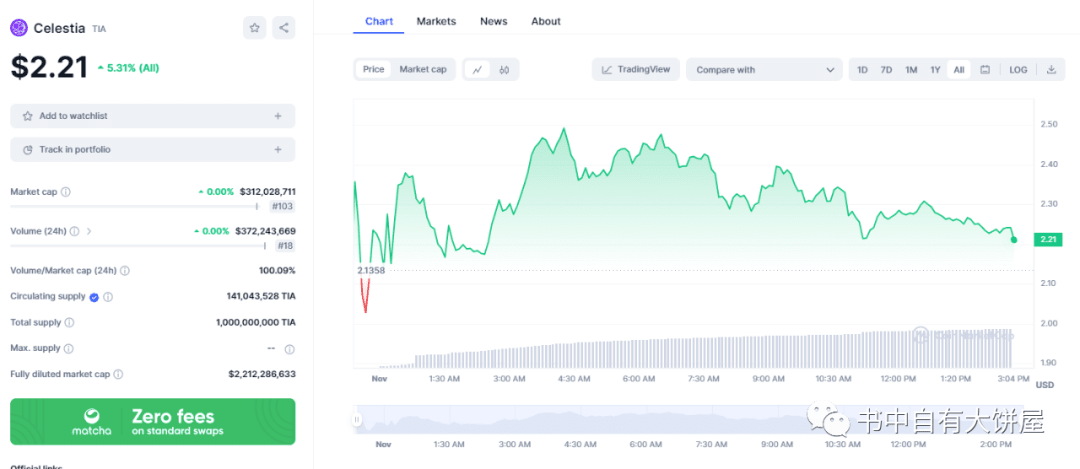
Today we are going to talk about a very popular project, which is tia, which just launched its mainnet yesterday. It has also been launched on all major mainstream exchanges, such as Binance, OK, Gate, etc. It is also a modular public chain. It has been stable at 2 US dollars, and the current market value is 300 million US dollars, ranking 100+, because it has just been launched, we will analyze its reasonable valuation range today.
Introduction
Celestia is a king-level project that was launched in the middle and late stages of the last bull market (20-21). Investors have considerable expectations for it. Many institutions are squeezing their heads and want to participate in the 55 million Series B financing.
Celestia completed a US$1.5 million seed round under the name LazyLedger in early 2021. In June 2021, it announced that it would be renamed to what we know as Celestia. In October, it completed a B-round financing of US$55 million at lightning speed. It gradually began operations and publicity at the end of 2021. In 2023 The airdrop was announced in September 2018, and according to official expectations, it will be launched on the mainnet by the end of the year, and airdrop transfers will then begin.
Celestia is very popular in the institutional investment circle, and it was able to obtain such a huge amount of financing in a short period of time, largely due to the influence of an academic paper in September 2018 - "Fraud and Data Availability Proofs: Maximizing Light Client" Security and Scaling Blockchains with Dishonest Majorities. Then the third author of this paper is Buterin, but it should just be a name, and it does not mean that Buterin gives it a platform. Celestia’s technical route is recognized by Ethereum, but Ethereum is exploring and supporting its own DA, and Celestia It's a third party.
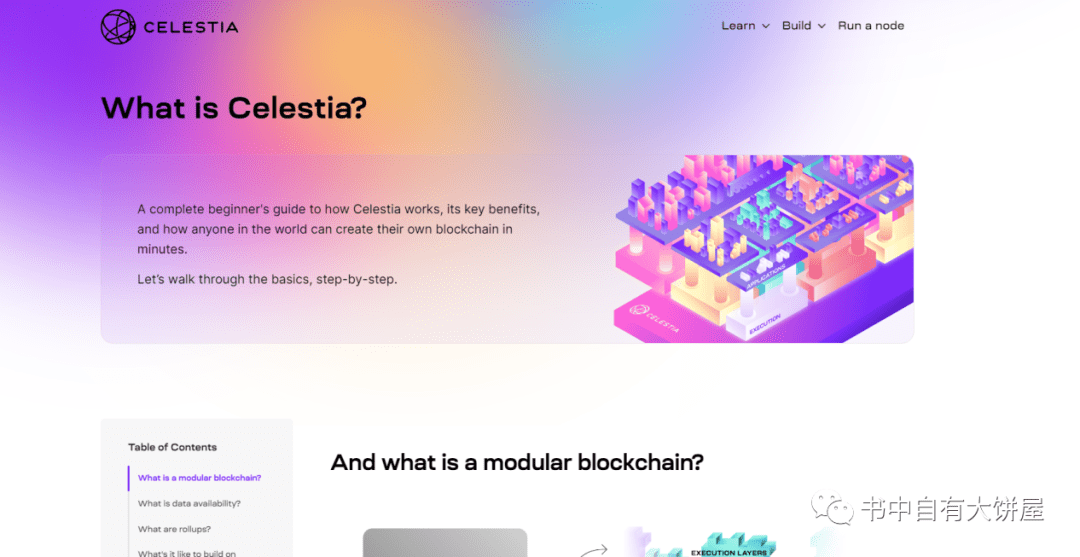
Celestia is a modular blockchain project focused on data availability, built on cosmos and designed to improve the performance and scalability of the blockchain. By separating the data layer and consensus layer, Celestia can better adapt to different application scenarios and needs, providing developers with more choices and freedom. The Celestia project has excellent technical background and team support. Its modular architecture and Sovereign Rollup solution can achieve advantages such as high performance, scalability, security and flexibility, providing developers with better blockchain performance and scalability. choose.
Celestia is a proof-of-stake blockchain based on CometBFT and the Cosmos SDK, which is unique in that it supports in-protocol delegation and will start with an initial set of 100 validators. Staking TIA as a validator or delegator will be able to receive staking rewards from the network. The verifier can also charge a certain fee to the delegator to obtain a certain proportion of the staking reward.
Celestia has the following features:
1. Modular architecture: Celestia deconstructs the blockchain into the data layer, consensus layer and execution layer, allowing each layer to be developed and optimized independently, improving the flexibility and scalability of the blockchain.
2. Data availability: Celestia reduces the deployment cost of blockchain by providing storage transaction records and providing data availability without losing decentralization. It uses technologies such as data availability sampling and namespace Merkle trees to ensure data security and integrity.
3. Sovereign Rollup solution: Celestia has introduced the Sovereign Rollup solution to assume the functions of the execution layer and settlement layer. Rollup is a scalable execution layer solution that improves blockchain scalability and performance by packaging transactions into batches and submitting them to the Rollup contract for verification.
4. Security and decentralization: Celestia ensures data security and integrity through technologies such as data availability sampling and namespace Merkle trees. At the same time, it adopts a decentralized consensus mechanism to ensure the security and credibility of the network.
5. Developer and community support: Celestia has excellent developer and community support. Its official website provides detailed documentation, tutorials and developer tools to facilitate developers to quickly get started and deploy applications. At the same time, Celestia also has extensive community support, attracting a large number of developer attention and participation.
Module architecture
Blockchain instantiates nodes in a distributed network as replicated state machines: nodes in a permissionless distributed network apply an ordered deterministic sequence of transactions to an initial state, producing a common final state. In other words, this means that all nodes in the network follow the same set of rules (i.e., an ordered sequence of transactions) from a starting point (i.e., an initial state) to an end point (i.e., a common final state). This process ensures that all nodes in the network agree on the final state of the blockchain, even though they are operating independently.
This means that the blockchain requires the following four functions:
1. Execution: Execute transactions that correctly update the status. Therefore, execution must ensure that only valid transactions are executed, i.e., transactions that result in valid state machine transitions.
2. Resolution: Provide an environment for the execution layer to verify proofs, resolve fraud disputes, and build bridges between different execution layers.
3. Consensus: Agree on the order of transactions.
4. Data Availability (DA): Making transaction data available. Note that execution, resolution, and consensus all require DA. A traditional blockchain, a single blockchain, combines all four functions in a base consensus layer. The problem with a single blockchain is that the consensus layer must perform many different tasks and cannot be optimized for any one of these functions. Therefore, a single paradigm limits the throughput of the system.
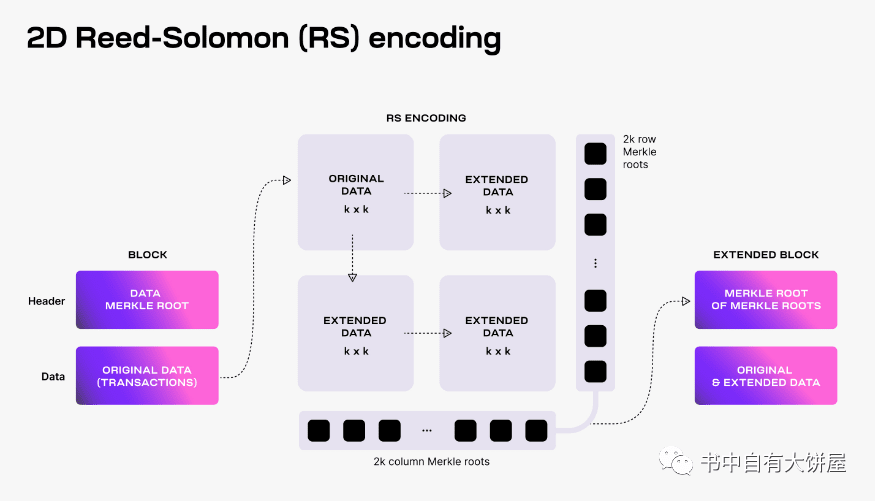
Celestia's DA (data availability) refers to ensuring that data is storable, verifiable and available, that is, ensuring that the transaction data behind the rollup block header has been published and available so that anyone can recreate the state. In Celestia, DA is implemented in an off-chain manner, specifically using Reed-Solomon erasure coding and a specialized Namespaced Merkle Trees structure to ensure data availability, making DA cheaper and performed in a more efficient manner.
After the node receives the transaction submitted by rollup, it will ensure that the appropriate fee is paid and order the transaction. The node then verifies the integrity of the transaction and divides the data according to the DNS mapping corresponding to the specific rollup inserted into Celestia. These steps ensure the availability and correctness of the data, allowing anyone to recreate the state.
Unlike traditional blockchains, Celestia achieves more efficient data availability and scalability by separating the data layer and consensus layer. This modular architecture allows each level to be developed and optimized independently, providing developers with more choices and freedom. At the same time, Celestia has also adopted the Sovereign Rollup solution to assume the functions of the execution layer and settlement layer. By packaging transactions into batches and submitting them to the Rollup contract for verification, it improves the scalability and performance of the blockchain.
Token economy
The total number of tokens is 1 billion, and then the annual inflation is 8%. Currently, 141,043,528 have been unlocked, with a circulation rate of 14.1%. The ratio of token distribution is 26.8% + 17.6% = 44.4%, which is still relatively high.
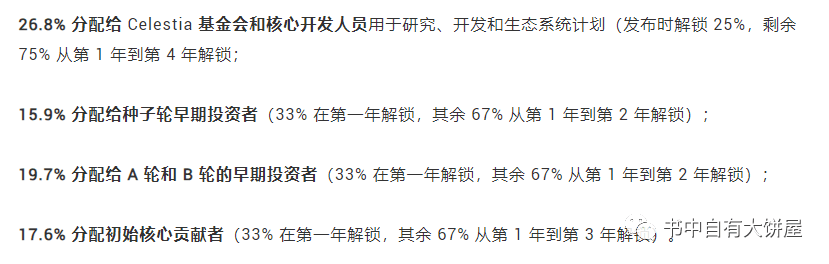
This round of mainnet launch, 60 million Celestia tokens TIA will be airdropped to 7,579 developers and 576,653 active addresses on the chain.
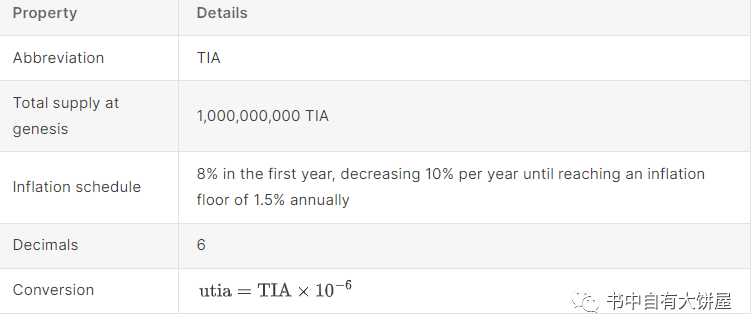
Then we can actually compare SEI. SEI is also a recently launched project. It is also layer1 based on Cosmos SDK and was launched some time ago. Binance’s launchpad, which was just launched, also has a circulation of 18%, which is similar to TIA’s 14%, so The best comparison is SEI. The total amount of SEI was 10 billion. At that time, the online price was between 0.1-0.2, and now it is 0.1. So at that time, everyone basically had a very clear expectation, that is, the default market value of new public chains is 1 billion US dollars. A relatively reasonable range, and the same is true for TIA. The current price is 2 US dollars, then multiplied by the total circulation is 2 billion US dollars, so its most reasonable price is 1, then if everyone sees 1, there is an interesting phenomenon, that is Yesterday Binance launched TIA’s spot, and today it launched the contract. It will make everyone make money (that is, short TIA, because there is still a large range to 1). You can think about it.