


Today we continue to talk about two players in the oracle track. You must know that we have repeatedly said that Link is very awesome and we should buy it. Now the results have been seen, right? Then there is the recent super Internet celebrity-TRB, which is currently turning over It’s 10 times. We have done a program to talk about TRB before. It has fundamentals. Although it has increased 10 times, its market value is not artificially high. Some friends in the group asked whether they should short TRB. My suggestion. Just don’t, because compared with other similar projects, although it has increased 10 times now, its market value is similar to other projects. It can only be said that its previous market value was low. Moreover, today we continue to talk about the two oracle machine tracks. , this basically covers the head of the oracle track, and then a horizontal comparison can be established.
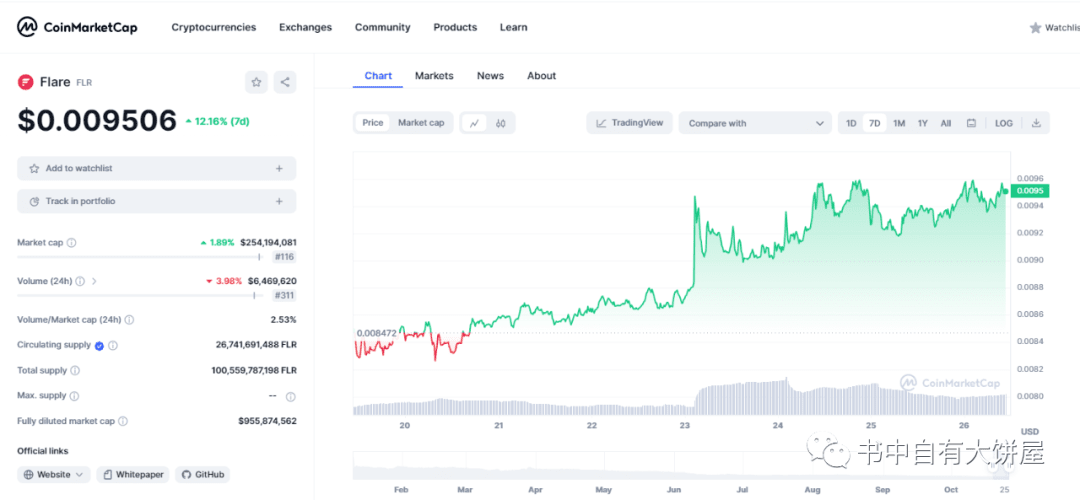
The first one is Flare, which currently has a market value of US$250 million and has seen a huge increase in the last seven days, a 20% increase.
Introduction
The Flare Network is essentially a layer 1 network that is fully compatible with the Ethereum Virtual Machine (EVM) and is specifically designed to facilitate interoperability and interconnectivity across the Web3 space and allow users to bridge cryptocurrencies between networks .
There are two protocols at the core of the project, such as State Connector and Flare Time Series Oracle FTSO. In addition, EVM is used to run complete smart contracts while also providing smart contract functionality for non-programmable tokens.
(1) State connector
State Connector can be used on top of Flare by essentially reaching consensus on information from external blockchains as well as the Internet. It implements this security in a decentralized way and is a solution to interoperability issues. technology
The state connector uses two tools to implement its functionality, including the request-submit-show (RCR) protocol and the branch protocol
Request-Commit-Reveal (RCR) Protocol - A user can request information from another blockchain, which is verified by the user, called a proof provider, who then provides a proof or attestation using a cryptographic tool called a Merkle tree.
After the branch protocol uses the RCR protocol to request and verify the data one by one, the branch protocol checks whether more than 50% of the proof providers agree, thus helping decentralize the data acquisition process.
Therefore, data from other blockchains (which may include transactions and information about which assets are held in a specific wallet) can be brought to Flare and recreated, which can enable functionality in native dApps on the network.
(2) Flare time series oracle
Flare Time Series Oracle (FTSO), on the other hand, is a native oracle for time series data such as cryptocurrency prices. By leveraging the network structure to provide highly decentralized price and data sequences to dapps on Flare without relying on centralized data providers. FTSO is currently supported by nearly 100 independent data providers, providing updated and reliable data every 3 minutes under a certain incentive mechanism.
To achieve this, the FTSO relies on a set of independent data providers who receive price pair information from external sources. This can include both centralized and decentralized exchanges. Once this data is collected, a final price estimate is calculated.
Additionally, each data provider’s submissions are weighted based on their stake and any shares that Flare holders have delegated to them. Decentralized price information is rapidly updating and expanding, while also being accurate and motivating participation.
Financing situation
Flare has raised a total of $11.3 million in its latest round of financing, led by Kenetic Capital, with participation from well-known institutions such as Digital Currency Group, Coinfund, LD Capital, cFund, Wave Financial, Borderless Capital and Backend Capital.
Token economy
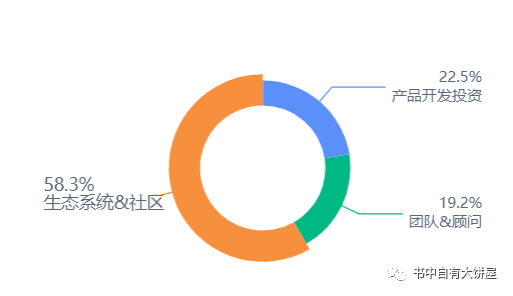
The total supply is 100,559,787,198 FLR, and currently there are 26,741,691,488 FLR in circulation. The circulation rate is 26%, which is still relatively low. The current currency price is US$0.096, with a historical high of US$0.186 (2023-01-10). In terms of token distribution, it is relatively simple. Team 19 %, product development 22.5%, the difference is only 40% because their team is self-sustained, the proportion is higher.
The second project BAND (Peninsula)
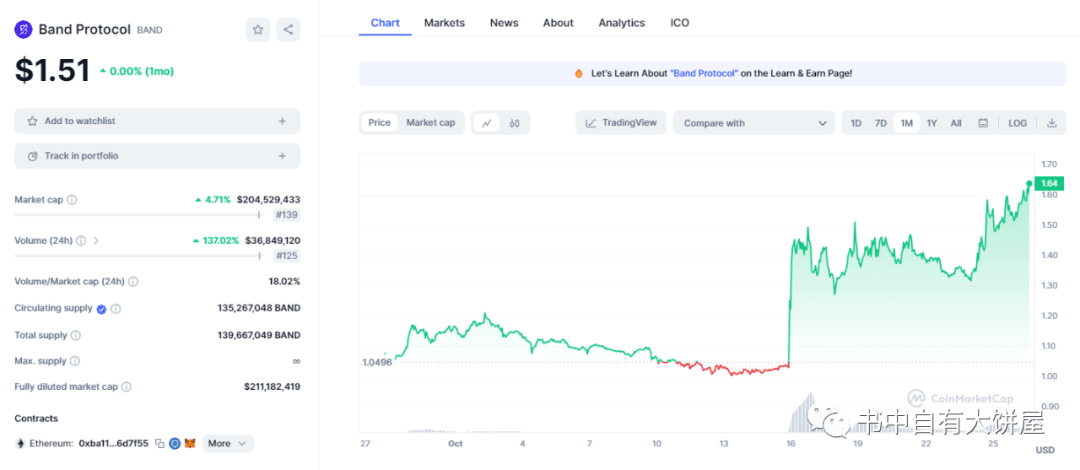
He is also a player on the oracle track. You can see that there has been a surge recently, from 1 to 1.6. The current market value is 200 million US dollars, ranking 130+.
The Band protocol is a secure and scalable decentralized oracle that expands the capacity of the public chain in the form of Layer-2. It allows decentralized applications to leverage existing data on the Internet without the need for trusted intermediaries, bridging use cases between Web 2.0 and 3.0. Band ensures data is not manipulated through a unique multi-token model and staking mechanism. By making data readily available and reusable on-chain, Band Protocol offers a cheaper and faster solution than other existing protocols without compromising security. Developers using the Band protocol will be able to build a wider range of decentralized applications and integrate off-chain financial data, reputation scores, identity management systems, and more, making the blockchain more likely to be adopted on a large scale.
It is also built based on Cosmos. The current product line is very similar to Link, including price feeders, VRF and other products.
Project solutions
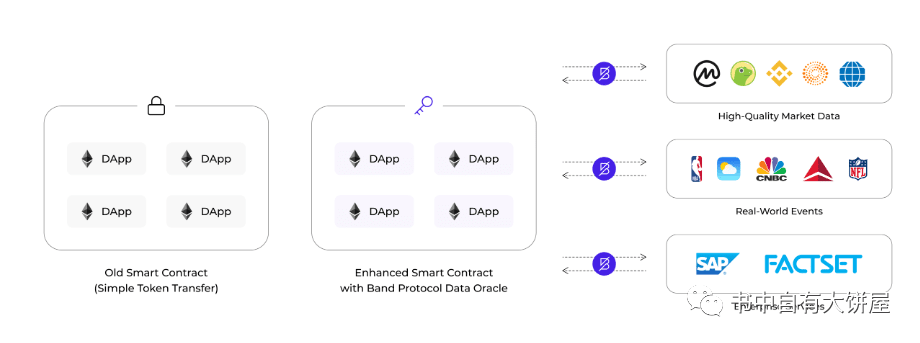
Band Protocol is a Web3.0 component layer solution, a technology stack used to manage data and solve the data availability and reliability issues of blockchain in Web3. Band Prorocol's Dapps use Band's public smart contract data Data is accessed through the client, rather than through an oracle external to the blockchain. Band's data is a data source optimized by the community, providing dApp users and developers with a data source framework that can be operated, optimized and managed by themselves. By creating a standard framework for community-governed data, Band can create a community-scalable way for all dApps to broadly adopt and integrate trusted data.
Project implementation mechanism
Band consists of two parts: on-chain and off-chain. The contract on the chain is mainly responsible for the issuance and custody of tokens, as well as the verification of oracle data. The off-chain protocol includes a P2P network composed of data providers. Each node in this network is a supplier of data for a certain data set. For each data set, there will be multiple data supply nodes that provide data for the data set. Only when a piece of data is signed by 2/3 of the nodes in the data provider network will the data be sent to the chain and provided to on-chain applications.
At the same time, there is a special node in the off-chain network, namely the coordinator (Coordinator Node). The coordinator node will be responsible for collecting data from all data providers. After the coordinator receives a data request from the chain, it will parse and forward the request to all relevant data provider nodes, and then all data providers will return the corresponding data according to the request and send it to the coordinator or node. Then, the coordinator node will merge the data (Aggregation) and send the merged data again to each data providing node for signature. Finally, the coordinator node needs to collect the final signed data from each data provider node again, and conduct signature verification to confirm whether the number of signature nodes reaches more than 2/3. Upon success, the coordinator will send the data to the on-chain dataset smart contract. Other smart contracts on the chain can read the latest off-chain data from this data set smart contract.
Incentives
Band Protocol relies on query fees to pay data providers and incentivize honest data optimization. Whenever a smart contract issues a data query function call, it must append the blockchain’s native currency (ETH in the case of Ethereum). The query fee is determined based on the fee schedule set by the data set provider and token holder in the governance parameters.
The decision to accept the blockchain's native currency was primarily made to simplify the onboarding and integration process, as it would be unreasonable to assume that every program would be willing to hold Dataset Tokens or BAND Tokens. In actual operation, Band Protocol utilizes decentralized trading protocols such as Uniswap to instantly convert accepted currencies into BAND tokens and then into dataset tokens through the bonding curve function in the same transaction. Therefore, even though Dapps are paid in native tokens, data providers and token holders still receive a share of the revenue in dataset tokens.
enter. In this process, as more and more BAND is locked into the bonding curve function, the supply of data set tokens will increase, causing the prices of both tokens to rise.
It should be noted that income is not necessarily required in specific data management methods to provide participants with certain economic income, such as optimizing the token registry. In this case, the dataset community might collectively decide to set the query cost to zero.
Token economy
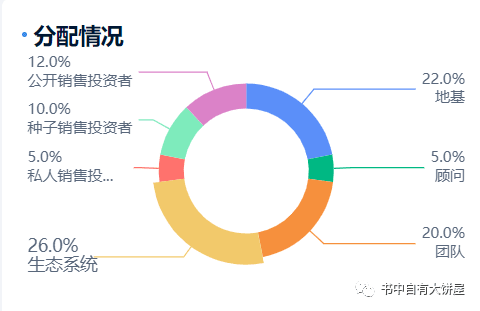
The tokens issued in 2019 have a maximum supply of 139,709,840 BAND. Currently, 135,309,840 BAND are in circulation, which can be regarded as basically complete. The current token price is around 1.6 US dollars. At the peak, the historical high was $23.1838 (2021-04-15). The current decline is It also reached 90%. In terms of token distribution, the team took 20% and the foundation took 22%. The team’s token holding ratio is still relatively high.
Finally, let’s summarize these two projects. They are both players in the oracle track. It can be said that the oracle track has been rising recently. Link has almost doubled, TRB has increased by almost 10 times, and API3 has not increased much. At present, except for Link, which is the leader with a market value of 6 billion U.S. dollars, the others are basically around 100 million to 200 million U.S. dollars, which is about 30 times behind Link. Therefore, it can only be said that the oracle machine track still has a lot of potential, at least it is still lacking. For a second child, the market value of this second child must reach half of Link’s, about US$3 billion, to be more reliable. Then let’s take a look at these two projects. Flare is relatively innovative, and Band’s innovation ability is average, but it is a layer 2 and can be well integrated with other chains or applications. At present, the fundamentals are similar. Just look at Whoever receives more applications and is used by defiDapp will be able to escape.