


Today we continue to develop a super 100-fold potential project. It is really potential, cost-effective, and innovative. And the current currency price has increased by 50% today, from 1.3 to 1.8. It is a straight line. He is UMA, a financial synthetic asset that is a super "priceless financial contract", is somewhat similar to the SNX mentioned before. Its current market value has reached 110 million U.S. dollars, ranking 180+, and there is still a gap several times between SNX's 500 million U.S. dollars. At that time, When we talked about SNX, we said that it has a hundred times the potential. So UMA has a lower market value than it, so it has greater potential. Today we will take a look at it.
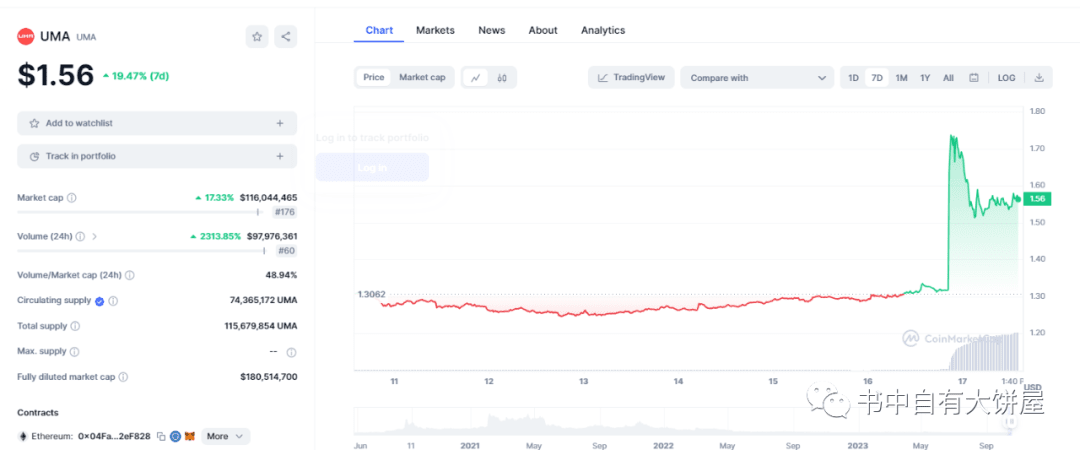
Introduction, it contains 2 products
1. UMA is a decentralized financial contract platform that uses UMA’s contract design model to create unique standardized products. UMA can be used to promote various financial innovations. UMA defines an open source protocol that allows both parties to design and create their own unique financial contracts.
Through UMA contracts and a no-price-feeding model, people can create their own financial products using standards such as ERC20. In short, UMA can help people create permissionless financial products. For example, UMA allows any counterparty to design and create its own financial contract. Its difference from traditional financial derivatives is that smart contracts are automatically executed and can generally enter various financial assets.
Unlike Synthetix, another synthetic token issuance protocol. The biggest difference between Synthetix and UMA is that Synthetix uses its SNX token as collateral to create synthetic assets, and UMA can use almost any cryptocurrency as collateral (in theory).
As a governance token, UMA coin's main function is to serve as system governance and resolve oracle disputes. For governance, UMA coin holders can vote on the financial contracts allowed to access the system, asset types, key system parameters and their upgrades, and the method for allocating UMA coins. In addition, UMA coin holders can also resolve disputes for price-feed-free contracts. When a contract dispute occurs, UMA coin holders play a role in reaching a consensus through the data verification mechanism DVM voting.
2. Unlike other DeFi protocols, UMA does not need to continuously receive price feedback and only needs the protocol to run.
UMA’s Data Verification Mechanism (DVM) - an economically guaranteed decentralized oracle system
Core points:
1. Design a system that can measure the cost of corruption (CoC)
2. Create a system that can measure the benefits of bribery (PfC)
3. Design a mechanism to ensure CoC > PfC and prove that it is feasible.
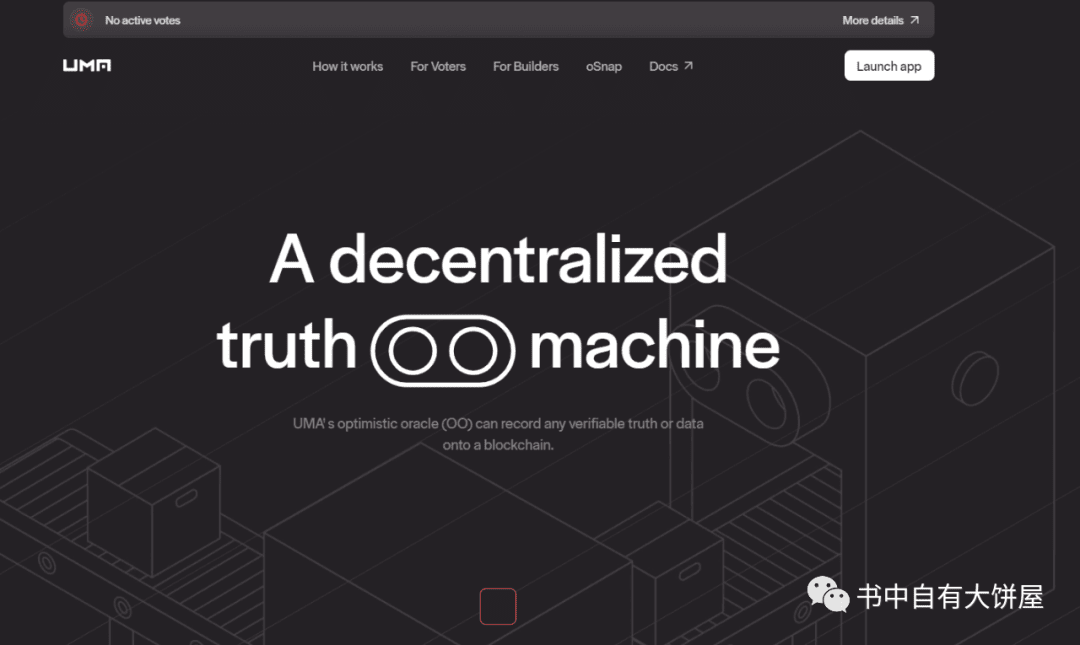
DVM mechanism overview
Mechanism overview:
Step 1: To measure the cost of corruption, DVM uses a Schelling-Point type voting system, using the number of tokens to define voting weights. Token holders vote on controversial prices and are rewarded for voting honestly and punished for voting otherwise. As long as the majority of participants are honest, the vote will determine a correct outcome. This means that the cost of corruption is the market price of buying 51% of the voting tokens.
Step 2: In order to measure the bribery proceeds, all contracts using this system must register with the DVM and report how much money will be stolen if the price is manipulated (that is, the PfC of the contract). DVM will sum up the PfC of each contract to obtain a system-level PfC.
Step 3: Use dynamic fees to guarantee CoC > PfC. An example is as follows: Assume that the PfC at the system level is US$100 million, which means that in the worst case scenario, if the attacker Bob successfully corrupts the oracle, he can profit from it US$100 million. In order to corrupt this system, Bob needs to buy or control 51% of the voting tokens, then the CoC of the system is the money needed to buy 51% of the tokens. To ensure that CoC > PfC, it is necessary to ensure that 51% of the voting tokens are worth more than $100 million. In other words, we want to ensure that the market cap of voting tokens is above $200 million. If the market cap is below this value, Bob can benefit from the attack. DVM's measures to ensure this are to continuously monitor the size relationship between CoC and PfC, and initiate programmed and repeated token repurchases once the token price falls below the target value. All repurchased tokens will be burned, reducing token supply (increasing token market value). Funds used to implement buybacks are raised from contracts using the system, and fees are charged proportionally to them.
In addition, the DVM system is also designed to reduce handling fees as much as possible under the constraint of ensuring CoC > PfC. Therefore, the system's handling fees are designed to be the minimum required to maintain system security. The result of this design is that when market participants expect the usage of DVM to grow, this growth expectation can ensure that CoC > PfC without the DVM levying any fees at all.
Project mechanism
Specific case demonstration operation process:
1. Establish a contract
Alice is bearish on the price of Apple and believes that the price of Apple will fall in the future. On the contrary, Bob believes that the price of Apple will rise in the future. Then, using the UMA smart contract template, both parties can customize a financial contract that tracks the price of Apple. In this contract, each party deposits a 10% margin requirement, and the contract period is set to 6 months. Either party will lose these deposits once it defaults.
2. Automatic execution (automatic margin call)
Over the next six months, Apple prices fluctuated (but mostly fell). As the price of Apple continues to fall (Apple price data is provided and trusted by the UMA oracle), Bob needs to continuously call for margin to prevent the system from forced liquidation.
3. Instant liquidation
After the expiration of 6 months, if the price of Apple falls by 30%, then Alice wins this round of bet. The smart contract is automatically settled. In addition to recovering the deposit, Alice also wins the bet, while Bob has been replenishing the deposit as the price drops, and recovers the remaining funds after expiration and liquidation.
In fact, the apple here can also be any other asset or anything else. Regarding the price of Apple, there is no need to rely on oracles for price feeding. Its main mechanism is to use an incentive mechanism to encourage all parties to maintain the correctness of the price. Participants must ensure sufficient mortgages, and the liquidator can liquidate insufficient mortgages. assets to make a profit. If a dispute arises, it will be resolved through dispute resolution.
team
Hart Lambur, the co-founder of UMA, graduated from Columbia University in New York with a major in computer science. He once worked in interest rate product trading at Goldman Sachs, founded the technology financial company Openfolio, and sold it to an asset management company.
UMA co-founder Allison Lu graduated from MIT with an economics major and once worked as a trader for Marco rates at Goldman Sachs.
The two founders of UMA have experience in prestigious universities and famous companies, and their work experience is very relevant to the entrepreneurial direction. Among them, Hart has the experience of successful entrepreneurial exit.
Compare SNX
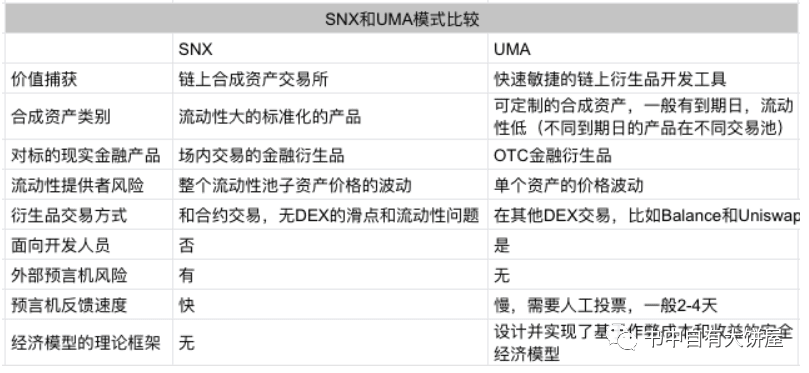
In general, SNX and UMA are both projects with great imagination and room for development, and each has its own unique value. We believe that UMA is more focused on customized financial derivatives, while SNX is more focused on standardized derivatives. In the traditional financial world, the market size of customized OTC derivatives will be larger than the market size of standardized on-exchange derivatives.
Token economy
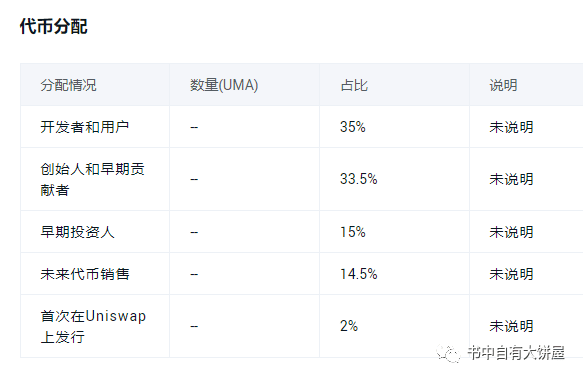
The current maximum supply is 115,679,854 UMA, the circulation is 74,365,172 UMA, and the circulation rate is 64%. The current currency price is 1.52 US dollars, because the project was actually released very early in 20 years, and its peak reached 43 US dollars in 21 years. , so it has dropped by more than 95%, so it has entered the value range. In terms of token distribution, we can see that the founders took 33.5% of the tokens, and 14.5% of the future token sales. All of this The ratio is a bit high.
In conclusion, the UMA project is a major innovation in the industry, because the market targeted by UMA is the derivatives market, with a value ranging from 500 trillion to more than 1 trillion US dollars. In the past, only accredited investors could enter, but the emergence of UMA has made it possible for anyone to enter the world's largest financial market. In fact, we also compared it with the leading SNX. In fact, I think from various dimensions, the two are basically equal, because each has its own advantages. For example, UMA can be synthesized with any assets, and UMA’s team is more awesome, etc. , and what SNX can say is that it is the leader, with a high market value, and it will come out early. UMA is backed by Coinbase and is the focus of Coinbase's investigation. Therefore, if SNX has a hundredfold potential, then UMA, which currently has a lower market value, actually has a hundredfold potential.