


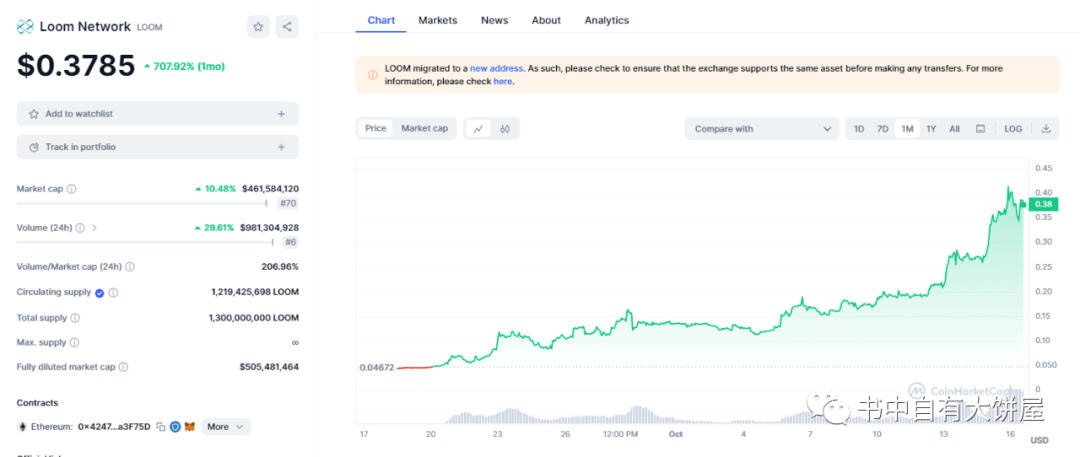
Today we are going to talk about a project that has skyrocketed 10 times in the past month, which is the Loom network. The token name is Loom. On CMC, you can see that it has increased from 0.04 to 0.4, removing a zero in the last month. The current market value has reached 460 million US dollars, entering the top 100, and is currently ranked 70+, which has surpassed many newly issued public chains. It is simply outrageous. Today we will take a look at who it is.
Introduction
Loom Network is an infrastructure platform dedicated to building Ethereum to help expand. As a set of officially launched Ethereum second-layer expansion solutions, it is a DPOS sidechain network, known as "EOS on Ethereum" that allows highly scalable games and user-oriented Dapps to run on it, providing the same high scalability and throughput promised by alternative platforms such as EOS, while still being fully compatible with Ethereum and its security. Its core product is the software development kit tool Loom SDK, which allows developers to focus on writing application logic, and the SDK handles blockchain logic. The Loom network runs on Plasma, a scalable solution that enables faster transaction processing throughout the network.
Official website introduction
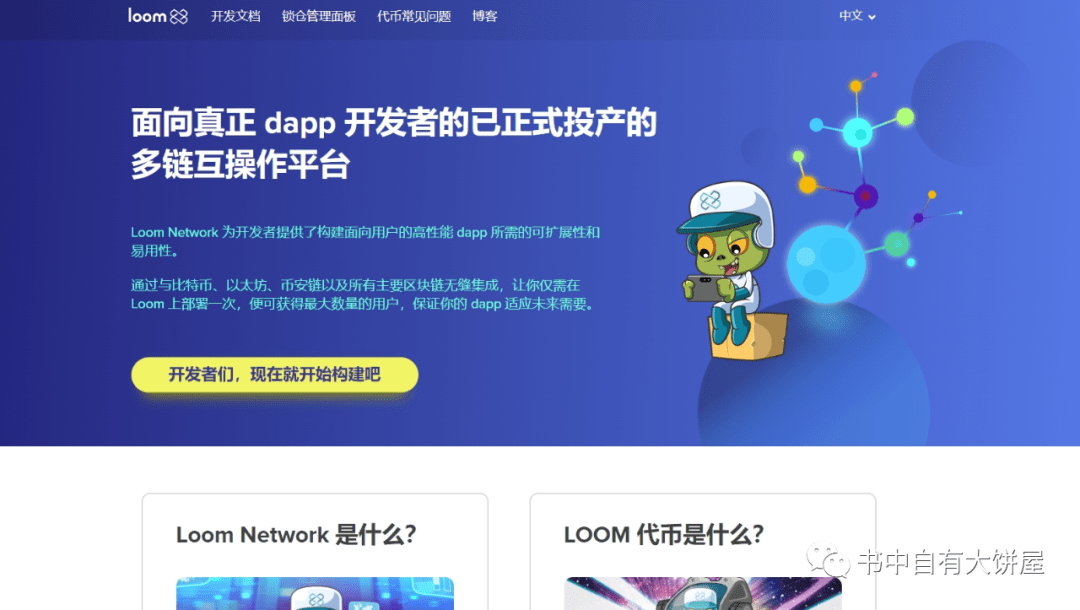
Loom Network is a multi-chain interoperability platform that has been live since early 2018. We optimize for high-performance dapps that require a fast and fluid user experience, allowing dapps to provide a user experience comparable to traditional applications, and onboarding new users without the need to download crypto wallet software.
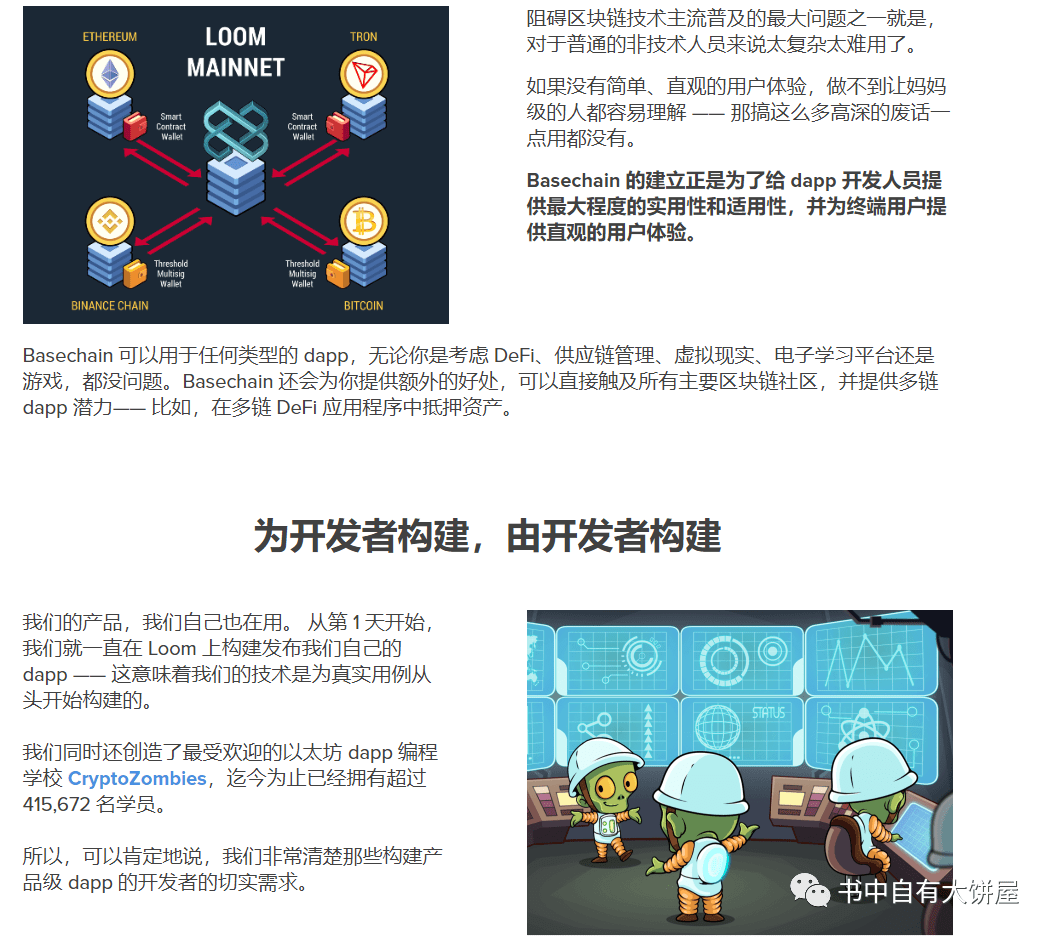
Additionally, Loom is integrated with Bitcoin, Ethereum, Binance Chain, Tron (and soon EOS and Cosmos). This allows developers to integrate assets from all major chains, build dapps only once, and make them available to users on all platforms simultaneously.
At present, the main network written on its official website is Basechain, not Ethereum, so it should have adjusted its direction at present. There are too many projects doing things around Ethereum, and what it does is some development toolkits. It is difficult to make money by doing this kind of thing, and the threshold is not high, so there will definitely be a lot of competition. Of course, he also said that he is a multi-chain toolkit, and he has not given up his previous work, but its current token loom is issued on the basechain chain.
Technical Overview
Loom Network uses sidechain technology to enable large-scale and high-throughput applications to be built on Ethereum. Loom uses Ethereum as the main chain, and developers can easily build DApp chains through the Loom SDK. Each Dapp chain is a Loom sidechain. It can also allow the emergence of sidechain platforms similar to EOS, where multiple Dapps can be built on a sidechain, such as the zombiechain currently developed by the Loom team.
The sidechain technology was proposed in 2014 and is defined by a custom "rule set" that can be used to divert computations from another chain. Each sidechain can follow different rules from the main chain while still relying on the main chain to process requests that require the highest level of security. The Loom team currently positions Dapp products in social platforms and games. When decentralization, security, and high scalability cannot be met at the same time (The Scalability Trilemma), the best performance can be achieved by sacrificing some security. At the same time, the economic incentive mechanism in a specific environment will compensate for the weakening of security, such as the extremely low returns from tampering with a blog message or a game transaction, which becomes unworthy. And the Loom ecosystem will support free forks. If a sidechain is controlled by a group, the community can choose to migrate to a new sidechain collectively.
At the value transfer level, all of these Loom sidechains use Ethereum as the Supreme Court and use Plasma Cash for security. Loom Network claims to be the first team to integrate Plasma at the level of developing DAppchains. The implementation of Plasma Cash consists of a Plasma smart contract that exists on the Ethereum mainnet and a Loom sidechain smart contract that can communicate with the Plasma contract. The user first sends their tokens to the Plasma contract, and after receiving the tokens, the Plasma contract emits a Deposit event, which is received by the listening sidechain. The user then receives a special Plasma Cash token on the sidechain, representing their ownership of the token on the mainnet.
The sidechain periodically “archives” to the mainnet by submitting the Merkle root of the block to the Plasma contract, showing any changes in token ownership. When a security issue occurs on the sidechain, a user can submit an exit request directly to the Plasma contract on the mainnet. The tokens then enter a “challenge period” in which the challenger can submit evidence of a signed transaction proving that the user attempting to exit the tokens is not its valid owner. If the challenge period ends without a successful challenge, the user can withdraw their tokens from the Plasma contract.
Project Features
Solve problems such as Ethereum network congestion and low performance:
Loom Network solves the shortcomings of the Ethereum network through a sidechain protocol, and this solution can basically coexist with other Ethereum expansion solutions such as Raiden, Plasma, etc.
Solve the problem of non-isolation of resources:
The entire DApp running on Loom’s DAppChain will run on a decentralized blockchain, meeting the needs of real-world decentralized applications without overwhelming the Ethereum network and avoiding another CryptoKitties incident.
Solve the problems of virtual asset depreciation, fairness, reputation and trust loss in traditional games:
Blockchain technology uses distributed accounting and smart contract technology to enable random number generation programs and automatic reporting systems to no longer be managed by humans, but rather through encrypted verifiable code. This will greatly improve the level of trust, thereby adding value to the online interactive gaming industry and improving the original ecosystem.
Application Scenario
Loom Network currently focuses on games and social applications:
Games - Create games that only blockchain can achieve: provably scarce items, tradable tokens, eternal worlds, and multiple games across the universe
Social - Get rid of the shackles of social applications being driven only by advertising, make profits through Karma tokens, expand through multiple clients, and reduce cumbersome authentication processes.
Internal Projects
DelegateCall:
DelegateCall is a blockchain-based question-and-answer system. Each user can earn corresponding points by asking or answering other people's questions in this system, and these points can be exchanged for DelegateCall Token (Token based on Ethereum). This is the first project launched by Loom Network on the public chain.
CryptoZombies:
CryptoZombies is an online interactive programming tutorial that teaches you to write your own crypto collectibles game to learn how to write smart contracts in Solidity. CryptoZombies is currently one of the most popular introductory blockchain programming tutorials, with more than 130,000 students.
EthFiddle:
EthFiddle has more than 10,000 users and is currently the most popular Solidity code sharing website. You can compile, run, and test any Solidity code snippet on the entire network. The friendly interface allows any developer to get started quickly.
SolidityX:
A practical language for writing scalable, high-security applications, SolidityX is a default safe superset of Solidity. Compile to safe Solidity at release time, avoid known pitfalls, and spend time fixing bugs instead of finding them.
Ethdeploy:
Rapidly deploy and test scalable business applications.
Token Economy
The current maximum supply is 1,300,000,000 LOOM, and the circulation volume is 1,219,425,698 LOOM. The current circulation rate is almost 100%. The current price of the coin is 0.38 US dollars. This token was actually issued quite early, in 2018, and I didn’t find out the distribution of the token. In fact, I looked at the official website, and there was no content. It has been 5 years and the progress is slow.
Finally, let me summarize this project, which has skyrocketed 10 times recently. In fact, after studying it, I feel that this project is really average. The main reason is that the track is not chosen well. It is a chain SDK with no future, and the market is too small. Then I feel that the project party is also very confused. It has been 5 years, and there is no splash. The tokens are probably all sold. This wave of rise may be because the dealer sees that there is no dealer on the project, and he wants to cut a wave and leave. For such projects, it is recommended to short directly.