


Today we are going to talk about a very good project, the MINA-mina protocol, which is the first ZK blockchain. Its current market value is only 490 million US dollars, ranking around 90th.
Introduction: Mina (formerly Coda Protocol), a blockchain encryption protocol with a constant block size. The Mina protocol compresses the entire blockchain into a snapshot the size of a Twitter tweet. This means that no matter how many transactions are performed, verifying the blockchain is still convenient and accessible to everyone.
To talk about why we need Mina's solution, we have to look at the problems of traditional blockchain.
• Traditional blockchains face the problem of growing storage and inefficiency in terms of data. This state bloat (state bloat is a problem caused by the growing amount of data, transactions, accounts, tokens, contracts and other information generated by the storage of blockchain) will have a negative impact on the decentralization of the network because fewer and fewer users can participate in chain verification.
•Mina Protocol is a new generation layer-1 blockchain that solves the state bloat problem. With the power of zk-SNARKs, the Mina blockchain maintains a fixed size of approximately 11 kB. In addition to decentralization, zk-SNARKs also make Mina more private and more efficient than other chains.
On May 21, at the non-profit annual global Ethereum conference EDCON 2023 held in Montenegro, Vitalik said that in the next 10 years, zk-SNARK, which uses ZK as the underlying technology, will be as important as blockchain.
Zero-knowledge proof (zk)
A zero-knowledge proof is a way of proving that the verifier does not know anything other than that a certain statement is true. It is easier to understand with a concrete example. You can imagine that there is a prize hidden behind one of the thousand doors in front of you on a game show. To find the prize, the best strategy is to open the doors in order. If you want to prove to someone that you know where the prize is, you can tell them the door number and they can verify it themselves. This can help you simply prove that you know the answer, but the key is that this method makes you leak the solution to the verifier. However, if you blindfold them and rotate them before taking them to the prize door, you can still prove that you know where the prize is without leaking the door number. This is a zero-knowledge proof. It confirms that you (the prover) know the solution, but it does not leak it to the verifier. It is worth noting that there is also an asymmetry in the work. The amount of work done by the prover to find the answer is much greater than the amount of work done by the verifier to check whether the answer is correct. The prover must search every door until he finds the right one, while the verifier only needs to check one door.
Succinct Non-Interactive Arguments of Knowledge (SNARKs)
SNARKs are zero-knowledge proofs. They are succinct because they are small and easy to verify. A SNARK proof on Mina is about 7 kB and it only takes 200 milliseconds to verify it.
While some zkp (zero-knowledge proofs) may require information to be exchanged back and forth between the prover and the verifier, non-interactive proofs do not require any further interaction with the prover and are verified by the verifier.
Arguments are a form of proof. In cryptography, proofs can be generated from valid statements, while excessive computational power may produce invalid proofs of arguments. However, this is only a theoretical difference, and for our purposes we can treat arguments as the same as proofs.
Knowledge means that the prover actually knows the answer. In our example, the prover not only proved that the prize exists, but also proved that they know which door the prize is behind.
SNARKs are therefore lightweight, easily verifiable proofs of knowledge that do not require back-and-forth communication between the prover and the verifier.
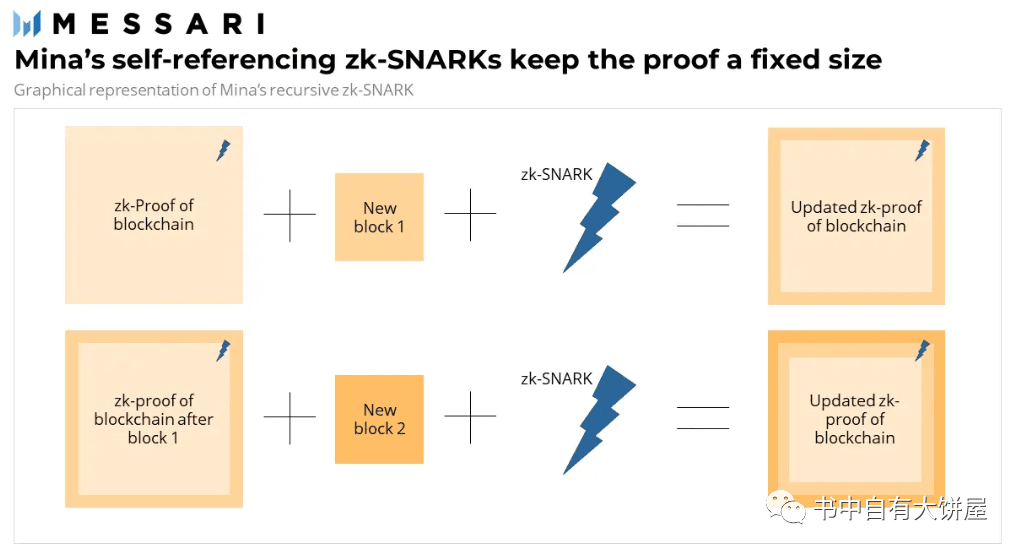
Finally, Mina uses a type of zk-SNARK called Pickles, which can recursively reference itself to create proofs of proofs, keeping the size of the blockchain fixed. Another feature of Pickles, unlike other SNARKs, is that it does not require a trusted setup. Trusted setups are considered less than ideal because future users must trust that the initial setup was executed fairly with proper controls.
Mina and zk-SNARKs
By leveraging zk-SNARKs, Mina can maintain a blockchain that remains small and of a fixed size. Whenever a new block is added, a new zk-SNARK must be created that contains the zk-SNARK of the previous block to prove its validity. This SNARK can only be created if the block data is correct. Therefore, the SNARK proves that the current block is valid and references the SNARK of the previous block to prove that it is valid. In this way, the entire state of the blockchain can be confirmed by verifying only the current SNARK, because it must have been generated on top of a series of valid SNARKs starting from the genesis block.
However, a cryptographic proof is not enough to run a full node. The proof alone does not allow the node to perform its basic functions because it does not provide clear information, such as account balances. So in addition to this, a node needs four pieces of information to function. The first is the protocol state containing hashed data structures, including the ledger. The second is the SNARK proof and the verification key of the protocol state. Secondly, the node must also store the account information and the Merkle path that matches the protocol to reliably (trustless) ensure that the account information is correct and belongs to the current protocol state.
Advantages of zk-SNARKs
Mina’s utilization of zk-SNARK technology makes it a compelling option with unique advantages over traditional blockchains.
Improvements in decentralization
Running a non-consensus node requires very little disk space and computing power. While other blockchains suffer from state bloat and may require powerful industrial-grade hardware to run full nodes, Mina’s non-consensus nodes will be able to run on a smartphone or browser. Each user can run their own node, significantly improving decentralization. The ideal of blockchain beyond self-regulation is self-verification, and Mina is the only blockchain that can achieve self-verification.
Work asymmetry
In traditional blockchains, each node must execute each transaction independently, resulting in wasted computing resources and increased transaction costs. Zero-knowledge proofs that verify transactions take up much less resources than executing the transactions themselves. This is the premise of Ethereum zk-rollups, which Buterin believes is the most critical part of scaling Ethereum upgrades. Mina, however, incorporates zero-knowledge proofs in its protocol design.
Privacy
Zero-knowledge proofs do not disclose any unnecessary information, thus ensuring privacy. Mina blockchain’s zero-knowledge proofs only prove that the state is valid, without revealing the interacting accounts. Even Mina’s consensus nodes only keep the history of the last 290 blocks.
consensus
The consensus mechanism used by Mina is Ouroboros Samasika, an improved version of Cardano's consensus mechanism Ouroboros. Ouroboros Samasika has the additional property of a concise blockchain that does not retain a full transaction history. As with other PoS chains, the probability of being selected as a block producer depends on the amount of Mina staked by the node relative to the total staked. Like Cardano, Mina does not require nodes to lock up funds, and the network does not confiscate funds. The network stops distributing rewards to nodes that are offline or have bad behavior.
MINA Token
As the native token of the blockchain, MINA is used to pay transaction fees and incentivize consensus participation through block rewards.
MINA is an inflationary currency with an initial inflation rate of 12%, which will drop to 7% four years after the mainnet launch. Inflation is fixed, and the staking yield changes with the staking participation rate. While inflation may seem high, it helps keep the chain secure because it encourages participation in staking.
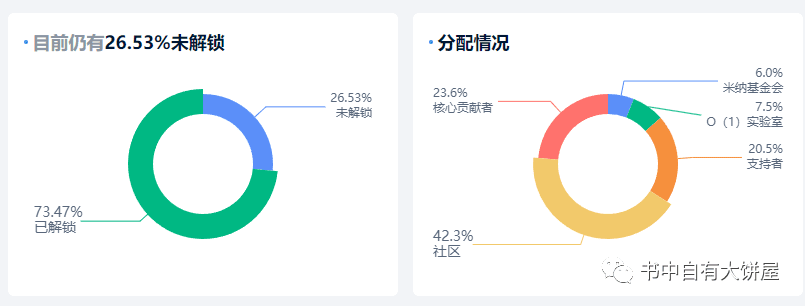
MINA has an initial total supply of 1 billion tokens, of which 806 million will be available for staking at the launch of the mainnet. Most of these tokens are locked for sale, but can be staked to earn block rewards. The remaining 194 million initial supply tokens will be distributed to the community over time in the form of excess rewards, SNARK mining rewards, and ecosystem grants.
The current price of the currency is US$0.5, and it reached US$6.6 at its peak in 2021.
Financing
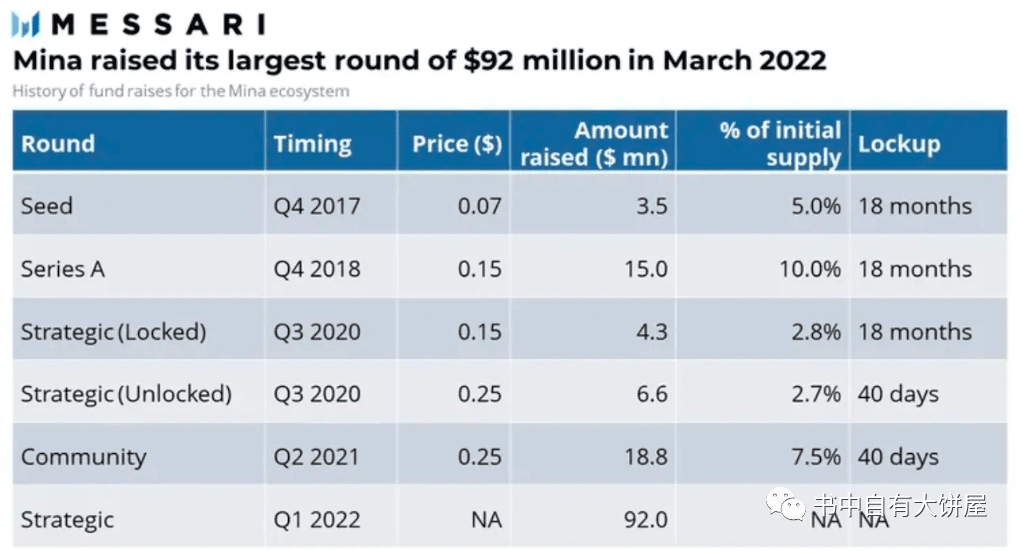
The Mina ecosystem has raised a total of $140 million in financing, the most recent of which was in March 2022, when it raised $92 million. Mina's backers are some of the most famous crypto venture capital funds, such as FTX Ventures, Three Arrows Capital, Paradigm, Coinbase Ventures, Polychain Capital, Electric Capital, and Multicoin Capital.
team
With a basic product and an ambitious roadmap, the contributing team becomes the most critical factor for Mina’s success.
The core team behind Mina is O(1) Labs, which is developing smart contracts and zk oracles for Mina. Evan Shapiro, the current CEO of the Mina Foundation, was previously the CEO of O(1) Labs. Evan graduated from Carnegie Mellon University with a Master’s degree in Computer Science and founded O(1) Labs in 2017.
O(1) Labs’ interim CEO is Emre Tekişalp, who previously worked as a business development manager at Coinbase and holds an MBA from Columbia Business School. Izaak Meckler is O(1) Labs’ CTO and is currently pursuing a PhD in cryptography at UC Berkeley.
The Foundation is building a bridge from Mina to Ethereum and other EVM chains. In September 2021, the Ethereum Foundation and the Mina Foundation provided it with $1.2 million in funding to build this cross-chain bridge.
In conclusion, MINA-protocol is a blockchain based on ZK-SNARK, and it is indeed solving the problems of the traditional blockchain, and it is not a false demand. Moreover, ZK is the final solution favored by Vitalik Buterin, and it is also working on Ethereum, similar to the SSV we talked about before, but SSV is a technical solution for the service and staking track, and it is currently progressing faster, while we have only talked about the ZK series. ZK is technically complex, and ZK-SNARK is also in its initial stage, but it is still optimistic because many solutions in this area are constantly building.