


Today we will continue to talk about a DEFI project, which has actually been mentioned before, including when we talked about Bancor yesterday, so this project is also a very classic project. It is oXprotocol, the token name is ZRX, the current market value is 1.6 US dollars, and the market value ranking is 140+.
Introduction
0x protocol is an open-source decentralized trading protocol for Ethereum. The protocol is designed to be an open standard and a universal building block, allowing developers to use it as an underlying protocol to build DEX or DApps with trading functions, and aggregate the liquidity in these DApps. In addition, the 0x protocol can currently aggregate the liquidity of other DEX protocols such as Uniswap and Curve through the 0x API.
Early DEXs generally imitated the operating logic of CEX and moved the entire transaction process to the chain. Due to the inefficiency and high gas of the Ethereum network, each operation required a long wait and high fees, and the experience was extremely poor.
In order to solve this problem, DEX at that time often adopted a semi-centralized approach, where orders initiated by users but not executed were not put on the chain, and were only put on the chain when the matching was successfully settled. That is, off-chain order book + on-chain settlement.
The 0x protocol is similar to it, but 0x is a bottom-level protocol that can aggregate the liquidity of many DEXs that adopt the protocol. The specific implementation principle is:
The 0x protocol introduces the concept of relayers, which are third-party DApps that use the 0x protocol. They can be DEXs or other DApps that integrate trading functions. Users initiate buy or sell orders, and relayers are responsible for recording, displaying, and managing them, and submitting orders to the 0x protocol for matching, and finally settling on the chain. Relays can set transaction fees and charge a handling fee after successful matching.
Relays are the most important role in the 0x protocol. If there are many relayers using the 0x protocol, it is equivalent to being able to build a huge public funding pool to gather liquidity for the entire 0x protocol network.
At present, the 0x protocol has been widely used. The figure below shows some of the projects built with the 0x protocol listed on its official website.
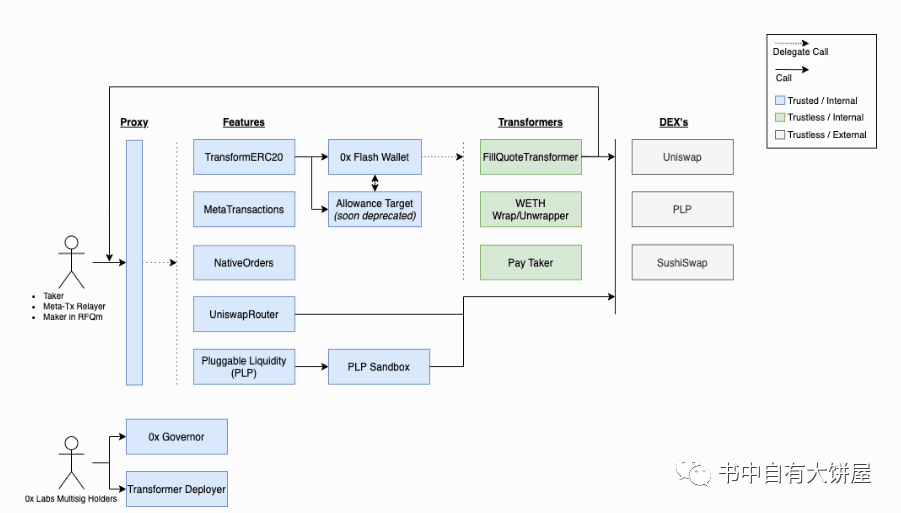
Technical features of the transaction
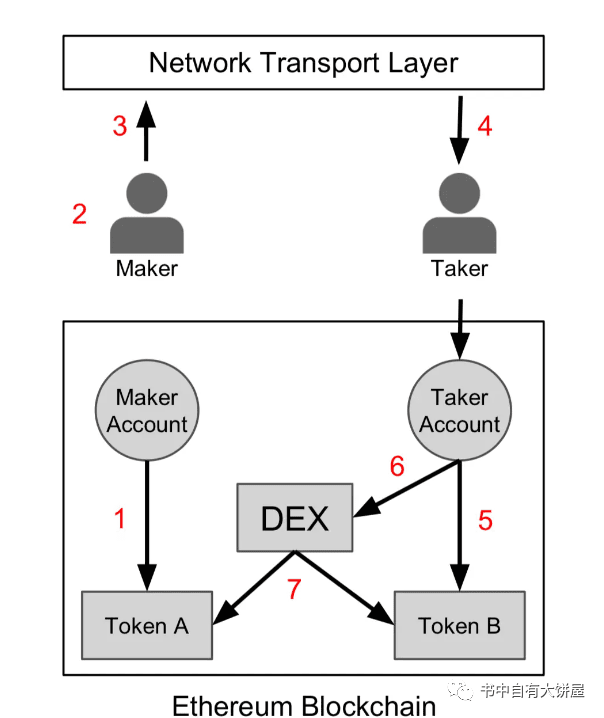
The gray rectangle and circle in the above figure represent the smart contract and account on Ethereum respectively. Specific logic:
Maker agrees that DEX (decentralized exchange contract) can obtain their information about Token A.
Maker creates an order to exchange Token A for Token B and declares the expected transaction rate and expiration time. Sign the above order.
Maker broadcasts this order through the network transport layer
Taker receives the order and decides to complete it.
Taker agrees to let DEX get his information about Token B.
Taker submits the maker's signed order to the DEX contract.
The DEX contract verifies the maker’s signature. Once the verification is passed, the two tokens are exchanged at the proposed rate.
Among them, operations 3 and 4 mentioned above are off-chain behaviors. The network transport layer, session layer, and application layer of 0x protocol are responsible for the relay, display, and push of the order. Of course, users can also broadcast the signed order through email, Twitter, etc. Once the Taker obtains it, he can send the order to the DEX contract to complete the transaction.
In 0x, orders are transmitted off-chain and settlement is performed on-chain. To support this off-chain solution, there are two ways to interact with the protocol on 0x:
1. Peer-to-peer (P2P user-to-user) token holders no longer need to broadcast their transactions to the blockchain network through a third party. Thanks to the 0x asset exchange smart contract, each user can produce their own orders and publicize them in any way, such as social networks, TV ads, written papers, etc. When another token holder wants to accept an order, he only needs to place an order and execute and complete the transaction through the 0x asset exchange smart contract.
2. Transaction Order Relayer: Relayer does not keep any tokens. The job of Relayer is only to host the order. The work of putting it on the chain is done by the trader. The trader will select the cryptographically signed order on the website hosted by the relayer, and then send it to a wallet such as MetaMask. The order will then be sent to the 0x smart contract for execution. In this process, the work done by the 0x smart contract is to accept the order sent and process it to ensure that the conditions required for the execution of the transaction are met, and finally transfer the value of the assets of the two parties to the transaction according to the conditions after execution.
Unlike centralized exchanges where transactions take effect instantly, it takes about 30 seconds for transactions in the 0x protocol to take effect.
Application Scenarios
0x is a p2p ERC20 token exchange protocol based on the Ethereum blockchain. It has a standard open source protocol, a universal creation block, and implements interoperability of transaction functions in distributed applications. Decentralized applications based on the 0x protocol can enter public liquidity pools, or create their own liquidity pools, and charge a certain fee.
1. Decentralized governance
Decentralized organizations use tokens to represent ownership and guide their governance logic. Decentralized organizations use the 0x protocol to seamlessly and securely trade ownership of startup funds.
2. Accurately predict the market
The decentralized prediction market platform generates a collection of tokens based on real-world events and the financial risks they contain. Using the 0x protocol, these tokens can be traded instantly.
3. Stable Tokens
The successful construction of new economic structures such as StableCoins depends on the support of efficient liquidity markets. The 0x protocol can effectively promote the underlying economic mechanism and help tokens remain stable.
4. Decentralized lending model
Efficient lending requires the support of a liquid market that provides investors with a platform to easily buy and resell loan products. Using the 0x protocol can build a self-organizing ecosystem for borrowers to efficiently determine the market price for all outstanding loans.
5. Fund Management
Decentralized fund management effectively limits the investment behavior of fund managers by dividing asset classes that need to be agreed upon in advance. Embedding the 0x protocol into the fund management smart contract ensures that it complies with security constraints.
Incentives
After the release of V3, 0x believes that market makers in the ecosystem are one of the most important participants, so the main incentive direction is focused on market makers who provide liquidity to the ecosystem.
For every transaction generated on 0x, the buyer taker will pay a fee denominated in ETH to the 0x protocol, which is approximately several times the gas cost generated by the transaction.
All of this ETH will flow into a liquidity reward pool called "Liquidity Rewards Pool". Every epoch (10 days), the ETH rewards in this reward pool will be automatically distributed to market makers according to a specific reward function.
The reward function is related to two variables, namely "liquidity contribution share" and "the amount of ZRX staked during an epoch interval", that is, the reward depends on the market maker's "liquidity contribution share" and "ZRX token stake ratio". In order to maximize economic benefits, a market maker needs to build its own staking pool in addition to contributing as much liquidity as possible, because if there is no staked ZRX token, the market maker will suffer huge economic losses. Once the liquidity provider does not stake enough ZRX tokens, the assets in the reward pool will automatically transition to the next epoch, providing the market maker with a future liquidity reward pool.
In addition, the V3 version of the protocol supports ordinary coin holders to entrust their ZRX tokens to market makers in order to obtain a certain proportion of ETH liquidity dividends. At the same time, 50% of the user's ZRX voting rights will be shared with liquidity providers, correspondingly increasing the voting weight of the "market maker".
Token Economy
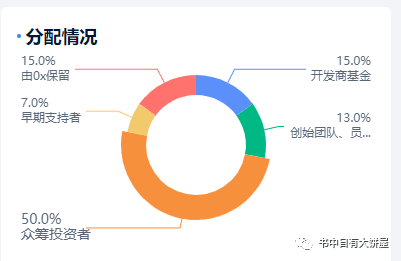
The total amount of tokens is 1,000,000,000 ZRX, and currently 847,496,054 ZRX are in circulation, with a circulation rate of 84.5%. The current price is $0.19, and the peak price was $2.1 (in 2018). Then look at its token distribution. 50% of the tokens are allocated to crowdfunding, the team has 15% reserved + 15% as a founding team reward, which means the team took 28%, which is still a bit high.
Finally, we have finished talking about the three projects in this field, namely Loopring, Kyber Network and OX. From the perspective of market value, LRC currently has a market value of 220 million US dollars, the highest market value, and KNC has the lowest market value of 110 million US dollars. OX ranks in the middle with 160 million US dollars. The other two exchanges have been made. I did not see 0X's own exchange on the official website, so their team is working hard on this technology, because it is okay for others to pay you for using your technology. In fact, the market value situation can already reflect the comprehensive strength of the three companies. Although 0X appeared earlier, I still think that Loopring's loop matching is relatively new in technology, but it is also its only advantage and it is the leader.