


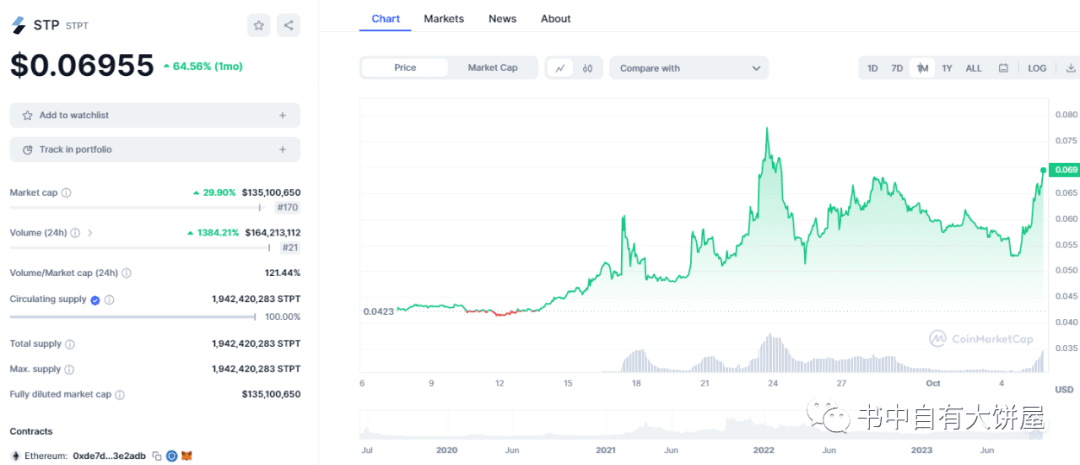
Today we continue to talk about it in the order of market value. The one we are talking about today has risen quite well recently. It has almost doubled in the past month, from 0.04 to 0.08 when it was the highest point, and then fell back. Especially today, it rose sharply, nearly 20%. But after I studied this project, I found that it was actually quite ordinary. The things to be done at the beginning were better, but it should be more difficult. Now it has transformed, a bit like the Aragon we talked about before, it is STPT, the standard tokenization protocol, with a current market value of 130 million US dollars, ranking 170+, a little behind ANT. Then let's take a look at it today.
Introduction
The Standard Token Protocol's STP Standard is an open source standard that defines how to generate, issue, send, and receive ownership of tokenized assets while complying with all necessary regulations. Tokens built on the STP Standard will use the protocol's on-chain compliance verifier to verify compliance with relevant regulations (including know your customer, anti-money laundering, certification, etc. in the example below), as well as any issuer-specific requirements (i.e. ownership concentration, holding period, voting). The Validator Committee will provide advisory services to ensure that compliance verifiers always implement the latest standards. The STP Standard Tokenization Protocol allows assets to be tokenized, making them fully compliant with regulations in different jurisdictions and cross-platform transfers on any ERC-20 platform.
Project Purpose
Issuance Fee
Issuers can use the Standard Tokenization Protocol to create STP standard tokens corresponding to a specific percentage of ownership, breaking down the legal ownership of their assets or their asset characteristics (including allocated resources, profits, etc.). These tokens built on the Standard Tokenization Protocol STP standard will comply with the global regulatory framework that comes with the compliance verifier, eliminating the compliance burden on issuers. To achieve this tokenization process, issuers will pay an initial issuance fee to the Standard Tokenization Protocol in STP to initiate the tokenization of their assets. Any issuer-specific requirements, parameters, and rules regarding token transfers will be added to the compliance confirmation through the Standard Tokenization Protocol as part of the initial issuance fee.
Compliance validator gas fee (Gas)
In order for the compliance verifier to ensure that both parties (sender and receiver) of the transaction comply with all necessary jurisdictional and issuer-specific requirements, a certain amount of gas is required. The essence of this gas fee is a small amount of STP tokens. The smart contract uses this token to incentivize the verifier to prove that the transaction meets the compliance verification requirements. To use this function, the sender of any STP standard token needs to use a certain amount of STP tokens as gas fees to provide costs for the compliance verifier when the transaction occurs. Subsequently, the gas fees are pooled and paid to the relevant parties and members of the regulatory committee as a reward for honest network behavior.
Staking
In addition to the first two use cases of STP tokens, the network also enables a proof-of-stake mechanism that allows token holders to stake and earn STP. That is, token holders’ STP holdings are proportional to their confidence in compliance validators, and they either receive compliance confirmation gas tokens in return, rewarding their honesty, or lose their holdings to reward other participants who reward honesty.
Governance
Token holders who wish to hold STP tokens do so by delegating their stake to a token-elected validator committee. Validators that make up the committee will earn STP for submitting public audit evidence that the compliance validator meets the legal requirements of their jurisdiction or other requirements for proper operation. Given that STP token holders will behave rationally, they will delegate their stake to trusted advisors, partners, and stakeholders in their market sector or jurisdiction, such as securities lawyers, regulators, and legislators to protect their shares. The validator committee's STP will be used to incentivize these groups and reward them for participating in a meaningful way and becoming an integral participant in the Standard Token Protocol network.
STP Standard Process
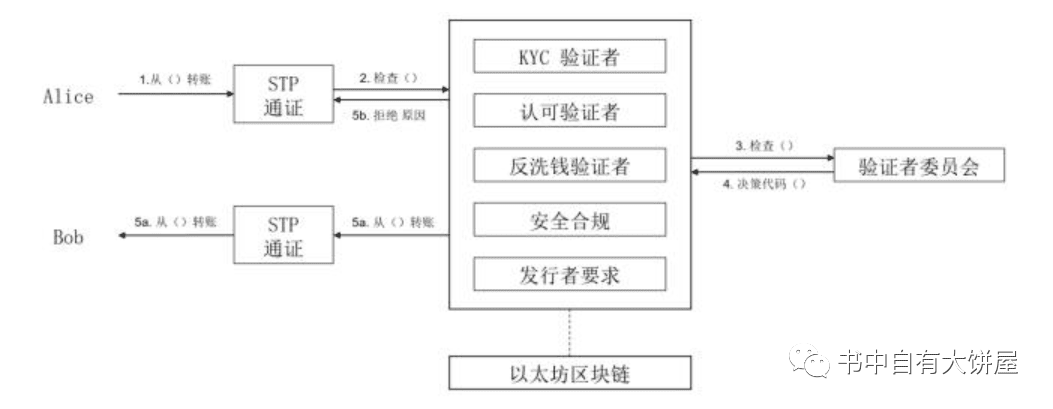
Alice sends Bob 10 STP passes. First, a request is sent to the compliance verifier to confirm that Bob has successfully passed the customer's check, is an accredited investor, complies with the corresponding anti-money laundering regulations, and will not destroy any issuer by accepting the pass. Restrictions imposed (i.e. majority ownership rules). If there are no conditions, Alice will receive a reason for rejection. If everything goes well, Bob will receive 10 STP passes.
1. Compliance Verifier
There are two main responsibilities for chain compliance certification: judicial compliance and issuer compliance. First, you must ensure compliance with the corresponding laws of the jurisdiction contained in the protocol code; second, you must ensure compliance with the parameters and restrictions imposed by the issuer before issuing assets.
1.1 Jurisdiction Compliance
For pass-through assets that comply with current regulations (e.g., certificates constituting securities under a specific region), certain jurisdictional requirements must be met to avoid public filing requirements. For example, jurisdictional restrictions may be imposed to limit the number of investors allowed to participate in the initial offering. While compliance verification in such jurisdictions always requires significant human capital, the STP compliance verification program can simplify and expedite the verification process in a provable manner.
1.2 Issuer Compliance
If there are no jurisdictional restrictions, issuers will want to impose specific restrictions on the issuance and transferability of their certificates. For example, a digital asset publisher with a "one pass, one vote" governance model, they may want to ensure that no investor can own more than 49% of the outstanding certificates at any given time, even if they have 100% supply in circulation. This is another task for the STP Compliance Validator, which automates the chain's handling of compliance. There are countless other publisher-specific features under the STP Passport standard, such as fixed lock-up periods, minimum and/or maximum investment amounts, and certification status restrictions.
Jurisdiction and issuer specific requirements together form the responsibility of the Compliance Verifier, who itself is at the heart of the STP pass criteria, ensuring demonstrable compliance for both cases is met at every pass at the pass level.
2. A verification committee selected by the certificate holder
In order to ensure that the protocol is always mandatory to comply with the latest regulatory standards, the system will establish an initial committee to verify the accuracy of the operation. It will be composed of a team selected by pass holders, including but not limited to industry-leading thought leaders, consultants, securities lawyers and cross-jurisdictional regulators to ensure that any changes in the regulatory environment are reflected in the protocol. In order to provide services to the Standard Certification Protocol network, the verification committee will be compensated using the network's local pass STP.
2.1 Service Providers
In the case of implementing issuer specific parameters, the committee will be composed of individuals and/or institutions that the licensee believes will ensure the issuance and maintenance of compliance verifier responsibilities. For example, prior to the initial issuance, the majority of certificate holders may be the project itself and may vote to a committee of certification bodies including underwriters and listing exchanges to ensure an appropriate organizational structure. As the CV supply is decentralized over time, the community of public holders may elect others to the committee to maintain the issuer specific parameters.
Latest Business
The business mentioned above is its previous business. In fact, blockchain itself is difficult to comply with regulations. The entire industry is difficult to comply with regulations. How can you ensure the compliance of other projects through your own project? So the demand is a real demand, but it cannot be done at present. This inability is not a technical problem, but a political problem.
Therefore, on its latest official website, it has transformed into a DAO company, which provides SDK that allows you to quickly create DAO organizations. It is a bit similar to ANT. You can refer to the previous Gu. I will not go into details here.
Token Economy
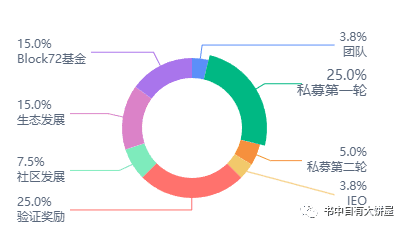
The total amount of tokens is 1,942,420,283 STPT, which are now basically all in circulation. The current exchange rate is 0.069 USD, and the peak was 0.29 (21 years). Then in terms of token distribution, his team still gets a relatively small amount, 3.8+15+7.5=25%, which is not a lot.
Finally, let me summarize this project. Since the project has already transformed, I will compare it with ANT. ANT currently has 190 million US dollars, while he has 130 million US dollars. In terms of size, they are similar. Another problem is that the founder of this project is Mike Chen, who is a Chinese at first glance, which is not very good. Then the project also gave up its own direction. It’s not that the direction adjustment is not good. Enterprises must adjust, otherwise it will die easily. But is the direction of transformation to DAO good? Or is this a trend? I don’t think so. DAO is a trend, but providing others with a tool to create DAO is definitely not. The fundamentals of the project are very general and it is not recommended to buy.