

Author: Blockdata
Compiled by: Bai Ze Research Institute
The increasing use of blockchain technology has led to significant changes in the global payment market. The increasing demand for more efficient payment systems by individuals/businesses has led to the entry of cryptocurrencies into multiple payment fields, including remittances, payment cards, and e-commerce. Since cryptocurrency payments have shorter settlement cycles, lower fees, and higher consumer adoption rates, more and more retailers are now accepting cryptocurrency payments. In addition, traditional payment and e-commerce companies are also getting involved in the field of crypto payments to provide consumers and businesses with seamless and secure payment solutions.
In this article, we examine how these traditional companies adopted crypto payments, how they launched their own crypto payment services, and their partnerships with crypto payment infrastructure providers.
Why do traditional payment companies and e-commerce platforms want to integrate crypto payments?
Currently, traditional methods such as cash, bank transfers and payment cards still dominate the payment field. However, crypto payments are gaining huge traction. According to data released by Visa, in the first quarter of 2022, Visa's payment network processed a total of $2.5 billion worth of crypto transactions, up from $1 billion in the first quarter of 2021.
Cryptocurrencies enable faster global payments by eliminating intermediaries such as banks and complexity. Traditional payment companies have been reluctant to adopt crypto. However, the recent rapid development of the blockchain/cryptocurrency industry and growing demand from consumers and businesses have prompted leading payment and e-commerce companies, including Mastercard, Visa, and Shopify, to adopt it.
The high volatility of cryptocurrency prices has been a reason why businesses have been reluctant to adopt it; however, with the emergence of stablecoins, businesses are now increasingly interested in integrating crypto payment options. Globally, more than 15,000 businesses in industries such as gambling, travel, food, and retail are accepting cryptocurrencies. According to a December 2021 study by Deloitte, nearly 75% of retailers intend to accept crypto payments by the end of 2023.
Crypto payments offer several benefits to consumers and businesses, including:
Payments without borders: Transfer and make payments internationally using cryptocurrencies powered by blockchain.
Faster Settlements: Crypto payments involve fewer intermediaries, resulting in faster settlements.
Lower costs: Crypto payments cost around 1% compared to traditional credit card fees of 1.5% to 3.5%.
Immutability: protects merchants from chargeback fraud (e.g. consumers fraudulently requesting a refund without returning the item)
Targeting new consumer segments: Businesses that accept crypto payments can connect to a larger consumer base of crypto enthusiasts.
Additional Income: Accepting cryptocurrencies enables businesses to generate additional income by earning yield from staking or lending using their cryptocurrencies.
Crypto products and services provided by traditional companies and their partners
In order to meet the different needs of crypto enthusiasts, traditional payment and e-commerce companies have partnered with crypto-native service providers such as custodians and payment providers to provide a variety of cryptocurrency-based products, such as:
Transaction and Funds Transfer Services:
As interest in digital assets grows among a wider consumer base, traditional payment companies such as PayPal and Revolut have launched crypto trading services and allow peer-to-peer transfers through their platforms. PayPal has partnered with blockchain infrastructure provider Paxos, and Revolut has partnered with Apex Crypto. Similarly, Block (formerly Square), a US-based financial services and payments company, also offers Bitcoin trading services through its Cash App platform.
Payment Card:
Both Visa and Mastercard offer crypto payment cards that are launched in partnership with cryptocurrency exchanges and crypto wallets, and holders can use these cards to make payments (cryptocurrencies are automatically converted into fiat currencies). Platforms that offer Visa crypto payment cards include Coinbase, Bitpanda and Wirex, while BitPay and Nexo offer Mastercard crypto payment cards. Some of these cards allow cardholders to earn crypto rewards after accumulating a certain amount of payments.
Merchant payment services:
Traditional payment companies have also begun to enable their merchants to accept cryptocurrency payments. For example, PayPal offers a service to check out with cryptocurrency, allowing its users to shop on the e-commerce platform using the cryptocurrency in their wallets, including Bitcoin (BTC), Ethereum (ETH), Litecoin (LTC) and Bitcoin Cash (BCH). Similarly, payment service provider Worldline has developed a crypto payment platform WL Payments in cooperation with Swiss crypto service provider Bitcoin Suisse, enabling its offline and online merchants to accept BTC (Lightning Network) and ETH payments.
E-commerce platforms such as Shopify, WooCommerce, BigCommerce, etc. are working with some crypto service providers to enable merchants to accept crypto payments. Shopify allows its merchants to accept cryptocurrencies such as BTC, ETH, DogeCoin, MATIC, and BNB through partnerships with Crypto_com, Coinbase's merchant service Coinbase Commerce, BitPay, DePay, OpenNode, and Strike.
Additionally, some payment companies are offering stablecoin settlement services to avoid the complexity of converting digital assets into fiat assets. Visa has partnered with Worldpay, the payment services subsidiary of Fidelity National Information Services (FIS), which in turn has partnered with Circle, the issuer of the stablecoin USDC, to enable businesses to receive USDC settlements.
Opportunities for traditional payment and e-commerce platforms
In fact, traditional payment and e-commerce platforms have far more advantages than crypto-native providers because they have a large user base, powerful systems and are regulated, which makes them a safer choice for customers to pay with cryptocurrencies. According to Paying With Cryptocurrency, as of June 2022, only about 23% of businesses that have accepted crypto payments worldwide are receiving cryptocurrencies through crypto-native wallets, and most businesses still use crypto payment solutions provided by traditional payment companies.
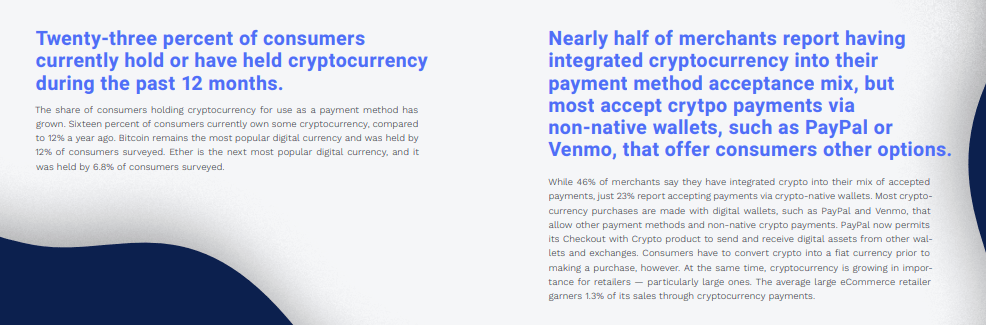
Therefore, providing crypto payment services can bring competitive advantages to traditional payment companies. Traditional payment service companies can integrate cryptocurrencies and blockchain technology into their platforms to cope with the growing demand for such services.
The development trajectory of traditional payment and e-commerce platforms providing crypto payments (2017-2021)
The table below highlights some of the major developments in cryptocurrency payments from leading traditional payment companies and e-commerce platforms.
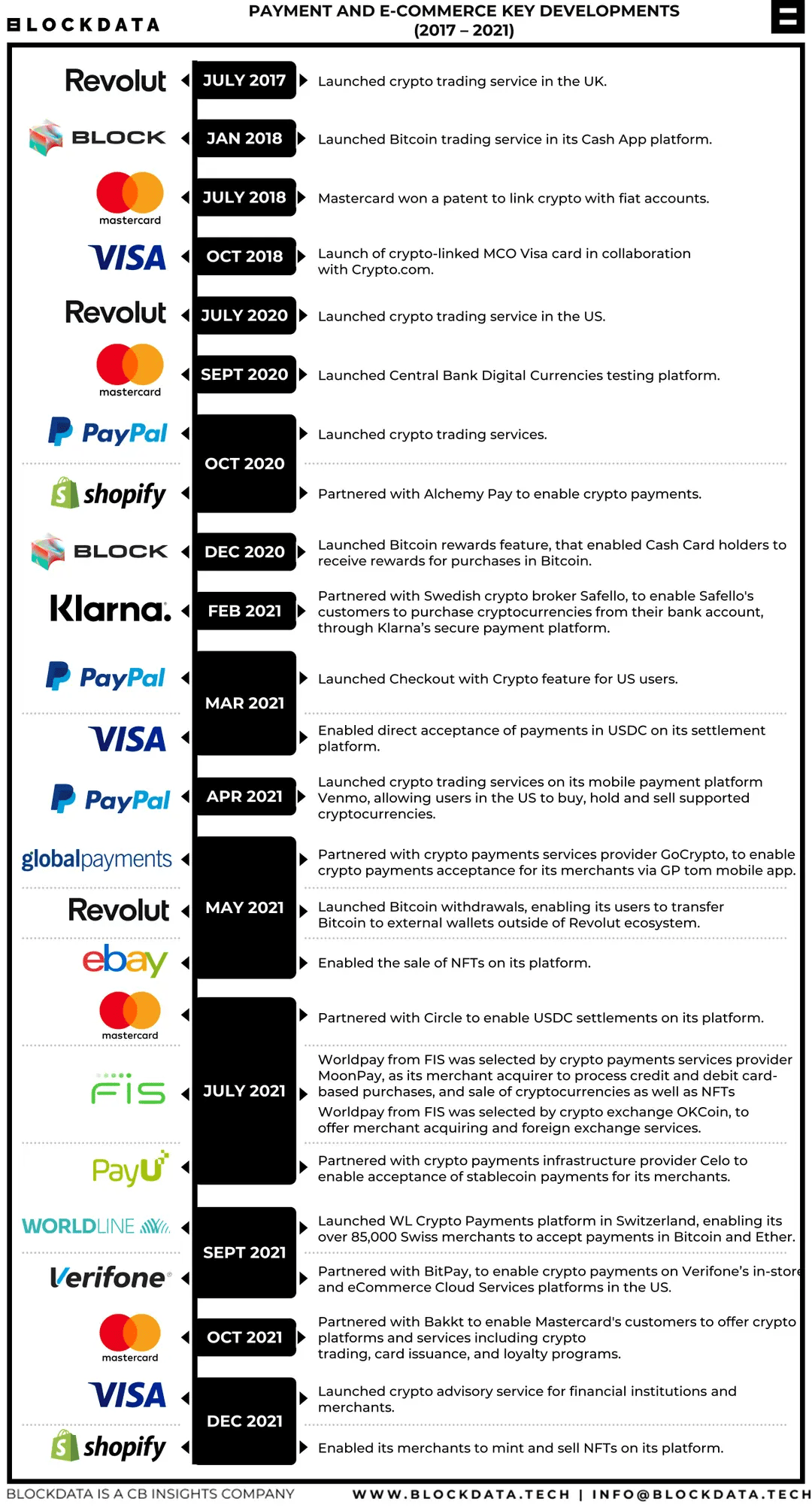
Revolut (July 2017): Launched crypto trading service in the UK
Block (June 2018): Launched Bitcoin trading service on its Cash App payment platform
Mastercard (July 2018): Awarded a patent for linking cryptocurrencies to fiat accounts
Visa (October 2018): Partnered with cryptocurrency exchange Crypto_com to launch crypto payment cards
Revolut (July 2020): Launches crypto trading service in the U.S.
Mastercard (September 2020): Launches central bank digital currency (CBDC) test platform
PayPal (October 2020): Launches crypto trading service
Shopify (October 2020): Partners with Alchemy Pay to enable crypto payments
Block (December 2020): Launched Bitcoin Rewards feature, enabling Cash payment card holders to receive Bitcoin payment rewards
Klarna (February 2021): Partnered with Swedish cryptocurrency exchange Safello to enable Safello’s customers to purchase cryptocurrencies using their bank accounts through Klarna’s payment platform.
PayPal (March 2021): Launched a crypto checkout feature for US users, allowing US users to use cryptocurrencies to check out for online shopping.
Visa (March 2021): Allows stablecoin USDC to settle payments in its payment network
PayPal (April 2021): Launched crypto trading services on its mobile payment platform Venmo, allowing users in the United States to trade and hold cryptocurrencies
GlobalPayment (May 2021): Partnered with crypto payment service provider GoCrypto to launch a service for merchants using Visa's POS application GP Tom to accept cryptocurrencies
Revolut (May 2021): Launched a Bitcoin withdrawal feature that enables its users to transfer Bitcoin to wallets outside the Revolut platform
eBay (May 2021): Launches NFT sales functionality on its platform
Mastercard (July 2021): Partnered with Circle to allow payments to be settled using the stablecoin USDC on its platform
FIS (July 2021): FIS’s Worldpay was selected by crypto payment service provider MoonPay as a merchant acquirer to process credit and debit card-based crypto transactions, as well as NFT sales services; Worldpay was also selected by cryptocurrency trading platform OkCoin to provide merchant collection and foreign exchange services
PayU (July 2021): Partnered with crypto infrastructure provider Celo to launch a service for its merchants to accept stablecoins
Worldline (September 2021): Launched crypto payment platform WL Payments in Switzerland, enabling over 85,000 merchants to accept BTC and ETH payments
Verifone (September 2021): Partnered with BitPay to launch crypto payments on the Verifone online store and e-commerce cloud service platform in the United States
Mastercard (October 2021): Partnered with Bakkt to provide crypto-related services to Mastercard customers, including crypto trading, payment card applications, and loyalty programs
Visa (December 2021): Launches cryptocurrency advisory service for financial institutions and merchants
Shopify (December 2021): Enables its merchants to mint and sell NFTs on its platform
2021-2022 Development Status
1. Traditional payment companies further expanded their product range:
In June 2022, PayPal expanded its crypto services, enabling its U.S. customers to transfer cryptocurrencies between PayPal and wallets and exchanges. It also eliminated fees for cryptocurrency transfers between PayPal users and obtained a crypto license, the Bitlicense, from the New York Department of Financial Services. In January 2022, the company announced plans to launch its stablecoin to complement its expanding crypto business.
In August 2022, Revolut expanded its crypto services in the UK by launching support for 22 new tokens, enabling its customers to trade more than 80 tokens. In September, it received a graded registration with the UK Financial Conduct Authority, allowing it to offer crypto services in the U.K. In August 2022, the company also expanded its crypto trading services to Singapore.
2. Traditional payment companies expand their crypto services through collaboration:
Visa and Mastercard are working with crypto wallets and trading platforms to launch crypto payment cards. On October 17, 2020, Mastercard partnered with cryptocurrency trading platform Paxos to develop a tool to help financial institutions provide cryptocurrency transactions.
In September 2022, Mastercard partnered with crypto-based financial services provider hi to launch NFT customizable payment cards. Cardholders can customize their physical payment cards with NFT avatars and use them to pay with fiat, stablecoins, and other cryptocurrencies at any supported merchant. Other partners of Mastercard in 2022 include Nexo and Binance.
Visa has partnered with Brazil’s Alterbank, Zro Bank, and Argentina’s Satoshi Tango to launch Visa’s crypto payment card.
In June 2022, American Express launched its first crypto payment card in partnership with crypto wallet Abra. Cardholders can get cash back in more than 100 cryptocurrencies supported by the Abra platform.
3. Traditional payment companies and e-commerce platforms launch crypto payment solutions for enterprises:
In September 2022, BigCommerce partnered with BitPay and CoinPayments to develop crypto payment solutions.
In May 2022, Shopify partnered with Crypto_com to launch the Crypto_com Pay feature, allowing merchants to accept payments in more than 20 cryptocurrencies.
In April 2022, the United States-based payment service Stripe launched a crypto payment service that allows its partner platforms to make instant payments to their stakeholders.
In February 2022, eBay incorporated crypto payments into its platform. In June 2022, it acquired leading NFT marketplace KnownOrigin.
In December 2021, Block (formerly Square) launched a crypto gifting feature that allows its Cash App users to gift Bitcoin with a minimum amount of $1.
In February 2022, FIS’s Worldpay partnered with Circle to enable businesses to accept payments in USDC. In March 2022, it partnered with Shyft Network to help its merchants comply with crypto regulations.
In June 2022, Mastercard partnered with a number of NFT marketplaces, including Immutable X, Candy Digital, The Sandbox, Mintable, Spring, Nifty Gateway, and crypto payment service provider MoonPay, to enable Mastercard cardholders to purchase NFTs directly.
The future of crypto payments looks promising
With merchants and consumers’ growing interest in digital assets and their viewing of cryptocurrencies as a viable and more efficient payment method, it is no surprise that traditional payment companies and e-commerce platforms are adopting crypto payments.
Cryptocurrency can create an advanced global payment ecosystem, and crypto payments provide important business opportunities for traditional payment companies and e-commerce platforms. The future development of stablecoins will further increase the speed of crypto payments and reduce transaction costs, which is crucial for businesses to continue to adopt cryptocurrencies.
All in all, crypto payments will open up a new way for businesses to serve their customers.