


Today we continue to talk about a fun project, the blockchain wiki encyclopedia, which is very similar to what I do. I also wrote this encyclopedia through 3,000 projects by talking about 3,000 projects, imitating the biographical style of "Historical Records" , this project is to create an autonomous wiki encyclopedia website by imitating Wikipedia. It is Everipedia, and the token is called IQ. The current market value is relatively low, only 80 million US dollars, and it ranks 200+.
Introduction
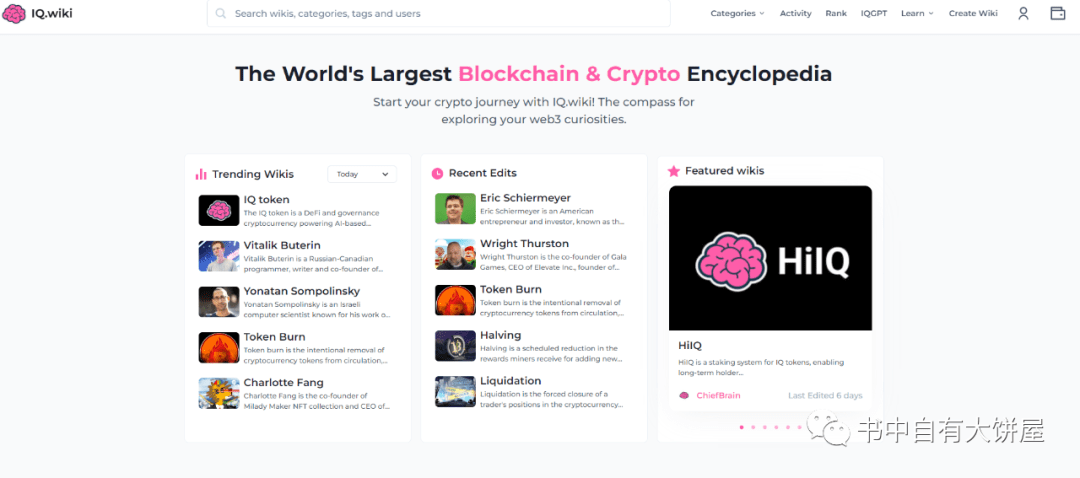
IQ Token is a cryptocurrency dedicated to building a smarter future through artificial intelligence and blockchain technology. The IQ token powers the knowledge ecosystem including applications such as IQ. Wiki, the world's largest cryptocurrency and blockchain encyclopedia. IQ.wiki integrates AI to complete tasks including summarizing wiki articles. IQ is a DeFi and governance token that enables native staking through HiIQ. The token is managed by BrainDAO, which also includes BrainDAO’s digital asset library.
background
The core of the product is to subvert the existing Wikipedia, and to amplify the economic efficiency of knowledge currently operated by non-profit organizations, so that both knowledge contributors (editors) and platform developers can follow the platform as they grow up. Gain benefits from the economic effects of knowledge in the future.
Wikipedia's knowledge is edited and enjoyed by everyone, without sharing of benefits. The key words are openness and contribution; although encyclopedia's knowledge is also edited by everyone, the final interpretation power rests with Baidu, and the benefits eventually flow into Baidu's pocket. The biggest subversion of Everipedia is the use of the incentive mechanism brought by blockchain technology to change the sharing economic model, and the interests tend to favor knowledge creators and maintainers. It is equivalent to bringing a business model to the Wiki model and at the same time dividing the centralized benefits of the encyclopedia among all contributors. The core is to create incentives, motivate contributors, and contributors feed back ecological development, creating a virtuous cycle.
origin
Everipedia was co-founded by Sam Kazemian and Theodor Forselius in December 2014 at UCLA. The website was created as a side project in Kazemian's dormitory.
Initially, they founded the company to build a more modern Wikipedia. They were inspired by a 2008 blog post by Y Combinator co-founder Paul Graham titled "Startup Ideas We Want to Invest in." Among some of his ideas, he advocated for being "more open and inclusive than Wikipedia."
Everipedia's official mission is to modernize, strengthen, and decentralize the governance of online encyclopedias. They are designed to allow for a greater range of content from traditional encyclopedia sites such as Wikipedia by allowing more editorial decisions during the editing process.
Another option for Everipedia is to import all of Wikipedia’s content onto their platform. This provides a basis for people to add content to the page that may not be accepted on the Wikipedia platform. For example, link to their website and social media accounts. In addition, Everipedia users can create pages for people, organizations, and other topics they can't find on Wikipedia.
develop
On December 6, 2017, Everipedia announced that they were creating "the first encyclopedia on the blockchain" using EOS blockchain technology. They said they were working on a cryptographic token called IQ. Don't mess with IQ. Confused, IQ tokens are intended to be used to vote on protocol upgrades and further submissions or modifications to Everipedia’s article database.
The decentralized database creates an incentivized peer-to-peer network (called the Everipedia Network) for submitting, curating, and governing the encyclopedia's article database. It is entirely governed by IQ token holders, who can approve edits, formulate network-wide rules that govern the encyclopedia, and can also buy and sell services on the network in exchange for tokens. These will run on Everipedia's pages, as well as any website or application that interacts with the Everipedia network (or a subset of the network) with their own user interface.
In addition, the IQ token plays a central role in the consensus protocol for final data being written to the network.
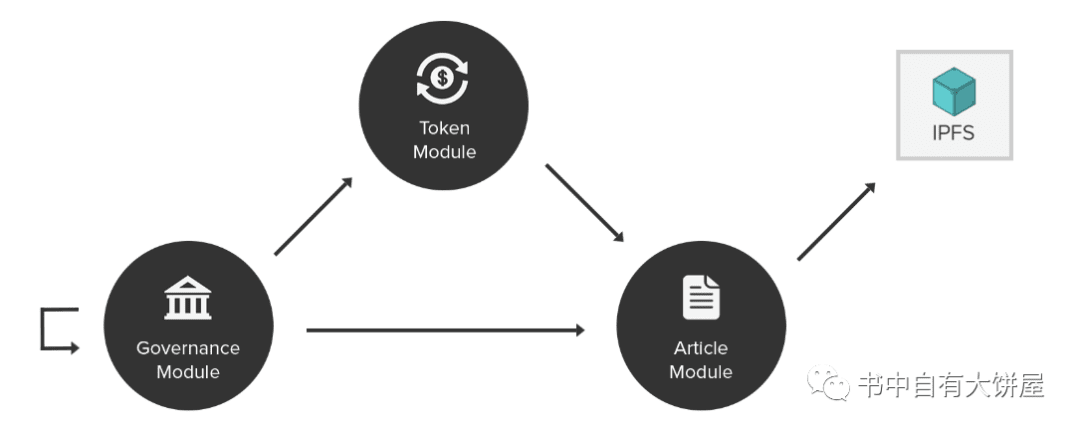
Everipedia's whitepaper discusses three modules that interact in the network:
IQ pass module
Everipedia's token module is mainly responsible for modifying the IQ token balance in the address. This includes the transfer of tokens, application of transaction fees, minting of new tokens, and token locking during the article consensus process.
Article module
Everipedia's article module is used for editing and submission in the database. Each edit proposal is sent and stored in an IPFS_node (InterPlanetary File System); there will be an IPFS hash pointing to the immediate parent version and an IPFS hash pointing to the new version.
In order to apply for an edit, users must submit a small amount of IQ tokens as collateral, which is returned if the edit is approved. This incentivizes people to submit accurate and valuable edits, discourages people from submitting spammy edits, and prevents incidents of malicious attacks.
Governance module
Everipedia's governance module addresses any goals that might change the network itself. Any governance-related changes approved by the community will be reflected in every module, including the governance module.
The purpose of the governance module is to enable the community to reach social consensus on the rules that govern the entire network. If approved, the new code can be deployed on the blockchain in a trustless manner.
Governance operations can modify the software of any of these three modules, but cannot modify the database containing token balances and articles.
When an upgrade is needed, community members come up with plans, but the discussion and final consensus are concentrated off-chain. Current social media or communication groups are used to hand over the upgrade task to people or teams in the community who are trusted enough after the decision is made. to deploy the upgrade. This off-chain consensus processing method will tend to be centralized, and there will be many problems such as what to do if people are deployed to do evil, but so far it is a feasible upgrade plan.
excitation
Everipedia has proposed two solutions, one is to collect donations like Wiki, and the other is to issue additional IQ to buy EOS. Fundraising is a destabilizing factor. Although Wiki receives more and more donations every year, this is not suitable for start-ups. It is still too difficult and tricky for Everipedia. The additional issuance of IQ can follow the issuance rate of EOS and use the additional issuance value to purchase the additional issuance value. If the project is developing, it should be able to keep up. This is indeed what IQ is currently doing.
So when we talk about the knowledge submission of Everipedia’s second module Token and the third module, combined with governance, Kamie found that the interaction design logic between them is also quite interesting.
Once the editor who submits knowledge is determined, he or she can obtain IQ. The IQ obtained comes from a bonus pool that is updated daily. The amount obtained is determined according to the value ratio of the editor's contribution. There is an algorithm for determining this value. Simply put, it is It is determined based on the editing level and the number of passes, so the final amount you get depends on the number and quality of editors that day.
After IQ is mortgaged, a new consumable token will be obtained, called BP (brain power), which is issued at a ratio of 1:1. When editing or voting, BP will be consumed. If it is consumed, unless there is a new one IQ is staked, otherwise new editing submissions cannot be initiated during the lock-in period. If there is no new IQ, you can only wait 21 days for the IQ to be unlocked. At that time, you can mortgage to obtain new BP for editing and submission.
Of course, in addition to raising the threshold for malicious submissions, Everipedia has also established a complete verification mechanism. All updates and modifications to the knowledge base are guaranteed by this set of algorithms. At the same time, Everipedia has also established an account-reputation system for users, which can View the edit history as one of the reference elements.
Token economy
The maximum supply is 21,000,000,000 IQ, and there are currently 16,652,993,053 IQ in circulation. The current token price is 0.005 US dollars, and the peak price was 0.045 US dollars (in 2021). However, the distribution of tokens has not yet been found, because its amount is daily It will be minted, that is, if someone edits the content, they will be rewarded, so it is also an inflation model.
Finally, we concluded that this project runs on the EOS chain. We have not talked about the EOS chain because it is a very old public chain and has not been up. It feels like it is about to die. This project is actually very It’s old, but I think it is a very interesting and thoughtful project. Many problems can be solved through blockchain. If the world of blockchain wants to grow, it must have these projects to realize it bit by bit. This is It’s a long process and requires everyone to work together on WAGMI. The future is promising!