


Today we continue to talk about two projects that have skyrocketed recently, one public chain project (ARK) and one DEFI project (HIFI). ARK has risen sharply in the past month, from 0.2 to 0.7, almost 3.5 times. Now it has begun to fall back and is currently around 0.5. It may continue to fall. Today we are talking about ARK, which currently has a market value of less than 100 million US dollars and ranks 240+ in market value.
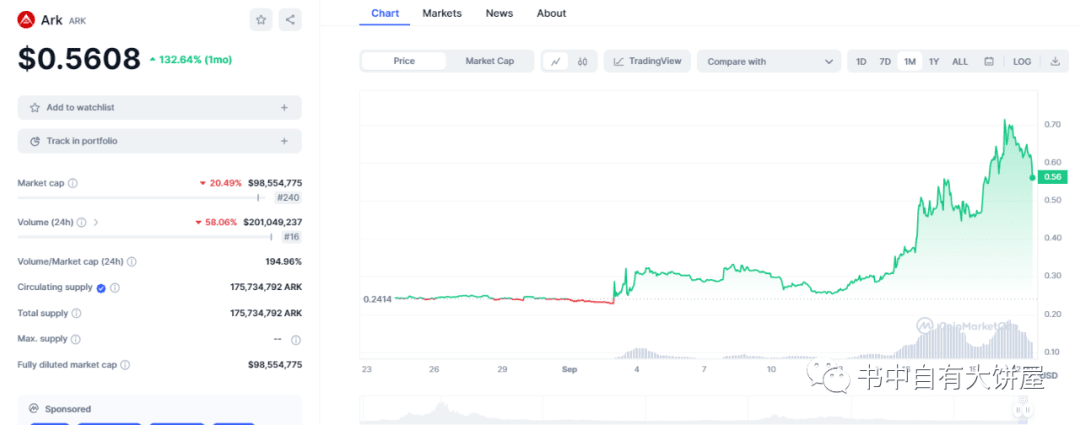
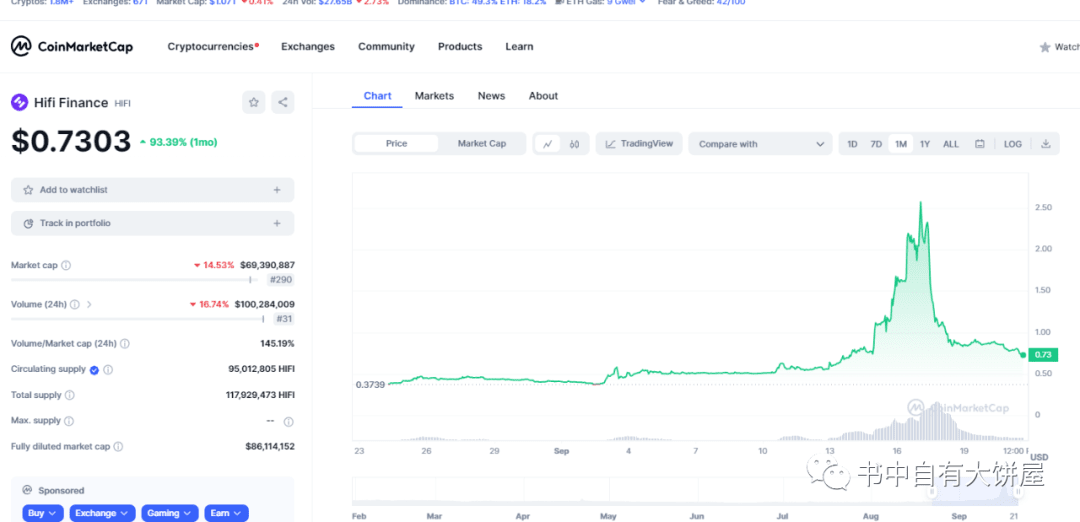
Defi project Hifi currently has a market value of 90 million US dollars and ranks 180+ in market value. It has increased 5 times in the past week. It can be seen that from 0.5 at the beginning of September to 2.5 on September 16, it has increased 5 times. However, it has also fallen sharply at present, falling to 0.7. It is a pity for this project, because when I saw the increase, I was going to make a program for everyone, but after I studied it, I found that there was not much to talk about this project, so I found other materials. The project is indeed very general, so the institutions just pull a wave and leave, pull a wave and leave, but through the lessons of this project, ARK currently also meets this feature, so I don’t think it’s too late.
Let’s talk about ARK first
About ARK
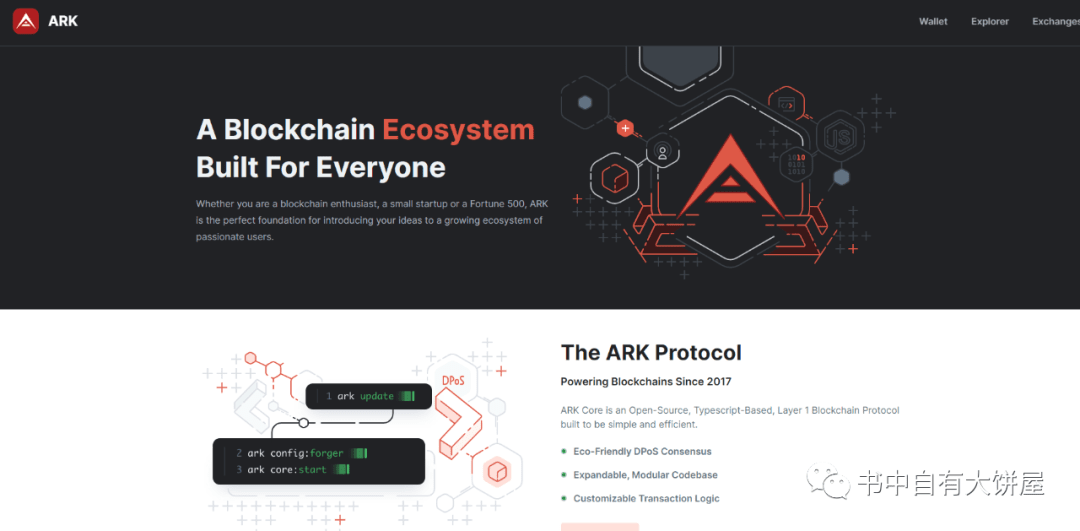
ARK is a cryptocurrency and blockchain-based development platform that allows anyone to create their own fully customizable and interoperable blockchain. By using custom transactions, logic, and multiple programming languages, the industry's need for smart contracts is reduced. On March 21, 2017, the ARK public network went live. Soon after, the ARK business entity was established, named ARK ECOSYSTEM SCIC. The business entity is often referred to as "ARK". This is part of the team brand and team website.
The ARK public network supports special transaction types such as multi-payment, multi-signature, multiple registration transactions, IPFS hash transactions, etc. ARK's Launcher product allows the creation of fully customizable interoperable blockchains using a graphical user interface. This plug-and-play creation method allows developers to take full advantage of ARK's consensus model, technology stack, product line, and custom transactions.
Problems ARK solves
ARK aims to solve the difficulties of using blockchain technology and develop solutions that satisfy a variety of use cases. The ARK Core Framework is designed to make blockchain technology more accessible to developers. The framework consists of ARK Core, which serves as the backbone of ARK-based networks and handles peer-to-peer operations, ledger database management, API access, custom business logic, and more. Within the ARK Core Framework is the Generic Transaction Interface (GTI), which enables developers to create custom transaction types that run on custom blockchains and satisfy the developer's desired use cases. The concept is similar to building a decentralized application in Solidity. However, there are no complex new languages to learn as GTI functions are in TypeScript. In the end, decentralized ARK-based applications and any associated crypto assets will run on sovereign interoperable blockchains to solve scaling issues.
II. Project Features
1. Fast
The ARK blockchain network can complete a block confirmation in just 8 seconds, making it one of the fastest networks in the industry.
2. Distributed
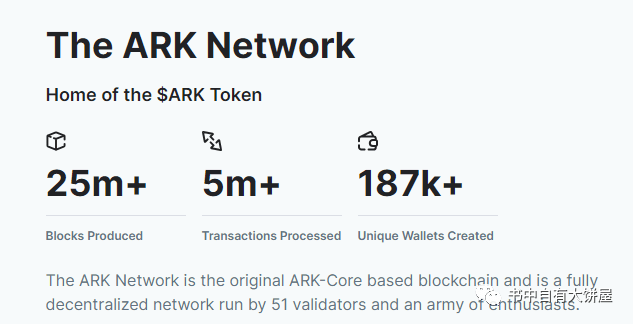
ARK uses an adjusted DPoS consensus mechanism. It is derived from Lisk, Crypti and BitShares, and has made a lot of improvements to the core code and the consensus algorithm of Delegated Proof of Stake (DPoS). The task of ARK nodes is to run the ARK blockchain network and get points rewards, just like Bitcoin miners. However, there are only 51 validators at present, which is relatively centralized.
3. Scalability
ARK’s main goal is to keep the core blockchain stable and evolving rapidly.
By using the custom SmartBridge feature, users can build hundreds of sidechains with non-essential functions. This allows for great scalability while keeping the main ARK blockchain accurate and fast.
4. Collaboration
ARK was not accomplished by one person, one team, or even one country.
ARK is a truly global collaborative effort made possible by the joint efforts of 14 core team members from 10 different countries and a growing number of community developers.
5. Bridging
ARK makes an interconnected blockchain ecosystem possible by using customized SmartBridge technology to bridge well-known blockchains. This is one of the main highlights of ARK.
6. Open Source
ARK’s ecosystem and projects are completely open source, helping users launch their own SmartBridge-compatible blocks as needed. Everything is hosted on GitHub for user convenience.
Token Allocation
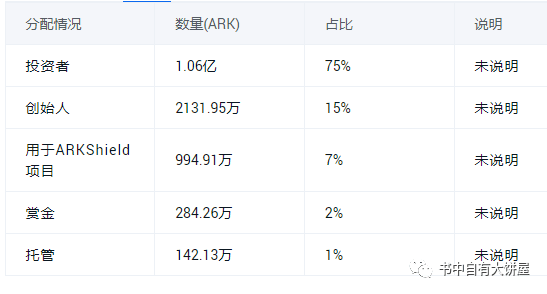
The first issuance time is 2017-05-24, with a maximum supply of 175,734,792 ARK. All of them are now in circulation, with a distribution of 15+7+1=23%. The team’s coin holding ratio is not very high. The current coin price is around 0.56, and the peak was $10.9149 (2018-01-08), so it has also fallen by 99% at present.
Then we are looking at the second project, a defi project, HIFI Fi finance.
Introduction
Hifi is a decentralized finance protocol that allows anyone to borrow their cryptocurrency, bringing fixed-rate, term loans to the Ethereum-based blockchain. HifiFinance (HIFI) is derived from Mainframe (MFT) token replacement, increment and brand upgrade, and is replaced according to the exchange ratio of 1MFT=0.01HIFI.
Hifi is a fixed-rate, term loan agreement based on a yield agreement document. The agreement is implemented in the Ethereum smart contract system.
Hifi was founded by Mick Hagen, an early adopter of blockchain technology. Hagen stepped down in early 2020 and was replaced by Doug Leonard, an avid NFT collector who famously funded his family's minivan with early crypto protocols. Leonard led Hifi's rebranding and pivot to decentralized finance.
Mortgage Program
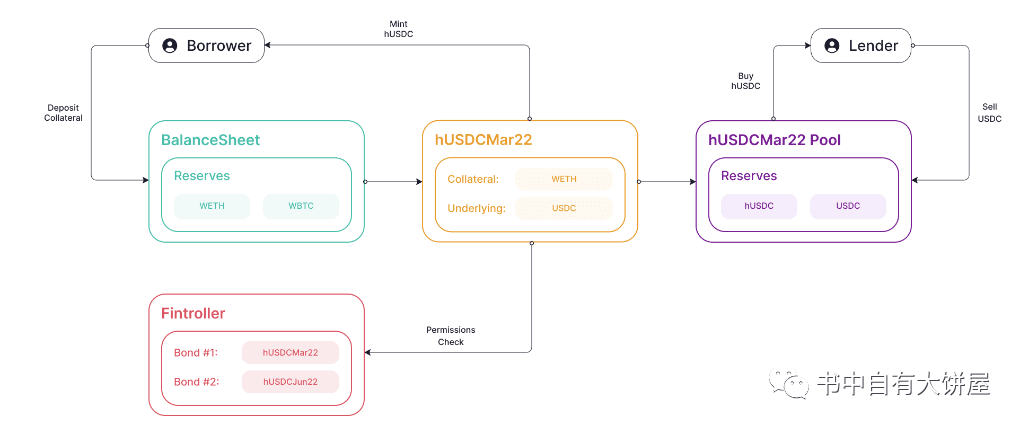
Take hToken with the symbol "hUSDC" as an example. This is a synthetic asset that tracks the USDC stablecoin. Borrowers mint hUSDC by depositing collateral, which can be any asset (such as ETH). Lenders sell USDC in exchange for hUSDC. Upon maturity, any holder of hUSDC can redeem the synthetic asset in exchange for USDC.
interest rate
Unlike most decentralized finance protocols, Hifi’s interest rates are not controlled by protocol developers. It is the open market that determines the interest rates paid or received by participants.
When an hToken is issued, we also create a Hifi pool for the hToken and the underlying. Anyone can provide liquidity to this pool and earn fees from transactions. The number of htokens bought or sold in the pool is used to calculate the effective interest rate.
Let's say you are interested in taking out a loan of 10,000 USDC on Hifi. You open the Hifi interface and you get a 5% interest rate quote. Assuming the expiration date is 1 year in the future, you will exchange 10,000 USDC for ~10,500 hUSDC at expiration. So if you hold hUSDC tokens for 1 year, you will be able to redeem 10,500 USDC.
Collateralization
Similar to other decentralized financial protocols, HiFi also has over-collateralization rules. That is, borrowers must obtain over-collateralization to mint htokens.
While well-known assets like ETH HiFi will use the industry standard of 125%, margin requirements for arbitrary collateral depend on several factors:
Mortgage asset quality
Market Conditions (Black Thursday Recall)
When the value of the borrower’s collateral falls below this collateral ratio, the account is said to be “insolvent” and can be liquidated.
To borrow, you need to deposit collateral in the protocol and withdraw new htokens based on the collateral. You can continue to sell htokens for the underlying token, locking in your borrowing rate. HiFi has a built-in automated market maker (AMM) that can effectively sell htokens.
At maturity, you must repay your debt to get your collateral back. Of course, you can also repay your debt early by returning the htokens you withdrew. Interest rate changes may affect (positively or negatively) the amount of borrowed assets you need to spend to get the htokens you need. Be careful when repaying early, as you may incur a higher interest rate than you would if you paid back at maturity.
Token Economy
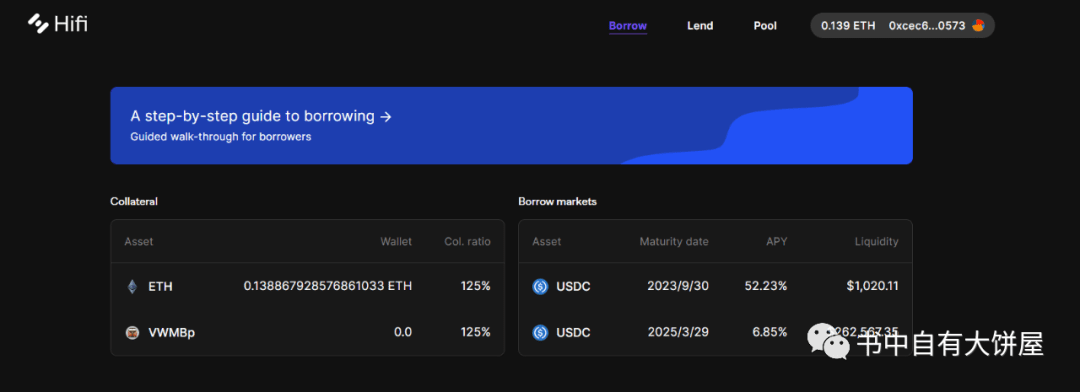
The current supply is 100,000,000 HIFI, and the specific distribution is not available. However, the money in the pool on the official website is very small, only 260,000 US dollars, which is not enough. With this amount, I really suspect that he has run away.
Finally, let's summarize. After looking at these two projects, we can see that their fundamentals are very poor. The first public chain has no innovation. The public chain projects we talked about before have more or less some innovations, but this one has none of them. There is no ecosystem. There is no dapp on the chain from 2017 to now, and there is no TVL on the chain. Think about what kind of project this is. Let alone the second DEFI. Just look at how much money is in the pool and then look at its market value. In fact, I saw the surge in HIFI last week, but there was too little content, so I left it there and didn't say anything. As a result, it fell this week. So it's the same with ARK. Short selling is over. So it seems that this video still has some value.