


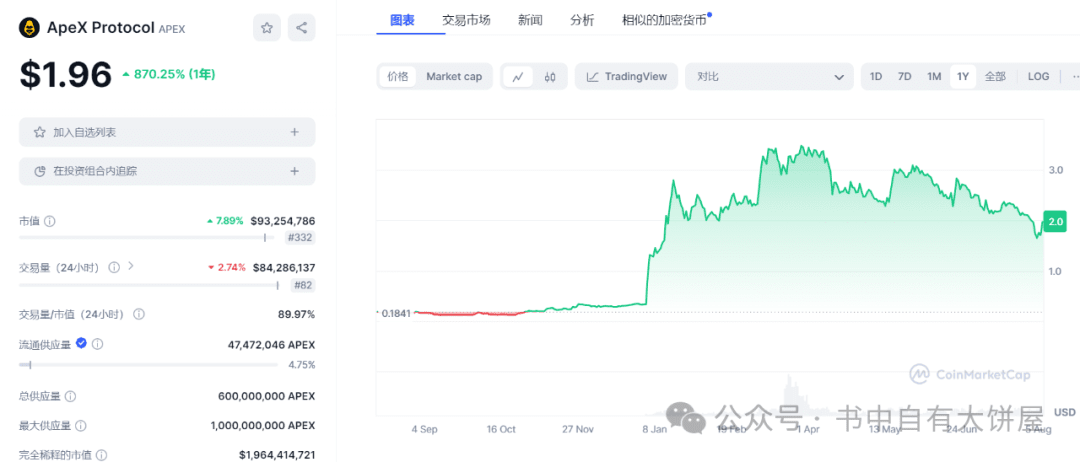
Today we continue to look at projects, also in the top 300 range. Since we have talked a lot about the 200-300 range, let’s first select some of the better projects in the 300 range. This project is also a DEX. It has increased almost 10 times in a year, and the current rebound is not bad. The market value of the project is only 93 million US dollars, and the fully unlocked market value is 1.9 billion.
1 Introduction
ApeX Protocol is a leading permissionless, non-custodial decentralized exchange (DEX) founded in 2022.
Its first product, ApeX Pro, facilitates decentralized derivatives trading through an order book model, provides perpetual contracts with cross-margin of USDC and USDT, and supports up to 50x leverage trading in more than 45 trading pairs.
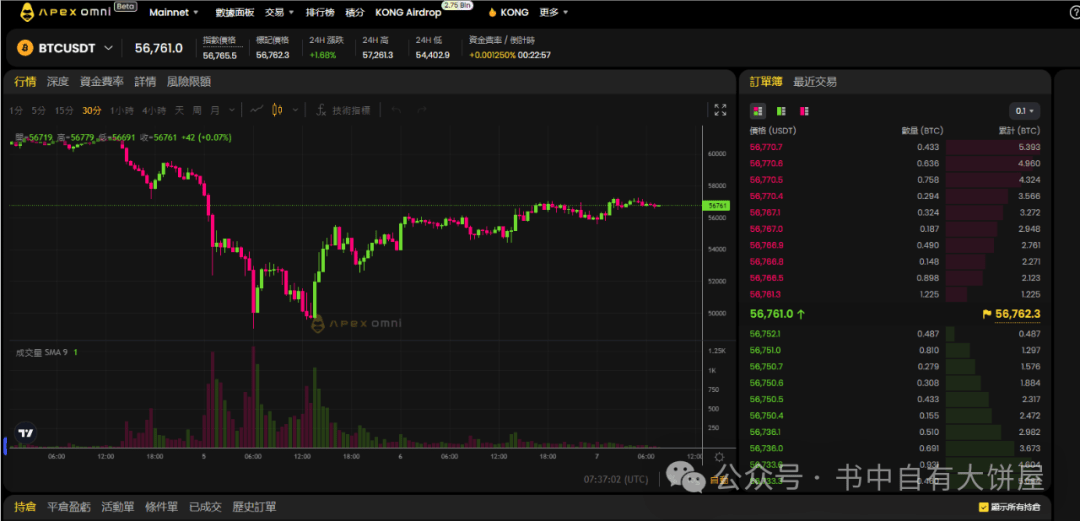
ApeX’s latest product, ApeX Omni, is a modular, intent-centric, and cross-chain agnostic DEX that aims to redefine the decentralized trading experience through an integrated multi-chain liquidity trading framework and enhance the DEX trading experience through its innovative features and powerful performance.
2. Product Matrix
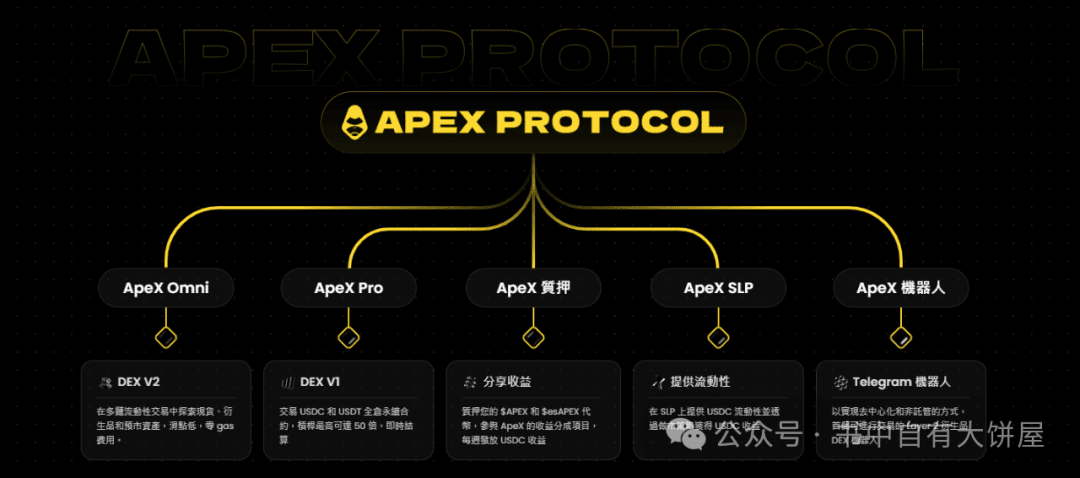
-Apex Omni: A multi-chain liquidity aggregation trading platform based on a modular, intent-centric architecture.
Perpetual contract trading with up to 100x leverage ensures high liquidity and low slippage. Enjoy zero gas fees, extremely low transaction fees, and ultra-fast transaction speeds of 10,000 transactions per second (TPS).
-Apex Pro: A non-custodial trading platform that provides unlimited cross-margin perpetual contracts (up to 50x) to its meta-community through a new social trading framework.
By integrating StarkWare’s Layer 2 scalability engine StarkEx and Validium, ApeX Pro offers cross-margin perpetual contracts with multi-chain support, low fees, deep liquidity, and the highest security.
-Apex Staking:
-ApexSLP:
-Apex Robot
3. Features
Permissionless: Users can create any trading pair without permission
Two-way Futures: Supports both forward and reverse contracts
eAMM: Elastic AMM, an AMM that only needs to provide one real asset as liquidity
PCV: Protocol Controlled Value
3.1 eAMM Mode
The underlying trading model of the ApeX protocol adopts the eAMM model, which is called the elastic automated market maker model.
Liquidity providers (LPs) do not need to provide two real assets to inject liquidity like Uniswap, but only need to inject a single real asset, which is also called the underlying asset, and the other asset is a virtual asset with elastic supply (for example, if you deposit WETH/USDT, you only need to deposit ETH, and USDT is automatically calculated).
In addition, eAMM is different from other AMM models in that it introduces a Rebase mechanism. When the price of the eAMM pool deviates greatly from the price of the external oracle, Rebase can be triggered, which will automatically increase or decrease the number of virtual assets in the eAMM pool to keep the price of eAMM consistent with the external market price. This mechanism will keep the price of eAMM and the external market price within a reasonable deviation range at all times, avoiding independent pin-in market conditions.
3.2 Perpetual Contract
The derivatives currently provided by the ApeX protocol are perpetual contracts, which support both forward contracts and reverse contracts. For example, for the trading pairs WETH/USDC and WBTC/USDC, if the margin is both USDC, it is a forward contract; if the margin is WETH and WBTC, it is a reverse contract.
Whether it is a forward contract or a reverse contract, any trading pair can be freely created by any user without permission, which is a feature that other derivatives protocols do not currently have.
In terms of the trading process, traders open long or short positions by recharging margin assets. At the underlying smart contract level, each account will only maintain one position in each trading pair, and can add or reduce margin for the position, increase or decrease positions, support full or partial closing, and even open reverse positions.
In addition, other derivatives trading protocols basically set a fixed maximum opening leverage multiple, so the maximum opening volume under the specified margin is also fixed. The maximum opening volume of the ApeX protocol is dynamically calculated, and its calculation formula is as follows:

Among them, the most critical factors are the opening margin rate and the depth of the pool. When the user's opening margin is relatively small compared to the depth of the pool, the maximum opening amount is mainly determined by the opening margin rate, which is equivalent to a fixed maximum opening multiple. As the user's opening margin increases, the second limit on the maximum opening amount will gradually increase, so that the user's actual leverage multiple will decrease as the amount of funds increases. This solution not only takes into account the security of positions, but also improves the utilization rate of funds.
3.3PCV
The ApeX protocol mainly realizes PCV (Protocol Control Value) through the Bonding mechanism. The basic principle is to capture users' real assets by selling discounted APEX (the governance token of the ApeX protocol) and inject the obtained assets into the eAMM to add liquidity. In this way, the liquidity is owned by the protocol, not the user.
Moreover, the liquidity controlled by the protocol itself can continuously earn transaction fees from eAMM, and the accumulated fees can be reinvested through different strategies to generate more returns.
4. Technical Architecture
In terms of technical implementation, the entire ApeX protocol can actually be divided into two major parts: the main protocol and the peripheral protocol. The main protocol implements the most core transaction functions, while the peripheral protocol includes several modules, mainly including Bonding, Staking and Referral.
The architecture diagram of the main protocol is as follows:
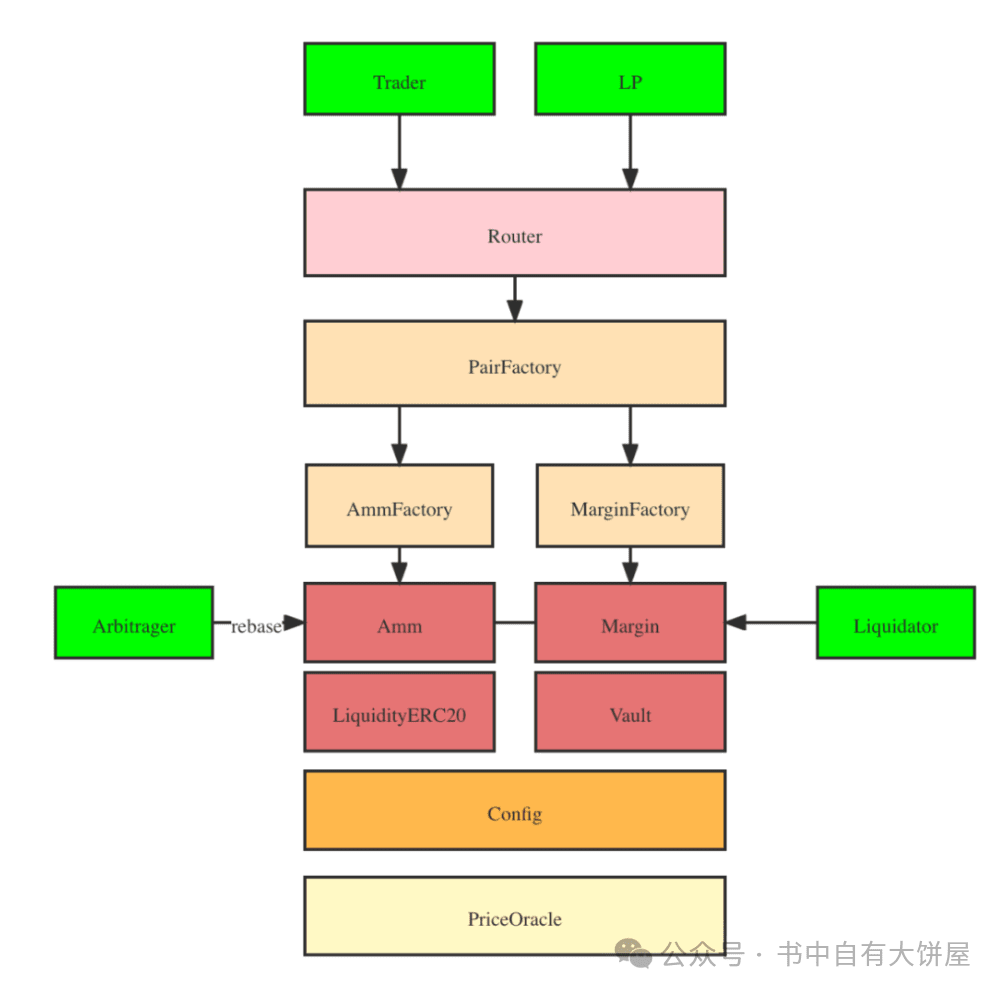
There are four main roles in the user group of the master agreement:
Trader: Traders are the main user group using the protocol.
LP: Liquidity Provider, liquidity provider, also the counterparty of Trader.
Liquidator: Liquidator, who can perform liquidation operations on positions that reach the liquidation threshold and receive liquidation incentives.
Arbitrager: When the internal price deviates greatly from the external oracle price, the market price can be adjusted through rebase.
The Master Agreement mainly includes the following contracts:
Router: The main entry point for Trader & LP to interact with the main protocol.
Factory: A contract used to create and query trading pairs. In order to avoid the problem of contract code exceeding the size in a single Factory, it is split into three contracts: PairFactory, AmmFactory, and MarginFactory.
Amm: Implements the underlying contract of eAMM. Each trading pair has an Amm contract instance. It also inherits LiquidityERC20, i.e., the LP Token contract.
Margin: The underlying contract that manages user positions. Each trading pair also has a Margin contract instance, which is bound to the Amm instance. It also inherits the Vault interface and manages real assets.
Config: manages all configuration parameters used by the main protocol.
PriceOracle: Price oracle contract.
Token Economy
APEX is a token that confers governance rights, while BANA is a trading-earning reward token on ApeX Pro.
There are 1 billion $APEX tokens in total, with a total supply of 600,000,000 and 47,472,046 in circulation. The current exchange rate is $1.9, and the peak was $3.8459 (2024-03-27). In terms of token distribution, 23% of the tokens are allocated to the core team and early investors, and the remaining 77% are used for participation rewards, ecosystem construction, and liquidity startup. Part of the APEX supply is used to create BANA, which is a reward token that supports the ApeX Pro trade-and-earn activity.
APEX holders enjoy the rights of governance, protocol incentives and staking. Through APEX, community members can control governance and protocol parameters.
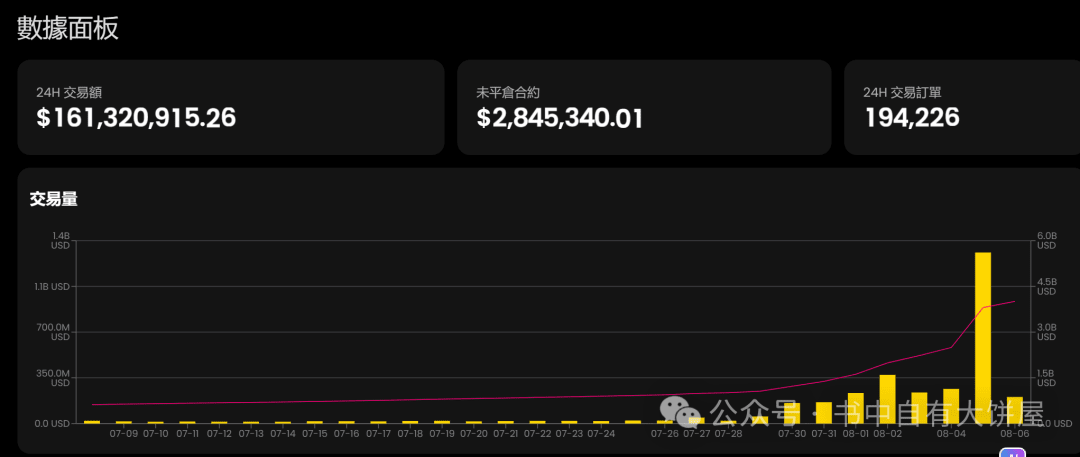
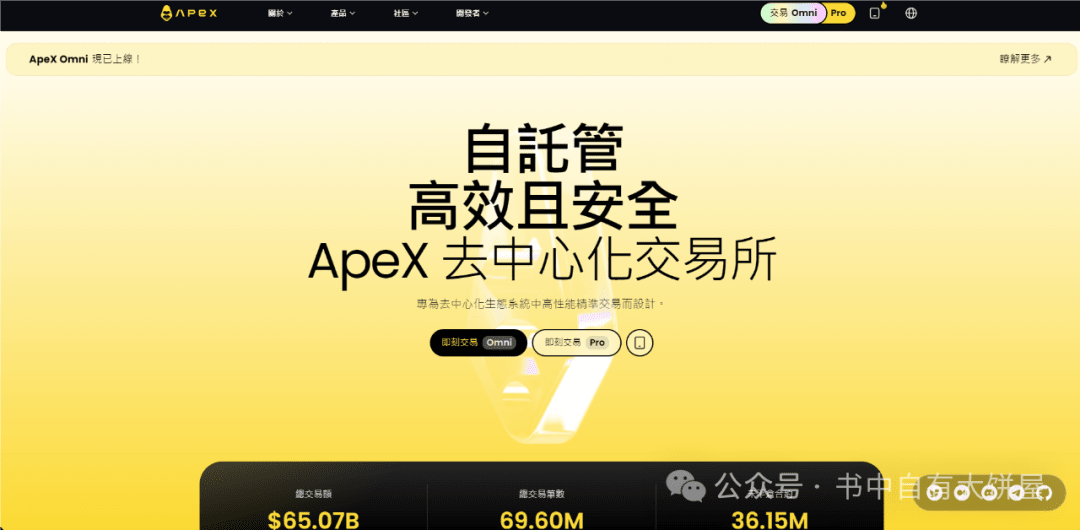
Finally, to summarize, this project is a perpetual contract DEX, with a current trading volume of 65 billion and 70 million transactions. If compared with the leading GMX, there is still a little gap. The current official website of GMX shows a trading volume of 200 billion and 630,000 users. GMX came out in 21 years, such as Apex, which was one year earlier, but the trading volume is 4 times higher. GMX’s current market value is 200 million US dollars, and Apex’s FDV is already 2 billion, so it is still a bit high at present, and there are still a lot of uncirculated, so the reasonable valuation should be lower. However, judging from the data board, especially in the past week, its trading volume has exploded. On August 5, the trading volume reached 1.3 billion, so we still look at it dynamically. If it continues to grow in the future, the threshold for purchase can be raised based on the data. For specific token strategies, we are still communicating with the planet and the fan group. #内容挖矿