


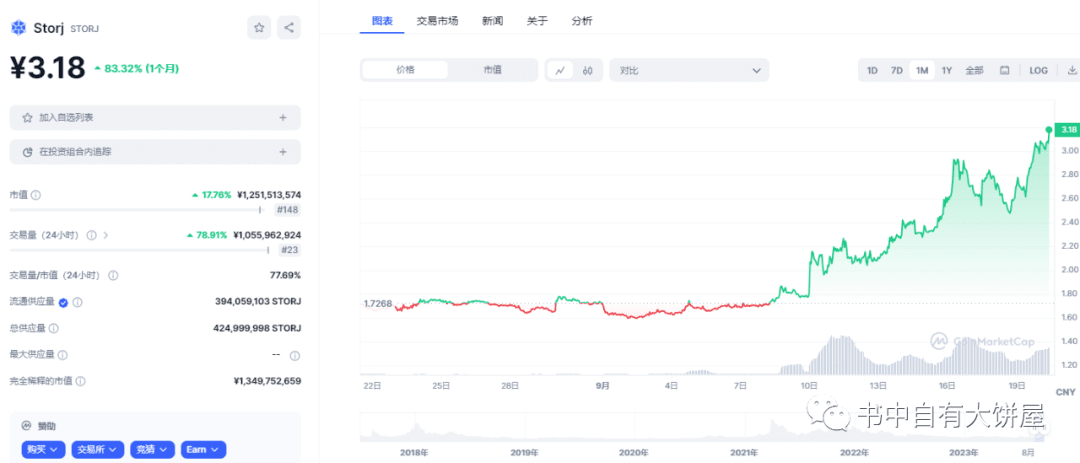
Today we are going to talk about two projects. Recently, the storage sector has been rising in rotation. In fact, we have talked about two storage projects before. One is the king Fil, and the other is the upstart AR. In fact, these two projects are very strong and have their own characteristics. The two projects we are talking about today are BLZ and StorJ. Recently, BLZ has doubled in a month, and StorJ has also doubled. The current market value of BLZ is 80 million US dollars, and the market value is about 200+. The market value of StorJ is 120 million US dollars, ranking around 150+, and the market value is similar.

Let’s talk about Bluzelle first.
Introduction
Bluzelle is a scalable decentralized database service platform based on user needs. It targets small and medium-sized software developers as its target customers and aims to provide them with enterprise-level database management services that are low-cost, fast to deploy, and fast to run. Bluzelle encourages users to rent and share their resources to build a decentralized digital economic database network. BLZ supports users to conduct transactions outside the Bluzelle Networks system and can purchase BLZ tokens through Bitcoin, Ethereum and other digital currencies. It is also built on Cosmos.
Bluzelle provides high security, unparalleled usability, and is censorship-resistant. Whether you are an artist, musician, scientist, publisher, or developer, Bluzelle protects the intellectual property of all creators. Bluzelle is data storage, file storage, oracle, and more. It is specific to NFTs and DeFi.
Bluzelle’s core products are all data-related and powered by its Tendermint blockchain:
Bluzelle DB - A decentralized database for software developers to store information
Bluzelle Oracle - A truly decentralized pricing oracle that provides high speed and security for Defi applications
Bluzelle Staking — BLZ holders can currently stake their tokens here and earn rewards for providing storage and pricing data.
Bluzelle adopts blockchain principles and the concepts of sharding and par22oning to create an AirBnB-like data storage and management market. This is a crypto-economic network composed of powerful producers and consumers.
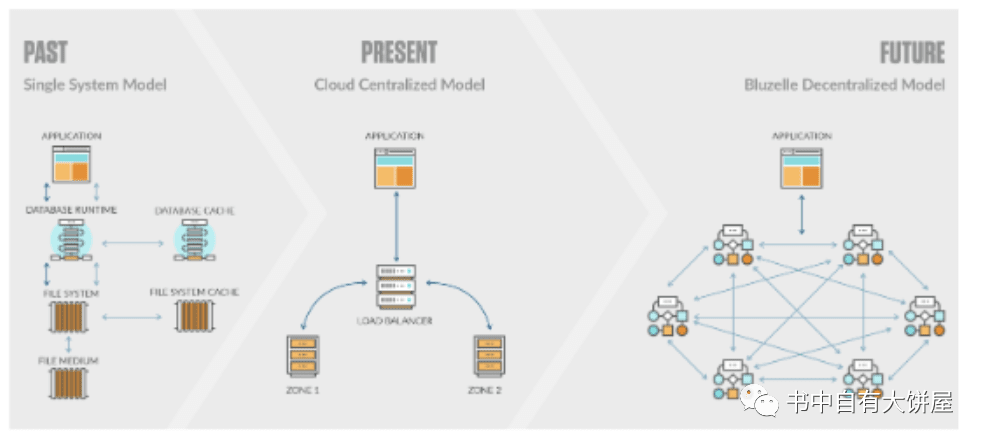
Bluzelle Features
performance:
Bluzelle's unique and proprietary clustering technology is designed to achieve the highest performance of the system. Bluzelle can reduce latency by retrieving data from the closest node in the leaf cluster, and greatly increase speed by retrieving data in parallel with the fastest node in the leaf cluster. This is like torrents and seeds. Since the process of requesting data and requesting data shards from all different clusters containing these shards is parallel, and these shard retrieval requests are all parallel, the performance indicators can meet the required requirements. Currently, its TPS can reach 10,000, but this is only stated on its official website and has not been actually tested.
reliability:
Using the concept of fog algorithm or swarm algorithm, Bluzelle follows a model where each unit’s data is 100% replicated to the leaves of the cluster. Therefore, although the data is only in one cluster, the cluster is protected from local outages caused by natural or human-related events because the nodes are many and geographically dispersed.
Scalability:
Bluzelle databases are scalable both horizontally and vertically. Bluzelle manages the various strategies and considerations for each use case that requires scalability. Horizontal scalability is the cornerstone of Bluzelle architecture, and each cluster is another "unit" of horizontal scalability at the larger cluster level. In each leaf cluster, each node becomes another agent for horizontal scalability at the leaf cluster level.
Token Allocation
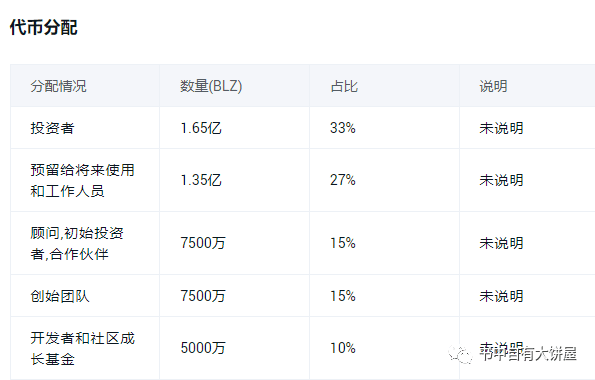
The total amount is 500,000,000 BLZ, and the circulation volume is 413,903,757 BLZ. Currently, 72% is in circulation. The current price is 0.21 US dollars. The peak was 0.9 US dollars in 2018. The project was launched in 2018, and it has been more than 5 years since then. The team has taken a relatively high proportion of 27+15=42%.
About StorJ
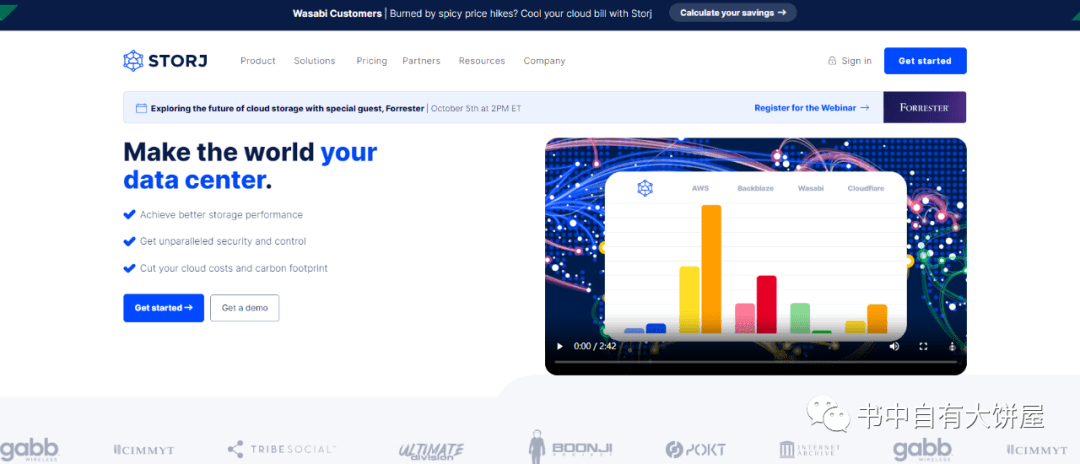
Storj (abbreviated as STORJ) is a decentralized, encrypted cloud storage system based on blockchain and secure network technology. It is a decentralized storage application that distributes files among a large number of trusted storage systems, each of which has an encryption mechanism. Since there is no central server, Storj is more secure than other cloud storages, and there is no single point of failure, which can resist security attacks. Fortunately, Storj also provides very cheap services; like a one-time rental on-demand cloud, such as Amazon's EC2, EBS, RDS, etc.
Business Introduction
Unlike other decentralized storage networks, the Storj network not only has users and storage nodes, but also adds satellites as a third role, forming an independent yet interdependent relationship between the three.
User: Use Uplink client to transmit content. Uplink is responsible for data encryption/decryption and fragmentation.
Satellite: Connects users and storage nodes, and is a coordinator in the network. It is responsible for storing node address information, metadata, maintaining node reputation, paying and managing node fees, auditing nodes, and managing user account authorization. Satellite will help users find the node with the fastest upload speed, and record the expenditure and income of the user end and the node.
Storage nodes: provide storage space and network bandwidth for users.
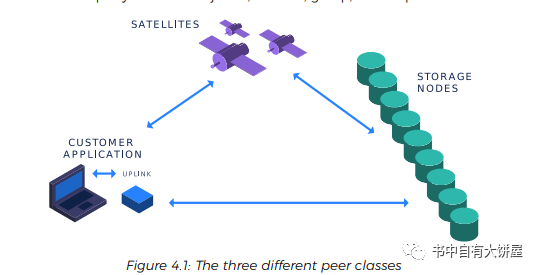
Between users, satellites, and storage nodes, Storj's technical architecture mainly revolves around data storage, data retrieval, and data repair. In order to maintain the normal operation of the system, data auditing and reputation management of satellites and storage nodes are also designed.
data storage
There are currently two main methods for storing data: storing complete files and using erasure codes.
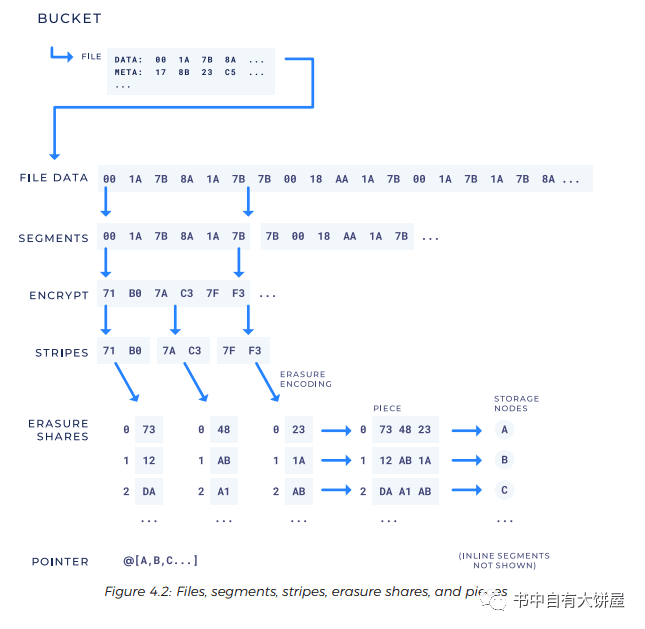
Storj uses erasure coding. In erasure coding, data is broken down into fixed-size fragments, each of which is expanded and encoded with redundant data. The redundant data saved in each fragment makes it possible to reconstruct the original file with only a subset of the fragments.
This means that in the Storj network, when a file is transferred, it is not transferred all at once, but the file is broken down into smaller data unit structures such as segments and stripes, and the transfer is verified one by one. This split transfer ensures that the storage node cannot go offline to avoid receiving and storing the complete file.
The following are the data units defined by Storj for data sharding:
Bucket is a collection of files identified by a path. Each file has a unique path in each bucket.
Segmenet, which represents a single array of bytes, between 0 and a user-configurable maximum segment size.
Strips, a stripe is a further subdivision of a segment, a stripe is a fixed number of bytes used as the boundary size for encryption and erasure coding. Erasure coding occurs solely in stripes, and stripes are also the unit for performing audits.
Erasure Share, when a stripe is erasure coded, multiple segments called erasure shares are generated. Only a subset of the erasure shares is needed to restore the original stripe. Each erasure share has an index that identifies which erasure share it is.
Piece: The erase shares with the same index of the same segment are connected in series. This group of connected erase shares is called a piece.
Pointer: A pointer is a data structure that may contain inline segment data and may track the storage node that stores the fragment of a remote segment.
Data Retrieval
After using erasure codes to shard stored data onto different storage nodes, the stored data needs to be tracked so that it can be quickly located when needed.
In the Storj network, satellites are used to manage and track the location of data storage. After the data is erased, a pointer is formed. The other individual components of the Storj network mainly communicate with the pointer database to store and retrieve pointers by path to perform actions. Pointers are the main storage content in the metadata storage system, and metadata is stored in satellites.
Data Audit
Storj is a trustless system, and verifying that storage nodes are storing data accurately and that other aspects of their behavior are as expected is critical to the smooth operation of the system.
Each network has its own unique method for proving how data is stored, and auditing is a way to confirm that storage nodes own the data.
In Storj, Satellites are responsible for auditing. Satellites send requests to storage nodes to prove that it actually stores the expected data and expect a valid response. When enough storage nodes return the correct information, any problematic or missing responses can be easily identified.
Compared to other systems that use more retrievable proofs (such as Merkle trees), the advantage of auditing is that it can be run arbitrarily without pre-generated challenges, which can cause storage nodes to commit fraud by not storing all requested data, only the data needed for challenge verification.
Data repair
Data loss is an ever-present risk in any distributed storage system. While there are many potential reasons for file loss, Storj believes that storage node churn will be the leading cause of data loss in its network compared to other causes.
Since the audit has verified that the node is storing the data correctly, the next step is to detect the point in time when a storage node leaves the network or stores data incorrectly, and then repair its data to a new node. To repair the data, the original data is recovered from the remaining pieces through coding erasure, and then the lost data pieces are regenerated and stored in new storage nodes in the network.
Reputation Management
As a coordinator in the system, the satellite needs to be reviewed by the storage nodes. When a new satellite joins, the storage node needs time to build trust in it. For untrusted satellites, the storage node can set a maximum storage limit for data from the satellite. In addition, Storj Labs will establish a list of recommended satellites. The satellites on this list will be required to comply with a set of strict quality control and payment service level agreements (SLAs) and sign a business agreement with Storj Labs.
The reputation management for storage nodes consists of four parts:
Proof-of-Work (PoW) identity system: For a storage node to enter the network and communicate with the satellite, it must pass a PoW puzzle to prove that the node operator has an investment cost. The difficulty of the puzzle is set by the satellite.
Audit process: Unaudited storage nodes will be treated as candidate nodes, but are also allowed to store data.
Screening system: Nodes that fail audits, cannot return data, are too slow, or do not have enough uptime are disqualified by Satellite and will restart the audit process to re-enter the network.
Preference system: Based on the latency, reliability, uptime history, geographic location and other characteristics of the storage node, the better performing nodes will be able to store more new data.
Storj is a trustless system, essentially a reputation-based decentralized storage network.
Pricing and Payment
Between users, satellites, and storage nodes, users pay fees to satellites through Uplink, satellites are responsible for paying storage and bandwidth fees to storage nodes, and storage nodes are responsible for providing storage and retrieval requirements.
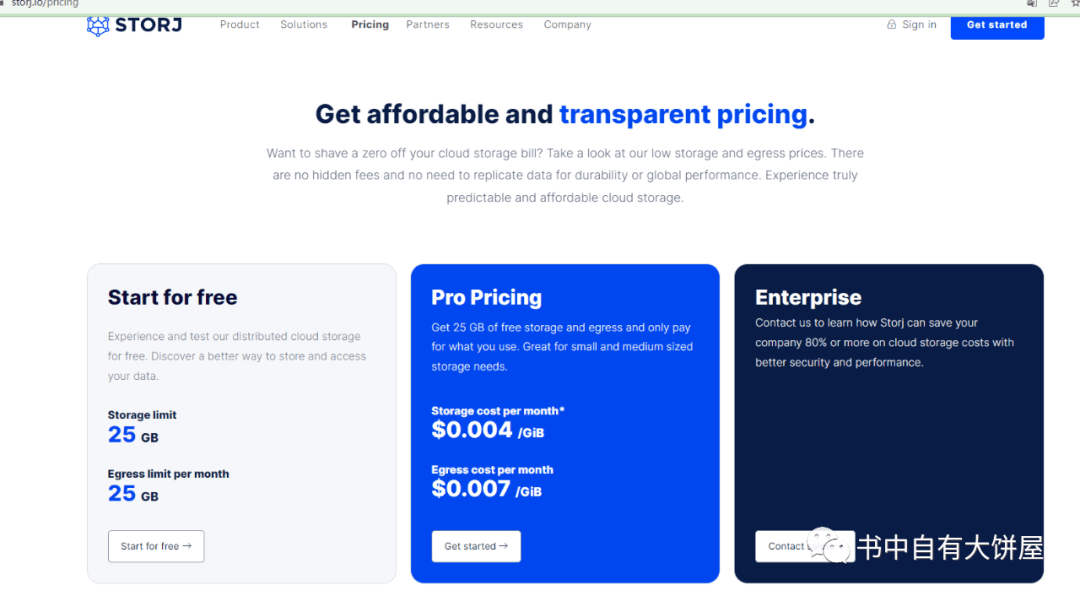
For storage nodes, the fee is set by Storj and paid by Satellite in Storj tokens. Storage fee is $1.5/TB/month, output bandwidth is $20/TB, and bandwidth fee for data audit and repair is $10/TB.
For users, the cost of using Storj consists of storage fees and bandwidth fees, and users can choose to pay in Storj tokens or fiat currency. Users can get 150GB/month of free storage and bandwidth services from Storj; or choose a paid account with a storage fee of $4/TB/month and a bandwidth fee of $7/TB/month.
However, the user's cost and the storage node's revenue are not equal.
As a public network, storage nodes can choose to leave or stay. In order to keep the nodes active for a long time and provide higher bandwidth, Storj withholds a certain amount of income. The withheld portion gradually decreases with the length of time the node is active in the network.
Months 1-3: 75% of revenue is withheld, 25% is paid to node operators
Months 4-6: 50% of revenue is withheld, 50% is paid to node operators
Months 7-9: 25% of revenue is withheld, 75% is paid to node operators
Months 10-15: 100% of storage node revenue is paid to node operators
After 15 months, 50% of the previously withheld funds will be refunded; when the storage node wants to leave the network permanently, it can request a refund of the other 50% of the withheld funds.
Business Features
Compatible with AWS S3
Currently, the most widely deployed public cloud is AWS S3, which has a complete ecological service system and first-mover advantage. As a benchmark business of S3, Storj is designed to be compatible with S3 and supports S3's 7 core APIs. This compatibility greatly reduces the transfer cost for Storj users.
In order to attract more users, Storj allows products that were previously incompatible with S3 to be compatible with S3 through Storj with minimal friction cost; at the same time, this also increases the requirements for Storj's performance and durability.
Token Allocation
STORJ is a token based on the Ethereum network, with a fixed total supply of 425 million. Currently, there are 394,059,103 STORJ in circulation, which is 98% of the total. The current price is $0.4. In March 21, it reached a high of $3.8, so it has fallen by more than 90%. This project was launched as early as 2017. As for the token distribution, it is indeed not queried, which is not good.
Finally, let's summarize these two projects. The first one is BLZ, which is a relatively standard project. It can be said that there is basically no innovation. It is currently the one with the lowest market value among these storage projects. The second one, StorJ, is still innovative, such as using satellites as third-party storage. It is better than BLZ in terms of fundamentals. Compared with the big brother FIL and the second AR, it is still a little bit worse. However, the storage track is definitely very important in WEB3, and there are not many players in the storage track at present. Look at how many public chains have come out, there are hundreds of them, but there are only a few storages at present, so as long as web3 can prosper in the future, these storages will explode, without a doubt.