

Author: Yin Ning, Gyro Finance
The crypto fire in Hong Kong was still in its infancy when a bucket of cold water was poured on it.
On September 13, the Hong Kong Securities and Futures Commission rarely named a virtual asset platform JPEX. This is also the first virtual asset exchange to receive a red card warning since the new Hong Kong encryption regulations.
According to the SFC’s website, JPEX actively promoted its services and products to the Hong Kong public through social media influencers and over-the-counter virtual asset currency exchange dealers. None of the entities under the JPEX Group are licensed by the SFC and have not applied for a license from the SFC to operate a virtual asset trading platform in Hong Kong.
In response to this naming, JPEX stated in its official website on the same day that "We have been unfairly suppressed by the SFC, causing us to consider withdrawing our license application in Hong Kong and adjusting our future policy development accordingly. The SFC should also bear full responsibility for undermining the development prospects of cryptocurrencies in Hong Kong." From the attitude, JPEX obviously expressed its dissatisfaction, believing that there are countless institutions claiming to have applied for exchange licenses, and being announced can only prove the discrimination of the SFC, and the last sentence is even more arrogant and indirect.
What’s even funnier is that despite the tough response, the JPEX booth at the Token2049 event held that day was already deserted. A booth costs at least 10,000 U in booth fees. It’s clear that they would rather abandon the booth and run away, showing how panicked they are.
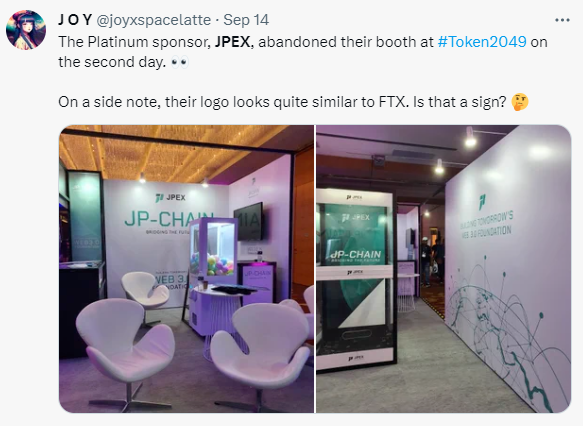
JPEX ran away in a hurry at Tokens2049, source JOY @ joyxspacelatte
After that, the course of events became increasingly bizarre.
On September 14, a screenshot of a withdrawal went viral in multiple crypto communities. A KOL withdrew 1,000 U from JPEX but only received 1 U, with a handling fee of 999 U, so he angrily called it a "fake exchange" on Twitter. JPEX responded again, blaming the CSRC's criticism of it, saying that it was "forced" to adjust the USDT handling fee in the early morning of the 14th due to the statement. The statement undoubtedly caused heated discussions on Twitter, and the industry continued to abuse and discuss.
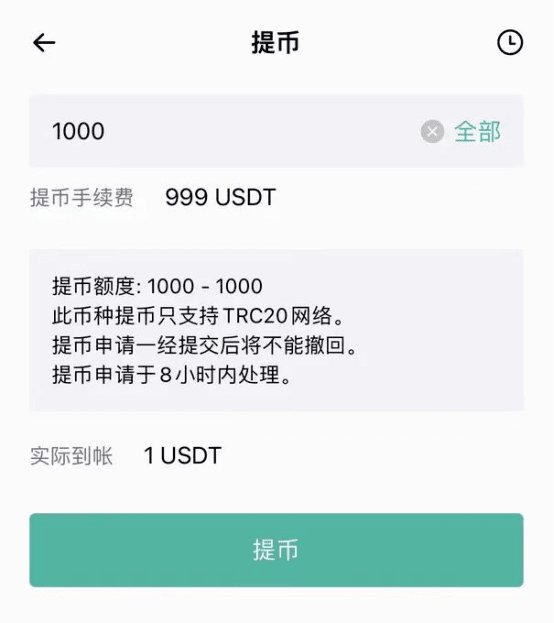
Withdrawal screenshot, source: KillTheWolf@killthewolf.eth
After withdrawing funds from the withdrawal address given in the subsequent statement, the amount received increased to 20U, showing a rogue attitude of "you can obviously grab it, but you have to take it reasonably". At present, the exchange has been unable to withdraw funds, and the police have intervened in the investigation. The influencers involved in the promotion have also been affected. According to the police, as of 22:00 on the evening of the 18th, a total of 1,641 people reported the relevant incidents, involving an amount of about 1.2 billion yuan, and the investor with the largest amount of money invested up to 40 million yuan.
At this point, the crusade against JPEX has affected the entire crypto industry in Hong Kong and Taiwan.
01 Is there not a single true statement in the description on JPEX’s official website?
What kind of exchange could be so shameless and stubborn? With this question in mind, the author collected information from various sources to investigate JPEX, which revealed an even more surprising scam.
In fact, Hong Kong people are no strangers to JPEX, and the exchange's promotional posters are all over major streets in Hong Kong. From the official website promotional page, JPEX Exchange's operating headquarters is in Dubai, and it has been focusing on serving the Asia-Pacific region for 20 years. It claims to have obtained the Canadian MSB Fintrac license, the Australian ASIC license, and the MSB financial license issued by the US FinCEN.
But back to reality, the actual situation is quite different from the introduction. JPEX changed its name to JPEX Green Stone Exchange this year and officially entered Hong Kong in 21 years, mainly through large-scale promotion by Internet celebrities + OTC. At the beginning of its entry into Hong Kong, it deliberately touched the Japanese crypto exchange JPX and hyped it as a famous Japanese exchange, forcing JPX to personally clarify on February 8, 2022 that similar names have nothing to do with the subject. After the clarification, JPEX responded as always that the company has no relationship with JPX, but even if you search for the exchange on Baidu now, there are still words such as Japanese exchange and Singapore headquarters associated with it.
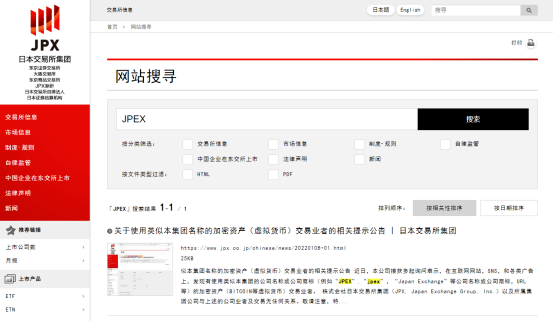
JPX Japan Exchange clarifies that it has nothing to do with JPEX, source: JPX official website
This is obviously not the only time that JPEX has committed malicious fraud. In early 2022, JPEX established a partnership with Simplex and announced the launch of a VISA card in the fourth quarter. JPEX refused to give up the opportunity to hype itself up and promoted it on a large scale in the name of VISA cooperation. VISA was naturally not happy about this. After issuing a negotiation notice, JPEX immediately apologized and made excuses, saying that it planned to cooperate with VISA's card issuing institutions to issue cards, not directly with VISA, and put the blame on the advertising contractor for the erroneous promotion. However, on the official website, JPEX still has a VISA cooperation promotion page, with an attitude of admitting mistakes and doing it again next time.
The licenses it claims to have obtained are even more suspicious. According to "Hong Kong 01", after investigations at multinational company registries, it was found that JPEX's registrations in various places were suspected to be "dummy" registrations. The platform has been registered since 2020 and has been in operation since 2021. The actual person in charge and office locations in many countries around the world have never been made public. From the perspective of registered companies, except that the director of JPEX Technical Support is Guo Haolin, no clues about the founder have been dug up. It is rumored online that the founder is "Coin Master" Huang Zhengjie, but there is no evidence. And it has successively cooperated with two listed companies, Tiangong Holdings (0428) and hmvod Video (8103), which also makes people wonder whether there is a capital injection background from listed companies. However, in April this year, both listed companies announced the suspension of the exchange's memorandum of understanding cooperation.
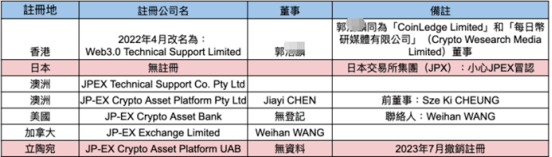
JPEX registration status in various regions, source: Hong Kong 01
The only offline location was deserted again. According to Hofeng Logistics, JPEX rented the 2nd to 6th floor, 10th floor and the exterior wall advertisements of Building 7 in the Asia Blockchain Building. Currently, all personnel have moved out maliciously. The registered place is not even public, and the license obtained can only be more ridiculous. As expected, when I searched for JPEX on the official website of the Financial Crimes Enforcement Network (FinCEN), there were no results. It is quite interesting that after the company withdrew, the beverage company Chunbai accused it of defaulting on 1,000 drinks. It is hard not to sigh that JPEX is so deep that it does not let go of retail investors, landlords, and even neighbors.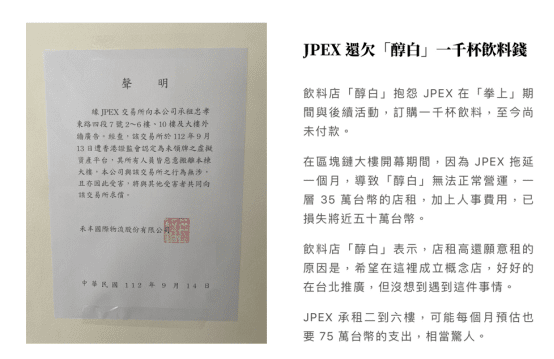
Source: MichaelTurtle @shawnchen_eth, Steward @ZStewardZ
02 Why is JPEX so popular?
How can such an exchange that is full of lies continue to operate and even appear on the streets under the name of "Hong Kong's largest exchange"?
In terms of current regulations in Hong Kong, although the Securities and Futures Commission has been monitoring the issue of unlicensed operations, it must collect evidence to prove that the platform is operating a business before it can intervene. Therefore, the marketing and promotion of the platform has not been banned.
On the other hand, JPEX hired a large number of Internet celebrities and celebrities from the entertainment industry to endorse JPEX through large dividends and publicity fees. Celebrities who have endorsed or promoted JPEX include Hong Kong male artist Zhang Zhilin, Taiwanese singer Chen Lingjiu, Hong Kong model Zhuang Simin, Hong Kong Internet celebrity "Coin Master" Huang Zhengjie, Hong Kong rich second generation Lin Zuo, Toyz, Fat Mama, Chen Dingbang, etc.

JPEX former spokesperson Chen Lingjiu, source: Hong Kong Wen Wei Po
After the incident, many artists spoke out on official channels to sever ties with JPEX. Zhang Zhilin said that he had already notified JPEX in writing in May that his image could not be used for publicity before obtaining a license. Spokesperson Chen Lingjiu claimed that he had already ended the endorsement in July this year, but according to people familiar with the matter, he brought his pet to visit the Asia Blockchain Building where JPEX is located on August 20.
In order to quickly attract traffic, JPEX also launched a partnership system to recruit partners with high commissions. The terms show that if 1,000 people are invited to join as JPEX customers, and the average assets invited within 30 days reach 10 million USDT, the partner will receive a monthly reward of 6,000 USDT, equivalent to 47,000 Hong Kong dollars. In April this year, JPEX upgraded the system again, stating that "the rebate can be up to 100,000 USDT", equivalent to 780,000 Hong Kong dollars. People familiar with the matter revealed that one of the partners of JPEX was Kebituo, who had a history of openly selling exchange KYC.
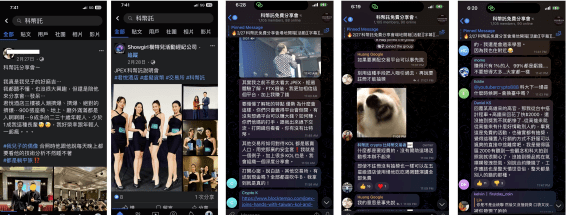
Kebitu is one of the partners of JPEX, source: Raysky @ rayskyinvest
The exchange has already possessed the basic elements of pyramid schemes by creating profits out of thin air by inviting people to participate in the profit sharing. Looking at the products of the exchange, it can be described as illegal written on the public screen. Not only can the exchange obtain rebates by attracting people to participate in the profit sharing, but the annualized rate of return is as high as an outrageous 13 times. The exchange's active interest financial management even reaches 20%, which is comparable to the previous Luna explosion.
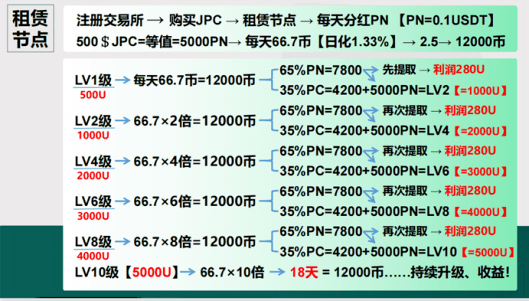
JPEX is suspected of being a pyramid scheme, source: Beike complaint
Tracking the trend of its platform currency JPC, the JPEX platform shows that its 24-hour trading volume is as high as 189 million US dollars, but the data on Coinmarketcap is only 230,000 US dollars, and the trading situation is clearly visible. On the other hand, JPEX does not set a funding rate for perpetual contracts. Such an exchange that does not conform to trading common sense can still be retained and developed to such a scale, which also makes many old crypto circles amazed.
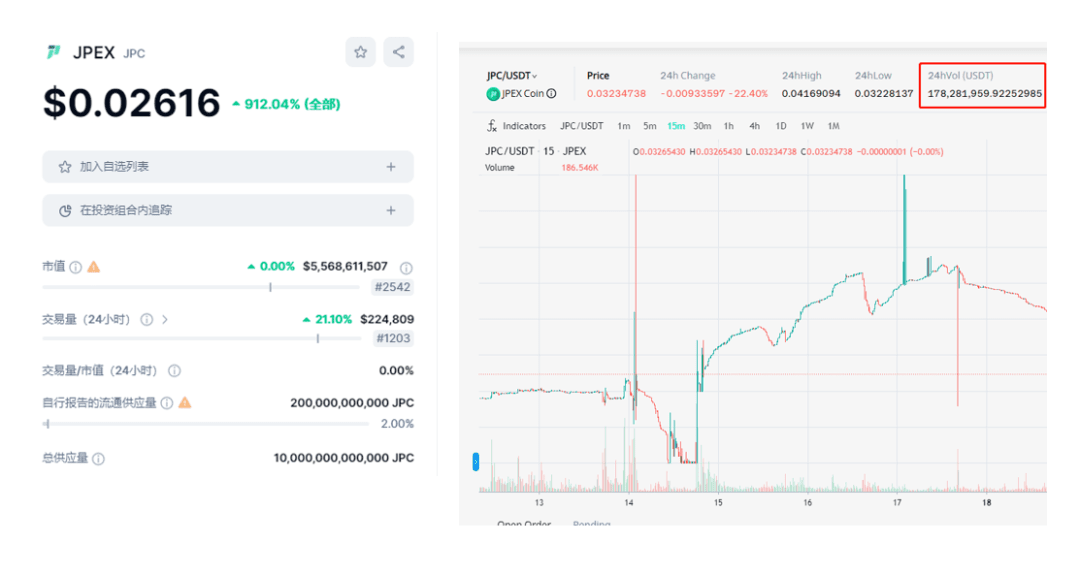
Comparison of JPC data on Coinmarketcap (front) and JPEX exchange (back)
Despite the many doubts, many retail investors still invested money in it under the temptation of visible publicity and high interest rates, which made them the main group of people injured in the incident. As early as June, JPEX had a criminal record. According to an exposé, in June, JPEX announced the details of the smart contract issuing boxing rewards in "The Cage 2023 Final Battle", and the on-chain data showed that it misappropriated 390,000 USDT of customer assets. Netizens commented, "Take it from the households and use it for the people."
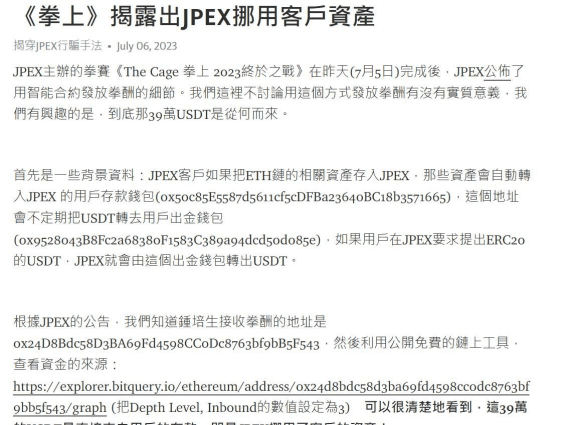
Previously, there was a report that JPEX misappropriated customer funds, from Raysky @ rayskyinvest
On September 18, Hong Kong Legislative Council member Wu Jiezhuang revealed that he has received help from about 30 victims, and the amount of money lost by each person is different. Some are six figures, and some are seven figures. It is estimated that the total amount involved is more than 100 million Hong Kong dollars. The previously promoted Internet celebrities were not spared. In the self-exposure incident promoted on Youtube, Zhuang Simin lost about 500,000 yuan; Toyz, who had received sponsorship fees from JPEX, also lost more than 100,000 US dollars. In the program, he said that the transaction volume of JPC was questionable, the interest rate was extremely high, and NFT was not on the blockchain.
03 What is the impact of the JPEX incident?
Looking at the entire incident, the incident caused by JPEX was not surprising to industry insiders who have experienced the ups and downs of the cryptocurrency circle, but the real victims were the crypto circle in its infancy in Hong Kong.
Since the new regulations were announced in June, Hong Kong has been making frequent moves. From the Chief Executive, legislators to the grassroots, all have issued statements in support of Web3, and legislators have publicly stated their support for compliant exchanges to develop in Hong Kong. It is precisely in this bright state that dark corners have emerged. JPEX took advantage of the policy to promote itself, blinding many investors.
According to Hong Kong Wen Wei Po, both in Hong Kong and the mainland, there are people who are involved in the large-scale publicity and who firmly believe in Hong Kong's regulatory policies. Some mainland investors said that because they had confidence in Hong Kong's financial regulations, they did not believe that Hong Kong regulators would allow unlicensed trading platforms to exist. In addition, there were no problems with "withdrawing funds" on the platform for the first time, so they were confident that their investment exceeded One million Hong Kong dollars. The incident collapsed before it was accomplished. This incident will undoubtedly affect the confidence of mainland investors in investing in Hong Kong.
Hong Kong clearly attaches great importance to this. On September 18, Hong Kong Legislative Council member Wu Jiezhuang held a separate press conference to respond to the suspected fraud incident of the virtual asset trading platform JPEX, saying that the incident had a great impact on the development of virtual assets in Hong Kong and the government should do more to protect small investors. On September 19, Hong Kong Chief Executive John Lee said that this incident reflects the importance of supervision, including the importance of investing in regulated and licensed trading platforms and the importance of personal understanding of virtual assets and related risks. He emphasized that the current licensing system is to protect investors, the SFC will monitor changes in the market to ensure that investors' interests are fully protected, and the authorities will also vigorously promote investor education.
Although the new regulations have tightened the supervision of virtual currencies, only OSL and Hashkey, two licensed exchanges, are supervised by the SFC and can guarantee that even if they go bankrupt, customer funds can be compensated up to 500,000 yuan. JPEX is not on the licensed list and is not supervised by the SFC, so it can only be investigated by the Hong Kong police for fraud. From the perspective of civil claims, since it is difficult to grasp the legal entity of JPEX and users are unsecured creditors, the priority of asset distribution during liquidation is after secured creditors, liquidation expenses, priority payments and floating mortgagees. In this argument, it seems difficult to recover customer capital. According to the latest disclosure by the police, the assets involved in the case have reached 1.2 billion yuan.
In this regard, another partner who is deeply involved in the case, Lin Zuo, seems to have foreseen it. On the 17th, he repeatedly dissuaded users from reporting the case in the fan group, saying that it would not be fruitful, and told users not to have illusions about getting their funds back. At present, according to the latest news from the Acting Chief Inspector of the Commercial Crime Bureau of Hong Kong, Mak Wai-kwong, at the case briefing, Lin Zuo and eight other people involved in the case have been arrested by the police. The JPEX crackdown operation has seized 8 million yuan in cash, and has frozen more than 12 million yuan in bank deposits and 44 million yuan in properties.
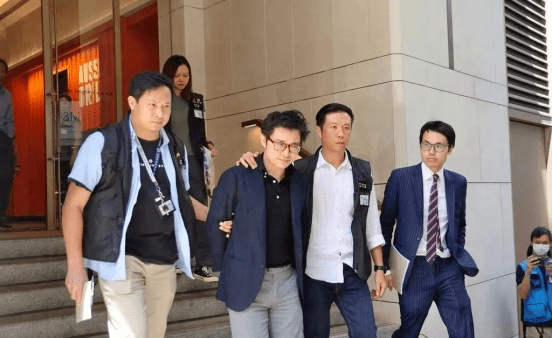
The person involved, Lin Zuo, was arrested. Source: Hong Kong Wen Wei Po
Even so, JPEX still did not change its bad habits. In its recent response, JPEX repeatedly emphasized the unfair treatment of relevant Hong Kong institutions, pointed out that this caused market makers to maliciously freeze funds, and said that it would "continue to operate unswervingly." In order to circumvent supervision, it has removed trading products involving financial management on the 18th.
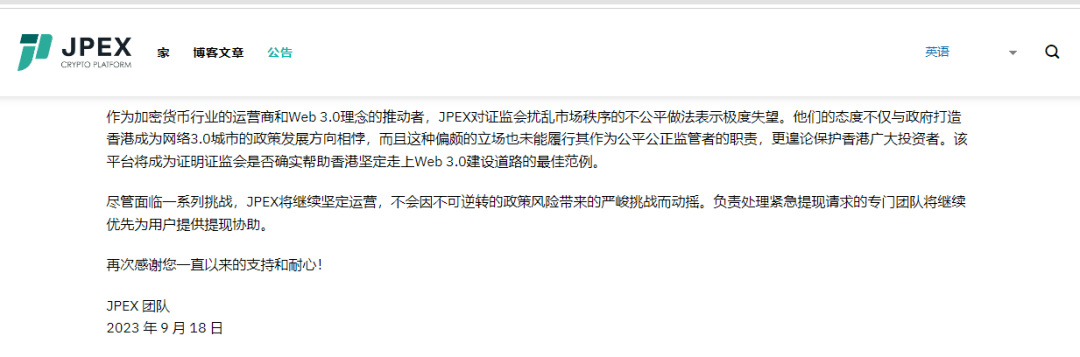
JPEX issued another announcement on September 18, source: JPEX official website
Such a shameless and outrageous exchange, for Hong Kong, which is building a crypto ecosystem, not only labels virtual currency as a crime again, exposing loopholes in Hong Kong's control over virtual assets, but also severely undermines the confidence of Hong Kong's political arena and investors in cryptocurrencies. Subsequent handling will be particularly important. Whether it is killing the chicken to scare the monkey or being difficult to trace will determine whether this matter is a thorn in the hearts of investors or a sword hanging over their heads. It is really a bad apple that spoils the whole barrel.
references:
Hong Kong Wen Wei Po: Virtual currency lacks supervision, and victims accuse Internet celebrities of mistrusting them for fear of losing their investment;
Hong Kong Afternoon Tea: More than 1,000 people reported the JPEX case to the police, involving 1 billion! Hong Kong's second-generation rich man, Lin Zuo, and four other men and two women were arrested! …
Shell complaint: JPEX, the billion-dollar cryptocurrency exchange in Taiwan, defrauded millions of people and was exposed by the Hong Kong Securities Regulatory Commission!
Consulting Index: One article reveals the background of the founder of the cryptocurrency exchange JPEX. Is JPEX safe?
Twitter, external websites and other news