


Today we continue with our big pie DEFI special. The TVL of the two projects we talked about today are both very high, almost 300 million, and neither of them has issued coins yet, so they are very worthy of our attention, and both have obtained good financing. The investment institutions behind them are quite powerful. You have to know that the areas where investment institutions are crazy about investing must be the hot areas in the future. 1. BitFI BitFi’s main business is actually a staking income platform for BTC. Currently, it only supports BTCB on BSC and WBTC on Ethereum. More types of packaged BTC may be opened in the future. By leveraging multi-chain adaptability and complex off-chain transaction strategies, BitFi provides guaranteed staking income and multi-layer income generation. The main product currently planned for the project (there is no C-end user end yet) is a staking project similar to the centralized BTC. At present, the income of this part is divided into several parts, namely the income of Cefi strategy, and platform income (if you hold BFBTC).
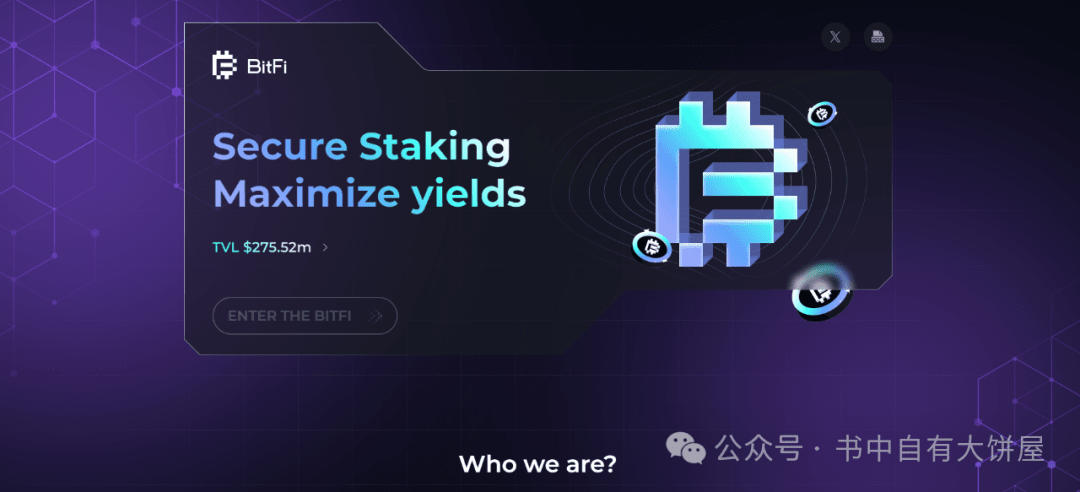
Features:
1. BitFi maximizes the returns of staked BTC assets through a secure and diversified approach, including staking, DeFi and CeFi mechanisms, and various innovative financial strategies.
2. BitFi synthetic dollars can be minted through a variety of pledged assets, while generating additional income through smart hedging and on-chain rewards.
route map
24Q3
-Crypto-collateralization: Users will be able to use cryptocurrencies as collateral to obtain loans or other financial services.
- Re-pledge: Users can re-pledge their already pledged assets to gain additional liquidity and access to a wider range of financial services.
-Synthetic Dollars and Internet Native Yields: These new products will provide users with new yield and trading opportunities.
Q4 2024
-CeFi Integration: BitUSD will be integrated into centralized finance (CeFi) platforms, becoming an important part of the centralized market and expanding its coverage and liquidity.
Q1 2025
-TradFi Transformation: BitUSD will be promoted as a margin asset on major platforms, including centralized exchanges (CEXs) and decentralized exchanges (DEXs), enabling users to participate in perpetual contracts (perps) and spot trading while earning interest.
Financing
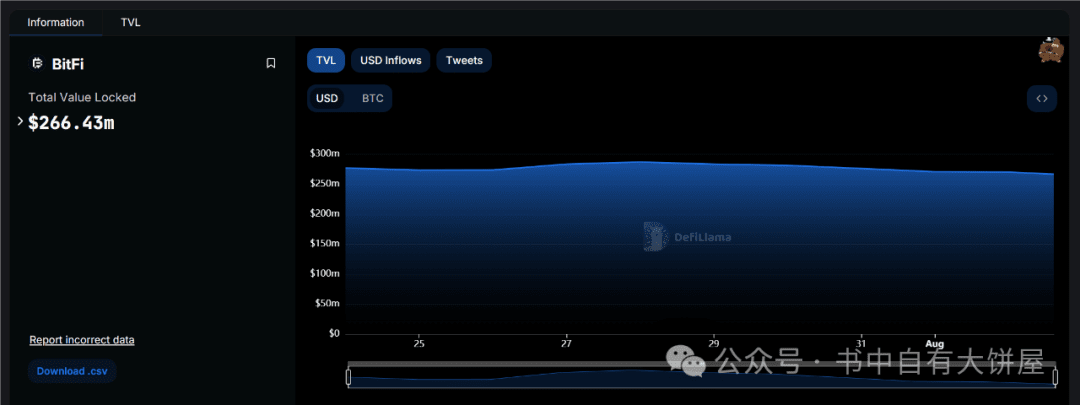
On July 28, 2024, the innovative CeDeFi business platform BitFi announced the launch of a seed round of financing with a valuation of US$50 million. Confirmed investors include Fundamental Labs, IBC Group Ventures, CGV FoF, TyreGate Capital Group and Citizen Journalism Network Accelerator (CJNA). The platform was founded by Han Liu, former co-founder and CTO of Ascendex. It launched an early access project on June 25 and accumulated a peak total locked value (TVL) of US$400 million within 1 month of its launch.
2.Ailayer
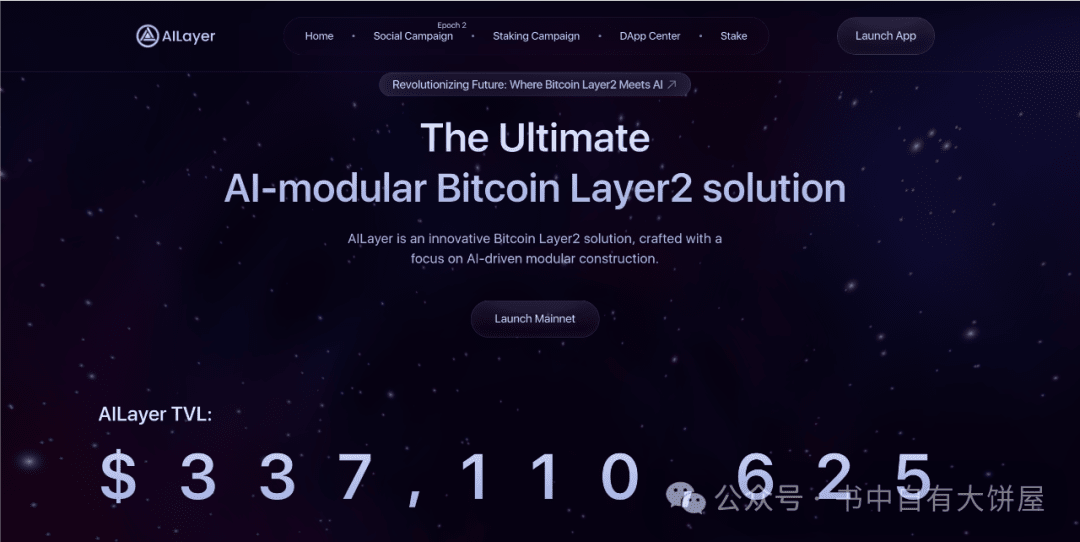
AILayer is a Bitcoin Layer2 that is compatible with EVM and uses inscriptions as Gas. AIL2 uses mining incentives to perfectly run a shared computing power platform for AI training. Layer2 is built based on AI-driven modularity. The project app is now online, with a cumulative TVL of 330 million US dollars. Therefore, this project is benchmarked against Merlin, and the data level is not as high as the previous Merlin.
Currently, a staking competition is being adopted, and the method used is the same as that of Merlin, that is, team staking. Additional rewards are given before reaching a certain stage. For example, if the team pledges 50BTC, the points reward will increase by 2.2%.
There are also social camp activities, such as forwarding Twitter, daily check-ins, friend invitations, etc., which will also give users social points.
working principle
AILayer can cross-chain Bitcoin assets or Bitcoin inscriptions from Bitcoin's Layer1 to Layer2, and also supports cross-chain back to Layer1. Users initiate cross-chain operations on Bitcoin Layer1, which involves staking BTC or inscriptions to the official bridge address and marking its target address on Layer2 using Bitcoin's op_return. On Layer2, it has 1,000 nodes running as light nodes, synchronizing the block headers of the BTC chain (for security verification) and cross-chain asset transactions. After verification, the state change is completed on Layer2, and BTC and inscriptions are mapped to the target address using a protocol similar to ERC20 tokens. Users initiate a withdrawal operation on Layer2 to cross assets back to Layer1. Layer2 nodes verify the legitimacy of the signature, and validators vote on consensus on blocks and withdrawal operations. Once consensus is reached, funds are released on the BTC chain using Schnorr signatures and threshold signatures.
Consensus method
AILayer uses the Tendermint consensus mechanism to create a POS validator set. Validators vote on blocks and withdrawal transactions and reach consensus through majority voting.
Finally, let's summarize these two projects. One is the staking of BTC, and the other is layer2, but in fact, they only rely on the staking of BTC. Since the popularity of Merlin, many project parties have also flocked to it. For the Merlin project, we can only say that the project parties and VCs are laughing and cheating the retail investors. It was launched at 10 US dollars and now it is a few US dollars. It reached its peak when it was launched. I have said before that the fundamentals of the Merlin project are okay, and the technology is okay, but if you do a good job of market value management, the project parties and institutions will sell crazily, and you will not be able to do it well.
So what about these two projects? The advantage is the BTC ecosystem. At present, a lot of capital is indeed entering the BTC ecosystem. So following these smart VCs, the Bitcoin ecosystem will definitely have an explosion in the future.
The disadvantage is that both projects do not have real-name team information, at least I haven’t seen it on the official website. Secondly, the official does not even operate a discord. Because on discord, we retail investors can communicate more or less directly with the project party, but the first project only has X, and the second project’s discord cannot be entered, and there are only a few thousand people, so the risk is relatively high from this point of view.