


Recently, there has been continuous on-chain activity of ARB whale selling. Starting from this Monday, whale addresses including market maker Wintermute Trading have successively transferred tens of millions of ARB to Binance. In addition, with the "FTX sales figures" Assets" caused a slump caused by overall market panic. The price of ARB fell to a historical low of $0.744 on Monday, a drop of 12% in the past seven days.
Faced with the currency price collapse caused by the whale selling, a large number of ARB Holders began to complain. In order to stabilize the currency price, Arbitrum began to save itself. On the 12th, it announced the launch of a 100 million ARB ecosystem funding plan. At present, ARB has made up for part of the decline. The price rebounded to $0.8.
The incentive plan turned into a "smashing plan"
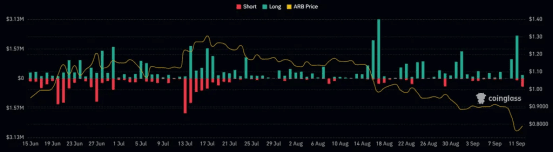
According to CoinGlass data, long positions worth $2.2 million were liquidated on September 11, which was the highest level since the ARB crash in August. The bullish signal before liquidation came from Arbitrum’s native governance aggregator PlutusDAO this month. A proposal for soliciting opinions on "activating ARB staking" was launched in the Arbitrum community. The proposal suggested that Arbitrum DAO mint 1.75% of the total supply of ARB as inflation and distribute it to the lockers of ARB tokens as an incentive within one year to mobilize the ARB market atmosphere and increase long-term Holder's earnings to combat short-term arbitrage. However, this approach has been questioned by some holders, saying that this move may dilute the value of the token, and users will lose information if it is solely based on inflation instead of being linked to real platform usage and economic activity. It is reported that PlutusDAO has currently locked 9.5 million ARB, which is obviously seeking personal gain under the guise of benefiting Arbitrum.
In fact, relevant incentive plans have been being explored on how to stimulate the Arbitrum ecosystem and mobilize the vitality of the ARB token market. On the 4th of this month, Arbitrum proposed an incentive plan to allocate ARB tokens to the community. The proposal aims to draw from DAO finance. The library distributes rewards of up to 75 million ARB to active Arbitrum protocols to meet the short-term needs of the community. This proposal is also controversial. The main point of controversy is that 75 million ARB will be distributed to the ecological protocol in the next 2-3 months, and the flow to the ARB secondary market will bring a lot of selling pressure; in addition, short-term token incentives It will have little effect on the long-term ecological growth of Arbitrum, but will instead increase the pressure for continued ecological growth.
According to Token Unlocks, Arbitrum will unlock 1.11 billion ARB tokens worth $1.24 billion on March 16 next year at a market price of $1.12. The unlocked amount is equivalent to 87% of the token circulation of 1.275 billion. The current ARB At least 12.75% of the token supply has been used in circulation. The huge unlocking volume coupled with this token incentive plan will undoubtedly bring greater selling pressure in the future.
It is these factors that caused the sell-off trend of whales. A large number of whale addresses chose to sell at a loss. According to Lookonchain data monitoring, on Monday alone, a total of 7 whale addresses sold ARB at a loss, with a total of 20.41 million ARB sold (approximately US$16.05 million), with a total loss of US$8.15 million.
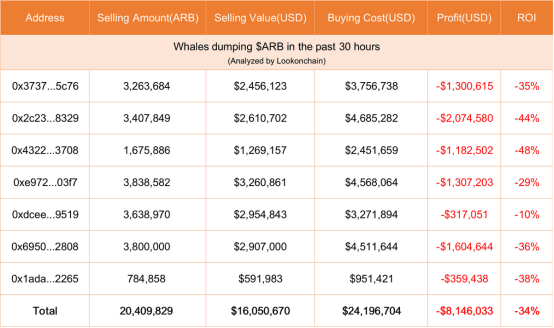
The originally launched ecological incentive plan has evolved into a giant whale smashing the market. Of course, this is "unexpected" by Arbitrum. However, how to solve the panic faced by the token selling pressure may only start from ecological construction, and the Arbitrum Ecosystem But he also began to face difficulties.
The “wealth effect” weakens and Arbitrum’s ecological growth is in trouble
In fact, as the "first year of L2", Ethereum L2 has experienced explosive growth this year. Just like the previous outbreak of public chains, a large number of project parties have begun to lay out the L2 track, from Arbitrum, Optimistic to the recent Base, more and more Many L2 projects are springing up like mushrooms after a rain. When the track grew to be extremely crowded, the Arbitrum ecosystem also began to fall into ecological growth difficulties.
Just like regular L2 products, Arbitrum focuses on achieving Ethereum expansion while ensuring security and decentralization. It already had a complete fraud proof when the first version was launched. Since then, Arbitrum's development team Offchain labs has also conducted Several technology stack product updates have brought nitro, stylus and bold. However, compared to zkSync, Starknet, Base, etc., which have already been airdropped, the growth of their users and TVL has begun to slow down compared to zkSync, Starknet, Base, etc., which are still expected to be airdropped.
Unlike Optimism, which is mainly supported by large VCs, Arbitrum's local applications are mainly funded by the community. Through the success of a single native project, profits are fed back to the community as a whole, and community profits quickly flow back to other projects in the ecosystem, forming an autonomous ecosystem. Circular ecosystem. This ecological model, which relies purely on internal liquidity support, is extremely easy to fall into trouble when the number of users is unstable and liquidity is scarce. The lack of liquidity in the Arbitrum ecosystem as a whole has caused the ecological living environment in L2 to be compressed, and then As latecomers led by zkSync and Base began to exert their efforts, competition on the L2 track intensified. Arbitrum's market competitiveness began to diminish and its market share was divided.
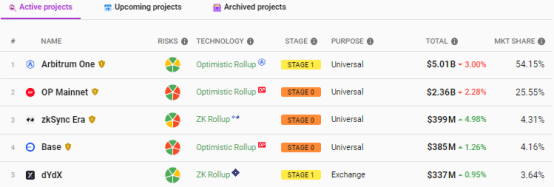
According to L2BEAT data, the current TVL of Arbitrum Network has dropped from a peak of $7 billion in April this year to $5.1 billion now, and its market share has also dropped from the previous 67% to 54.15%.
Throughout the ecological development of Arbitrum, in order to better serve Web 3 developers, from nitro to the recent stylus, Arbitrum has been focusing on the development of new technology stacks. In addition, the Arbitrum ecosystem has also seen popular projects such as the DeFi ecosystem GMX and Treasure in the gaming sector. The success of these native projects has without exception attracted a large number of ecosystem builders to tap into the user base of the Arbitrum ecosystem and build on the Arbitrum ecosystem. At the beginning of this year, there was a small explosion in the Arbitrum ecosystem. However, with the bearish market and the rotation of sectors, the wealth effect of Arbitrum ecological projects has weakened, and the previous high-quality projects have gradually begun to show signs of "anticipating the beginning and ending at the end."
In fact, most of the Arbitrum ecosystem caters to user groups who have a preference for leverage and a high risk tolerance. Since the Arbitrum ecological climax has passed, except for the latest release of the development environment stylus, there has basically been no new development environment. The progress of new ecological projects that can mobilize the enthusiasm of investors and bring increased wealth. In other words, except for developers who truly enjoy the convenience brought by technology development, most of the ecological user groups can be said to be "generating power for love." , which is why the "whale selling" occurred after the recent exposure of the incentive plan.
How useful is L3 exploration?
With the rise of L2 players, market competition is becoming increasingly fierce. In addition to adhering to the L2 advantages of "low cost and high efficiency", the L2 industry has begun to explore new trends in modularization, increasing scalability and building L3: on the same track Optimism has turned to Op Stack multi-chain infrastructure and developed in the direction of super chain; zkSync proposed a customizable trustless link blockchain Hyperchain to achieve better super scalability and improved composability; StarkWare began to develop a For multi-tiered solutions, explore L3 for custom extensions. Arbitrum is no exception. Through Arbitrum Orbit, it has opened up the vertical exploration of the L3 network and launched a new development environment Stylus for developers.
Stylus is an open source SDK developed by Arbitrum that supports building applications in multiple languages. It allows developers to use traditional EVM tools on Arbitrum while also using WASM-compatible languages such as Rust, C and C++ to build applications. Compared with using traditional Solidity, WASM makes the execution of Dapps more efficient and significantly reduces gas costs, while L3 XAI benefits from Arbitrum's technology stack Nitro+BOLD+Stylus' L3, which can natively integrate BOLD and Stylus.
While Op Stack monetizes access to its shared sequencer infrastructure, Arbitrum seeks to monetize its code base as a proprietary development environment. L3 XAI is defined as a smart contract on Arbitrum's L2, and its transactions will be through Arbitrum L2 (Arbitrum One or Nova) performs settlement. In addition, XAI, as a game-specific L3, can achieve higher performance and has dedicated computing and storage resources, making resource-intensive use cases on the chain possible. The advent of XAI will help increase the scalability of the Arbitrum ecosystem while diversifying its execution environment and security model.
There was the launch of L3 XAI before and the update of the development environment Stylus later, trying to create new possibilities for the Arbitrum ecosystem: Stylus expanded the language categories it supports, while L3 created a more diverse execution environment for it. In the future, the Arbitrum ecosystem will attract developers who want more control and seek customizability, allowing them to fork according to specific needs and freely adjust the Arbitrum source code to form so-called "customized chains."
summary
The Arbitrum team has been trying to save themselves.
In order to save the currency price, Offchain Labs has repeatedly repurchased ARB using addresses starting with 0xb41. Just this week when currency prices fell, Offchain Labs once again stepped in to help, emergency repurchasing 1.799 million ARB (approximately US$1.4 million) from Binance, with an average price of US$0.78. According to Spot On Chain data, since August 23, Offchain Labs has repurchased a total of 7.166 million ARB from Binance at an average price of $0.9. In addition, Arbitrum also launched an ecosystem funding plan that will provide more than 100 million ARB in four tracks: games, developer tools, new protocol concepts, education, community development, and events.
After a series of "emergency rescues", ARB has now risen back above $0.8. However, overall, the price of ARB is still sinking at the bottom, with no sign of a sharp rise.
Looking back, the previous increase in ARB currency price is most likely due to the outbreak of the Arbitrum ecosystem. The fundamental reason for saving ARB lies in the activation of the Arbitrum ecosystem. As far as the expansion of Arbitrum ecological development mentioned above is concerned, XAI's Odyssey event has been launched and will give developers a lot of rewards, but the overall operation is still in its early stages and needs to be verified over time. In the future, will L3 XAI usher in large-scale applications, and will Stylus encourage more dApp developers to enter the Arbitrum ecosystem to develop projects with more wealth effects to win back users? Everything is still unknown.
Faced with the severe "involution" of the L2 track and the efforts of latecomers to catch up, Arbitrum may only be able to speed up its pace and fight with its last resort.

