

Source: Biteye
According to overseas KOL Ardizor, among the active VCs in the industry, Binance Labs topped the list of "Which VCs love airdrops more" with an airdrop rate of 15.4% of its investment targets, far exceeding major VCs such as a16z, Coinbase, and Muticoin.
In the cryptocurrency and blockchain industry, investment and incubation are key factors in driving innovation and development, and Binance Labs can be said to be one of the important players in this field.
In order to find the Gem in Binance’s investment portfolio, this article will delve into multiple aspects of Binance Labs, including its introduction, advantages, and investment layout, and then focus on the projects in Binance’s investment portfolio that have not yet issued coins but have certain airdrop expectations.
Binance Labs Overview
Binance Labs was founded in April 2018 and is the venture capital business unit within Binance. Its main mission is to identify, invest in, and empower promising blockchain entrepreneurs, startups, and communities. In addition to direct investment, Binance Labs also invests through an 8-10 week incubation program (MVB), providing advisory support, financing, and resources.
The Binance Incubation Program has been held for six seasons. In the latest season, Binance invested in four of the best-performing projects participating in the 6th MVB, namely AltLayer, KiloEx, Kinza and Sleepless AI, covering DeFi, infrastructure and Web3 games.
In an interview with The Block in April this year, Binance Labs stated that their theoretical return on investment reached more than 10 times, which is closely related to Binance Labs' advantages and theory of project selection.
Binance Labs Advantages:
- Global influence: Binance Labs’ investment portfolio has covered 25 countries and has invested in more than 200 projects.
- Funding support: According to Binance’s 2022 year-end report, Binance Labs will provide at least $1-2B in funding to the crypto industry.
- Value creation services: In addition to financial support, we also provide general consulting, operational support and technology/product joint development.
- Rich resources: As part of the world's largest cryptocurrency exchange platform, Binance Labs has abundant resources and a large network, which are key factors in its ability to successfully incubate and invest in projects.
Binance Labs will consider the following five attributes when selecting projects:
- The first attribute is product innovation. Are you building something completely new that users will benefit from?
- The second attribute is a sustainable business and token model. Is your business model profitable in the long run and are your token incentives structured in the right way?
- The third attribute is traction. What is the number of users of the project at this stage? What is the revenue generated? If you are in the pre-launch stage, we will want to understand your actual expectations.
- The fourth attribute is the quality and durability of the team. Are you and your co-founders able to commit to this project full-time if the project requires it?
- The last attribute is technology. Is the technology you are building feasible and realistic? We look at what you have built and what you can build based on your project roadmap.
From the above, we can see that Binance Labs’ investment philosophy can be summarized into five attributes: product innovation, sustainable business and token models, adoption rate, team persistence, and technical feasibility.
Binance Labs’ key investment tracks
Binance Labs' investment layout is very extensive, covering most tracks related to Web3, including public chains, protocols, infrastructure, NFTs, blockchain games, metaverse, DeFi and CeFi, etc. According to the 2022 year-end report, Binance Labs will provide at least $1-2B in funds for the crypto industry recovery plan.
Binance Labs places particular emphasis on infrastructure, on-chain applications, data analysis, and security. These areas are not only the core of the cryptocurrency industry, but also the priority investment direction for Binance Labs. From the following figure, we can see the key track layout of Binance's investment:
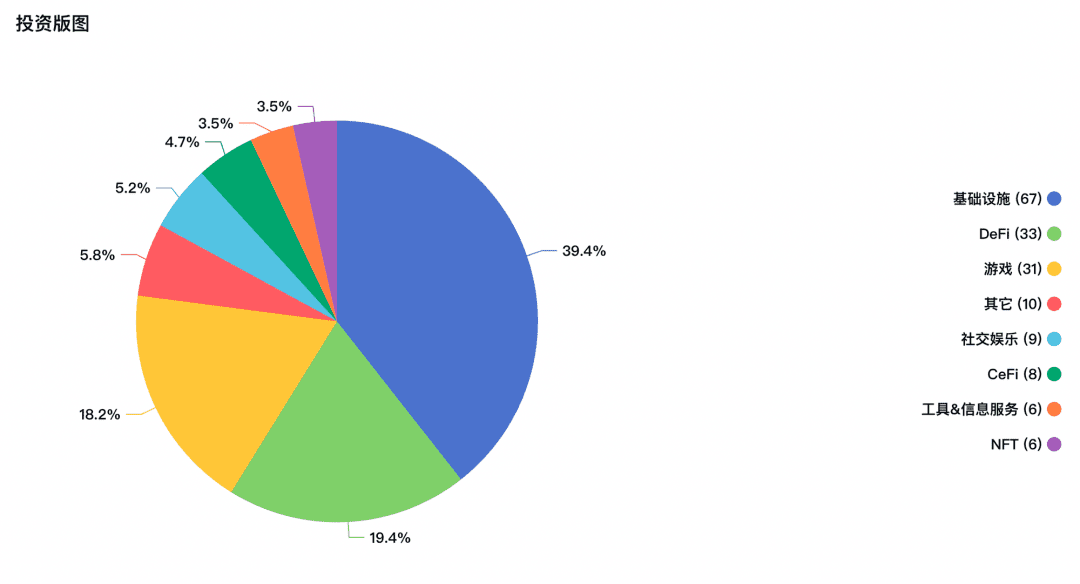
- Infrastructure: It accounts for the largest proportion of Binance Labs’ investment portfolio, reaching 39.4%, and is the cornerstone of the blockchain and cryptocurrency industry.
- DeFi and Games: They account for 19.4% and 18.2% of the investment respectively. These two fields not only have huge market potential, but are also at the forefront of leading industry innovation.
- Web3 related tracks: including social entertainment, tools, NFT, metaverse, etc. These areas are considered to be the next growth points of the cryptocurrency industry.
Inventory of unissued tokens
We will review the four major sectors of infrastructure, Web3, DeFi, and games to review the projects in Binance’s investment portfolio that are worth paying attention to but have not yet issued tokens.
(Risk warning: The following projects are just those that have not issued tokens but have investments. The fundamentals of the specific projects cannot be guaranteed. The risks of crypto projects are high. Users can use the following list as a reference for further DYOR.)
infrastructure:
1. Polyhedra: $25M
Polyhedra is a startup company that provides full-stack infrastructure based on ZKP technology, focusing on interoperability, scalability, and privacy. It generates SNARK proofs faster in a distributed manner, and then develops zk full-stack projects (zkBridge, zk-DID, zk-NFT) based on this. The zkBridge testnet is already online, and there is an airdrop expectation.
2、AltLayer
AltLayer is an open and decentralized protocol for developers to launch Rollups customized for their applications.
The protocol provides a code-free Rollups-as-a-Service dashboard built on top of its core network Beacon Layer, allowing for quick customization of Rollups with fraud/zk proofs, gaining security from the underlying L1/L2. It received funding from Binance's sixth season MVB.
3、DappOS
DappOS is an intent-centric operating protocol designed to make dApps as user-friendly as mobile apps.
As a unified operating protocol for Web3, it builds a layer between users and cryptographic infrastructure such as public chains and cross-chain bridges, allowing users to complete verification and execution in the decentralized world by simply interacting with dappOS, making it easy for anyone to access decentralized applications without complicated processes or in-depth cryptographic knowledge.
4. Mind Network: $2.5M
Mind Network is a composable data protocol that allows developers to interoperate data across platforms. Mind Network's vision is to become the first decentralized knowledge graph that intelligently connects all people and products on Web3. The Mind Network roadmap states that the token will be launched in the third quarter of 2023.
5. LayerZero: $315M
LayerZero is a full-chain interoperability protocol that focuses on data messaging between chains. LayerZero's data transmission method based on oracles and relays makes the protocol more lightweight and has certain security guarantees. The current network adoption rate of the protocol is good, and there is an airdrop expectation.
6. Celestia: $56.5M
Celestia is the first modular blockchain network that advocates dividing the consensus, settlement, execution and other functions of a single public chain into different layers, and then improving performance by optimizing the functional layers. It also allows specialized blockchain hosting applications to be deployed on it, and is optimized in terms of scalability, flexibility and interoperability.
7. Web3Go: $4M in funding
Web3Go is a data intelligence network that provides a suite of AI-native digital asset tools and real-time data infrastructure.
The network will enable users to produce a variety of AI-native digital assets, including trading information flows, trading strategies, trading robots, entertainment, education, and social intelligence assistants. Asset ownership will be verified through the blockchain, providing creators with a fair, self-custodial, trustless ecosystem.
Web3
1、Paragraph
Paragraph is an on-chain creator platform that helps creators publish, share, and build businesses around their content, using a permissionless protocol to enhance growth and monetization potential.
Paragraph is leveraging novel on-chain mechanisms such as enabling creators to turn posts into collectibles, send newsletters to wallet addresses, monetize through recurring memberships, and leverage decentralized social protocols (e.g., Farcaster, Lens, XMTP) to build and cultivate their communities.
Not only did it receive investment from BInance Labs in October 2022, it also received investment from Base's first ecological fund in September this year.
2. Tabi: $10M
Tabi is a cross-chain NFT platform that provides NFT issuance, trading, auctions, and tailored in-store services. It aims to connect creators and users in a decentralized way. Airdrops have been confirmed. Tabi also converts users' on-chain activities into "experience points" that can be used to redeem future airdrop rewards and earnings.
3、Lifeform
Lifeform is a decentralized visual digital identity (DID) solution provider. Its core technologies include: ultra-realistic 3D avatar creation tools; visual DID protocols; secure and innovative contract solutions; Web3 native decentralized identity systems; Metaverse Engine Software Development Kit (SDK). It has completed three rounds of financing, with the latest round of financing reaching a valuation of 300 million.
4. Playbux: $2M
Playbux is an e-commerce metaverse platform based on the blockchain network. The project was shortlisted for the Binance Labs Season 4 incubation program. Its product aims to become an accessible Shop&Earn metaverse platform. It allows users to spend and earn cash back at more than 20,000 merchants around the world.
game
1. Xterio: $55M
Xterio is a global, cross-platform, play-to-earn developer and publisher dedicated to connecting millions of people around the world through deeply engaging gaming worlds enhanced by digital ownership. Xterio’s focus is on developing Web3-native universes that scale across all media and platforms.
2. Fusionist: $6.6M
Fusionist is a game world with collectible NFTs, consisting of 3 types of games, namely Colonization, Conquest, and Unity. Players will manage their own planets, collect rare resources, upgrade technology, scan blueprints to manufacture mechas, and build production lines. Fight through PvP and PvE battles, build starship fleets for interstellar wars, and conquer the galaxy.
The founding team is composed of senior people from Tencent Games, Electronic Arts and Mengton Games. Players who participate in the test will receive token airdrop rewards.
3. Ultiverse: $4.5M
Ultiverse is the social gaming metaverse that connects Web3 with immersive, fully VR-compatible virtual worlds of AAA quality. By empowering players with different economic capabilities to build mutually beneficial relationships, Ultiverse aims to create MetaFi, with strong airdrop expectations.
4. Tatsumeeko: Loan of $7.5M
Tatsumeeko is an MMORPG playable on Discord. It combines casual gaming, Japanese RPGs, and creative building games with social elements and user-generated content to create a platform-agnostic, community-driven, modern fantasy MMORPG-lite.
5. Heroes of Mavia: $5.5M
Heroes of Mavia is an MMO strategy game that draws fantasy elements from the popular mobile strategy base-building game Clash of Clans.
Players build and develop their bases, train armies, and battle other players on the island of Mavia. As the player's base and army grow, they are able to attack more challenging opponents and receive tokens in return, which can be used to upgrade the base itself and create special super-troops called heroes. Land NFTs have been issued, with airdrops expected.
6. Sleepless AI: Funding
It is an AI blockchain-based virtual companion game that uses AIGC and LLM to create rich story-based gameplay and organic interactions with characters. The project is currently developing three games, with the first game being HIM.
DeFi
1. Helio: $10M
Helio is an open-source liquidity protocol for lending and earning yield on HAY — a new BNB-backed, over-collateralized, and entirely new crypto asset class called “destablecoins” (where “de” stands for decentralized). Built on the BNB chain, the Helio protocol consists of a dual token model and mechanism that supports instant conversions, asset collateralization, lending, yield farming, and staking.
2、Bracket Labs
Bracket Labs has launched the Bracket Protocol options market, which aims to simplify traditional options and structured products, where buyers can trade multi-currency contracts. The innovation of the platform is that users can interact directly on a decentralized, permissionless, and non-custodial platform without a margin account; there is no forced liquidation, and buyers always receive the full value of their claims. Currently, BracketX is online on the Arbitrum testnet.
Summarize
In summary, Binance Labs, as the venture capital and incubation department of Binance, the world's largest cryptocurrency trading platform, has become one of the indispensable players in the blockchain and cryptocurrency industry.
Its global influence, financial support, value-creating services and abundant resources enable it to successfully incubate and invest in projects.
For users, the bear market can be said to be the best time to discover potential projects. Without the TVL brought by Fomo and false APY in the bull market, it is easier to screen out project parties who are serious about their work. Players can prepare for the bull market by tracking the data growth of promising projects.
The above project list can be used as a research and interactive reference, but it must be noted that in the crypto market, projects that can truly meet user needs and succeed are rare. Most projects have higher risks than potential. Therefore, when participating in a project, you must do a good job of risk management and ensure the safety of your funds.