


Today we continue to talk about projects in the order of market value. The project we are talking about today is a big data application called Ocean protocol (OCEAN). Its current market value is 190 million US dollars, ranking around 120+. Because we know that big data and blockchain seem to have little to do with each other, because blockchain is inefficient, and big data processing requires very high speed, so let's take a look at what this ocean does.
Ocean Protocol Background
Data is a very important production factor at present. Technavio, a leading global technology research and consulting company, proposed in its latest big data research report that by 2024, the size of the global big data blue ocean market may grow to US$142.5 billion overall.
Moreover, the Metaverse craze will continue in the future, the value of data will become more prominent, and a large amount of user privacy data analysis will provide users with a better immersive experience. In addition, artificial intelligence, which is very popular recently, also needs a lot of data to feed AI, so that artificial intelligence will become stronger and stronger.
However, according to data from the International Data Corporation, only 0.5% of the world's data is actually used and analyzed, and the rest is dormant in databases.
The main reasons are:
1. The leakage of intellectual property and user privacy information will encourage unhealthy business competition, bring about privacy and security issues, and hinder the flow and sharing of data.
2. In addition to data privacy protection, the release of data value also requires a lot of tedious steps. Raw data cannot bring actual benefits. Only analysis generated after logical analysis and combination of different data can release the value of data.
So, how can we eliminate the concerns of all parties so that the data in their hands can be shared efficiently and release greater value?
Furthermore, when data generates value, how can data owners unlock the value of the data to maximize their own interests?
The Ocean Protocol was created to solve these problems. When data is shared and circulated, data transactions generate value, making data financialization possible.
What is Ocean Protocol?
Ocean Protocol aims to provide secure, reliable and reliable borderless data distribution to unlock the data economy. It allows users to build marketplaces and data services on top of it. The protocol can also be an “open source” protocol for exchanging and monetizing data and other “data-based” services.
It is built on the Ethereum blockchain and uses data tokens to control the entry of datasets. These tokens are later redeemed by members who want to access this data or information. The protocol aims to make all the datasets on its network available to researchers and beginners without them leaving their storage.
One of the main advantages of the software is that it facilitates communication. It connects users who need data or storage resources with those who have more than they need. The system pays these resource-saving users some OCEAN (the protocol’s native currency) for their work.
OCEAN coins or tokens are made into a multi-purpose cryptocurrency for maintaining datatokens. The system allows its holders to participate in the buying and selling of tokens and the general governance of the protocol.
How is sensitive data traded and shared?
The pain points of current data sharing
In the past, sensitive data held by various parties was difficult to share, and greater industrial value could not be released.
For example, the hospital's database accumulates a large amount of patient case information and personal information. If data sharing can be achieved, artificial intelligence practitioners will be able to use this patient data for machine learning training and modeling, thereby better assisting doctors in identifying signs of illness.
However, in reality, due to personal privacy issues, these data cannot be directly handed over to the demand side for training.
This not only wastes valuable data resources, but also greatly hinders the development of the medical industry.
The data does not move, the algorithm moves
The Ocean Protocol's "compute-to-data" functionality ensures that algorithms run on data sets in an isolated and secure environment, allowing sensitive data to be used for algorithm training without leaking sensitive information in the data itself.
In this way, data providers are willing to provide the data they have and create profits through the data; and data scientists can also provide algorithms to further develop the value of the data and create profits by providing algorithms.
Ocean Protocol Architecture
The bottom layer is the smart contract layer, which is deployed on the Ethereum mainnet and other networks, the middle layer is the facility layer that provides convenience for high-level languages, and the top layer is the application layer. From left to right, the functional groups are: data NFT and data token tools, market tools (including pools), tools for using data services and metadata, and external ERC20 tools.
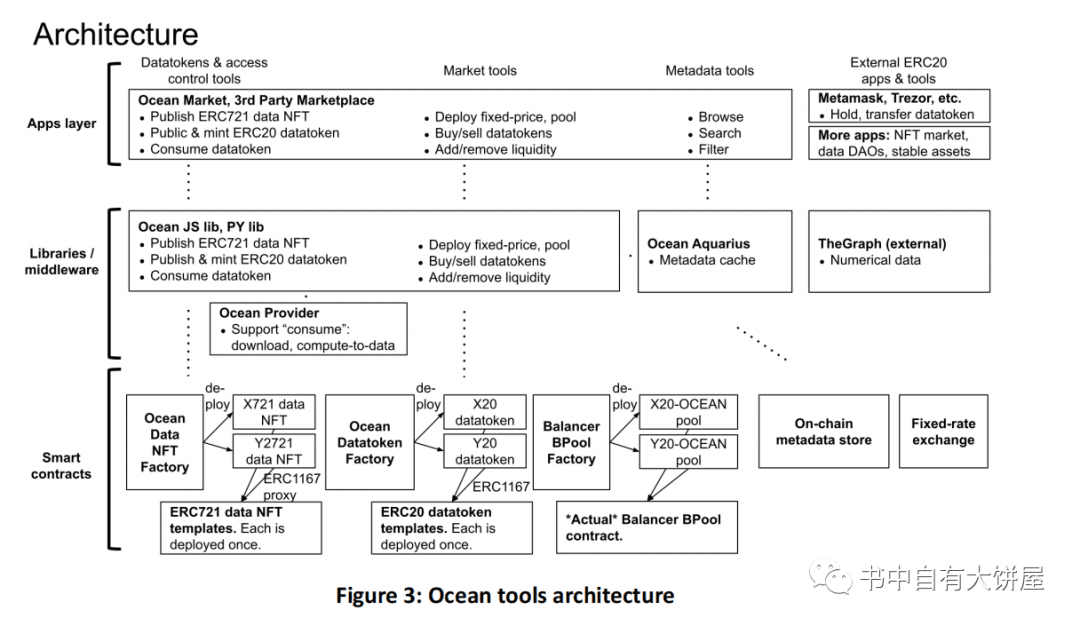
Publishers save datasets in Google Drive, Dropbox, AWS S3, on their phones, on a main server, etc. The dataset has a URL. Publishers can choose to use an IPFS content-addressable URL or, alternatively, publishers can run a computer to the data service instead of a file.
In the publishing step, the publisher calls Ocean Data NFT Factory to deploy the new data NFT to the chain. The publisher can then call Ocean Datatoken Factory to deploy a new data token contract (for the data NFT) to the chain) and then generate data tokens.
The issuer operates the Ocean Provider. In the consumption step, the Provider software needs to retrieve the data service URL for a given data token address. One is that the issuer runs a database; however, this adds another dependency. To avoid this, it stores the URL on-chain. So that others cannot see this encrypted URL.
To initiate the consumption step, the data consumer sends a 1.0 data token to the provider wallet. They then make a service request to the provider. The provider loads the encrypted URL, decrypts it, and then provides the requested service (sending static data, or enabling a computer-to-data job).
How does Ocean Protocol work?
Ocean Protocol uses smart contracts. A custom program that ensures all datatokens are exchangeable within the Ethereum blockchain and its Dapps. The Ocean platform operates through 3 main components to ensure a working system.
Providers: They mint or produce data tokens and enable users to access off-chain datasets.
Consumer: Consumers purchase data tokens and retrieve access to datasets.
Marketplace: This is where transactions take place. Marketplaces connect consumers with suppliers to enhance transactions.
This is an AMM (Automated Market Maker). It facilitates the minting and exchange of data tokens.
AMMs use a combination of liquidity pools similar to Balancer and Uniswap. They allow all trades to be settled through smart contracts. They indicate in multiple fields to remind consumers of the data tokens they minted and issued. Balancer was then chosen from AMMs because Balancer has more options for adjustment.
Why did the Ocean team choose the AMM format for data transactions instead of order books or auctions?
The main reasons are as follows:
1AMM mechanism can provide continuous price updates and execute transactions at any time.
2. The order book requires buyers and sellers to match quotes, which has high liquidity requirements and is not suitable for transactions in long-tail markets such as data tokens.
3 Auctions are a very slow process, which is not conducive to continuous price updates and efficient market operation.
team
Bruce Pon and AI researcher Trent McConaghy founded Ocean Protocol in 2017. The founders work with a large team of diverse professionals interested in using AI to liberate data. They have forty members, spread across the world.
Bruce Pon, the main founder of Ocean Protocol, also founded a blockchain database software company (BigChainDB). BigChainDB is a software project supported by the Ocean Protocol and OceanDAO foundations. They are a non-profit company and DAO (decentralized autonomous organization) in Singapore respectively.
He also founded Avantalion Intl Consulting, a banking business that aims to provide banking services to the unbanked. Bruce Pon worked here from 2008 to 2013. He helped the company set up more than 18 financial institutions in unbanked areas of the world.
However, the second founder of Ocean Protocol, Trent McConaghy, is an artificial intelligence expert. He worked for the Canadian government in 1997 and is also the founder of ADA, which aims to help analog circuit designers use AI faster.
After ADA was acquired in 2004, Trent also founded Solido, another company that helps circuit designers use AI. Siemens took over Solido in 2017. During this period, 20 of the top 19 semiconductor companies in the world used Solido to improve their chip styles.
Most of the Ocean Protocol team members are entrepreneurs. Before joining Ocean, they had a lot of experience in opening private companies. Ocean Foundation raised $268,000 through multiple rounds of token issuance. They also offered a total of 16 billion tokens.
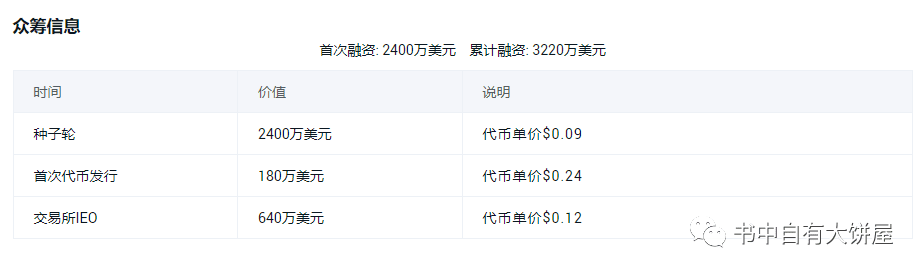
Crowdfunding information
Token Economy
Ocean token is the native token of Ocean Protocol used to manage/power the network. It is the utility token of the protocol called OCEAN. The main purpose is to buy and sell data and services. OCEAN is a reward for providing liquidity through data management and staking.
The platform’s users use tokens to create data tokens that are used to run the marketplace. Ocean runs the entire data economy. It encourages the community to provide the necessary resources needed to scale and secure the network.
The Ocean ecosystem can use already existing tokens such as ETH as its medium of exchange. The OCEAN token was developed as the protocol’s native reward token and sets some monetary policies.
This is not possible if external tokens are adopted. Any fluctuation in 3rd party tokens leads to disruption of trading order in Oceania market. However, there are 4 main ways to obtain OCEAN tokens.
Ocean Data Provider
These are the system participants who have enough data available. They are ready to distribute it to others at a given price. When buyers use the data, they reward the providers with OCEAN coins.
Ocean Data Curator
This is a means for users to judge whether data is good or bad. Since Ocean Protocol is decentralized, this role is not undertaken by a centralized committee. The protocol allows anyone with experience to serve as a curator of the market. These experienced users are also rewarded (OCEAN tokens) for their services in weeding out fake data in the market.
Ocean curators stay honest by using their tokens as a sign of better quality.
Marine Performer Registry
The openness of Ocean Protocol requires more than just management of data in the marketplace. It also requires management by the members of the system.
The actor registry fulfills this role. It forces all system participants to stake more tokens. This process makes “good behavior” economically attractive in the ecosystem and makes it easier to punish bad behavior.
Sea Shepherd
These are the nodes in the Ocean software. They run the software and make all the datasets available. Nodes are called Keepers in the Ocean platform.
They receive OCEAN like any other protocol participant to perform their functions. These functions include enabling data providers to easily contribute or offer data to the OCEAN network.
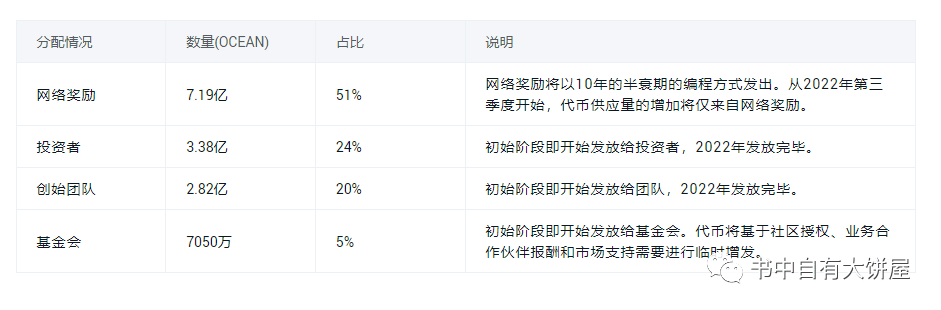
The first issuance time is 2019-05-04, the maximum supply is 1,410,000,000 OCEAN, the circulation volume is 613,099,141 OCEAN, and the circulation rate is 43.48%. The current coin price is around 0.3 US dollars, and the crowdfunding price is 0.09 US dollars. From this point of view, it has risen a lot. The peak was 1.9 US dollars (21 years), and it has also fallen by 90%. In terms of token distribution, the founding team + foundation accounted for 25%, which is neither high nor low, but there are still a large number of coins that have not been unlocked.
Finally, Ocean Protocol is a decentralized data trading platform based on blockchain architecture. By creating data tokens + AMM DEX liquidity pool + staking mining, it allows users to create data tokens and corresponding token markets on it through smart contracts. The platform's native token OCEAN is used as a functional token for purchasing, staking, selling data and community governance. At present, it cooperates with German car manufacturers in the entity aspect and cooperates with Balancer on its platform AMM mechanism. The current data market is small in size and is also in a stage of rapid development. For example, in China, Shanghai, Shenzhen and other places are currently creating a large number of data exchanges, so there is a lot of room for development in this area. The founding team has strong technology in the fields of artificial intelligence and data mining. In general, this direction is definitely the general direction, and it is also the leader in the field of blockchain, so it is worth paying attention to.