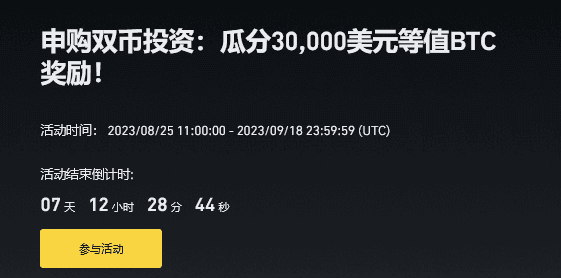


A previous article, "Use Binance Finance dual-currency investment products to make money in the bear market, and share the limited-time $30,000 prize pool," talked about the plan to use dual-currency investment to ensure profits during the shock and decline at the end of the bear market.
After thinking about it, I still have to write a more detailed underlying logic analysis. CYBER’s financial management incident caused a lot of noise before. From my point of view, Binance is really fine. In the end, it came up with a subsidy plan generously. However, retail investors rely on the platform to lose money, and this core problem has not been solved. Any investment and financial management is risky, so we still have to understand the underlying logic and user terms of dual-currency investment in order to be better responsible for our own investments.

Financial foundation of dual-currency financial management
Dual-currency financial strategy products are based on the options market. An option is a financial derivative that gives investors the right to buy (i.e., a "call option") or sell (i.e., a "put option") a specific asset at an agreed price at a specific time in the future. Non-obligation. This specific asset, called the "underlying asset", can be stocks, bonds, commodities, currencies, indices, etc.
The buyer of an option pays a fee, which is called the "option premium" or "option price." The seller of an option is obligated to buy or sell the underlying asset when the option is exercised.
The main characteristics of options are as follows:
Rights but not obligations: The option holder can choose whether to exercise the option. For example, an investor who holds a stock call option can choose to buy the stock when the stock price is higher than the exercise price and sell it at a high price in the market to make a profit; conversely, he can choose not to exercise the option and the maximum loss is only the amount paid. Option premium.
Risks and Rewards: Options trading can carry significant risks and rewards. The risk of the option buyer is mainly that he may lose all the option premium, but the profit is unlimited. The option seller's risk is unlimited, but the maximum return is only the option premium received.
Leverage effect: The option price usually accounts for only a small part of the underlying asset price, so investors can control a larger underlying asset with less money, which is called the "leverage effect." This means that small price changes in the underlying asset can lead to large changes in the option price, resulting in high gains or large losses for the investor.
Dual-currency financial products are designed based on the characteristics and mechanisms of these options markets, which also explains why it can provide a relatively high annualized rate of return.
Detailed explanation of the investment strategy of dual-currency financial management
Dual-currency financial management is an investment strategy in the digital currency market. Its core is to use option strategies to obtain income. Here’s a closer look at this strategy:
Digital currency selling strategy:
Suppose you hold a certain digital currency (such as BTC, ETH, etc.), you can choose to sell it at a predetermined price A at a certain point in the future (such as 20 days later).
During these 20 days, your digital currency will be locked, that is, you cannot perform any trading operations.
20 days later:
If the market price ≥A, your digital currency will be automatically sold at the price of A.
If the market price is <A, your digital currency will not be sold, but returned to you in its entirety.
No matter what, you will receive interest on the digital currency for these 20 days.
Stablecoin buying strategy:
Assuming you hold stablecoins (such as USDT), you can choose to buy a certain digital currency (such as BTC, ETH, etc.) at a predetermined price B at a certain point in the future (such as 20 days later).
During these 20 days, your stablecoin will be locked, that is, you cannot perform any trading operations.
20 days later:
If the market price ≤ B, you will automatically buy the predetermined digital currency at the price B.
If the market price > B, you will not buy the digital currency, but the stablecoin will be returned to you intact.
No matter what, you will receive interest on the stablecoin for these 20 days.
Efficient investment strategy:
Some investors choose not to make delivery after the financial management expires, but directly obtain high interest income.
This strategy is equivalent to you accurately judging the resistance and support levels of the market, thereby obtaining stable returns amid market fluctuations.
In short, dual-currency financial management combines options strategies and the characteristics of the digital currency market to provide investors with a new and efficient investment method. But like all investment methods, it also involves risks, and investors should invest based on their own risk tolerance and market judgment.
Risks and advantages of dual-currency financial management
Risk analysis:
Lock-up period risk: During the lock-in period, such as 5 days, the market may fluctuate significantly, and investors are unable to perform any operations and can only sit back and watch.
Booking price risk:
If you set a price of 32,000 to sell BTC after 5 days, but the market price soars to 50,000 after 5 days, the system will sell it for you at the price of 32,000 you predetermined, resulting in a huge opportunity cost loss.
If you set a price of 28,000 to buy BTC 5 days later, but the market price plummets to 8,000 5 days later, the system will still buy it for you at the price of 28,000 you predetermined, resulting in huge capital losses.
Advantage analysis:
Zero handling fees: For daily swing traders, dual-currency financing is very suitable because it does not charge any handling fees and can also earn interest income.
VIP level and BNB holding assessment: The amount of dual-currency financial management will be included in the assessment of VIP level and BNB holding, so investors can enjoy various discounts and benefits on the Binance platform.
Advantages for long-term currency holders: For those investors who firmly believe that a certain digital currency has huge room for growth in the future, dual-currency financial management is very attractive. Because even if the market price is lower than their psychological expectations, they will continue to hold it and obtain high interest income from it. As CZ said: "If you can't hold it, you won't get rich."
Overview of User Terms:
Product definition: Two-way investment is a financial derivative product that provides fixed income while also providing investors with the opportunity to obtain higher returns when market prices rise or fall.
Trading and Settlement Currencies: Investors can choose to use USDT or other cryptocurrencies for trading and settlement.
Maturity and Settlement: The maturity date of a product is determined at the time of purchase. Upon expiration, the product will be settled.
Income mechanism: Income will change with changes in market prices. If the market price reaches or exceeds the trigger price, investors will receive principal and income in the settlement currency; otherwise, investors will receive principal and income in the transaction currency.
Risk warning: Two-way investment products involve market risks. Investors should fully understand the operating mechanism of the product before investing and make decisions based on their own risk tolerance.
Conclusion: This article has analyzed in detail the risks and advantages of dual-currency financial management. In the next article, I will delve into the practical operation of dual currency investment and share it with you.
Finally, if you participate in dual-currency financial management now, you can also participate in Binance’s event to share 30,000 US dollars in rewards! There are still 7 days left in the event!