

Author: Solaire, YBB Capital
Preface
Stablecoins have always been the most critical part of the crypto world, accounting for 8.6% of the total market value of the entire blockchain (about $124.5 billion). Among them, centralized stablecoins with US dollars and US bonds as collateral have always dominated, such as USDT and USDC, but centralized stablecoins are always controlled by the center. For example, Tether is fully capable of freezing USDT in any address, and their security is guaranteed by centralized entities. This is obviously not in line with the original intention of the existence of blockchain, and in the exploration of decentralized stablecoins, two main branches have emerged, over-collateralized stablecoins and algorithmic stablecoins. Although over-collateralized stablecoins can remain stable in the highly volatile crypto market due to their high collateralization ratio, their minimum collateralization ratio of 1.5-2 times leads to low capital efficiency. The market for algorithmic stablecoins has always been the cruelest. Although they have the highest capital efficiency, due to their model close to 0 collateralization, death always accompanies them. After the failure of LUNA, this track has disappeared for a long time. But the author always believes that there should be a non-over-collateralized decentralized stablecoin in the crypto world, and this article will explore the history of algorithmic stablecoins and some new ideas.
What is algorithmic stablecoin?
Generally speaking, an algorithmic stablecoin is a stablecoin that does not require any reserves or collateral, and its supply and circulation are fully regulated by an algorithm. This algorithm controls the supply and demand of the currency, and aims to peg the price of the stablecoin to a reference currency (usually the US dollar). Generally speaking, when the price goes up, the algorithm will issue more coins, and when the price goes down, it will buy back more coins on the market. This mechanism is similar to seigniorage, which is the way central banks regulate the supply and value of currency by issuing or destroying it. For some algorithmic stablecoins, their functions can be modified based on the community's suggestions, and this modification is achieved through decentralized governance, so that the power of seigniorage is given to the users of the currency rather than the central bank.
In summary, compared to common stablecoins such as USDT and USDC, algorithmic stablecoins are different in terms of decentralization, they do not require reserves and are independent. Since algorithmic stablecoins are currencies based on the intrinsic relationship between mathematics, monetary economics and technology, they introduce a stablecoin model that may be more advanced than centralized stablecoins.
A brief history of algorithmic stablecoins
Early attempts to influence algorithmic stablecoins can be traced back to 2014, when economist Robert Sams proposed a model called "Seigniorage Shares" that maintained price stability by automatically adjusting the money supply. This concept was inspired to some extent by modern central bank monetary policy. Next, BitShares tried a hybrid model that, while primarily based on asset collateral, also included some elements of algorithmic adjustments. This can be seen as an important step in the development of algorithmic stablecoins, although it is not a pure algorithmic stablecoin itself.
In 2017, a project called Basis (formerly known as Basecoin) attracted widespread attention. The project attempted to maintain the value of stablecoins through a complex three-token system. However, due to incompatibility with US securities laws, the project was eventually forced to shut down at the end of 2018.
In 2019, Ampleforth proposed a new model called "elastic supply", which not only adjusts the issuance of new tokens, but also adjusts the number of existing tokens in the user's wallet to achieve price stability. Almost at the same time, Terra also released its stablecoin, which uses a composite model including taxation, algorithm adjustment and asset collateral to mint its native token. Of course, the name of this token is also widely known, which is later known as LUNA.
Earth MOON
LUNA is the most representative project in algorithmic stablecoins and also one of the most notorious projects in the crypto world. Its history is like a flash bomb, which is very bright in an instant but disappears in an instant. Today's discussion on LUNA is just to learn from history and find some inspiration for the future.
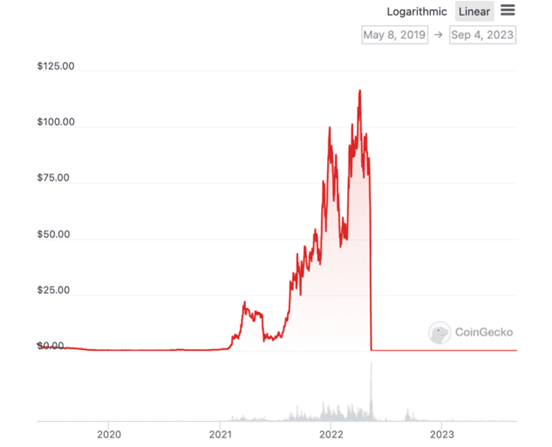
OFFICER
history
K
Line (data from
CoinGecko
)
Terra is a blockchain built on Cosmos SDK and Tendermint consensus. It was originally designed to solve e-commerce payment problems through cryptocurrency. However, traditional cryptocurrencies are too volatile, and it is not easy to use them like legal tender. Centralized stablecoins such as USDT have regional and centralized problems. Therefore, Terra wants to create a rich and decentralized stablecoin portfolio, such as Korean won, Thai baht, and US dollar.
In order to achieve this goal, Terra needs to launch a universal minting mechanism. Soon after, in April 2019, a minting method was proposed by Terra's two co-founders, Do Kwon and Daniel Shin, in the white paper of Terra Money, that is, to mint stablecoins of various countries through LUNA (Terra's native token). Here, I will briefly explain this method, taking UST (Terra's US dollar stablecoin) as an example.
First of all, UST is pegged to the US dollar at a 1:1 ratio;
If UST exceeds the pegged price, you can convert $1 of LUNA into 1 UST, at which point UST is worth more than $1, and you can earn the difference by selling it;
Vice versa, if UST is below the peg price, you can always exchange 1 UST for 1 USD of LUNA.
This model has been questioned since its launch. From the birth of LUNA to the eve of its fall, various well-known people in the crypto circle have warned that LUNA is nothing more than a Ponzi scheme. But even so, many people continue to pour into this dangerous place, so why?
Seigniorage
To understand a Ponzi scheme, we must first understand the motivation for designing the scam. In addition to increasing the price of LUNA, the large-scale adoption of UST also has a key benefit point - seigniorage.
Seigniorage is an economic concept that describes the revenue a government has earned from issuing currency in the past. Specifically, the term is often used to refer to the difference between the face value of a currency and its production cost. For example, if it costs 50 cents to produce a $1 coin, then the seigniorage is 50 cents.
In the crypto world, all three types of stablecoins have seigniorage. Stablecoins that are collateralized by fiat currencies generally charge a seigniorage of about 0.1% during the minting and destruction process. Overcollateralized stablecoins, on the other hand, earn revenue from handling fees and interest rates paid by holders. As for algorithmic stablecoins, they have the highest seigniorage rate. By introducing a mechanism that pegs to volatility tokens, stablecoins are able to convert all funds entering the system into seigniorage, which is creating something out of thin air. This mechanism greatly reduces startup costs and increases the anchoring rate to a certain extent, but it also comes with inherent fragility.
Anchor Protocol
LUNA is a miracle in the history of algorithmic stablecoins. All previous algorithmic stablecoin projects failed in a very short period of time or never managed to grow. LUNA not only ranks third in the stablecoin sector, but is also one of the few companies that has opened up payment services.
Before Terra's sudden death, it actually had an excellent financial ecosystem and two payment systems built on the Terra protocol, CHAI and MemaPay. CHAI has even opened up local payment channels in South Korea in one stop, and has partnerships with a large number of companies. Nike Korea and Philips are among CHAI's customers. In Terra's financial ecosystem, there are also active agreements such as stocks, insurance, and asset splits. In fact, Terra has been very successful in bringing the convenience and benefits of blockchain into the real world.
But unfortunately, all this prosperity was built on Do Kwon's scam. Instead of steadily advancing the various application scenarios of UST, Do Kwon pressed the acceleration button of Anchor Protocol, which accelerated Terra's success and also accelerated Terra's death.
Anchor Protocol is a decentralized bank in the Terra ecosystem. It offers a very attractive savings product, a 20% APY lossless UST deposit business (the early design was 3% APY, but Do Kwon insisted on 20%). When banks in the real world cannot even provide 1% interest rate, UST has 20% APY. So Do Kwon found the mysterious button for large-scale minting and stable selling pressure of UST.
In order to maintain this scam, Do Kwon was almost crazy in the later period of Terra. He maintained the annualized rate of UST (at that time, there was a proposal to reduce the annualized rate to 4%, but Do Kwon knew that the huge selling pressure was more terrible) and the stability of UST through refinancing and purchasing BTC. However, paper can never cover fire. On the night when UST migrated from Curve 3Pool to DAI killing 4Pool, when UST liquidity was the lowest, a well-planned short-selling attack directly hit UST to decouple. BTC, as the second layer of shield, failed to protect the fixed exchange rate of UST, but fed the short-selling attackers. At this point, the giant empire of Terra collapsed in an instant.
Parallel Worlds
If there is another parallel world, Do Kwon did not press the button for profit, or there was no attack on the night when UST migrated the pool. Can Terra avoid the final death? The answer is no. In the parallel world where UST was not attacked, UST would eventually die because of Ponzi, and even if there was no Ponzi, UST would still die because of the forced peg. It is extremely difficult to peg to another currency. Even if there is no short-selling attack, this fragility will still be defeated by many uncontrollable events.
Schwarzschild radius
The Schwarzschild radius is a physical parameter on a celestial body, which means that any celestial body smaller than its Schwarzschild radius will inevitably collapse into a black hole.
In fact, this principle applies not only to celestial bodies, but also to algorithmic stablecoins such as LUNA, and even to centralized stablecoins that use the "gold standard". Since LUNA and UST are twins, either of them is the Schwarzschild radius of the other. Once UST is decoupled or LUNA has liquidity problems, and the minting mechanism is still running as usual, they will eventually collapse into a "black hole" at a very fast speed.
For centralized stablecoins that use the U.S. dollar or U.S. Treasury bonds as collateral, their Schwarzschild radius can be said to be the security of centralized entities. This centralized problem not only affects them themselves, but also banks and custodians. Although we all know that both USDT and USDC have existed for so many years and have survived countless FUDs, their history is only relatively long compared to the crypto world. No one can guarantee that there are any centralized institutions in the world that are too big to fail. After all, Lehman Brothers could also go bankrupt. Once they lose their collateral or cannot be exchanged back to U.S. dollars (USDC almost encountered this crisis in March this year), they will be squeezed into a "black hole" in an instant.
Looking back at the monetary history of the real world, these mechanisms have actually collapsed into black holes. For example, the collapse of the gold standard was due to the imbalance of gold reserves during the war and the large amount of money printed by central banks. Their gold reserves could not match the total amount of money printed. Civilians had no idea how much gold the banks had in their reserves. Only when a run on the bank occurred did everyone realize that the money in their hands was already worthless, and finally it became legal for the central bank to overprint money (modern paper money system). In the case of a currency pegged to another currency, such as the pound indirectly pegged to the German mark, the United Kingdom briefly participated in the European Exchange Rate Mechanism (ERM), a semi-fixed exchange rate system between multiple currencies. In the ERM, the exchange rates of the participating countries fluctuated within a relatively narrow range, and the German mark was often used as an "anchor" currency. This can be regarded as an indirect peg. However, due to a variety of factors (including rising interest rates due to the reunification of Germany and domestic economic pressures in the United Kingdom to lower interest rates to stimulate exports), the fixed exchange rate maintained by the United Kingdom in the ERM became increasingly unsustainable.
The famous Black Wednesday incident in history took place at this time. Soros discovered the fragility of this system. He and some mutual funds and multinational corporations that had been engaged in arbitrage operations for a long time sold the weak European currencies in the market and shorted them, forcing these countries to spend huge sums of money to stabilize the value of their respective currencies.
On September 15, 1992, Soros decided to short the British pound in large quantities, and the exchange rate of the pound to the mark fell all the way to 2.8. At this time, the pound was on the verge of withdrawing from the EMR system. On the 16th, even though the British Chancellor of the Exchequer raised the country's interest rate to 15% in one day, it still had little effect. In this war to defend the pound, the British government used $26.9 billion in foreign exchange reserves, and the central bank repurchased $2 billion in pounds every hour, but still could not keep the exchange rate at the minimum limit of 2.778. In the end, it was defeated and forced to withdraw from the EMR system. Soros made a profit of nearly $1 billion in this battle and became famous in one battle. The method of shorting LUNA is almost exactly the same.
Credit money
The modern monetary system is built on the credit of centralized governments. The money in each of our hands is the debt of banks or governments, and national debt is the debt of debt. Modern currency is essentially "credit currency". The continuous issuance of debt by the government will only cause the currency to depreciate and accelerate the inflation cycle. This monetary system may be the biggest Ponzi scheme in human history, but when it comes to "money", most people don't think of anything other than legal currency. This is because people have accepted the Schelling point. If a scam lasts long enough, it is "real". If we want to establish a stable currency on the blockchain, we may have to accept the existence of a certain Ponzi.
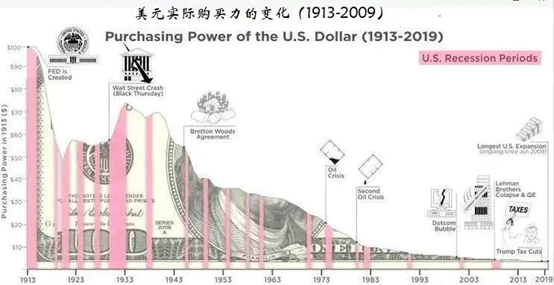
Changes in the purchasing power of the US dollar (Source: Tencent News)
Reflection
Here are my personal opinions on how to build a currency on the blockchain:
Volatility is low but allowed, and liquidity is ample;
Not forcibly linked to any legal currency;
Track supply and demand indicators for deployment;
Accepting a certain amount of Ponzi exists, making this coin a Schelling point;
There are enough application scenarios to enable real-world payments.
Floating stablecoin, f(x) Protocol
f(x) is an ETH tiered leverage protocol designed to meet the need for stable assets in the crypto space while mitigating centralization risk and capital efficiency issues. The f(x) protocol introduces a new concept called "floating stablecoins" or fETH. fETH is not pegged to a fixed value, but instead gains or loses a fraction of the price movement of native Ethereum (ETH). A complementary asset called xETH is also created, which acts as a zero-cost leveraged long ETH position. xETH absorbs most of the volatility of ETH price movements, thereby stabilizing the value of fETH.
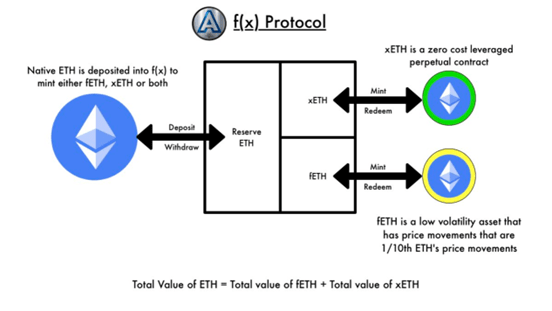
Image source:
f(x)
official
X
fETH: A low-volatility ETH asset, whose price is 1/10 of the price fluctuation of native ETH (β coefficient is 0.1). For example, today's ETH price is $1,650, and 1,650 fETH are minted, and the price is also $1,650. Tomorrow the price of ETH drops to $1,485, while the price of fETH can still be maintained at $1,633.5, and vice versa. You can also simply understand it as 90% stablecoin + 10% ETH;
xETH: A zero-cost leveraged long ETH position that absorbs ETH volatility to stabilize the price of fETH (i.e., β>1). These xETH can be traded in DeFi (through the ETH long position demand support system).
Under this mechanism, the β coefficient can be adjusted.
b
In finance, beta is a metric used to quantify the volatility of an asset or portfolio relative to the overall market. It is a key parameter in the capital asset pricing model (CAPM), which is used to estimate the expected return and risk of an asset.
Calculation method
Beta is calculated through regression analysis, usually comparing the return of an individual asset to the return of the market as a whole (usually represented by a market index such as the S&P 500). Mathematically, beta is the slope of the regression equation:
Asset return = α + β × market return
Here, α is the intercept term, which represents the expected return of the asset in a risk-free situation, and β is the slope, which represents the sensitivity of the asset to the market return.
explain
β = 1: The volatility of the asset is consistent with the volatility of the market as a whole;
β > 1: The asset is more volatile relative to the market, that is, it is likely to move more when the market rises or falls;
β < 1: The asset is relatively stable relative to the market and has low volatility;
β = 0: The asset has no correlation with market returns, usually a risk-free asset such as a Treasury bond;
β < 0: The asset is negatively correlated with market returns. Such an asset may have positive returns when the market falls, thus acting as a hedge.
working principle
The f(x) protocol only accepts ETH as collateral and low and/or high volatility (beta) tokens backed by this collateral. Providing ETH allows users to mint fETH and/or xETH, with the amount based on the price of ETH and the current net asset value (NAV) of each token. Conversely, users can redeem NAV ETH for fETH or xETH from the reserve at any time.
The NAV of fETH and xETH changes with the price of ETH, so at any time, the total value of all fETH plus the total value of all xETH equals the total value of the ETH reserve. In this way, each fETH and xETH token is backed by its NAV and can be redeemed at any time. Mathematically speaking, at any time the invariant holds:

Where neth is the amount of ETH collateral, peth is the ETH USD price, nf is the total ETH supply, pf is the ETH NAV, nx is the total xETH supply, and px is the xETH NAV.
The protocol limits the volatility of fETH by adjusting its NAV based on changes in the ETH price, so that 10% of ETH returns (for βf=0.1) are reflected in the fETH price. The protocol also adjusts the xETH NAV to exceed the ETH return by a margin to satisfy the f(x) invariant (Equation 1). In this way, xETH provides leveraged ETH returns (tokenized, with zero funding costs) while fETH exhibits low volatility, and both remain credibly decentralized.
Risk Model
In fact, under this concept, fETH needs to rely on xETH to exist. If the demand for xETH is not large enough, the 0.1β coefficient of fETH cannot be maintained, or if the volatility is too high, it cannot be maintained. Therefore, the protocol introduces a CR formula to calculate the health level of the entire system.

CR is the total collateral value divided by the total NAV of fETH, and four risk levels are set based on the percentage.
If the system's CR falls to a level where its ability to maintain βf = 0.1 is at risk, the system's risk management system will initiate four progressively more powerful modes to steer the system back toward overcollateralization. Each mode sets a CR threshold below which additional measures are initiated to help maintain overall system stability. The incentives, fees, and controls described in each mode will remain in effect as long as the CR is below its specified level, so, for example, if Level 3 is in effect, it means that Levels 1 and 2 are also in effect. They automatically resume when the CR rises back above the relevant level.
Level 1——Stability Mode: When the CR value is below 130%, the system enters stability mode. Starting in this mode, fETH minting is disabled and the redemption fee is set to zero. The redemption fee of xETH is increased, and xETH miners receive additional rewards from fETH holders in the form of a small stability fee;
Level 2 — User Rebalance Mode: When the CR value is below 120%, the system enters User Rebalance Mode. In this mode, users can earn rewards by redeeming fETH for ETH, and the remaining fETH holders pay a stability fee in a similar manner to the stable mode. In this way, users can earn slightly more than the NAV of fETH when redeeming. In this mode, the redemption fee of fETH is set to zero;
Level 3——agreement balance mode again: When the CR value is below 114%, the system enters the agreement rebalancing mode. This mode is equivalent to Level 2, except that the protocol itself can use the reserve to rebalance. This mode is unlikely to be triggered because the rebalancing actions of Level 2 are profitable and users are more responsive than the protocol, but it creates an additional layer of protection. In this mode, the protocol uses ETH from the fETH reserve to buy on the market and then burns fETH from the AMM. Using this mechanism, the NAV of fETH only reduces the rebalancing stability fee that the protocol obtains in this case;
Level 4 — Recapitalization: In the most extreme case, the protocol has the ability to issue governance tokens to raise ETH for recapitalization by minting xETH or purchasing and redeeming fETH.
Conclusion
f(x) Protocol proposes a method to create stablecoins by controlling volatility. This idea is very interesting, but it still has obvious shortcomings, because fETH can only exist when the market is relatively stable and xETH adoption is high enough. But this is indeed a very innovative idea. Blockchain wants to establish a system similar to modern credit currency under the premise of decentralization, which is bound to fail (it can only succeed under centralized conditions). Therefore, we need to focus on enough application scenarios and low volatility and liquidity. I personally think that some Meme tokens (such as Dogecoin) have the potential to develop application scenarios, and some new attempts at calculating stability are not only made by f(x). For something in its infancy, we should give a certain amount of patience and tolerance.
references
1. f(x) White Paper
2.Terra Money: Stability and Adoption
3. Denationalization of currency
4. The Lord of the Rings dream of algorithmic stablecoins: After LUNA, there will be no next UST
5. Starting with LUNA coin: Why I think the attempt of algorithmic stablecoin is doomed to fail