


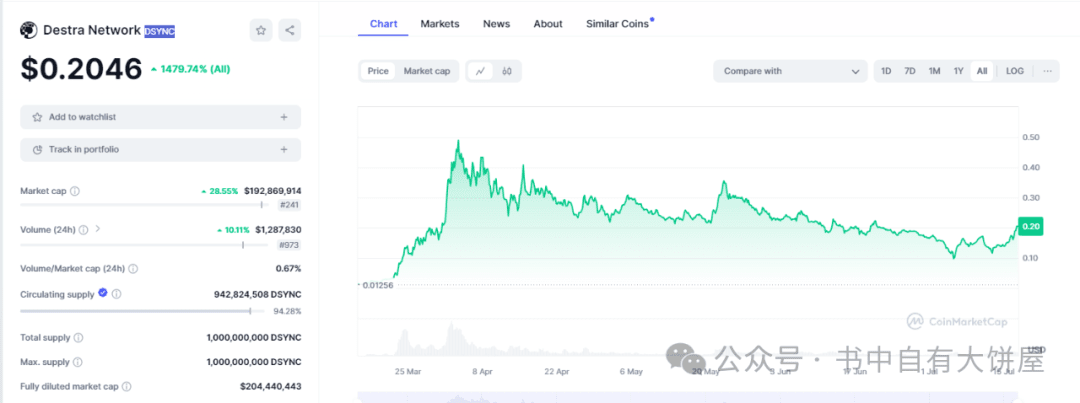
Today we continue to talk about the 200-300 range project. It has been online for 3 months and has been growing rapidly. The current exchange rate is 0.2 US dollars. When it was first launched, it was only 0.01 US dollars. The highest price has reached 0.5, which is also a 50-fold increase. The current market value is 190 million US dollars, and FDV is about 200 million. It can be regarded as a player in the Depin track called Destra Network.
Introduction
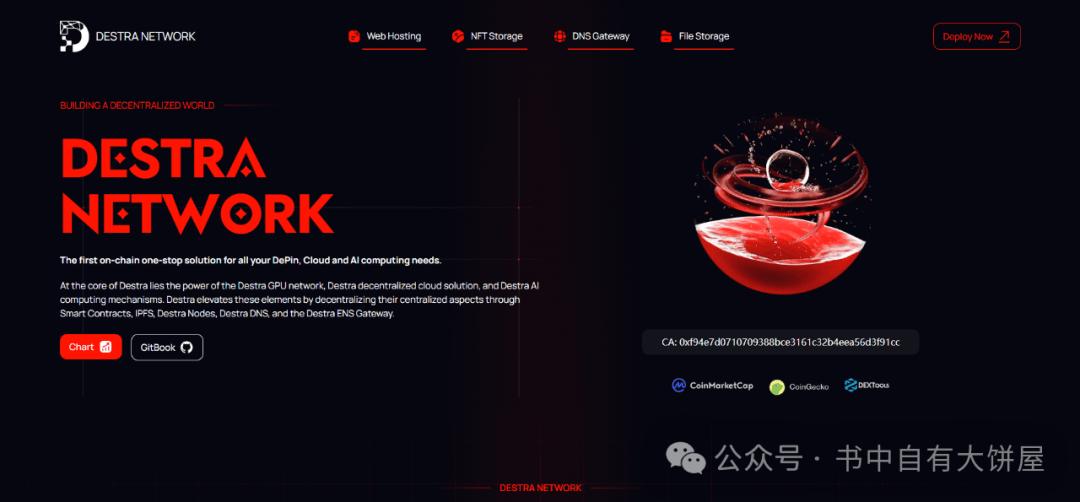
Destra Network (DSYNC) is a platform for building a decentralized ecosystem for cloud computing, artificial intelligence, and network services. It aims to solve the centralization, censorship, and privacy issues of traditional network infrastructure. Destra provides a decentralized GPU network and truly decentralized cloud solutions such as storage and network hosting. Its unique features include Destra DNS, Destra RPC, and a synchronous proof-of-sense consensus mechanism to ensure that users get a fair, secure, and censorship-resistant experience.
Three core products – “Destra GPU Network”, “Destra Cloud Solution” and “AI Computing Solution”.
1. Destra Cloud decentralized cloud solution:
The network provides the following services:
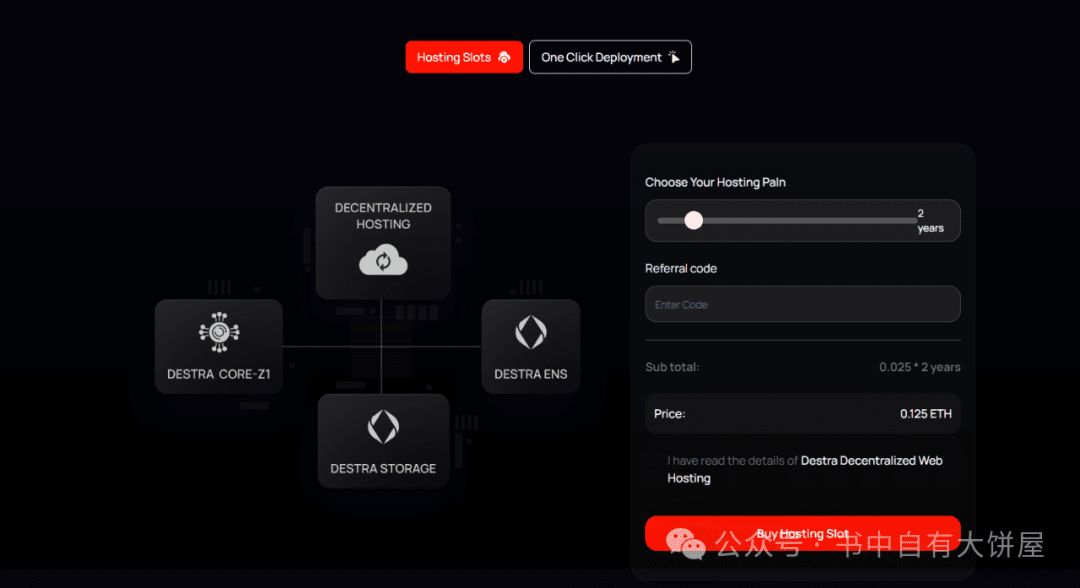
-Decentralized web hosting: Provides secure, reliable and decentralized web hosting services to ensure that website data is not affected by single point of failure.
-Decentralized Domain Names (ERC-1185): Use a decentralized domain name system based on Ethereum.
-Decentralized object storage service: Provides efficient, scalable and decentralized data storage solutions to ensure user data security and privacy.
-Decentralized ENS Gateway: acts as an extension of Ethereum Name Service (ENS).
-Decentralized DNS: Build a DNS system that is not controlled by any single entity to improve the reliability and security of domain name resolution.
-Proof of Sync Consensus: An innovative consensus mechanism used to ensure that nodes in the Destra network remain in sync while improving the stability and efficiency of the network.
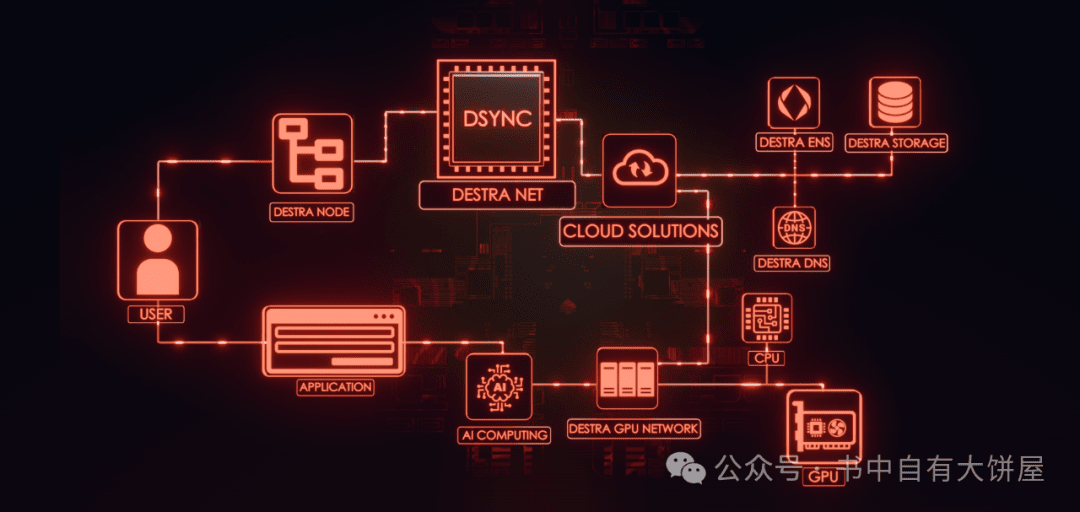
2. Destra GPU Network
On the Destra network, users’ GPU resources will be contributed to the network and rewarded for doing so. To calculate the rewards, the network uses a Proof of Sync consensus mechanism.
The Destra Network solves the centralization and accessibility issues in the current GPU resource market by providing a decentralized framework, ensuring the accessibility, security, and efficiency of resources.
3. AI computing solutions
Destra's algorithm optimizes resource allocation and traffic flow across the entire network, achieving load balancing and ensuring that every user and application gets the bandwidth, storage, and computing power they need while avoiding unnecessary waste or bottlenecks.
Architecture
- Physical layer
The physical layer consists of a globally distributed network of GPU nodes with varying computing power and capabilities, ranging from high-end GPUs in nodes built specifically for the Destra GPU network to consumer-grade GPUs in personal computers. These nodes are connected via the Destra network's security protocol, which ensures data integrity and confidentiality through end-to-end encryption and zero-knowledge proofs, minimizing the risk of data breaches.
Consensus Layer
The Proof of Sync mechanism is a key innovation in the Destra network. Unlike traditional Proof of Work (PoW) or Proof of Stake (PoS) systems, Proof of Sync aims to verify not only transaction data, but also the integrity and completion of computing tasks distributed on the network. The mechanism uses a range of cryptographic techniques, including but not limited to Byzantine Fault Tolerance (BFT) algorithms and cryptographic hash functions, to ensure the accuracy and reliability of the calculations performed by the network.
Application Layer
The application layer interacts directly with end users and developers, providing access to network resources through a user-friendly dashboard. This layer integrates advanced AI-based task routing and scaling algorithms that analyze the computational requirements of submitted tasks and dynamically allocate them across the network to optimize resource utilization and task execution time.
Token Economy
The token was launched in April 2024. It was originally a startup on Gate. The total number of tokens is 1,000,000,000. Currently, 942,824,508 are in circulation, with a circulation rate of 94%. The current exchange rate is 0.2 USD, and the peak price was 0.46 USD. However, I did not find out the distribution of the tokens. But I am more puzzled. Now that the tokens are in circulation, what will be used to incentivize users in the future? Because I did not see any relevant description in the official documents.
Finally, to summarize this project, there is no module that can provide GPU on the official website, and it should still be in the early stages, but the market value is still increasing rapidly. Then I looked at the token holders and there are 18,000 people. 1% of the tokens only have uniswap addresses, and 0.1% of the tokens have 240+. The tokens are almost all unlocked. At first I thought that the project party might have sold them all. What should I do with the subsequent projects? (No incentive) But I took a closer look at this address and found that there is still a little problem, because although the tokens of each address are different, there seems to be a little bit of pattern, that is, the difference in the number of addresses holding this token is not very large, just a little bit.
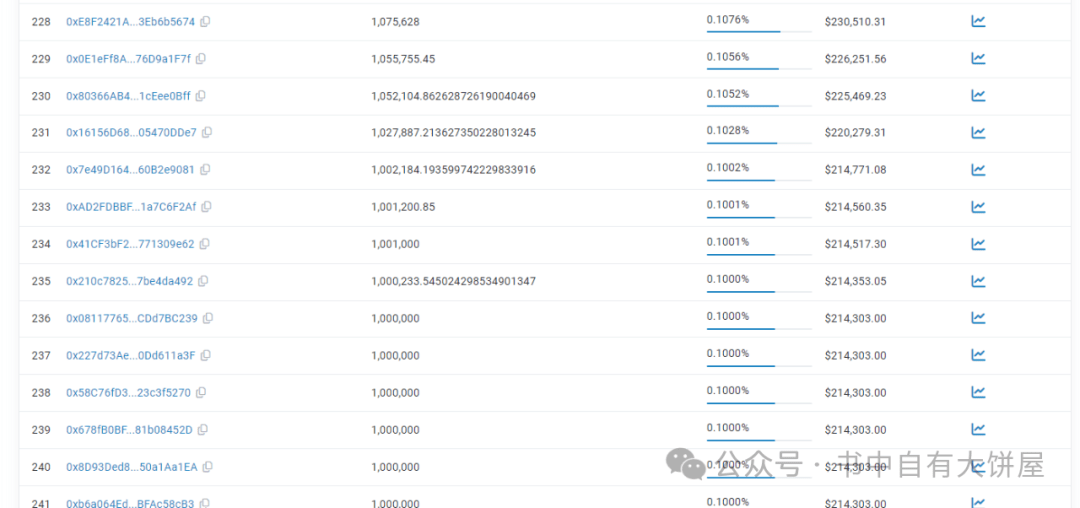
We have actually seen many addresses with tens of thousands of holders before, and the number of addresses of 0.1% is only less than 100, while this 0.1% has more than 200. If you look carefully at the distribution data, I think the project owner may have arranged hundreds or thousands of addresses and dispersed the coins. If you don’t believe it, take a closer look yourself and compare it with truly decentralized projects, such as dog coin.
Actually, I thought this project was pretty good, but when I saw the last part, I saw some clues. So whether you can get on board or not depends on your own consideration. The project owner may continue to pull you back, and you may get off at any time. At least this plate is controlled by someone else. Do you choose to pick up pennies on the highway, or do you choose to be more stable? #内容挖矿