


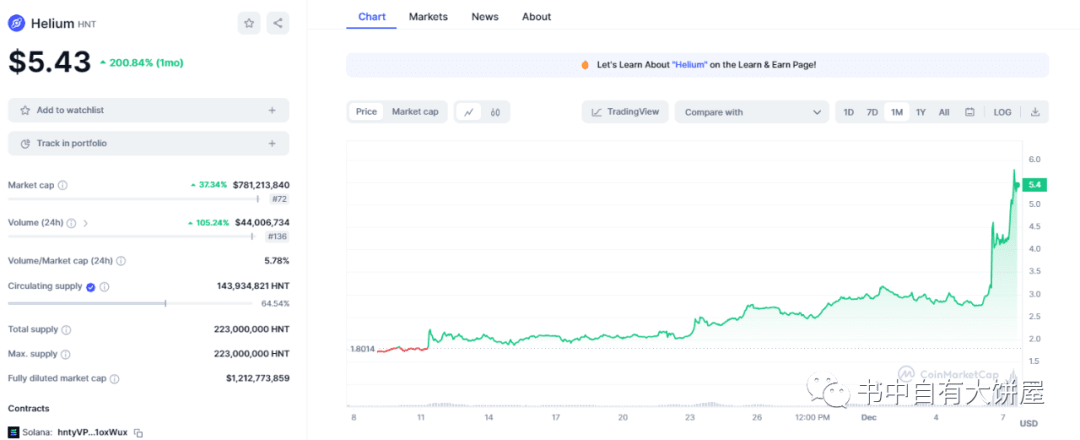
Today we continue the project analysis. Today we analyze a project in the field of IOT, HNT. It has gained momentum recently and has increased several times. Its current market value has reached 780 million US dollars, and its ranking has reached 78th, so let’s analyze it. This project is actually a very early project. It was started in 2013. However, it encountered various problems later and later transformed into a blockchain. It has also been migrated to the SOL chain.
Introduction
Helium is a point-to-point wireless network established to enable low-energy IoT devices to communicate with the Internet.
Helium is committed to allowing IoT devices around the world to have more open, broad, and free wireless network coverage.
In order to achieve this goal, Helium uses a new proof mechanism, PoC (Proof of Coverage), to provide incentives for network expansion and maintenance.
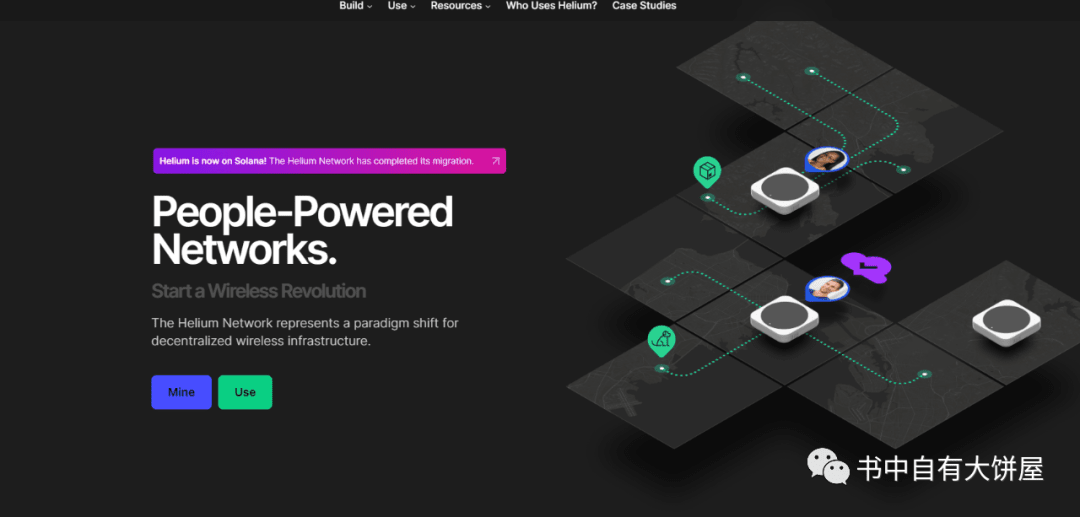
HNT is a point-to-point wireless network established for low-energy IoT devices to communicate with the Internet. Using Hotspots and other data transmitters for IoT devices, network maintainers can prove their contribution to the network through Proof of Coverage Challenges and Get rewarded with HNT tokens.
HNT tokens can generate DataCredits, which are used to pay for information and token transmission fees. The blockchain and token Helium developed a new cryptographic consensus mechanism for this network to provide incentives for network expansion and maintenance. Helium provides a practical service for extending the network to a specific geographical area, which is verified through Helium's "Proof of Coverage Mechanism". As a final result, gateways will receive tokens as a reward for their efforts in contributing verification computing power to the underlying network.
Helium was founded in California in 2013 by Shawn Fanning, Amir Haleem, and Sean Carey with the goal of transforming Internet of Things (IoT) communications. Helium's mission is to prepare IoT communications and decentralized infrastructure for the future.
Its hotspots are pieces of hardware that users can plug into, which provide network coverage within a certain radius and reward participants in the native token HNT. Once the hotspot is active, any sensor using Helium's long fiber wireless protocol can connect to the network.
Launched in 2019, the network now has more than 960,000 global hotspots, making it the world's largest LoRaWAN network (long-distance, low-rate wireless communication protocol).
LoRaWAN is a combination of two technologies, where LoRa is a way of manipulating radio waves to encode information. WAN is a low-power wide area network. The Helium network is designed to be used by battery-powered devices that can send small amounts of data over long distances, including smart pet collars, environmental sensors and bicycle trackers. Its website says there are now thousands of compatible LoRaWAN devices.
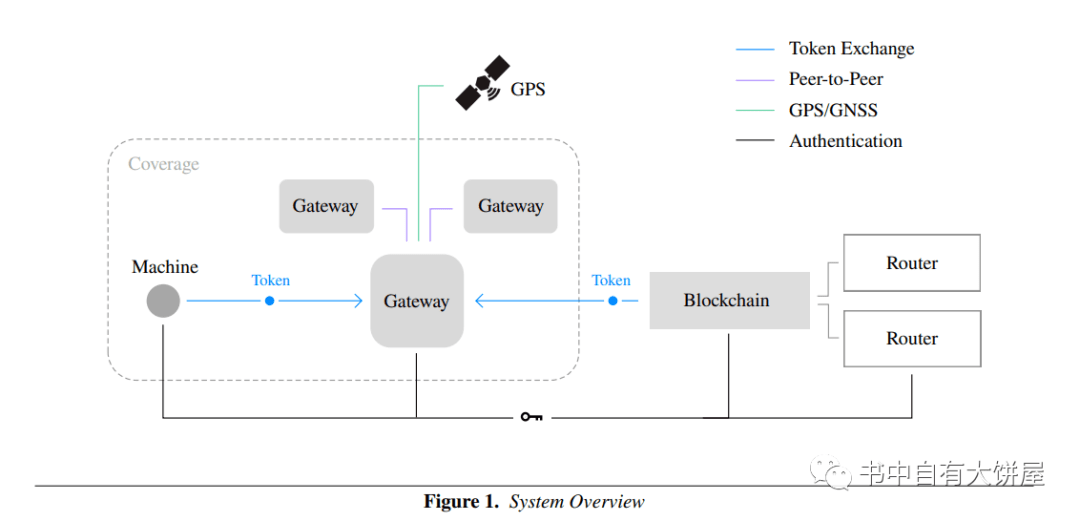
POC Consensus Mechanism Coverage Proof
Token incentives are used to encourage hotspot miners to purchase Hotspot equipment (hotspot mining machines in the Helium network), and to deploy Hotspot to provide wireless network access to nearby IoT devices. Its hotspot mining machine uses the LongFi wireless protocol (an Apache-licensed open source protocol in the Sub-GHz frequency band) to provide wireless network coverage, allowing IoT devices to use the Helium wireless network to transmit data with low power consumption.
The PoC mechanism refers to how when Hotspots are owned by different individuals, they (Hotspots) collaborate with each other to provide wireless connection coverage for the network. PoC is like an automatic detection mechanism for network health, and each Hotspot has a complete blockchain node. Hotspot will always query the blockchain to verify that the network is still valid and provides effective coverage. Hotspot will also keep asking to question the PoC team. The behavior of questioning and proving Hotspot is used to verify that Hotspot has completed effective network coverage.
In the PoC consensus mechanism, there are three main roles: challenger, challengeee and witness.
1. As a Challenger, you can challenge random hot spots in the network every 240 blocks;
2. As the challenged hotspot, after receiving the challenge information, the challenged hotspot will initiate an undifferentiated radio broadcast based on the challenge information;
3. As a witness, if it is found that hot spots around the challenger receive radio broadcasts, the information will be sent back to the Helium network for verification.
Advantages of Helium
1. Low energy consumption and wide coverage, 24-hour power consumption of 0.21 degrees, no noise, no radiation, green and environmentally friendly, no service fees are charged. If you want to increase the output of the mining machine, you can use a higher frequency antenna within a radius of 300 meters - 5000 meters. Deploy 3 or more machines within the limit. This makes it easier for hotspots to participate in PoC to obtain higher profits. In addition, 30% of the rewards will be given to real data transmission. If there are local Helium-based IoT applications, the mining machine must be kept online. Because the switch will consume GAS fees, changing the geographical location will also charge GAS fees.
2. POC consensus mechanism, its official website also provides hotspots for purchase, so you can also understand it as a public chain for POW mining, but its electricity bill is very low, and it does not mean that the more equipment, the better, because it The consensus is that all hotspots within 300 meters will have reduced returns, so the distance between them must be more than 500 meters to get better returns.
3. Wireless communication protocol LoRaWAN supports two-way communication. Supports unlicensed sub-GHz frequency bands, allows the creation of multiple channels, supports switching between channels, reduces network interference, and increases data transmission speeds
team
Helium was co-founded by Napster founder Sean Fanning and Quake 3 world champion and video game developer Emile Halim. They came together to create a way to make it easier for the Internet of Things to connect to the Internet. Sean Fanning is the founder of Napster, the world's first popular P2P file sharing platform. The Napster he created was the first software to use the P2P network for MP3 format music sharing, which caused quite a sensation at the time. The Helium team foresaw the development trend of the Internet of Things in 2013, and then re-integrated blockchain technology in 2018 to apply the economic model to the entire ecological development.
Financing
In 2021, it completed US$111 million in financing through Token sales. Helium completed a US$200 million D round of financing in early 2022. Participants included well-known institutions such as Tiger Global and a16z, with a post-investment valuation of US$1.2 billion.
Helium’s dual-token model
HNT meets the needs of two major players in the Helium ecosystem:
Hotspot hosts and operators. Hosts are rewarded with network tokens such as IOT or MOBILE when deploying and maintaining network coverage. These network tokens can be redeemed for HNT.
Data Credits (DC) are realized through data transmission. Network connection Helium network users need to pay data credits DC to obtain data traffic. DC is obtained by destroying HNT. Consumption of data credits means the destruction of the corresponding amount of HNT. HNT cannot be regenerated after destruction. . The value of flow points is fixed at $0.00001 and is non-transferable, that is, 1DC = $0.00001. The amount of HNT burned corresponding to one flow point depends on the market price of HNT.
For example, for a LongFi device transmitting every five minutes, using the Helium network would cost approximately $1.04 for a year. HNT is generated by gateway device mining. Miners obtain HNT by providing effective network coverage, participating in PoC challenges, joining consensus groups, etc. The greater the data transmission volume on the network provided by miners, the higher the score in participating in the challenge and the chance to obtain it. More HNT earnings. The total circulation starts from the genesis block, with 2.5 million HNT mined every month. The output is halved every two years, and 223,000,000 HNT is mined in 50 years.
Token economy
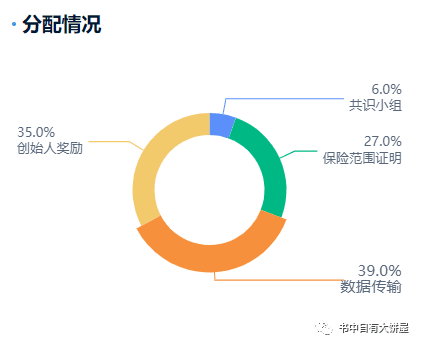
The total number of tokens is 223,000,000, of which 143,934,821 are currently in circulation, with a circulation rate of 64%. The current currency price is 5.4 US dollars, and the peak price was $55.3568 (2021-11-13), so it is also 90% lower. In terms of token distribution, 35% is given to the founders, and the rest are given as rewards, but the proportion given to the founders is a bit high.
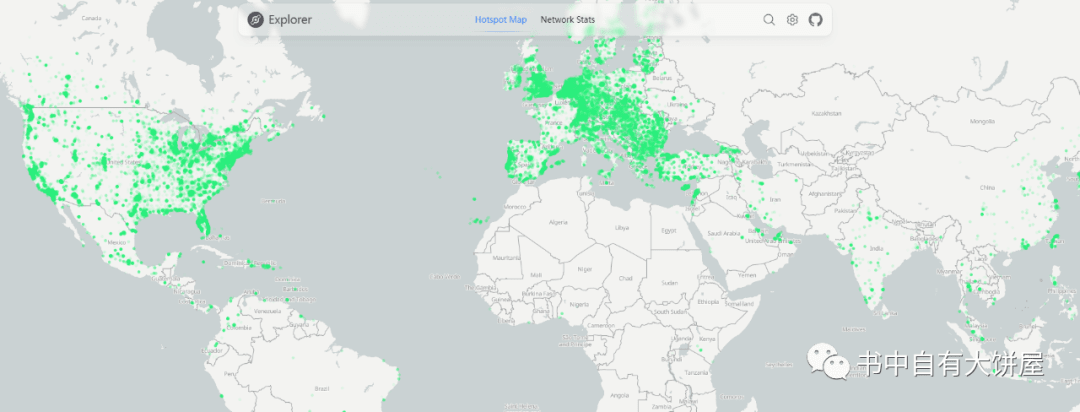
Finally, we summarize this project. This should be regarded as the leading project in the Internet of Things depin track. I have talked about the IOTA project before. IOTA is responsible for the infrastructure of the Internet of Things, while HNT is responsible for the wireless base station to help this project. The Internet of Things device can find the transmission network, so it needs to lay a large number of hotspots. Now that you have laid so many hotspots, you can apply them. Currently, there are many partners on the official website, almost There are more than a dozen application providers, so it depends on the development of the industry. Of course, this idea is very good. Low-cost hotspots can provide Internet of Things devices everywhere. However, if you look at the hotspot map of devices, they still tend to be in the Middle East, and there are very few in China, because China is an infrastructure maniac. China Mobile and China Unicom have base stations everywhere, and there are quite a few in the United States. There may also be some policy reasons. On the industry track is the field of Internet of Things, which is very big. There is no problem in the field, but it still depends on the development. However, the Internet of Things, which has been called for so many years, has actually been developing relatively slowly recently. Today I learned about another leading project on the depin track.