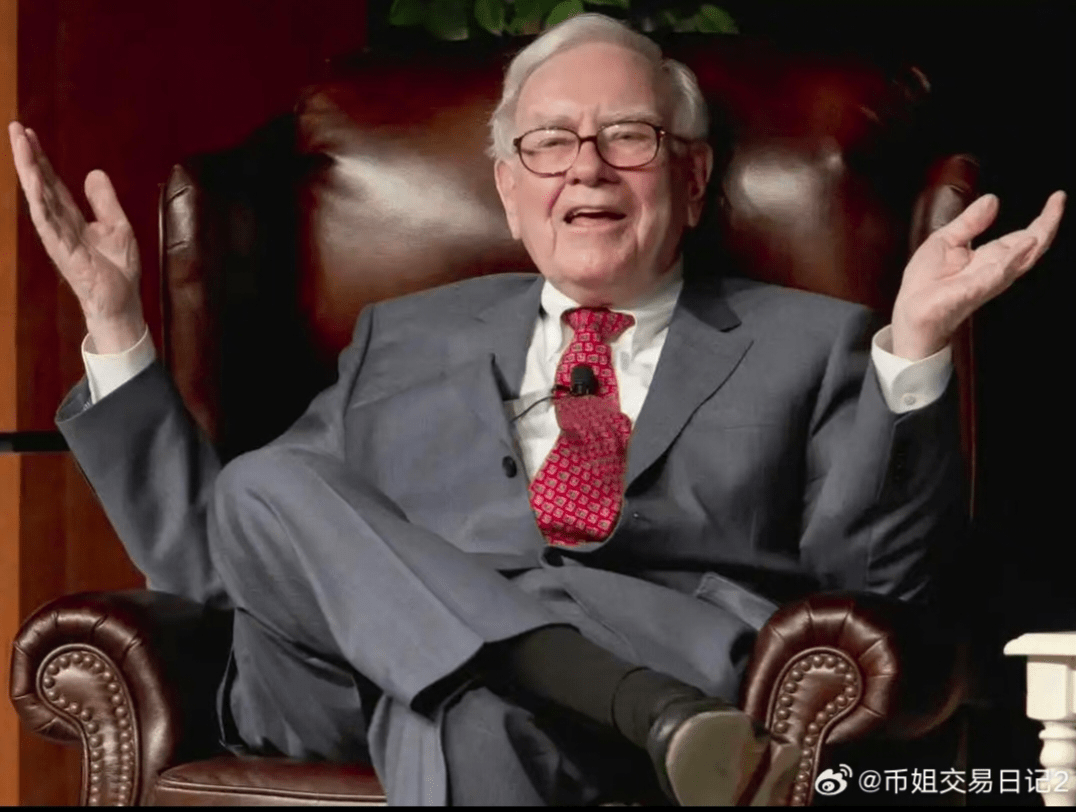
(This article will break your original understanding of long-term investment, take a screenshot and see)
Investors generally divide their investment into three categories: short-term is intraday trading, medium-term is swing trading, and long-term is what Buffett calls value investing.
The definition of short-term is very simple. It does not consider the upward cycle or the downward cycle, but only makes money from short-term glitches, which is the source of short-term profits.
The mid-line is to bet on the direction, also known as trend trading. Go long in the upward cycle and short in the downward cycle. This is the mid-line operation strategy.
Buffett is the originator of long-term investment, but many people have misunderstandings about the so-called long-term value investment. They think that holding it for a longer period of time is long-term investment, and holding it for a long period of time or a bull market is long-term investment.
But actually, how did Buffett do it?
First of all, the market that Buffett chose is the U.S. stock market. The U.S. dollar is destined to be over-issued in this market, and after the over-issuance, the money will flow back to the U.S. stock market. Anyone who uses Buffett’s strategy in the U.S. stock market will make money.
But what if you try this strategy in the Japanese and European markets?
So does Buffett take a long-term approach, holding on to the up cycle as well as the down cycle, or does he cash out at the top of the up cycle and deposit the cash in a bank?
Actually, it is not. For Buffett's long-term investment, he will always hold a certain proportion of cash. This is like a football game, there will be a group of substitutes, which is indispensable.
So what does Buffett do during up and down cycles?
When the upward cycle reaches the top, he will not sell for cash, but will still invest in the company, but the direction has changed.
Just like now, the US stock market is at a high level, and he will not take over at a high level. He hopes that someone will come in to take over, but at the same time, he goes to Japan to buy a large number of cash cow companies.
The characteristic of this cash cow enterprise is that it is not affected by cycles and can continuously bring in cash flow. On the one hand, this will ensure that when the market enters a downward cycle, there will be sufficient cash flow to support low-price purchases. On the other hand, it can help find new suppliers for the United States.
So, have you discovered? Buffett has three principles for long-term investment:
1. Long-term investment starts from the primary market
From a businessman's perspective, you should do whatever it takes to understand the company's operating process, and then buy the process directly, just like buying a piece of land and building a house yourself, instead of waiting for the developer to build it before buying it.
This is the most cost-effective way
Long-term investment is about perseverance to make money. The competition is about who has the best cost. Otherwise, you will not be able to hold on to the high position.
Therefore, most secondary markets are not suitable for long-term investment, and their cost is lower than that of primary markets (except for the rising market of US stocks).
2. Always hold a certain percentage of cash
This is the army's reserve team, the football field's reserve team
You can always use it to hedge against a pullback when the top is overvalued.
Otherwise, it will be like a team without substitutes. Once something goes wrong and a replacement is needed, it is doomed to lose if no one can be found.
3. When the market is going up, choose companies with strong growth potential, and when the market is going down, go back to cash cow companies.
It is equivalent to flipping a birdcage, not leaving the market, but adjusting the position.
So to sum up, if you think about it carefully, there is actually no distinction between short-term, medium-term, and long-term for professional investors. It seems that they can make profits from all aspects, it only depends on the market, stage, and opportunity.
Short, medium and long are essentially meant to constitute an investment system, just like a three-legged tripod.
Investors are not afraid of short-term floating losses, but they are afraid that the capital chain will be broken, or if all three legs of the three-legged tripod are broken, then everything will collapse.
Otherwise, the game will go on and on and never end.