Today we are going to talk about a project, and we will talk about it in order of market value as we talked about before. It is TON, and its current name is The open network. Its original name is Telegram Open Network, which is a blockchain developed by Telegram. After the project was abandoned, it was handed over to the community and renamed The Open Network.
Telegram CEO Pavel Durov and his brother Nikolai founded Telegram Open Network in 2018. After failing to register an ICO’s $1.7 billion token sale, the SEC ordered Telegram to stop selling $GRAM, a token previously associated with the TON blockchain.
In May 2020, founder Pavel Durov announced the end of Telegram's participation in blockchain development and began issuing refunds to early investors. In 2020, after a lawsuit was filed in court, the Telegram team agreed to a settlement with the SEC and was forced to stop its work on The Open Network.
So TON, like Libra launched by Facebook in the early years, are brothers in the same boat. They were both stopped by the SEC. Then the Libra faction split and the APTOS we know now was founded by people from the previous Libra team.
TON is a PoS layer 1 network. It can be infinitely sharded and achieve millions of TPS, carrying billions of users, smart contracts, and decentralized applications. TON can access other blockchains and connect different blockchains to each other through original HyperCube technology.
As usual, let’s talk about its white paper. There are many white papers, more than 130 pages, and there are no pictures in the whole text, it is all text. The old rule is that if you want the full series of white papers, you should still go to the official account: there is a big cake house in the book, and you can get it by replying to the white paper.
Features of TON
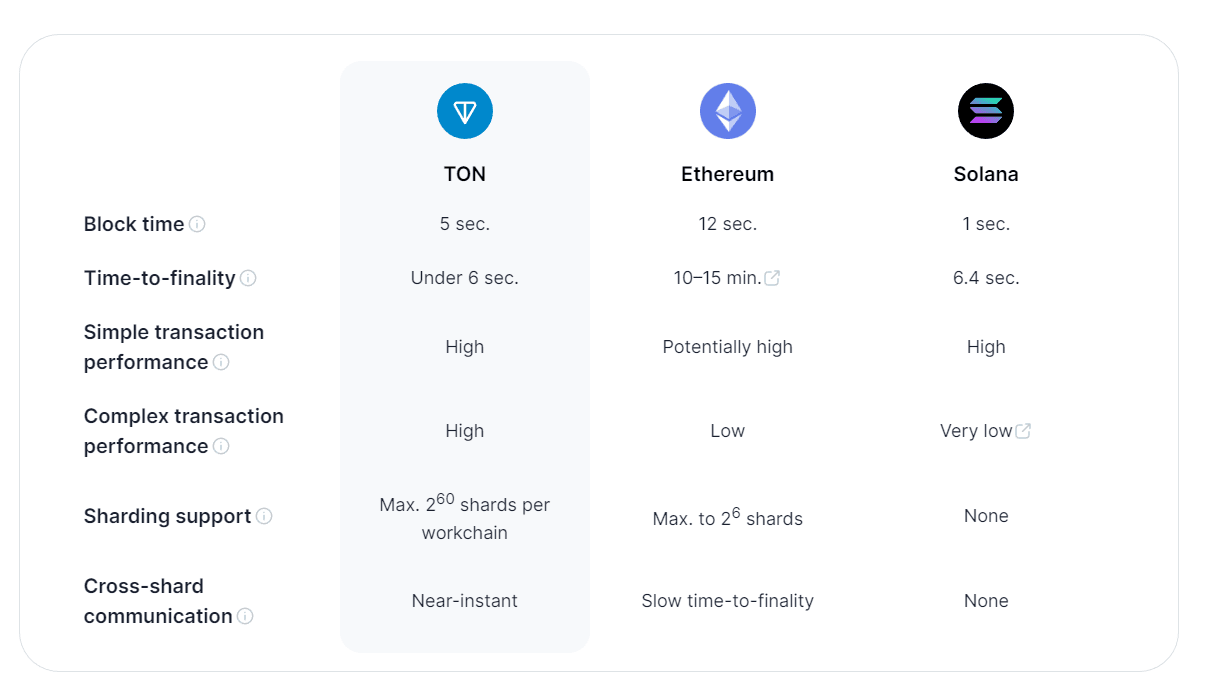
1. Multi-chain: TON is similar to recent popular cross-chain projects such as Cosmos and Polkadot, both of which are multi-chain architectures. On TON, there are heterogeneous multi-chains including the master chain and the work chain (the work chain can be up to the 92nd power of 2), as well as the heterogeneous multi-chains of the work chain and the shard chain. Constructing multiple chains, each working chain can define its own exclusive protocol, making the services that the entire TON network can support full of infinite possibilities. Among them, workchain and masterchain share verification nodes. By introducing a main chain for endorsement, TON shortens the transaction confirmation time to a new block, which is 5 seconds.
Sharding: The white paper shows that in the TON system, the workchain is not the smallest unit. It can be subdivided into 2 to the 64th power of shard chains, and these shard chains are all isomorphic multi-chains. TON's vision is to have unlimited sharding and be able to automatically shard or merge when the load becomes too high. In the updated version of the white paper, a technology called "instant hypercube routing" is introduced, which is "designed to ensure that transactions are processed quickly despite the large scale of the system."
2. Tight coupling: This refers to the tight coupling between workchain and shardchain. Tight coupling relies heavily on the correlation of modules, and also has high requirements on the system's ability to handle transactions. Therefore, under the premise of sharding, tight coupling in the blockchain only makes sense. The reason why EOS and Polkadot are loosely coupled is because they have no sharding. ETH 2.0 is a good example of tight coupling. This approach also increases its scalability.
3. PoS+BFT: The consensus algorithm used by TON is the same as that of Cosmos and Polkadot. According to the white paper, becoming a node does not require permission, and only requires a certain number of tokens and ordinary IT operation and maintenance capabilities. There are four roles in the TON network: Validator, Nominator, Fisherman, and Collator. Malicious validators will be punished by slashes; in addition, the blessing of the BFT consensus mechanism It ensures that consensus will not branch and is more suitable for "tightly coupled" multi-chain architecture.
4. Anonymous protection of account privacy (this is very important): TON Proxy (network proxy/anonymity layer), one of the components of the TON blockchain, is used to hide identities and create decentralized virtual private networks (VPNs) to protect online privacy.
6. Smart contracts (new language Fift): In May 2019, co-founder Nikolai Durov announced a new language called Fift on May 23. This language is specifically used to develop and manage TON blockchain smart contracts and interact with the TON Virtual Machine (TVM). In turn, TVM executes smart contract code in the TON blockchain, supporting all operations required to parse incoming messages and persistent data, as well as create new messages and modify persistent data. Tooz said its role is similar to Libra's Move.
Blockchain structure
The entire TON blockchain network consists of a unique main chain and several working chains.
Each work chain can define its own protocol. Users in each work chain cannot communicate with each other. The work chain can start running after being registered on the main chain.
TON supports up to 2^32 work chains. In the initial state, there is only one work chain of each type. When the load (transaction volume) of a working chain continues to be greater than a certain threshold, it will automatically be split into two shard chains. Sharding is performed based on the prefix of the user account. Users with the same prefix will be arranged under the same shard. Each work chain can support up to 2^60 shards. In the same way, when the load of two adjacent shards continues to be less than a certain threshold, the shard chains will be automatically merged. This is how TON achieves automatic expansion and contraction.
TON initially includes a zeroth work chain to carry TON's currency - TON Coin.
Then let’s take a look at its ecosystem. There are currently more than 500 apps. But none of them are star projects that we are familiar with, so this is quite embarrassing.
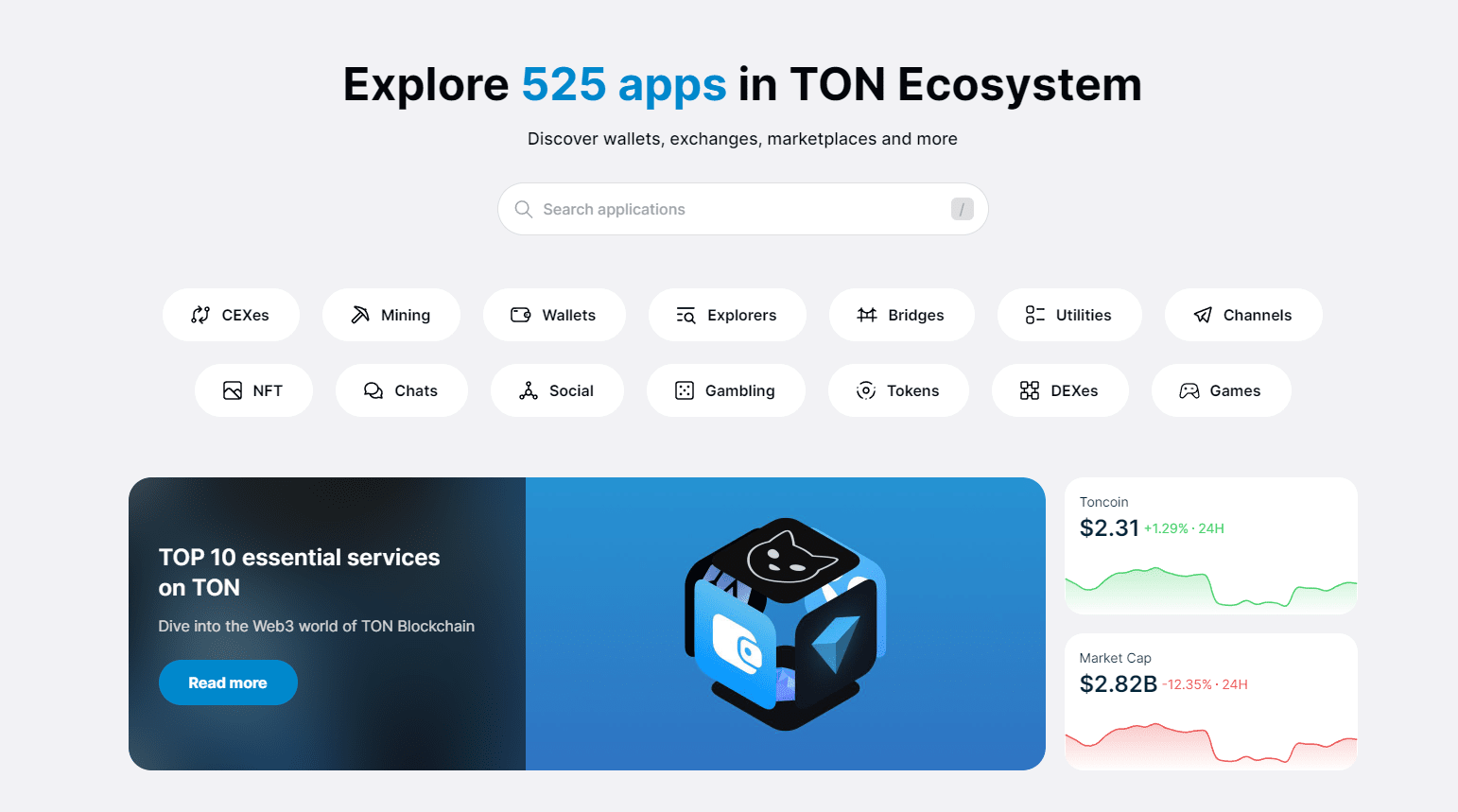
Finally, let us summarize. Although the current market value of TON is still in the top 30, with about 3 billion US dollars, after its main creative team Telegram gave up the development of this project, although during the period from 20 to 21, there was a A small team of open source developers - NewTON - dive into TON's codebase, architecture and documentation. They resumed active development of TON to comply with the design detailed in the original TON documentation.
Because Telegram originally planned to develop TON for use by its own Telegram, but now the official has given up, and there is no such a large application platform and such a large user traffic, so it is still a pity. The second comparison is that the initial vision of TON was officially written by Telegram, and the subsequent teams also studied the previous things and worked hard to restore them, but after all, they accepted it, not to mention fully understanding TON’s previous vision and technical architecture. , there will always be deviations.
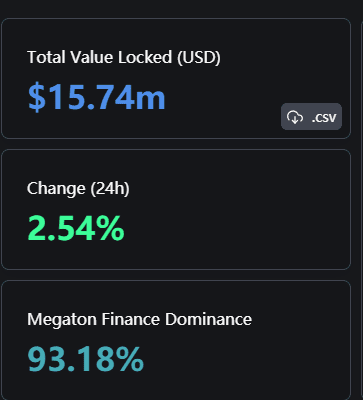
Third, I checked the data and found that the current locked-up amount of TON is also very low, only 15 million US dollars. You have to know that even EOS, a public chain that is almost rotten, has a TVL of more than 100 million US dollars.
Although its speed, sharding technology, etc. may still have been very powerful at the time, the public chains coming out now are very fast, such as SOL, AVAX, sharding and other near, etc., if it were not adopted at that time If the SEC blocks it, then it is possible that it can still develop well. So, in short, this project is quite a pity.