

Written by: Jaleel, BlockBeats
Editor: Jack, BlockBeats
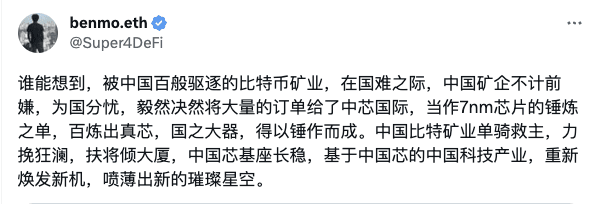
The news of Grayscale's victory in its first battle against the SEC was still brewing on the other side of the ocean, but the release of Huawei's new generation flagship phone Mate 60 Pro instantly made the technology market boil. A piece of news about a Chinese mining company "single-handedly saving the day and promoting the development of SMIC's 7nm chips" spread in the community.
The views of Super Jun from the Benmo Community on this matter have brought the story of SMIC's 7nm chip to a new climax in the cryptocurrency circle. There are even online articles claiming that the early orders provided by domestic mining companies to SMIC have made it a "training hero" for domestic 7nm chips.
In this regard, BlockBeats interviewed several chip industry practitioners. Avalon-related people responded that the online rumors were exaggerated, and Bitmain declined to comment. Another practitioner said that the relevant descriptions in the online article were "only 30% true." In addition, an employee who previously worked in Huawei's chip sales said that the components used in mining machines are actually not large in size, and the online rumors are a bit exaggerated. "To be honest, just because a company gives you an order does not mean that you can survive stably."
Although the early orders provided by crypto mining companies to SMIC did not play a decisive role in the development of 7nm chips as everyone imagined, it is undeniable that in the past decade, crypto mining companies have indeed had varying degrees of impact on the chip industry in various aspects.
SMIC's 7nm technology emerges, bringing mining companies back into the public eye
There are also market rumors behind Huawei's new product launch that due to technical issues with SMIC's 7nm chips, its final output may be limited. The industry has not yet clarified whether SMIC's N+1 and N+2 processes are equivalent to the 7nmT process on the market. But the industry has reason to believe that its N+1 process should be equivalent to the 7nm LPE process, while the N+2 process is comparable to the 7nm LPP process.
As the only company in China that can mass produce 14nm FinFET technology, SMIC's N+1 and N+2 processes are derived from the further optimization of 14nm FinFET technology. Using DUV lithography technology, SMIC has successfully circumvented US technology sanctions. Although the most advanced process currently uses EUV lithography, there are still companies exploring improvements based on 14nm, such as Apple, although its experimental results did not meet expectations and was dubbed "electronic waste" by the industry.
For 5nm technology, although the technical barriers of its process are not absolute, its yield is a huge problem. Recall that Samsung only has a 60% yield rate under 7NM technology, which means that up to 40% of products need to be eliminated. If it is possible to jump directly from 14NM technology to 5NM, the yield challenge may require huge funds and time to overcome.
The choice of technological process determines the upper limit of the product. Although this may not affect marketing, for experts in the industry, choosing a process without paying attention to power consumption is no different from deception.
BlockBeats also interviewed Maxwell on the question of whether SMIC's 7nm chips can be mass-produced. In the interview, Maxwell said that the development of 7nm chips is very difficult and is indeed a bottleneck. But in 2021, SMIC's N+1 7nm technology has matured and is preparing for large-scale use. Now two years have passed. As Huawei's foundry and also a top company in the domestic chip industry, with order demand, SMIC will not have no progress and breakthroughs. So the current mass production news is well-founded.
According to the MinerVa Semiconductor website, this IC started shipping as early as July 2021, from which it can be inferred that SMIC was able to mass-produce the 7nm process in early 2021. After Huawei launched the Mate 60 without any preheating, the mining companies that had disappeared for a long time once again came into our sight.
What impact do mining companies have on the chip industry?
Just as the blogger in the technology and digital circle said, mining machines are the most suitable orders for Fab to practice. SMIC's 7nm chip really has to thank the miners for their unintentional success.
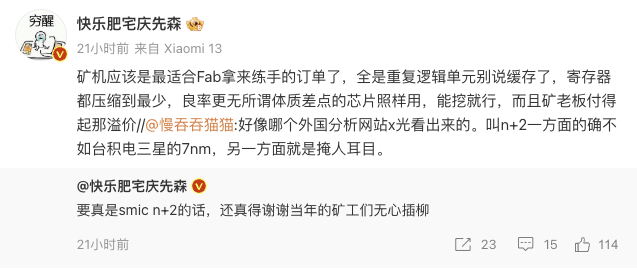
Then the community members also began to recall the past. In 2021, the Federal Reserve launched unlimited QE, and virtual currencies began to soar. The mining bosses disliked the low computing power/energy consumption ratio of traditional graphics card mining, and ordered special mining machines from special mining machine manufacturers. At that time, TSMC and Samsung were both guaranteeing supply to N A, and they didn’t look down on them at all. So the mining machine factory found SMIC, which had just successfully tested 7nm. This 7nm process should be far inferior to Samsung’s 8nm in the same period. It is an extreme process improvement version of duv 14nm. But in this strange economic environment, SMIC finally delivered the goods to the mining machine factory (the money earned can cover the low yield). So, this somewhat unintentional move, 7nm began to be continuously updated, and finally gave it to the K9000s on Huawei mate60pro today! It is a breakthrough.
Since the advent of mining machines, this market, which has been basically monopolized by China, has formed a four-way competition: Canaan Creative, Bitmain, MicroBT, and Ebang International.
Bitmain was co-founded by Wu Jihan and Zhan Ketuan in 2013. In a short period of time, it launched the Antminer S1 mining machine based on the 55nm chip BM1380, which opened its rapid growth path. In 2014, it further launched the Antminer S3 mining machine based on the 28nm chip BM1382. In addition, the company also provides many mining-related services and products.
In 2011, Zhang Nangeng appeared on the Bitcointalk forum under the name "ngzhang" and soon launched China's first FPGA mining machine - Icarus and Lancelot. As a result, he was affectionately called "Pumpkin Zhang". When "Butterfly Labs" announced the development of ASIC mining machines in 2012 and claimed that it was only for its own use, Zhang Nangeng decided to enter the market in person to stop the monopoly of Bitcoin computing power. He gave up his studies and concentrated on the research and development of ASIC mining machines. In 2013, he founded Canaan Technology and launched Canaan's first ASIC mining machine - Avalon. After various efforts, in 2019, Canaan successfully landed on Nasdaq and became the "first domestic mining machine stock".
MicroBT was founded in July 2016. Compared with the other three companies, MicroBT was the latest to enter the market. MicroBT's founder Yang Zuoxing actually entered the mining circle as early as 2014. After experiencing the "Baked Cat Runaway" incident and the "Bitmain Equity Dispute" incident, he decided to start MicroBT. The market share of its mining machine brand "Shenma Miner" has soared since its launch. With its high cost-effectiveness, it has begun to compete with Bitmain. In December of the same year, its developed 28nm chip BT1000 was officially taped out. In April 2017, MicroBT's Shenma M3 mining machine was officially mass-produced, and the sales of the first batch of M3 mining machines were nearly 10 million yuan.
The story of Ebang International began in 2010. Initially, the company was mainly engaged in the communication equipment business, but its founder Hu Dong had a keen interest in Bitcoin very early on. In 2014, when the communication industry was in a trough, Ebang International began to get involved in the mining machine business. After nine versions of improvements, it finally successfully launched mining machine products in 2016. After successfully listing on the Nasdaq on June 26, 2020, it became the "second domestic Bitcoin mining machine stock", and now has gradually disappeared from the market.
Blood transfusion chip "volunteer"
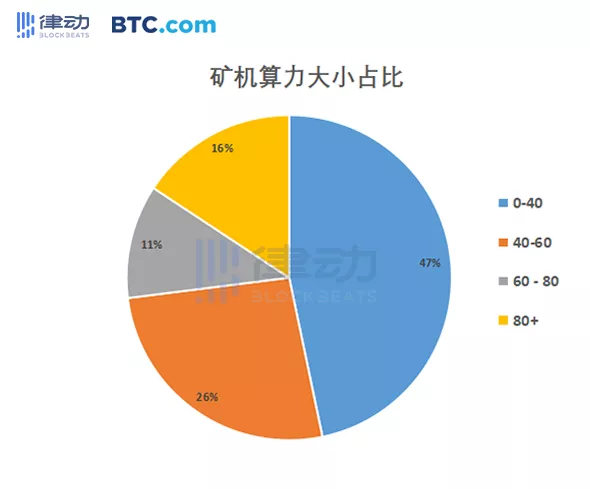
By the end of 2020, BTC.com's global computing power statistics revealed an interesting fact: in recent months, computing power above 80TH/s has accounted for 16%, while computing power mining machines above 60TH/s accounted for 27%. This means that the new generation of 7nm or 8nm Bitcoin mining machines have been put into use in large quantities.
Related reading: "2020 Mining Ecosystem Review: Changes in the Mining Machine Market Landscape"
The chip manufacturers behind the scenes also form a three-way competition: TSMC, Samsung and SMIC.
In January 2013, the birth of the Avalon mining machine meant a significant increase in computing power, and even led the entire industry into the ASIC era. It was also in this year that Bitmain emerged and quickly emerged, and formed a close cooperative relationship with TSMC.
For a long time afterwards, while the global market is facing a chip shortage and supply exceeds demand, TSMC has endless business. Behind all this, it is inseparable from the power of Bitmain. As early as the second half of 2017, Bitmain became TSMC's second largest customer in China and was included in TSMC's list of major customers, receiving a large number of orders from Bitmain every year.
In 2021, TSMC released its fourth quarter and full-year financial report showing that its revenue reached $15.74 billion, setting a new record. It is worth noting that Bitmain placed an order with TSMC for 50,000 chips in the second half of that year, which is expected to bring in $1.2 billion in profits. At that time, some media reported that TSMC attached great importance to this, and even TSMC executives went to Japan to purchase key equipment for the order.
However, with the decline in Bitcoin prices and restrictions on mining in China, Bitmain's orders have decreased, which has had a certain impact on TSMC's operating performance. Despite this, Bitmain is still a major customer of TSMC and remains in the top ten.
Let's talk about SMIC's 7nm chip behind Huawei's new generation flagship phone Mate 60 Pro. In 2020, SMIC officially announced for the first time that its products would be used in mass-produced cryptocurrency mining machines. According to reports at the time, the 14nm mining machine chip that SMIC and Canaan Technology cooperated on had completed testing and would be mass-produced and shipped in the second quarter of 2020. The specific chip type may be a small currency mining machine. The highest chip process that SMIC could provide that year was 14nm, and it is expected to start trial production of 7nm in the fourth quarter of 2020.
According to industry insiders, 2020 is not the first time that SMIC has tried to enter the mining machine field. As early as the beginning of 2018, SMIC had cooperated with well-known people in the Dongguan currency circle, but due to the sharp drop in the price of Bitcoin, investors withdrew their capital. Although the chip was designed, it was not mass-produced. SMIC has been actively entering the mining machine industry and has also cooperated with other mining machine manufacturers, but there is no mainstream mass-produced model.
Low-voltage chip "pursuer"
The core technologies of mining chips at that time were in two major directions:
First, the calculation of SHA256 is in full customization mode. The so-called full customization does not mean that the circuit is synthesized through hardware description language, but the macro modules of SHA256 calculation are manually customized directly through NAND gates, and then these macro modules are copied tens of thousands or even hundreds of thousands of copies in the same chip, so as to achieve high-speed processing capabilities;
The second is low voltage technology. Since Bitcoin chips need to work all the time, shutting down the clock (clock gating) and partially shutting down the power (power domain) are useless, and low voltage is one of the core technologies of Bitcoin chips; the chip dynamic power consumption is the square of the operating frequency (F) and the power supply voltage (VCC^2); the frequency cannot be reduced, and if it is reduced, the mining will be slow; so low voltage is the core technology of Bitcoin chips.
At that time, Canaan Technology also published a statement saying that it had noticed that process technology is only one factor affecting chip performance. Therefore, Canaan Technology has made a lot of efforts in the fields of low voltage, standard circuit unit design and optimization, high-performance computing, and cooling solutions, and has accumulated a large amount of underlying technology.
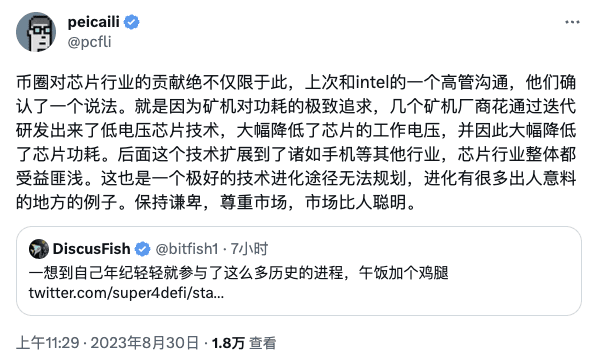
Bitcoin miner peicaili (@pcfli) believes that low-voltage technology has also been expanded to other industries such as mobile phones, benefiting the entire chip industry.
NVIDIA graphics card "savior"
On May 19, 2017, the price of Ethereum broke through the $100 mark for the first time, and a new round of crypto bull market was about to start. In this bull market, the most impressive thing is the prevalence of ICO.
It was also during this period, from 2016 to 2018, that Nvidia’s market value grew from $14 billion to $175 billion. The value of this Silicon Valley giant increased tenfold in two years, shocking all investors. In 2017 alone, Nvidia’s operating income reached $9.714 billion, a month-on-month increase of 40.58%. It is no exaggeration to say that the 17-year crypto bull market has brought Nvidia a very generous and considerable return.
Ethereum uses the Ethash encryption algorithm. During the mining process, it is necessary to read the memory and store the DAG file. Since the bandwidth of a computer each time it reads memory is limited, and it is difficult for existing equipment to make breakthroughs in this technology, no matter how miners increase their computing power, mining efficiency will not be significantly improved. This is also This makes Ethereum’s PoW mechanism “ASIC resistant”.
It can be said that Ethereum, the world's largest decentralized development network, has created an extremely huge market for Huang Renxun's graphics card sales, and even helped completely rewrite Nvidia's life curve.
Nvidia launched the GTX 1060 6GB graphics card with no output interface for Ethereum mining. The first batch of 300,000 units were supplied, and later even the market supply of normal graphics cards with output was stopped. At the end of the year, the performance of graphics cards was optimized, and a series of professional "mining cards" with stronger computing power and lower prices, such as P106 and P104, were launched. This series of graphics cards does not even have IO output interfaces, and users cannot even use them to play games.
In order to seize the chip supply in the mining market, Nvidia even went so far as to work closely with its arch-rival AMD to accelerate the research and development and production of "mining products."
In 2018, Nvidia’s CFO publicly disclosed the fact that he made money by selling “mining cards”, and Huang Renxun revealed his “interest” in the mining industry in his words: “Nvidia actually has some control over the purpose of users buying GPUs... We must pay attention to its existence (users buying graphics cards for mining) and ensure sufficient inventory to deal with it.”
When Ethereum also ushered in the second mining boom, Nvidia was not surprised and did not miss the start of a new round of bull market. It went out again. Under the pressure of global chip shortage and player demand, it developed the CMP series of mining cards for graphics card miners. In order to obtain the highest mining efficiency, CMP directly abandoned the graphics processing function. Later, under pressure, it announced that the newly launched GeForce RTX 30 series graphics cards would limit mining performance, causing graphics card prices to rise again.
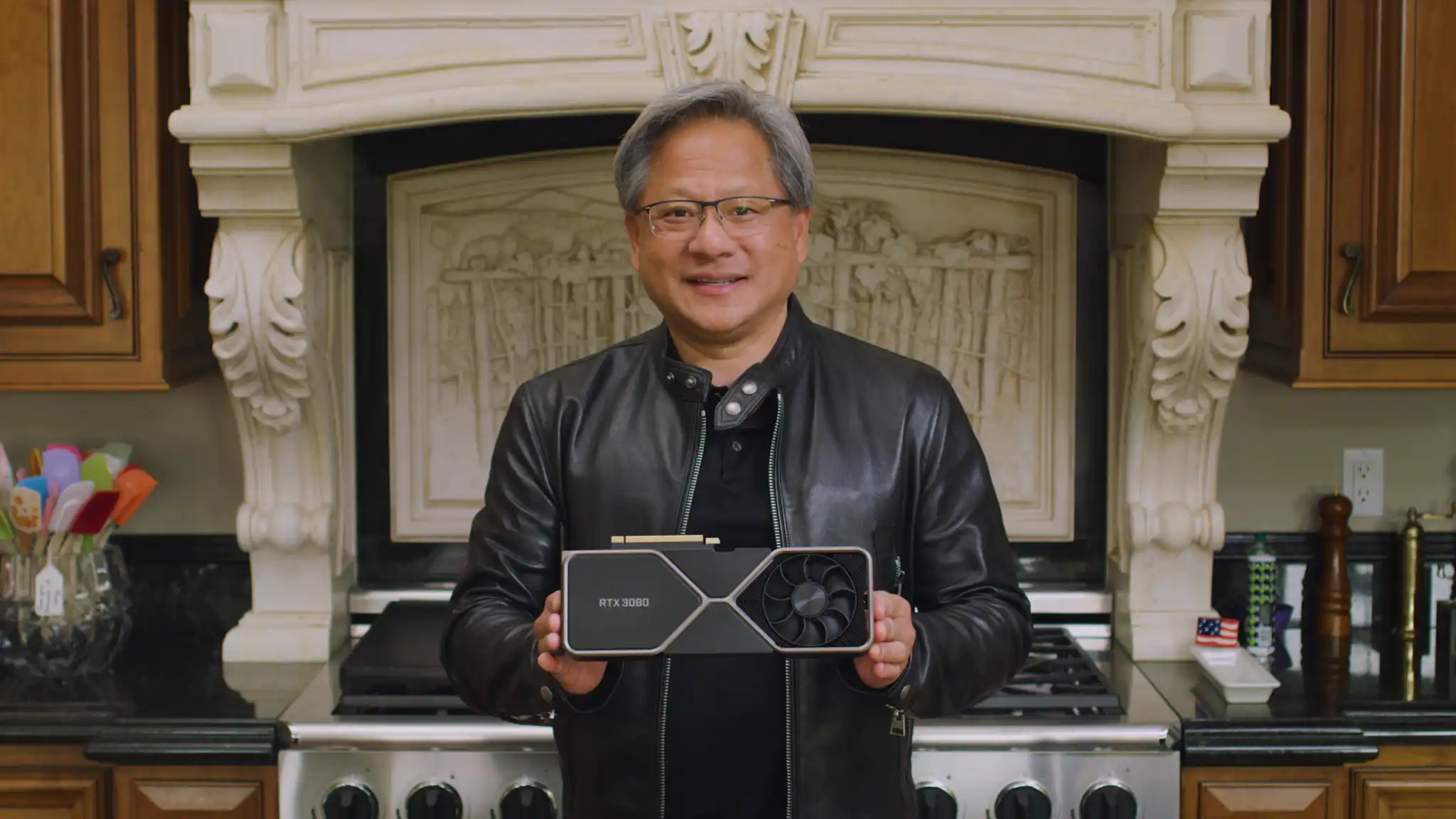
Huang Renxun shows the RTX 30 series graphics card. The picture comes from the Internet.
At this time, the price of Ethereum was approaching $3,000, and PoS mergers were no longer seen as a potential threat in the face of rising prices. Huang Renxun became a full-fledged advocate of cryptocurrency, publicly expressing his long-term optimism about the market boom and the value of blockchain. Miners also bought into it, and graphics cards were snapped up. According to insiders, some large mining farms even picked up the goods directly from Nvidia, rather than going through the primary and secondary markets.
For a time, the price increase of graphics cards became a topic repeatedly reported by CCTV and self-media. According to institutional reports, in 2021, Nvidia generated approximately $3 billion in revenue by selling graphics cards to miners. In the same year, Nvidia's market value exceeded $500 billion. In the fiscal year report in February of the following year, the company's annual revenue set a record of $26.9 billion, a year-on-year increase of 61%, achieving 7 consecutive quarters of revenue growth.
What is the point of mining?
There are more or less misunderstandings and discriminations about the relationship between mining companies and chip manufacturers. Many people question "what is the meaning of mining?" or think that "mining chips are a low-end industry." But in fact, the story behind this is much more complicated than imagined.
Chinese mining companies have become the world's leading companies, a position that is no different from the United States' dominance in the field of operating systems. However, the outside world's views are often contradictory. On the one hand, they admit that this is a fact; on the other hand, they seem to be contemptuous.
The orders provided by crypto mining for chip companies as a testing ground helped the rise of chips; the research and development results of mining machine manufacturers, such as low-voltage chip technology, have been widely used in mobile phones and other industries; the rescue of Nvidia, the undisputed king of graphics cards today, is obvious to everyone in the industry. These facts all prove the great contribution of mining to technological progress.
Mining uses the most advanced chip technology and employs top R&D personnel. If mining is “useless”, then aren’t many other industries the same? To those critics, everything they use should also be considered “useless”.
Although mining companies are not all of SMIC's R&D, and may even only account for a small part, their impact on the industry is indispensable. Crypto mining companies have promoted the progress of chip manufacturers and graphics card manufacturers in the wave of technology, and also brought huge commercial value. This is the significance of mining.