


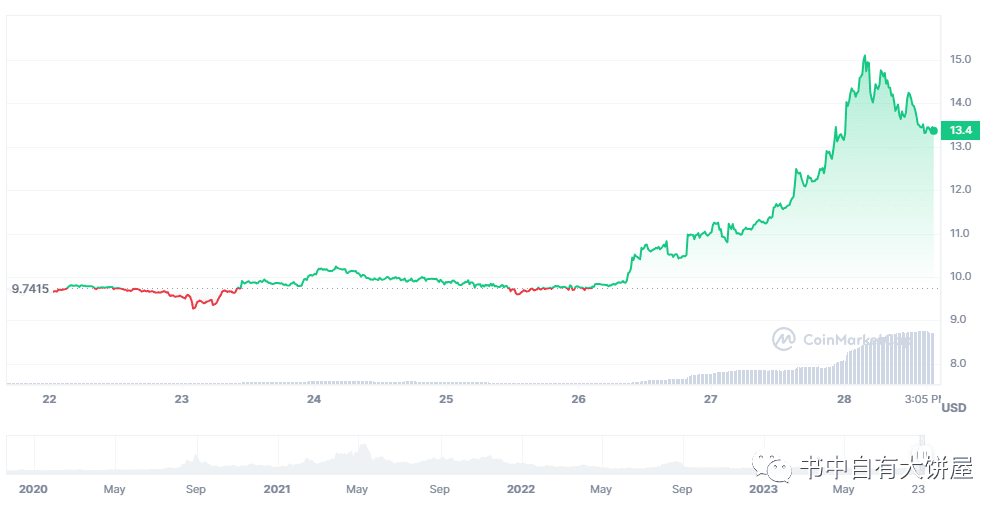
Today we are going to talk about an item that has seen decent growth recently. It almost doubled in 3 days, from 0.9 to 15. It is also a project on the decentralized language machine track. I have highly recommended this track before, such as chainlink, which has been highly recommended before. This is also an oracle. Its current market value is only 22 million US dollars, ranking 500+, compared to link’s market value of 3 billion. , there is still 100 times the space.
Introduction
What is Tellor? Tellor is a decentralized oracle network based on PoW consensus, which is composed of data information service providers, verifiers and currency holders. It uses an encryption economic incentive system to ensure the security of the entire process of moving all types of data on the chain. Tellor operates on both L1 and L2. Liquity, Reflexer and Ampleforth projects are all using Tellor oracle's services.
Tellor’s core team has backgrounds in economics, statistics, and work experience in government departments such as the U.S. CFTC. The team once developed the cryptocurrency derivatives protocol Daxia, and during the process realized the strong demand for reliable data in smart contracts, so they shifted their focus to the development of the decentralized oracle Tellor.
The project started in March 2019. It has gone through Binance investment incubation, code auditing, and testnet, and was launched on the mainnet in August 2019. It has already received investment from Binance, Maker, and ConsenSys, and the project has not been crowdfunded.
Project Vision
Tellor hopes to build a decentralized oracle solution through a combination of PoW+PoS to ensure that any willing participant can provide real data and receive rewards.
Market demand
Decentralized oracle solutions based on Ethereum for DeFi or other applications require reliable data from trustless sources. The existing "trusted" data sources do not actually exist in the blockchain, and their information cannot be guaranteed to be valid through the consensus mechanism. It is more like manually entering the data into the contract and relying on a centralized party to provide it. , either on a set of trusted known parties, or even by incentivizing end users to provide it. The problem with all these solutions is that none of them are truly decentralized or trustless.
What are the characteristics of Tellor mining?
1. There is no concept of "block generation" in the Tellor network. This may be the first non-underlying blockchain protocol mining you are about to participate in. Miners do not "produce blocks" on the Tellor network, which is why you don't see the word "block" in the table above. Tellor is not a blockchain, it is a protocol built on the Ethereum network.
2. Miners compete for the right to “provide data”. Oracles provide price data for smart contracts, and miners compete with their computing power for the power to provide data and the rewards that come with it.
3. 5 miners will receive rewards every 10 minutes. The network provides data requesters with data (such as the current ETH/USDT price) every 10 minutes, and at the same time sends the same amount of token rewards to 5 miners, and their transactions are recorded in the Ethereum block at that time. The 5 selected miners each provide 1 piece of data within a time range, and the middle value of the 5 pieces of data is finally selected.
4. A mining network that introduces a mortgage mining mechanism. Before miners join mining, they need to mortgage 1,000 TRB tokens (miners who choose to mine in the mining pool do not need this step), mainly to increase the connection with the network value and encourage miners to provide more accurate data. On the Tellor network, miners who provide data that is questioned and voted to determine that the data is false will be fined and their staked tokens will be confiscated. Likewise, participants who raise questions are required to stake their tokens first to incentivize participants to make prudent decisions.
5. A rare PoW oracle network. Oracle networks based on PoW consensus are rare. Tellor chose PoW and adopted a relatively slow data query time (every 10 minutes). It believes that speed is not the core feature of the blockchain and prefers to build a decentralized first to provide reliable data query for high-value assets. network of.
6. Mined ERC-20 tokens. Most of Ethereum's ERC-20 tokens do not have a mining mechanism, while Tellor tokens need to be generated through computing power competition, which we will introduce in the token reward section later.
Operating mechanism
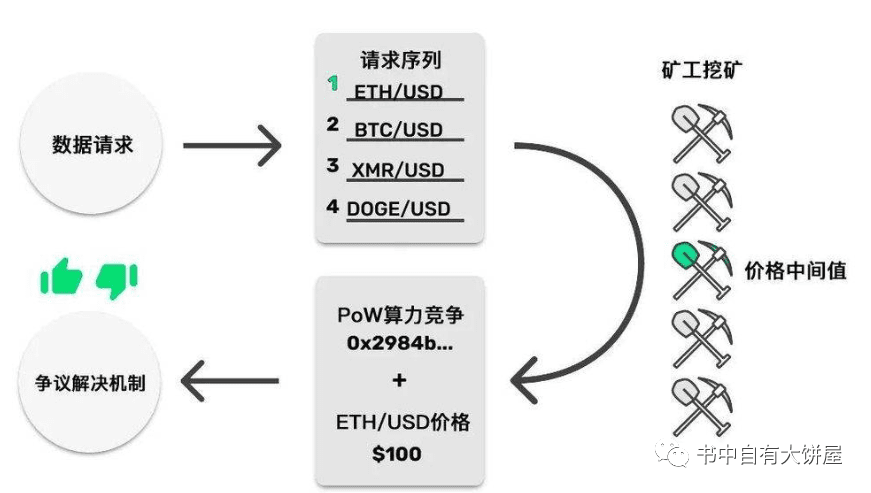
1. Data requesters (DeFi projects such as Maker) look for price data for their smart contracts, initiate a request to the Tellor network, pay a certain TRB as a fee, and decide which request to provide data for next based on the fee.
2. The miners start mining and select 5 miners after the PoW computing power competition.
3. The five miners who win the computing power competition provide price data to the data requester. The system selects the middle value of the five data and provides it to the data requester. 5 miners receive the same amount of TRB rewards and share the cost of data requests equally.
4. Any TRB holder can dispute the data within 144 queries (1 day) after staking TRB.
5. Coin holders initiate a vote on the dispute, and the miners questioned will be "frozen" for 1 week. If the data is successfully challenged, the challenger will obtain the tokens pledged by the miner, otherwise the miner will obtain the tokens of the person who raised the dispute.
Token distribution
The full name of the Tellor token is Tellor Tributes, or TRB for short. It is an ERC-20 token. Most ERC-20 tokens on Ethereum do not require computing power to be mined, while TRB is one of the few ERCs that can be obtained through computing power competition. -20 tokens.
TRB tokens can be used to pay for data requests, serve as collateral for mining, reward data providers, initiate disputes, vote for disputes, etc.
Moreover, TRB tokens have no crowdfunding or pre-mining from the beginning, so mining is particularly important for the Tellor network. Tellor's goal is to achieve decentralized governance, and it also sets 10% of the mining rewards as a development share.
The most “relentless” token production reduction in 2020 has already occurred on the TRB network. Through community governance, the output has been reduced to ⅕ of the original, and the inflation rate will be reduced from 140% to 17% within one year after the production reduction. Tellor incentivizes token holders by adjusting the inflation rate, thereby promoting the increase in token value and the realization of the network's long-term goals.
TRB is set to have no fixed token supply, and the current supply is approximately 2,497,031TRB. After the supply inflation rate is adjusted, excluding the development share, the initial reward for each miner is 5TRB, and then decreases by 0.003% every 10 minutes. The reduction starts from the ETH block height of 9,619,370 until the block reward is 1TRB, and then remains unchanged. Achieve the inflation rate adjustment target.
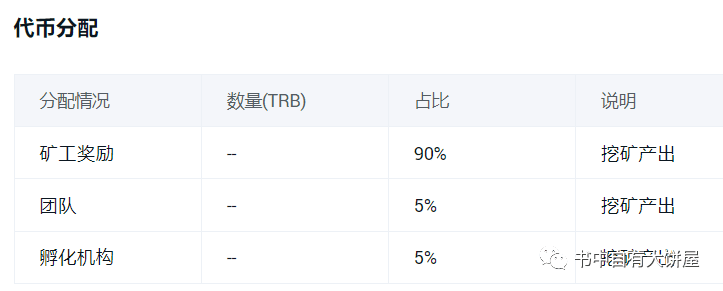
The current supply is 2,497,031 TRB, and the circulation is 1,703,441 TRB. The first issuance time is 2019-11-19. The current price is 13 US dollars. The peak price was 163 US dollars when it was divided in May 21. It has also fallen by 90%. However, the recent turnover rate is still a terrifying 6000%, and the ghostwriting distribution is very friendly. The team only has 5%, and the rest are all mining rewards.
Finally, we conclude that the oracle machine track still needs more attention. We have been paying attention to the defi or chain game track before, but you must know that the rise of the defi track must be indispensable for the oracle machine. We have talked about chainlink and api3 before. , in fact, there are many others such as Band protocol, UMA, etc., which are also classified into different scenarios.
Vitalik, the founder of Ethereum, once published a proposal on "Can Oracle Machines Achieve Joint Staking, and How Can RAI-like Systems Safely Support Pledged ETH?" This proposal may solve the potential risks of oracle machines doing evil to a large extent, and is also relatively relatively simple. Easy to land. In this article, V God proposed three solutions: 1. Oracle as a staker; 2. Oracle as a 2-of-2 staker; 3. Semi-credible oracle with hierarchical security. All three options have pros and cons in terms of ease of implementation, protection against bad oracles, protection of bad CDP holders, and willingness to run oracles. However, Buterin said that Option 1 seems to be easier to implement in the short term and will be an interesting addition to the space to earn other staking benefits at the same time. However, Option 2 and Option 3 seem to be more trustless, more durable, have lower trust in oracles, and better maintain the decentralization of pledges. Therefore, in the long run, V God is more inclined to choose the latter two. plan.
As a bridge between the blockchain and the real world, oracles are still in their early stages of development. In the future, more efficient and secure oracle solutions will continue to appear; with the development of the blockchain industry, more assets and application scenarios will be put on the chain, and the application fields of oracles will also become wider, such as finance, insurance, and supply chain , Internet of Things, etc. From the perspective of application fields, with the expansion of on-chain credit, credit oracles may be the most worthy of attention in the next bull market.